

Microsoft’s advisory for CVE-2026-20938 describes an elevation-of-privilege weakness in Windows’ Virtualization‑Based Security (VBS) Enclave, a security boundary designed to isolate sensitive runtime code and secrets; the vendor’s guidance makes the vulnerability’s existence clear and requires administrators to map the CVE to the specific KB updates Microsoft published and to prioritize patching on VBS‑enabled systems.
Virtualization‑Based Security (VBS) enclaves are a Windows platform feature that places sensitive workloads into an isolated, hypervisor‑backed memory region. Enclaves protect secrets, attestation and attestation-related control flows that underpin features such as Credential Guard, secure launch, and a range of hypervisor‑protected runtime services. Properly implemented enclaves depend on strict input validation, signed enclave binaries, and platform integrity checks; when any of those controls are weakened an attacker with local access can often turn a limited foothold into a host compromise. CVE‑2026‑20938 is presented in Microsoft’s update guide as a VBS Enclave Elevation of Privilege vulnerability. The public advisory associated with the CVE is intentionally terse — listing the vulnerability type, the affected component class, and pointing administrators to the Update Guide for KB → SKU mappings — but the vendor acknowledgement alone establishes a high operational priority for VBS‑enabled hosts and management stations.
Important caution: the low‑level exploit mechanics for CVE‑2026‑20938 are not public at this time; independent verification of specific exploit details (e.g., IOCTL names, vulnerable function signatures, or published PoC code) was not available in public trackers at the time of writing. Any claim that the CVE has been weaponized in the wild or that a public PoC is circulating should be treated with skepticism until corroborated by multiple reputable sources or forensic evidence. Rely on vendor KB mappings, test patches in controlled canary deployments, and preserve forensic artifacts if suspicious activity is detected.
This advisory is intended to be practical and operational: apply the vendor KB, prioritize VBS‑enabled and administrative hosts, harden the management plane, and tune detection for enclave/attestation anomalies. Where specific technical exploitation details remain unpublished, treat those claims as unverified and focus on proven mitigations and forensic readiness.
Source: MSRC Security Update Guide - Microsoft Security Response Center
 Background / Overview
Virtualization‑Based Security (VBS) enclaves are a Windows platform feature that places sensitive workloads into an isolated, hypervisor‑backed memory region. Enclaves protect secrets, attestation and attestation-related control flows that underpin features such as Credential Guard, secure launch, and a range of hypervisor‑protected runtime services. Properly implemented enclaves depend on strict input validation, signed enclave binaries, and platform integrity checks; when any of those controls are weakened an attacker with local access can often turn a limited foothold into a host compromise. CVE‑2026‑20938 is presented in Microsoft’s update guide as a VBS Enclave Elevation of Privilege vulnerability. The public advisory associated with the CVE is intentionally terse — listing the vulnerability type, the affected component class, and pointing administrators to the Update Guide for KB → SKU mappings — but the vendor acknowledgement alone establishes a high operational priority for VBS‑enabled hosts and management stations.What the public record actually says (and what it doesn’t)
The vendor’s canonical statement
Microsoft’s update guide entries for VBS enclave issues generally do three things: (1) summarize the vulnerability at a high level (e.g., “insufficient verification of input” or “missing integrity check”), (2) list the KB updates that remediate the issue for each Windows SKU/build, and (3) omit low‑level exploit mechanics to reduce short‑term weaponization risk. CVE‑2026‑20938 follows that pattern — it is acknowledged and mapped to remediation packages, but Microsoft’s public text does not publish exploit primitives or proof‑of‑concept code. Administrators must therefore treat the MSRC Update Guide as the authoritative source for patching and KB mapping.What independent trackers and vendors confirm
Independent vulnerability trackers and vendors repeatedly characterize VBS enclave disclosures the same way: the observable pattern is a local, authenticated attack vector that yields information disclosure or integrity bypass inside enclave/DRTM (Dynamic Root of Trust for Measurement) code. That class of issue is noteworthy not because it is remotely wormable, but because leaked enclave state or broken integrity checks materially lower the cost of subsequent kernel exploitation or elevation chains. Multiple industry trackers (NVD, Rapid7, vendor advisories) have historically aligned with Microsoft’s classification for similar VBS CVEs.Important caveat — verification status for CVE‑2026‑20938
A straightforward fact: the Microsoft Update Guide entry provided by the user is the vendor acknowledgment. Because the Update Guide is rendered dynamically and omits exploit mechanics, public technical details for CVE‑2026‑20938 (for example, exact vulnerable function names, IOCTLs involved, or proof‑of‑concept exploits) are not available in public writeups at the time of this writing. Independent sources commonly corroborate the high‑level impact (VBS enclave information disclosure / integrity failure → elevated risk), but explicit exploit mechanics for this specific CVE are not published in third‑party advisories at the moment. Treat any claims that assert an in‑the‑wild exploitation campaign or released PoC for CVE‑2026‑20938 as unverified unless corroborated by multiple reputable technical writeups or forensic evidence.Technical anatomy — why a VBS enclave defect matters
VBS enclaves combine two powerful properties that make related vulnerabilities high‑leverage:- Isolation and secrecy: enclave memory is intended to be inaccessible to regular kernel or user code, so any data or layout information leaked from an enclave can reveal secrets (keys, attestation material) or internal layouts that make exploitation of other bugs far easier.
- High value of local access: many realistic attacker models already produce a local foothold (malicious tenant in a multi‑tenant host, compromised low‑privilege user, malicious VM image). If an attacker can use that foothold to extract enclave information or bypass an integrity check, they can often escalate to kernel privileges or to host‑level control.
- Information disclosure — an enclave pointer or key is leaked, allowing attackers to bypass KASLR, craft kernel payloads, or validate later exploit stages.
- Insufficient integrity/validation — malformed input or missing integrity checks permit untrusted code paths to execute privileged enclave logic or to substitute data used by enclave verification routines.
Realistic attacker models and exploitation chains
Think of an attack in two stages:- Local foothold acquisition
- Initial access may be ephemeral and low‑privileged: a malicious VM tenant, an unprivileged user on a shared server, a phishing‑delivered process, or a compromised admin workstation.
- In cloud or hosting environments the “attacker” need not be external; a tenant with poorly isolated interfaces can exercise privileged interfaces indirectly.
- Enclave abuse to escalate
- Use crafted inputs or leverage an unauthenticated path to leak enclave state or bypass an integrity check.
- Use leaked information (layout or keys) to bypass mitigations like KASLR or CFG and build kernel‑level primitives.
- Achieve SYSTEM or host control, persist implants, and move laterally.
Operational impact — who must act now
Prioritization should be simple and urgent:- High priority: Hyper‑V hosts, domain controllers, management jump boxes, and administrative workstations that have VBS, Credential Guard, Secure Launch or enclave features enabled. These are the systems with the maximum blast radius.
- Medium priority: Endpoints where VBS is enabled but that are not host or admin systems.
- Lower priority: Systems that do not support or have VBS disabled, but confirmation of VBS status is needed — do not assume.
Immediate 0–72 hour remediation checklist (practical, battle‑tested)
- Inventory and identification
- Enumerate hosts where VBS is enabled (Msinfo32, Win32_DeviceGuard WMI class, or endpoint inventory). Tag Hyper‑V hosts, management jump boxes, and domain controllers.
- Confirm firmware and TPM presence for critical hosts.
- Confirm vendor mapping and obtain the correct KB(s)
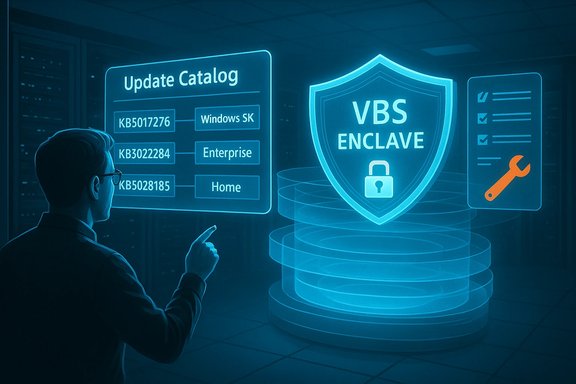
- Use Microsoft’s Security Update Guide / Update Catalog to get the exact KB(s) for each OS SKU and build before rolling updates. Do not rely on generic CVE labels.
- Pilot and validate
- Apply the patch to a representative pilot ring that includes virtualization hosts and admin jump boxes. Validate live migration, Credential Guard, attestation workflows and backup/restore behavior.
- Staged rollout
- Roll updates from management hosts → virtualization hosts → domain controllers → endpoints. Schedule reboots in maintenance windows and validate KB installation post‑reboot.
- If patching must be delayed — apply compensating controls
- Restrict who can perform enclave management and attestation operations.
- Isolate jump boxes and admin hosts on segmented networks.
- Enforce least privilege and remove unnecessary local admin rights.
- Apply application allow‑listing (WDAC/AppLocker) on high‑value systems.
- Update EDR/IPS/IDS signatures tuned to enclave and DRTM activity to provide interim detection coverage.
- Forensic readiness
- If you suspect exploitation, isolate but do not reboot the host if possible. Capture full memory images and WER minidumps; these artifacts are critical for vendor triage and for reconstructing DeviceIoControl/IOCTL sequences.
Detection, hunting and telemetry (what to look for)
Because vendor advisories purposely omit detailed IOCs for kernel/VBS defects, hunting should prioritize behavioral and artifact‑based detection:- Monitor for unusual DeviceIoControl/IOCTL activity aimed at virtualization or attestation device objects.
- Watch for unexpected process elevations to NT AUTHORITY\SYSTEM from non‑privileged user contexts.
- Hunt for anomalous enclave provisioning or attestation API calls originating from unprivileged processes.
- Alert on kernel instability signals — sudden BSODs referencing enclave components, strange minidumps or repeated service restarts.
- Correlate enclave‑related telemetry with process ancestry, recent administrative changes, and network behavior.
Hardening beyond patching — reduce future exposure
Patching resolves the immediate vulnerability, but long‑term resilience requires reducing the local attack surface:- Enforce least privilege and just‑in‑time (JIT) admin practices to reduce the number of accounts able to interact with enclave management tools.
- Use WDAC or AppLocker to prevent execution of untrusted binaries on management hosts.
- Enable Memory Integrity / HVCI and strict driver signing policies where supported to make kernel exploitation more difficult.
- Restrict mounting or automatic attachment of untrusted VHD/VHDX images — move risky file‑parsing (for example, thumbnailing or VHD import) into constrained, disposable environments.
- Segment management networks: keep jump boxes and admin tools on isolated networks with tightly controlled remote access.
Strengths, uncertainties and risk assessment
Strengths
- Vendor acknowledgement and published KB mappings mean there is a clear remediation path — that makes governance and deployment planning practical.
- Independent trackers and reputable vendors consistently treat VBS enclave disclosures as operationally important; that consensus fortifies the remediation priority.
- The absence of a public PoC at disclosure reduces immediate mass weaponization risk.
Uncertainties and residual risks
- Microsoft’s public advisories intentionally omit low‑level exploit mechanics; defenders are therefore forced to rely on behavioral detection rather than precise IOCs. This complicates incident detection and increases the risk window that follows public patch publication (attackers often reverse‑engineer patches to craft PoCs).
- If a host has already been compromised, enclave leaks can materially reduce exploit difficulty; therefore, the presence of historic unexplained anomalies on critical hosts should be treated as potentially significant and triaged urgently.
- Automation pitfalls: the Microsoft Update Guide is JavaScript‑rendered; automated pipelines that scrape the page may miss KB→SKU mappings. Confirm mappings in the Update Catalog when automating patch rollouts.
Cross‑checking the public record (how this advisory aligns with prior VBS CVEs)
Public tracking of earlier VBS enclave CVEs shows the consistent pattern that informs how defenders should react today: local authenticated attack vector → information disclosure or integrity bypass → downstream elevation or host compromise. Multiple CVEs in 2024–2025 followed this model and each time the operational response was the same: map KBs, patch VBS‑enabled hosts, and adopt compensating controls until the patch is rolled out. This historical alignment gives additional confidence in Microsoft’s remediation path and the urgency of patching.Executive summary for IT leaders (one page, actionable)
- Fact: CVE‑2026‑20938 is a vendor‑confirmed VBS Enclave Elevation of Privilege vulnerability; Microsoft lists the CVE in its Update Guide with KB mappings to apply.
- Impact: High for VBS‑enabled Hyper‑V hosts, management jump boxes, domain controllers, and admin systems. Treat these systems as top priority for patching.
- Immediate actions (0–72h): inventory VBS hosts, map CVE→KB→SKU using Microsoft’s Update Guide and the Update Catalog, pilot KBs, roll out patches in prioritized waves, capture forensic artifacts if compromise is suspected.
- Short‑term mitigations: restrict enclave/attestation management privileges, segment admin networks, enforce WDAC/AppLocker, apply EDR/IPS vendor signatures.
- Monitor: DeviceIoControl/IOCTL anomalies, unexpected SYSTEM elevations from user contexts, enclave attestation calls from unprivileged processes, and kernel instability signals.
Final verdict — practical recommendations and a cautionary note
CVE‑2026‑20938 is a vendor‑acknowledged vulnerability in a trust boundary that Windows and enterprise services rely on heavily. The public advisory and Microsoft’s Update Guide give a clear operational path: identify VBS‑enabled hosts, obtain the exact KB updates for each build, test in a pilot ring, and roll out patches to prioritized systems. Complement the patching effort with network segmentation, least‑privilege enforcement, and behavioral detection rules focused on enclave and DRTM activity.Important caution: the low‑level exploit mechanics for CVE‑2026‑20938 are not public at this time; independent verification of specific exploit details (e.g., IOCTL names, vulnerable function signatures, or published PoC code) was not available in public trackers at the time of writing. Any claim that the CVE has been weaponized in the wild or that a public PoC is circulating should be treated with skepticism until corroborated by multiple reputable sources or forensic evidence. Rely on vendor KB mappings, test patches in controlled canary deployments, and preserve forensic artifacts if suspicious activity is detected.
Appendix — quick commands and checks
- Check VBS status per host:
- Run Msinfo32 and look for “Virtualization‑based security” entries.
- PowerShell: Get‑CimInstance -ClassName Win32_DeviceGuard -Namespace root\Microsoft\Windows\DeviceGuard
- Confirm installed KBs:
- Get‑HotFix or query WMI for recent security updates; compare KB IDs to Microsoft Update Guide mappings.
- Capture forensic artifacts if exploitation suspected:
- Use enterprise EDR to collect full memory dumps and WER minidumps.
- Save Windows Event logs and driver listings (driverquery).
This advisory is intended to be practical and operational: apply the vendor KB, prioritize VBS‑enabled and administrative hosts, harden the management plane, and tune detection for enclave/attestation anomalies. Where specific technical exploitation details remain unpublished, treat those claims as unverified and focus on proven mitigations and forensic readiness.
Source: MSRC Security Update Guide - Microsoft Security Response Center
