

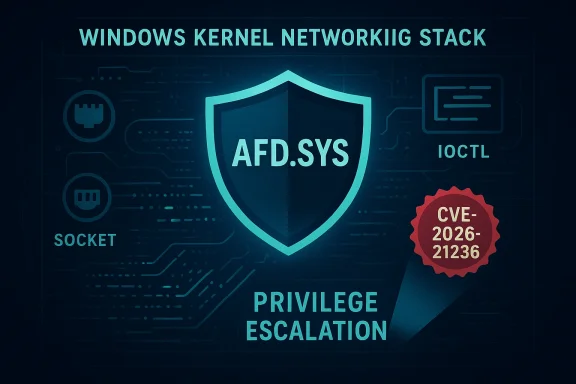
Microsoft’s security tracker now shows CVE-2026-21236 as an elevation-of-privilege issue in the Windows Ancillary Function Driver for WinSock (AFD.sys), a kernel‑mode driver that sits at the heart of Windows’ networking stack; the vendor entry and multiple community trackers confirm the CVE but provide only a compact advisory rather than full technical disclosure, leaving important exploitation details unverified at publication. ](Security Update Guide - Microsoft Security Response Center))
AFD.sys — the Ancillary Function Driver for WinSock — is a core kernel driver used by Windows to implement socket semantics, marshal IOCTLs from user mode into kernel networking paths, and interact with transport drivers. Because AFD runs in kernel mode, any memory‑safety or synchronization flaw in its code can be converted by attackers who already have local code execution into a full SYSTEM‑level compromise. This pattern has recurred over recent years: multiple AFD‑related CVEs (heap overflows, use‑after‑free, race conditions, and untrusted pointer dereferences) have produced high‑value local elevation‑of‑privi and urgently‑patched advisories.
What the vendor’s public update guide entry for CVE‑2026‑21236 confirms:
If you manage Windows systems: use Microsoft’s Update Guide to get the exact KB mappings for your OS builds, prioritize remediation for admin and multi‑user hosts, and treat the absence of a public PoC as a reason for caution — not complacency.
Source:** MSRC Security Update Guide - Microsoft Security Response Center
 Background / Overview
AFD.sys — the Ancillary Function Driver for WinSock — is a core kernel driver used by Windows to implement socket semantics, marshal IOCTLs from user mode into kernel networking paths, and interact with transport drivers. Because AFD runs in kernel mode, any memory‑safety or synchronization flaw in its code can be converted by attackers who already have local code execution into a full SYSTEM‑level compromise. This pattern has recurred over recent years: multiple AFD‑related CVEs (heap overflows, use‑after‑free, race conditions, and untrusted pointer dereferences) have produced high‑value local elevation‑of‑privi and urgently‑patched advisories. What the vendor’s public update guide entry for CVE‑2026‑21236 confirms:
- The vulnerable component isary Function Driver for WinSock (afd.sys)**.
- The impact class is local elevation of privilege — an authenticated or locally running low‑privilege actor could escalate to SYSTEM if exploitation succeeds. (msrc.microsoft.com)
- Microsoft’s Update Guide serves as the canonical mapping between the CVE as and KBs that fix the issue; administrators should use that mapping to identify and deploy fixes. (msrc.microsoft.com)
What’s known (confirmed) and what remains uncertain
Csys is the affected driver; the vulnerability allows local privilege escalation when triggered by a low‑privilege user/process. ([msrc.microsoft.com](Security Update Guide - Microsoft Security Response Center published an Update Guide entry for CVE‑2026‑21236 and has released fixes mapped to specific Windows builds (the Update Guide is the authoritative source for SKUs and KB mapping).
- Public vulnerability trackers and community reporting have indexed the CVE and categorized it alongside other recent AFD flaws that historically carry High severity and rapid exploitation interest.
Unverified or missing technical specifics
- The exact vulnerability class (heap overflow, use‑after‑free, race, untrusted pointer dereference, bounds check) for CVE‑2026‑21236 is not explicitly detailed in the public advisory. Past AFD CVEs have covered several different weakness classes; without a vendor tresearch write‑up we cannot responsibly assert the precise bug type. Treat any claim about exact exploitation primitives as speculative until corroborated by Microsoft patch diffs or independent technical analysis.
Technical analysis: likely exploitation vectors and attacker prerequisites
Because AFD.sys interfaces directly between user mode socket APIs and kernel networking code, the usual exploitation surface combines:- IOCTLs or socket control operations that pass pointers or buffers from user mode into kernel handlers.
- Handle/descriptor race windows where a freed kernel object may be reused (use‑after‑free), or where improper validation of an attacker‑controlled pointer allows a kernel dereference of untrusted memory (untrusted pointer deref).
- High‑frequency or concurrent sequences (race conditions) to create timing windows foe memory corruption.
- A low‑privilege local process opens a handle to the AFD device (commonly via CreateFile on .\AFD) or uses Winsock APIs that result in internal driver IOCTLs.
- The attacker issues carefully crafted IOCTL or socket control sequences designed to corrupt kernel memory (e.g., trigger use‑after‑free, overwrite kernel pointers, into dereferencing attacker‑controlled data).
- After corrupting kernel memory, the exploit attempts to manipulate process token pointers or dispatch a SYSTEM‑level shell/process (token theft, token duplication, or direct code execution in kernel ugs are especially dangerous
- High privileges: AFD runs in kernel context, so any reliable code‑execution primitive becomes SYSTEM immediately.
- Broad availability: every Windows system with the network stack uses AFD; the attack surface and blast radius are large across desktop and server SKUs.
- History of weaponization: previous AFD vulnerabilities have been rapidly weaponized or used as post‑compromise steps by advanced actors, increasing urgency to patch even when public PoCs are absent.
Real‑world impact and threat scenarios
- Lateral escalation and domain compromise: an attacker with limited local access (attacker‑controlled account on a workstation) can escalate to SYSTEM, dump credentials, and use those credentials to move laterally or compromise domain services.
- Ransomware and persistence: ransomware operators can convert an initial foothold into SYSTEM to disable security tools and deploy payloads with fewer obstacles.
- Supply‑chain and multi‑stage attacks: AFD EoP primitives are valuable to attackers who already have a foothold (e.g., from a compromised vendor, developer machine, or CI runner), because SYSTEM access simplifies persistence and credibility of code signing circumvention.
- Cloud and hosting environments: multi‑tenant host systems and developer word local admin policies are high‑value targets because compromised VMs/containers with local exploitation can lead to broader cloud account compromise.
Mitigation and detection: immediate actions for administrators
Short list (high pri updates immediately: use Microsoft’s Update Guide mapping for CVE‑2026‑21236 to identify KBs for each affected OS build and deploy via your patch management flow (WSUSune, or manual catalog downloads). The Update Guide is authoritative for SKU→KB mappings. (msrc.microsoft.com)- Prioritize critical hosts: stage a pilot on admin workstations, domain controllers, jump boxes, and internet‑facing management hosts; escalaoints rapidly.
- Reduce the attack surface: remove unnecessary local admin privileges, restrict interactive logon for service accounts, and enforce the principle of least privilege.
- Watch for unusual AFD/WinSock activity: high‑frequency DeviceIoControl sequences targeting afd.sntrol calls, or processes issuing many parallel socket control operations are suspicious. Tune EDR to flag processes performing unusual socket control IOCTL patterns.
- Correlate process elevation cases where a non‑privileged process spawns a SYSTEM process or where token duplication events appear immediately after abnormal socket control activity. Collect WER dumps and EDR kernel traces when afd.sys crashes or OOM/kernel dumps align with suspicious processes.
- Maintain extended log retention for endpoint telemetry during and after patch rollouts; AFD exploits are often used in stealthy, multi‑stage intrusions and may only be visible in historic logs.
- Enforce application allow‑listing on high‑value endpoints.
- Harden local execution policies and remote management: restrict software installation, enforce MFA for remote admin sessions, and limit interactive logon for all non‑human accounts.
- Increase monitoring windows for suspicious WinSock/AFD patterns and for sudden SYSTEM‑level process creation.
How to verify successful remediation
- Use Microsoft’s Update Guide to obtain the exact KB and patched afd.sys driver build for each OS SKU in your estate; confirm that deployed machines repodriver file version. (msrc.microsoft.com)
- Validate functionality with a pilot group and verify network services behave as expected after update (AFD is fundamental; unexpected regressions should be resolved with Microsoft support channels).
- Re‑baseline EDR telemetry: update detection rules to ignore benign, known‑good socket control patterns introduced by the patch while preserving hunt rules for high‑frequency or IOCTL‑heavy sequences.
Critical appraisal of vendor response
Notable strengths- Microsoft documented the CVE in the Update Guide and released fixes mapped to SKUs; shipping a vendor patch is the primary, effective mitigation, and that action reduces attack surface quickly when organizations apply updates. ([msrc.microsoft.com](Security Update Guide - Microsoft Security Response Center guidance (EDR hunts, detection rules) has been produced rapidly and emphasizes conservative assumptions (assume private exploitation until proven otherwise), which is an appropriate defensive posture for AFD‑class bugs.
- Patch rollout inertia: large enterprises take days-to-weeks to deploy mass updates. Because local EoP primitives are so valuable post‑compromise, delayed rollouts leave a meaningful window for adversaries to weaponize private exploits.
- Private exploitation: absence of a public PoC does not equal absence of exploitation in the wild. Advanced threat actors commonly retated campaigns; treat AFD advisories as urgent even when public weaponization is not reported.
Practical playbook (30–90 minute operational checklist)
- Map: Query inventory and identify hosts matching the Windows builds lUpdate Guide for CVE‑2026‑21236. (msrc.microsoft.com)
- Pilot: Select a small pilot ring (admin workstations, jump boxes, critical servcrosoft KB(s) to them first. Validate connectivity and key application behavior.
- Rollout: Schedule and automate deployment across remaining endpoints using your patch management tooling; prioritize by asset criticality and exposure.
- Compensate: Where immediate patching is impossible, tighten local privileges, enable application allow‑listing, and raise logging/EDR sensitivity for AFD/WinSock telemetry.
- Hunt: Run EDR hunts for high‑frequency socket IOCTLs, unexpected afd.sys crashes, and SYSTEM child process spawns originating from low‑privileged parents. Collect forensic artifacts for anyerify: Confirm KB application and afd.sys driver version across systems and document compliance metrics for audit reporting. (msrc.microsoft.com)
Long‑term lessons and reckernel drivers that handle user input — especially networking drivers like AFD — as high‑risk attack surfaces. Prioritize fuzzing, code review, and exploit mitigation hardening for those components.
- Maintain rapid patch channels and automation for high‑volume infrastructures. AFD class vulnerabilities consistently show that a single kernel bug can unlock entire networks if not promptly remediated.
- Invest in behavioral EDR capabilities: fine‑grained kernel telemetry and the ability to correlate suspicious socket control operations with process elevation events significantly reduces dwell time even when specific exploit details are unavailable.
Conclusion
CVE‑2026‑21236 is another entry in a recurring and worrying pattern: the Windows Ancillary Function Driver for WinSoces to be a high‑value target for local elevation‑of‑privilege bugs. Microsoft has acknowledged the issue and mapped fixes in its Update Guide; that vendor patching is the decisive mitigation and should be applied as the first order of business. While the public advisory deliberately wloit detail (a reasonable operational decision), defenders must assume a conservative posture: patch now, harden privileges, and tune EDR hunts for AFD‑related behavioral artifacts. The combination of rapid vendor updates and robust, behavior‑based detection is the most effective defense against AFD‑level EoP vulnerabilities. (msrc.microsoft.com)If you manage Windows systems: use Microsoft’s Update Guide to get the exact KB mappings for your OS builds, prioritize remediation for admin and multi‑user hosts, and treat the absence of a public PoC as a reason for caution — not complacency.
Source:** MSRC Security Update Guide - Microsoft Security Response Center
