

The Linux kernel patch addressing CVE-2026-22978 fixes a subtle but meaningful kernel information‑disclosure bug in the wireless (WEXT) code by ensuring the legacy user-facing structure
The Linux wireless extensions interface (WEXT) provides a long‑standing ioctl-based API that many userspace wireless tools and drivers still interact with. One of the data carriers in that API is
This class of bug is not exotic: uninitialized or partially-initialized structures that differ between compatibility modes (32‑bit userspace on 64‑bit kernels, for example) are frequent sources of tiny but exploitable information disclosures. The kernel community’s response was a narrowly focused patch that zeroes the working
What exactly is
Key takeaways on affected systems:
To be explicit: the CVE fixes the leak of a small, architecture‑specific chunk of memory (32 bits). That alone does not equate to immediate remote compromise or an automatic privilege escalation. The exploitability model is local: an attacker must be able to run code on the host (e.g., a malicious user account, a compromised container, or a malicious process on a multi‑user system) to trigger the ioctl/event path and observe the leaked bytes. But once an attacker can obtain stable kernel memory fragments, they may combine that information with other bugs or knowledge to escalate privileges or craft reliable kernel exploits.
I should note a caution: even low‑level infoleaks can be valuable in multi‑stage exploits. Threat actors invest time in chaining bugs — a small leak that reveals a pointer could materially lower the bar for a privilege escalation exploit when combined with other kernel bugs. Security teams running multi‑tenant systems, containers, or shared development hosts should therefore weight this CVE more heavily. This nuance — small initial severity multiplied by orchestration potential — is a recurring pattern in kernel security.
Why that works: zeroing the whole structure ensures that any padding or alignment bytes are deterministic and non‑sensitive; subsequent writes fill the explicit fields and the zeroed padding remains inert when copied out. This is a classic defensive programming pattern in kernel code when interacting with user‑visible binary structures, and it’s frequently applied across many subsystems where ABI layouts differ between architectures or compat modes. (spinics.net)
Operationally, this CVE reinforces two perennial lessons:
For additional context on the nature and remediation of this type of leak, see the upstream netdev discussion and your distribution’s kernel security advisories. (spinics.net)
Note: internal analyses and community threads highlight that information leaks like this one can reduce the difficulty of subsequent exploit stages by revealing kernel pointers or stack contents; teams with exposed local user access or multi‑tenant services should assign higher urgency to this kind of patch.
Source: MSRC Security Update Guide - Microsoft Security Response Center
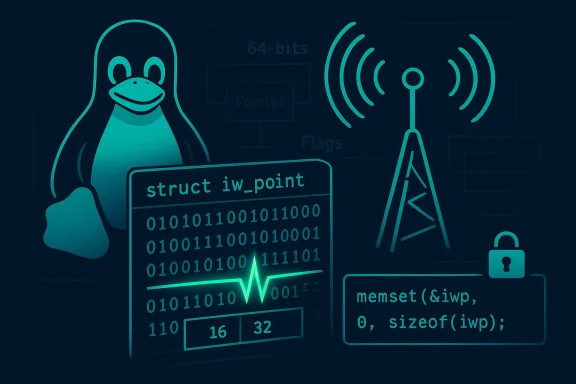
struct iw_point is zero‑initialized before it’s returned to userspace, closing a 32‑bit “hole” on 64‑bit architectures that could leak kernel memory contents. (spinics.net)
 Background / Overview
The Linux wireless extensions interface (WEXT) provides a long‑standing ioctl-based API that many userspace wireless tools and drivers still interact with. One of the data carriers in that API is struct iw_point, a compact structure that bundles a userspace pointer together with accompanying metadata (length and flags). On 64‑bit systems the structure’s memory layout creates an alignment‑sized gap between the pointer and the later 16‑bit fields; if that gap is not explicitly cleared, it can contain leftover kernel stack or heap data that — when copied back to userspace — becomes an information leak.This class of bug is not exotic: uninitialized or partially-initialized structures that differ between compatibility modes (32‑bit userspace on 64‑bit kernels, for example) are frequent sources of tiny but exploitable information disclosures. The kernel community’s response was a narrowly focused patch that zeroes the working
iw_point instance before populating its explicit fields, removing any residual bytes that would otherwise be visible to a caller. The patch and discussion landed on the netdev/lore mailing lists and was merged into stable trees. (spinics.net)The vulnerability dissected
What exactly is struct iw_point and why does alignment matter?
struct iw_point is defined to carry:- a user pointer to the data buffer,
- a 16‑bit length field, and
- a 16‑bit flags field.
Where in the stack did the leak occur?
The problematic windows are in the compatibility and legacy ioctl handling paths of the wireless code (files such aswext-core.c and wext-priv.c in net/wireless). Some code paths prepare a struct iw_point (or a compatibility variant) on the kernel stack and later hand that structure to functions that copy it out to userspace or embed it in wireless events. Because event generation and compat conversions can produce slightly different views of the structure depending on whether the caller is a 32‑bit task on a 64‑bit system, the padding bytes could be copied out unintentionally. The maintainer discussion and patch notes make clear that the fix is defensive: always zero the structure (e.g., memset(&iwp, 0, sizeof(iwp))) before assigning the explicit fields. (spinics.net)Affected systems and vendor response
Multiple distribution advisories and vulnerability trackers added CVE‑2026‑22978 after the kernel patch was merged. The National Vulnerability Database (NVD) lists the issue and summarizes the root cause as a kernel infoleak viastruct iw_point. Several Linux distributors — including Debian and components tracked by Amazon Linux and vendor security feeds — incorporated the upstream fix into their kernel updates and published security advisories and fixed package versions. Debian’s LTS advisory bundle that included this CVE was published in February 2026 and lists the relevant fixed package versions for long‑term kernels. Amazon’s ALAS advisory and other trackers likewise mark the issue as addressed or pending fixes for the relevant kernels in their repos.Key takeaways on affected systems:
- The issue is a Linux kernel vulnerability that was fixed upstream in the network/wireless code; affected versions depend on distribution and kernel branch. Consult your vendor’s security advisories and kernel package versions.
- Debian provided security updates (DLA/DSA advisories) that list CVE‑2026‑22978 among a set of kernel fixes and identify fixed package versions for LTS and stable branches.
- Several distribution trackers (e.g., AWS ALAS, Vulners, security databases) classify the severity in the low‑to‑medium range and recommend applying vendor kernel updates.
Impact and exploitability — how bad is a 32‑bit leak?
Technical impact
On its face, the vulnerability permits a local, low‑privileged process to learn 32 bits of kernel memory that otherwise should remain secret. Any kernel information disclosure is valuable to an attacker because it can weaken kernel address space layout randomization (KASLR) and can serve as a stepping stone for more powerful exploitation chains (for example, turning infoleaks into reliable kernel pointer knowledge that helps bypass exploit mitigations). Security researchers and vendors treat disclosure bugs that reveal kernel pointers or partially reveal stack data as meaningfully reducing the difficulty of follow‑on attacks.To be explicit: the CVE fixes the leak of a small, architecture‑specific chunk of memory (32 bits). That alone does not equate to immediate remote compromise or an automatic privilege escalation. The exploitability model is local: an attacker must be able to run code on the host (e.g., a malicious user account, a compromised container, or a malicious process on a multi‑user system) to trigger the ioctl/event path and observe the leaked bytes. But once an attacker can obtain stable kernel memory fragments, they may combine that information with other bugs or knowledge to escalate privileges or craft reliable kernel exploits.
Practical severity
Distribution trackers and some vendor feeds classify the issue as medium or low‑to‑medium severity, with CVSS scores reflecting a local attack vector and limited direct impact (information disclosure rather than code execution). For example, Amazon Linux’s advisory lists a CVSSv3 score in the 5.5 range for related kernel advisories incorporating the fix; Debian included it in broader kernel security updates rather than isolated emergency critical advisories. Operationally, this is a patch‑now but not panic‑now item for most organizations: apply kernel updates as part of normal maintenance, and prioritize based on exposure of multi‑user workloads and the presence of untrusted local users.I should note a caution: even low‑level infoleaks can be valuable in multi‑stage exploits. Threat actors invest time in chaining bugs — a small leak that reveals a pointer could materially lower the bar for a privilege escalation exploit when combined with other kernel bugs. Security teams running multi‑tenant systems, containers, or shared development hosts should therefore weight this CVE more heavily. This nuance — small initial severity multiplied by orchestration potential — is a recurring pattern in kernel security.
The patch and code-level fix
The upstream fix is surgical and conservative: zero‑initialize the in‑kerneliw_point instance before populating its explicit fields, removing the chance that padding bytes contain leftover kernel data when the structure is copied to userspace or used in event payloads. Netdev discussion shows the patch author and reviewers agreeing on both the root cause (32‑bit hole on 64‑bit arches) and the remedy (explicit memset followed by setting pointer, length, and flags). The change was applied to compat and native paths to avoid leaving any variant exposed. (spinics.net)Why that works: zeroing the whole structure ensures that any padding or alignment bytes are deterministic and non‑sensitive; subsequent writes fill the explicit fields and the zeroed padding remains inert when copied out. This is a classic defensive programming pattern in kernel code when interacting with user‑visible binary structures, and it’s frequently applied across many subsystems where ABI layouts differ between architectures or compat modes. (spinics.net)
Timeline and disclosure
The kernel community’s threads show the patch discussion occurring publicly on the kernel mailing lists in early January 2026, with CVE‑assignment and trackers populating the public vulnerability feeds in late January/February 2026. Distributions coordinated fixes into their kernel update cycles in February, as part of regular kernel security updates for stable and LTS branches. The upstream commits and netdev discussions document the technical rationale and reviewers’ comments; distribution advisories provide the practical remediation pathways for administrators. (spinics.net)Recommendations for system administrators and developers
- Patch promptly:
- Install the kernel updates published by your distribution that include the
struct iw_pointfix. Debian LTS and other distro security advisories list fixed package versions in their February 2026 bulletins. - Prioritize high‑value hosts:
- Give priority to multi‑user systems, hosting providers, shared development machines, bastion hosts, and any environment that allows untrusted local logins or containers.
- Temporary mitigations (if you cannot patch immediately):
- Restrict local access where feasible. Limit which users can run wireless‑related utilities or the specific ioctls if your environment supports syscall or ioctl filtering mechanisms.
- Use container hardening and sandboxing to reduce the risk that a local, unprivileged process can leverage the leak for escalation.
- Long‑term code hygiene:
- For driver and kernel developers: adopt explicit initialization for all user‑visible binary structures, especially where compat and ABI differences exist. Zeroing or using initializer macros prevents these sporadic padding leaks.
- Detection and monitoring:
- While this CVE is informational rather than a crash or RCE, monitor for anomalous local processes performing ioctl calls against wireless interfaces; auditing and syscall tracing can help detect unusual local reconnaissance attempts.
Broader analysis — strengths of the fix and residual risks
Strengths
- The upstream fix is minimal and low‑risk: zeroing a structure is a well‑understood, low‑impact change that removes the root cause without altering ABI semantics.
- The kernel review and discussion were public and included maintainers familiar with compat pitfalls, which strengthens confidence that the right path was identified and that the change was backported into stable branches. (spinics.net)
- Distribution packaging tracked the fix through regular security updates, enabling straightforward remediation via normal update channels.
Residual risks and caveats
- The fix eliminates this particular leakage vector, but other uninitialized-padding or compat‑conversion bugs remain a recurrent class of kernel vulnerabilities. Code that marshals between kernel and userspace must be audited with attention to ABI and padding differences.
- The real-world impact depends heavily on context. If an attacker already has local code execution capabilities (e.g., via a userland exploit), this leak is less meaningful; conversely, on a hardened host where local compromise is otherwise difficult, the leak may be a meaningful enabler when combined with other weaknesses.
- The patch is defensive but does not protect against drivers that may choose to create custom wire formats or manually construct user payloads in nonstandard ways. Kernel developers should treat this CVE as a reminder to apply the same defensive initialization across subsystems.
How this fits into the bigger picture of kernel security
Kernel security is often a story of many small fixes adding up. Tiny issues such as uninitialized padding, structure misalignment, and compat conversion errors are routinely found and fixed. Each one on its own may look minor, but attackers frequently chain small imperfections to produce impactful exploits. Thestruct iw_point fix is emblematic of steady upstream maintenance: targeted, correct, and quickly propagated into distribution updates.Operationally, this CVE reinforces two perennial lessons:
- Keep kernels up to date. Many exploit chains are practical only on unpatched trees where multiple small bugs coexist.
- Treat infoleaks seriously in threat modeling, especially for hosts exposed to untrusted local users or hosting code from different trust domains (containers, build systems, CI runners, etc.). The small leak here is a useful reconnaissance asset for attackers who specialize in kernel exploitation.
Final checklist for responders (quick action list)
- Validate: Confirm whether your kernel package version on each host includes the fix (check distro advisory or package changelog).
- Patch: Apply the vendor’s kernel update during your next maintenance window; follow your rollback and testing procedures.
- Restrict: If you cannot patch immediately, restrict local access and instrumecious ioctl activity.
- Review: Ask kernel driver maintainers and in‑house kernel code owners to adopt explicit initialization patterns for all user‑visible structures. (spinics.net)
Conclusion
CVE‑2026‑22978 is a textbook example of how ABI/compatibility quirks and small structure layout differences can lead to information disclosure in kernel code. The fix — zeroing thestruct iw_point instance before use — is clean, low‑risk, and broadly applied across the compat and native paths. For administrators, the practical action is straightforward: apply your vendor’s kernel updates and prioritize multi‑user and shared systems. For kernel developers and reviewers, the lesson is equally clear: defensive initialization of user‑visible structures must be a standard practice to avoid leaking sensitive kernel state in subtle ways. (spinics.net)For additional context on the nature and remediation of this type of leak, see the upstream netdev discussion and your distribution’s kernel security advisories. (spinics.net)
Note: internal analyses and community threads highlight that information leaks like this one can reduce the difficulty of subsequent exploit stages by revealing kernel pointers or stack contents; teams with exposed local user access or multi‑tenant services should assign higher urgency to this kind of patch.
Source: MSRC Security Update Guide - Microsoft Security Response Center
