

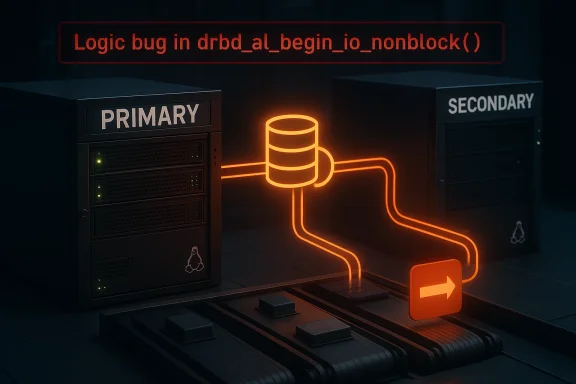
Microsoft’s advisory for CVE-2026-23356 points to a Linux kernel issue in drbd, specifically a logic bug in
The broader lesson is familiar to anyone managing production Linux storage: a bug in a low-level replication layer can ripple far beyond the function that actually misbehaves. When the kernel’s block and replication logic gets confused, the result can be stalled writes, failed failover, or edge-case inconsistencies that are difficult to diagnose under pressure. In other words, even a “logic bug” can behave like a major incident when it sits underneath databases, virtual machines, or highly available file services.
DRBD, short for Distributed Replicated Block Device, has long been used to mirror block devices across nodes so one server can take over when another fails. That architecture makes DRBD attractive for high availability, but it also means the driver sits on a very thin line between resilience and disruption. Any flaw in its asynchronous I/O path can affect not just a single machine, but the health of an entire cluster.
The function named in the advisory,
This is a classic pattern in storage and networking bugs: the code does not need to crash immediately to become operationally critical. A faulty branch, a missed check, or an incorrect retry path can produce intermittent stalls that only surface during load, failover, or synchronization. Those are the kinds of bugs administrators hate most because they are hard to reproduce and easy to misattribute.
The Microsoft Security Response Center listing is notable because it brings attention to a kernel issue in a component many Windows administrators may never directly touch, but which still matters in hybrid environments. That is especially true where DRBD-based appliances, virtualized storage layers, or Linux-based replication nodes support services consumed by Windows workloads. In mixed estates, a Linux kernel bug can still become a Windows outage.
For that reason, the important question is not merely “what is the bug?” but “what behavior can it trigger in a real deployment?” With storage and replication code, the answer is often less bandwidth, more waiting, and weaker failover guarantees rather than a simple yes-or-no security outcome. That makes triage dependent on topology, usage patterns, and how aggressively the environment relies on synchronous replication.
In clustered storage, the most expensive failures are often partial failures. The system looks alive, but failover takes too long, writes pause unexpectedly, or secondary nodes disagree about what has been committed. That kind of split-brain-adjacent instability is precisely why replication software is treated as infrastructure rather than just another kernel module.
A bug in a non-blocking admission path can produce several types of failure:
In many environments, DRBD is used as part of a larger stack that includes fencing, cluster managers, and failover scripts. Those layers can absorb some failures, but they can also make diagnosis harder when the root cause is in the replication path itself. If the kernel gives inconsistent signals, higher layers may fail over too early, too late, or repeatedly.
The same is true for service providers and managed hosting platforms. A single flawed storage node can affect multiple tenants or dependent systems, and the cost of remediation increases when maintenance requires coordinated downtime. That is why kernel-level storage advisories tend to be treated as high-priority even when they do not describe an obvious remote code execution path.
Because the advisory text is terse, it does not by itself prove exploitability in the remote-code-execution sense. Instead, it points to a correctness defect that may be reachable through carefully timed or unusual I/O patterns. In security practice, that distinction matters: the bug may be more about denial of service, data-path disruption, or integrity concerns than about direct privilege gain.
This is where patch management becomes more than a checkbox exercise. Storage and replication fixes often need validation in a staging environment, because a rushed kernel update on a clustered node can itself become an outage. The trick is to move quickly without treating a critical storage-path fix like a routine desktop update.
There is also a growing recognition that storage bugs are business-critical even when their disclosure language sounds understated. Enterprises increasingly run databases, backup targets, and virtualization layers on Linux storage primitives, so a defect in a block replication module can have effects comparable to a server-side application bug. The line between infrastructure reliability and security vulnerability is thinner than many organizations assume.
That is why a terse advisory should not be mistaken for a minor one. The shortest writeups often mask the hardest problems.
That matters because many organizations still divide responsibilities by platform instead of by service dependency. The Windows team may own the user-facing problem while the Linux team owns the root cause. Advisories like this one are reminders that modern infrastructure is layered, and layers leak.
The practical implication is that security teams should map critical services end-to-end, not just by operating system. If a Linux kernel issue can interrupt a Windows business workflow, it deserves the same attention as a Windows patch Tuesday fix.
Administrators should treat exposure assessment as a topology review, not a generic vulnerability scan. Kernel CVEs often require package-level and feature-level context. A server can be nominally “Linux” and still be unaffected if the DRBD module is absent, unused, or already fixed in a vendor backport.
Longer term, advisories like this one will keep pushing infrastructure teams toward more disciplined dependency mapping and more realistic recovery testing. The lesson is not that Linux storage is inherently unsafe; it is that low-level correctness matters immensely when your service depends on replicated state. The teams that treat kernel storage bugs as business continuity issues, not just security bulletins, will be best positioned to absorb the next one.
Source: MSRC Security Update Guide - Microsoft Security Response Center
drbd_al_begin_io_nonblock(). That wording matters: this is not being presented as a flashy memory-corruption flaw, but as a correctness problem in how the driver handles I/O state, which can still have serious operational consequences for storage stacks and clustered systems. For administrators running DRBD-backed workloads, that makes the vulnerability especially relevant because the impact is likely to show up as availability trouble, recovery complexity, or data-path instability rather than a classic exploit chain.The broader lesson is familiar to anyone managing production Linux storage: a bug in a low-level replication layer can ripple far beyond the function that actually misbehaves. When the kernel’s block and replication logic gets confused, the result can be stalled writes, failed failover, or edge-case inconsistencies that are difficult to diagnose under pressure. In other words, even a “logic bug” can behave like a major incident when it sits underneath databases, virtual machines, or highly available file services.
 Background
DRBD, short for Distributed Replicated Block Device, has long been used to mirror block devices across nodes so one server can take over when another fails. That architecture makes DRBD attractive for high availability, but it also means the driver sits on a very thin line between resilience and disruption. Any flaw in its asynchronous I/O path can affect not just a single machine, but the health of an entire cluster.The function named in the advisory,
drbd_al_begin_io_nonblock(), sits in the area where DRBD coordinates write intent and I/O admission without blocking. That sounds abstract, but in practical terms it is part of the machinery deciding whether a write can safely proceed while replication and locking conditions are being enforced. A logic error there can lead to incorrect state transitions, which is often more dangerous than it first appears because the system may keep running while quietly drifting into a bad state.This is a classic pattern in storage and networking bugs: the code does not need to crash immediately to become operationally critical. A faulty branch, a missed check, or an incorrect retry path can produce intermittent stalls that only surface during load, failover, or synchronization. Those are the kinds of bugs administrators hate most because they are hard to reproduce and easy to misattribute.
The Microsoft Security Response Center listing is notable because it brings attention to a kernel issue in a component many Windows administrators may never directly touch, but which still matters in hybrid environments. That is especially true where DRBD-based appliances, virtualized storage layers, or Linux-based replication nodes support services consumed by Windows workloads. In mixed estates, a Linux kernel bug can still become a Windows outage.
For that reason, the important question is not merely “what is the bug?” but “what behavior can it trigger in a real deployment?” With storage and replication code, the answer is often less bandwidth, more waiting, and weaker failover guarantees rather than a simple yes-or-no security outcome. That makes triage dependent on topology, usage patterns, and how aggressively the environment relies on synchronous replication.
Why This Bug Matters
A vulnerability described as a logic bug may sound less dramatic than a memory safety flaw, but operationally it can be every bit as disruptive. Storage drivers are built on assumptions about ordering, exclusivity, and the exact state of ongoing I/O. When those assumptions fail, the driver may authorize an action it should block, block an action it should allow, or leave bookkeeping in a corrupted state.In clustered storage, the most expensive failures are often partial failures. The system looks alive, but failover takes too long, writes pause unexpectedly, or secondary nodes disagree about what has been committed. That kind of split-brain-adjacent instability is precisely why replication software is treated as infrastructure rather than just another kernel module.
What “nonblock” Implies
Thenonblock part of the function name suggests the code path is intended to avoid waiting when conditions are not immediately suitable. That can improve throughput and responsiveness, but it also increases the burden on state validation. If the non-blocking path mishandles a corner case, the bug may only show up under contention, which is exactly when administrators least want surprises.A bug in a non-blocking admission path can produce several types of failure:
- delayed writes that appear as random latency spikes
- incorrect denial of I/O that should succeed
- state drift between primary and replica nodes
- error handling paths that were never meant to be exercised together
- cascading retries that amplify load at the worst possible moment
How DRBD Fits into Enterprise Risk
Enterprises that rely on DRBD usually do so because they need resilience without the complexity or cost of a larger storage fabric. That means the software often sits on critical paths for databases, virtualization hosts, or file services where downtime translates directly into business impact. A vulnerability in the replication layer is therefore more than a kernel curiosity; it is a risk multiplier.In many environments, DRBD is used as part of a larger stack that includes fencing, cluster managers, and failover scripts. Those layers can absorb some failures, but they can also make diagnosis harder when the root cause is in the replication path itself. If the kernel gives inconsistent signals, higher layers may fail over too early, too late, or repeatedly.
Enterprise Versus Consumer Exposure
For consumers, this kind of bug may never be encountered at all because DRBD is not a mainstream desktop component. For enterprises, especially those running self-managed Linux storage nodes, the exposure is much more real. The difference is operational dependency: if the system is a pet project, the bug is a nuisance; if it underpins production data, it is a business risk.The same is true for service providers and managed hosting platforms. A single flawed storage node can affect multiple tenants or dependent systems, and the cost of remediation increases when maintenance requires coordinated downtime. That is why kernel-level storage advisories tend to be treated as high-priority even when they do not describe an obvious remote code execution path.
Common Enterprise Consequences
- degraded replication performance during peak load
- failover events that take longer than expected
- write admission failures under contention
- noisy alerts that obscure the true root cause
- increased recovery time after a node outage
Technical Interpretation of the Advisory
The key phrase in the listing is “fix ‘LOGIC BUG’ in drbd_al_begin_io_nonblock()”. That suggests the maintainers found a path where the driver’s decision-making was wrong, not merely fragile. In kernel terms, that can mean the function allowed an invalid state transition, failed to account for concurrency, or mishandled an edge case in resource accounting.Because the advisory text is terse, it does not by itself prove exploitability in the remote-code-execution sense. Instead, it points to a correctness defect that may be reachable through carefully timed or unusual I/O patterns. In security practice, that distinction matters: the bug may be more about denial of service, data-path disruption, or integrity concerns than about direct privilege gain.
Likely Failure Modes
A DRBD logic bug in an I/O begin path can plausibly lead to issues such as:- incorrect reference tracking on active writes
- misordered admission and completion behavior
- resource leakage in busy or aborted paths
- unexpected lock or contention behavior
- inconsistent local versus replicated state
Why Kernel “Logic Bugs” Still Deserve Fast Patching
Kernel bugs are often dismissed until they produce a crash or a headline. That is a mistake. A logic bug in a highly privileged subsystem can be just as disruptive as a memory-safety flaw, especially when it sits in the storage layer where every application eventually lands. The fact that the vulnerability is named as a logic issue should not reduce urgency; if anything, it should prompt more careful testing because the failure may be subtle and environment-specific.Patch Management Implications
Because the advisory concerns a Linux kernel component, the remediation path will likely depend on the exact distribution, kernel branch, and packaging policy in use. That means there may not be a single universal fix date for every environment. Administrators should expect vendor-specific backports and potentially staggered availability across supported distributions.This is where patch management becomes more than a checkbox exercise. Storage and replication fixes often need validation in a staging environment, because a rushed kernel update on a clustered node can itself become an outage. The trick is to move quickly without treating a critical storage-path fix like a routine desktop update.
A Practical Triage Sequence
- Confirm whether DRBD is in active use on any production host.
- Identify the kernel version and distribution package source.
- Check vendor security advisories for backported fixes.
- Validate cluster failover behavior in a maintenance window.
- Schedule rollout by criticality, not by convenience.
What to Test After Patching
- write throughput under normal load
- behavior during node disconnects
- promotion and demotion of primary/secondary roles
- resync performance after rejoin
- application latency during fence and failover operations
Broader Linux Storage Security Trends
This advisory also fits a larger pattern in Linux security: a steady flow of bugs in block, network, and filesystem code where the primary risk is not always classic exploitation but service reliability. Kernel developers continue to harden these subsystems, but the complexity of concurrency and state management means logic errors remain common. That is especially true in older code paths that have accumulated many edge-case behaviors over time.There is also a growing recognition that storage bugs are business-critical even when their disclosure language sounds understated. Enterprises increasingly run databases, backup targets, and virtualization layers on Linux storage primitives, so a defect in a block replication module can have effects comparable to a server-side application bug. The line between infrastructure reliability and security vulnerability is thinner than many organizations assume.
Why Storage Bugs Are So Hard to Eradicate
Storage code has to manage asynchronous events, locking, retries, and topology changes all at once. Each of those dimensions adds state, and each new state combination increases the chance of a missed branch or a mistaken assumption. The result is a class of bugs that can survive years of testing because they only appear under specific timing and load conditions.That is why a terse advisory should not be mistaken for a minor one. The shortest writeups often mask the hardest problems.
Operational Takeaways
- cluster health checks should include kernel patch status
- failover drills should be routine, not exceptional
- administrators should track upstream and vendor kernel branches separately
- storage-related CVEs deserve escalation even without exploitation reports
- change windows should be aligned with replication traffic patterns
Why This Will Interest Windows Administrators
At first glance, a Linux DRBD kernel bug may seem irrelevant to a Windows audience. But Windows admins increasingly live in hybrid infrastructure where Linux storage nodes, backup appliances, or virtualization backends support workloads that users experience through Windows clients. In those environments, a Linux-side failure can surface as a Windows application outage, a slow file share, or a backup job that mysteriously stalls.That matters because many organizations still divide responsibilities by platform instead of by service dependency. The Windows team may own the user-facing problem while the Linux team owns the root cause. Advisories like this one are reminders that modern infrastructure is layered, and layers leak.
Hybrid Environments and Hidden Dependencies
A Windows file server can depend on a Linux-based replication target. A virtualization cluster may rely on DRBD-backed storage somewhere below the hypervisor. A backup appliance may use Linux kernel storage modules internally even if the admin interface is entirely web-based. Those hidden dependencies are where security and reliability bugs become organizational surprises.The practical implication is that security teams should map critical services end-to-end, not just by operating system. If a Linux kernel issue can interrupt a Windows business workflow, it deserves the same attention as a Windows patch Tuesday fix.
The Communications Problem
One of the hardest parts of cross-platform incidents is nomenclature. A Linux kernel logic bug may be tracked by security teams as a CVE, by operations as a failover issue, and by users as a “network problem” or “storage slowness.” That mismatch delays response because nobody initially owns the whole picture. Better dependency mapping shortens that gap.How to Evaluate Exposure
Not every environment using Linux is exposed to this exact issue, and not every DRBD deployment will experience the same severity. The real question is whether the buggy code path is reachable in your topology and workload profile. High I/O contention, replication churn, and failover activity are the kinds of conditions that usually expose latent logic flaws.Administrators should treat exposure assessment as a topology review, not a generic vulnerability scan. Kernel CVEs often require package-level and feature-level context. A server can be nominally “Linux” and still be unaffected if the DRBD module is absent, unused, or already fixed in a vendor backport.
Questions Worth Answering Internally
- Is DRBD loaded on any production host?
- Which nodes are primaries, secondaries, or hot spares?
- Are any systems under heavy synchronous write load?
- Are there recurring failover or resync events?
- Have any recent kernel updates changed storage behavior?
What Not to Assume
Do not assume that because the advisory is short, the issue is harmless. Do not assume that because the CVE looks kernel-local, it cannot affect service availability. And do not assume that a non-desktop feature is irrelevant to the business just because end users never see it directly. Infrastructure bugs travel upward.Strengths and Opportunities
The upside of an advisory like this is that it gives operators a chance to tighten a part of the stack that is often overlooked until something breaks. It also highlights the value of vendor coordination, because backported kernel fixes can protect production systems without forcing organizations onto bleeding-edge releases. More broadly, it reinforces the case for service-level dependency mapping and failover testing.- The fix appears targeted at a narrow but critical I/O path.
- Operators can prioritize remediation based on actual DRBD use.
- Vendor backports may reduce upgrade disruption.
- The issue creates an opportunity to re-test cluster failover.
- Security and operations teams can align around a shared storage risk.
- Hybrid environments can improve dependency inventories.
- The advisory helps surface hidden Linux dependencies in Windows-centric shops.
Risks and Concerns
The main concern is that storage-layer bugs are often quiet until they are expensive. A logic flaw in DRBD may not produce an obvious crash, which can delay detection and make the first symptom an outage rather than a warning. Another risk is that patching clustered storage nodes without planning can itself destabilize service, especially if failover or resync behavior changes.- The bug may manifest only under high contention or failover.
- Partial replication failures can be harder to diagnose than crashes.
- Kernel updates can create compatibility issues with cluster tooling.
- Administrators may underestimate impact because the advisory sounds abstract.
- Exposure may be missed in environments with hidden DRBD dependencies.
- Emergency patching could trigger avoidable downtime if not tested.
- Monitoring systems may not clearly attribute symptoms to the kernel layer.
Looking Ahead
The immediate next step for affected organizations is to determine whether DRBD is actually part of the production footprint and, if so, which kernel builds contain the fix. From there, the patching strategy should be guided by workload criticality, maintenance windows, and cluster failover design. The organizations that move fastest will be the ones that already know where their replication layers sit and how they behave under stress.Longer term, advisories like this one will keep pushing infrastructure teams toward more disciplined dependency mapping and more realistic recovery testing. The lesson is not that Linux storage is inherently unsafe; it is that low-level correctness matters immensely when your service depends on replicated state. The teams that treat kernel storage bugs as business continuity issues, not just security bulletins, will be best positioned to absorb the next one.
- Verify DRBD presence on every Linux host with production storage roles.
- Confirm kernel package versions against vendor backports.
- Test primary/secondary promotion and demotion paths.
- Review monitoring alerts for storage latency and resync anomalies.
- Document who owns Linux storage when Windows services depend on it.
Source: MSRC Security Update Guide - Microsoft Security Response Center
