

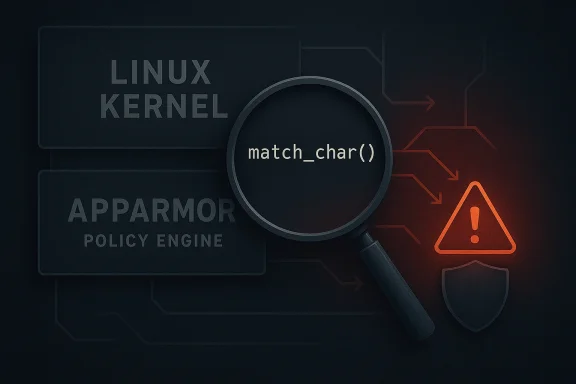
Microsoft’s security guidance for CVE-2026-23406 points to an AppArmor bug in the Linux kernel, described as a side-effect issue in the
AppArmor is one of the major Linux Security Module implementations, alongside SELinux, Smack, and Tomoyo. The kernel documentation describes it as a MAC-style security extension that attaches profiles to tasks and enforces those profiles as the kernel mediates access to files, processes, and other resources. That architecture makes AppArmor a boundary technology: if it misbehaves, the consequences are not confined to a single application, but can ripple through the trust model of the host.
The most important thing to remember about AppArmor is that it is not a standalone user-space filter. It is kernel-resident enforcement logic, which means correctness is not optional and edge cases are not academic. A logic error in a parser or matcher can translate into a policy mismatch, a denial of service, or a subtle security bypass depending on how the code is reached and what assumptions it violates. That is why even a description that sounds like a “macro usage bug” can become security-significant.
This CVE also fits a larger pattern in Linux security maintenance: maintainers often assign CVEs to bugs that are not dramatic memory-corruption primitives but are still security-relevant because they affect the reliability or correctness of kernel enforcement. The kernel security documentation explicitly notes that CVE assignment can cover a broad range of issues and that the CVE team may be conservative in assigning numbers to bugs that are identified as security fixes. In other words, security impact is not limited to code execution.
The wording in the Microsoft advisory excerpt is especially important because it emphasizes total loss of availability or persistent denial of access to resources in the impacted component. That is a meaningful threshold: the issue is not merely a transient slowdown or cosmetic glitch, but something that while the attack continues, or leave the component stuck in a bad state even after the attack ends. That framing tells defenders to treat the problem as an operational security issue, not just a correctness bug.
There is also a process lesson here. AppArmor is a long-lived kernel subsystem with clearly documented maintainer ownership and stable interfaces, yet bugs still appear in the least glamorous parts of the code — the macros, helper paths, and character-handling routines that quietly underpin the policy engine. That is typical of mature security code: the headline risks are often elsewhere, but the outages come from small pieces of plumbing.
That matters in a security module because matching code often sits on critical control paths. AppArmor policy evaluation needs to parse strings, compare tokens, and advance through input deterministically. If a macro increments a pointer, consumes a character, or mutates some shared state more than once, the match engine can drift out of sync with the actual input and reach an unintended path. Even when the result is “only” a crash, that can still become a denial-of-service against the subsystem.
In kernel code, the risk is amplified because correctness and safety are intertwined. A wrong branch in a policy matcher can reject legitimate activity, loop endlessly, or crash an enforcement path that the rest of the system assumes is reliable. That is why security maintainers are so sensitive to even narrow macro misuse.
This distinction matters because not all DoS bugs are equally operationally painful. Some only affect one request or one process instance, while others break a kernel subsystem in a way that forces service rs, or emergency remediation. For AppArmor, which participates in system enforcement, even a partial failure can have broad effects if the surrounding environment depends on predictable policy checks.
This is a useful reminder that availability bugs can be security bugs with direct business consequences. A policy subsystem that becomes unstable may not just inconvenience a local user; it can block workloads, disrupt container hosts, or trigger fail-closed behavior in systems that rely on MAC enforcement. In enterprise terms, that is production risk, not merely theoretical exploitability.
Because AppArmor operates in the LSM layer, it sits close to the trust boundary between user space and kernel enforcement. If its parsing or matching logic misbehaves, the result can be a policy decision that is wrong at exactly the moment the kernel needs to be authoritative. That makes small code hygiene issues unusually important.
That is why kernel maintainers care so much about defensive coding conventions. A function-like macro might be acceptable for performance or historical reasons, but once it starts obscuring side effects, it can undermine the very invariants the subsystem exists to protect. Security code has a low tolerance for surprises.
Consumer exposure is narrower but still real. Desktop Linux users, especially those on distributions that enable AppArmor by default or ship profiles for major applications, may never consciously interact with the subsystem — which is exactly why it is easy to underestimate. A flaw in a background policy engine can surface as app crashes, blocked launches, or systems experience as “Linux being weird,” even though the fault lives much deeper in the stack.
That is why enterprise teams should think beyond endpoint count. A security module bug can affect login workflows, package management, container launches, and other operations that rely on kernel mediation, which means the blast radius can reach much further than the original proof of concept suggests. The kernel does not care whether the workload is a laptop or a cluster node.
The technical significance is that the bug may not have required malformed data in any deep sense. Instead, an attacker may only need to supply input that steers the parser through the problematic path. When the matcher consumes the wrong character or increments the wrong pointer, subsequent comparisons no longer reflect the real input stream, and the state machine can become inconsistent.
That distinction matters especially in low-level code where performance and readability often pull in opposite directions. Kernel developers use macros for many legitimate reasons, but when the macro becomes a hidden control-flow device, the risk rises quickly. In a security-sensitive parser, explicit is better than clever.
Kernel maintainers tend to prefer changes that reduce ambiguity in sensitive code paths. In practice, that can mean converting a macro to an inline function, rewriting a match helper so it does not double-evaluate expressions, or otherwise making side effects explicit. The advantage is not only correctness; it also improves auditability for future reviewers.
That approach also helps downstream distributors. Smaller, more targeted fixes are easier to backport across supported kernel branches, easier to review for unintended consequences, and easier to validate against distribution-specific AppArmor configurations. That matters a lot when the affected code sits in a common security framework.
A final concern is the security-evolution issue. Once one macro-related side-effect bug is exposed, reviewers should assume there may be others lurking in adjacent parsing code. That does not mean the subsystem is broadly compromised, but it does mean the bug should trigger a broader hygiene review rather than a narrow one-and-done response.
A second thing to watch is whether the upstream AppArmor maintainers or kernel security teams use this as a chance to harden related matching helpers. If the root issue is a macro-side-effect pattern, the smart follow-on move is to search for similar constructs elsewhere in the codebase. That kind of preventive cleanup is how kernel projects reduce the odds of repeat incidents.
Source: MSRC Security Update Guide - Microsoft Security Response Center
match_char() macro usage. In practical terms, that kind of bug matters because a security-critical parser or matcher can behave differently than the programmer intended, which opens the door to incorrect policy handling and, in the worst case, a denial-of-service condition in the impacted component. AppArmor itself is a Linux mandatory access control framework that enforces task-centered policies, so flaws in its matching logic deserve attention even when the technical root cause looks small on the page. //www.kernel.org/doc/html/v5.10/admin-guide/LSM/apparmor.html)
 Background
AppArmor is one of the major Linux Security Module implementations, alongside SELinux, Smack, and Tomoyo. The kernel documentation describes it as a MAC-style security extension that attaches profiles to tasks and enforces those profiles as the kernel mediates access to files, processes, and other resources. That architecture makes AppArmor a boundary technology: if it misbehaves, the consequences are not confined to a single application, but can ripple through the trust model of the host.The most important thing to remember about AppArmor is that it is not a standalone user-space filter. It is kernel-resident enforcement logic, which means correctness is not optional and edge cases are not academic. A logic error in a parser or matcher can translate into a policy mismatch, a denial of service, or a subtle security bypass depending on how the code is reached and what assumptions it violates. That is why even a description that sounds like a “macro usage bug” can become security-significant.
This CVE also fits a larger pattern in Linux security maintenance: maintainers often assign CVEs to bugs that are not dramatic memory-corruption primitives but are still security-relevant because they affect the reliability or correctness of kernel enforcement. The kernel security documentation explicitly notes that CVE assignment can cover a broad range of issues and that the CVE team may be conservative in assigning numbers to bugs that are identified as security fixes. In other words, security impact is not limited to code execution.
The wording in the Microsoft advisory excerpt is especially important because it emphasizes total loss of availability or persistent denial of access to resources in the impacted component. That is a meaningful threshold: the issue is not merely a transient slowdown or cosmetic glitch, but something that while the attack continues, or leave the component stuck in a bad state even after the attack ends. That framing tells defenders to treat the problem as an operational security issue, not just a correctness bug.
There is also a process lesson here. AppArmor is a long-lived kernel subsystem with clearly documented maintainer ownership and stable interfaces, yet bugs still appear in the least glamorous parts of the code — the macros, helper paths, and character-handling routines that quietly underpin the policy engine. That is typical of mature security code: the headline risks are often elsewhere, but the outages come from small pieces of plumbing.
What the advisory is really saying
The phrase “side-effect bug in match_char() macro usage” suggests that the vulnerability is not about a spectacular buffer overflow. Instead, it points to a dangerous macro expansion pattern where an argument may be evaluated more than once, or where macro semantics cause a state change that the caller did not expect. In C, macros are convenient precisely because they are not functions; that also means they can behave in ways that surprise even experienced developers when the argument carries side effects.That matters in a security module because matching code often sits on critical control paths. AppArmor policy evaluation needs to parse strings, compare tokens, and advance through input deterministically. If a macro increments a pointer, consumes a character, or mutates some shared state more than once, the match engine can drift out of sync with the actual input and reach an unintended path. Even when the result is “only” a crash, that can still become a denial-of-service against the subsystem.
Why macro side effects are dangerous
A macro that expects a simple value is usually safe. A macro that receives an expression with side effects is where trouble begins. If the expression is used twice, once in a comparison and once in a post-increment, the observable behavior can diverge from the programmer’s mental model; that is the kind of bug that hides in plain sight until a weird input sequence exposes it.In kernel code, the risk is amplified because correctness and safety are intertwined. A wrong branch in a policy matcher can reject legitimate activity, loop endlessly, or crash an enforcement path that the rest of the system assumes is reliable. That is why security maintainers are so sensitive to even narrow macro misuse.
- Macros can evaluate the same argument more than once.
- Side effects in arguments can therefore happen multiple times.
- Small parsing mistakes can become kernel-level availability problems.
- Policy engines are especially sensitive because they guard access at the boundary.
Availability impact and why Microsoft’s wording matters
Microsoft’s description focuses on availability, and that should steer how defenders interpret the issue. The advisory language describes a condition where an attacker can deny access to resources in the impacted component in a sustained or persistent way, which is stronger than a nuisance-level crash. That is a classic sign that the vulnerable code path is close enough to the service’s core logic that repeated triggering can keep the component unusable.This distinction matters because not all DoS bugs are equally operationally painful. Some only affect one request or one process instance, while others break a kernel subsystem in a way that forces service rs, or emergency remediation. For AppArmor, which participates in system enforcement, even a partial failure can have broad effects if the surrounding environment depends on predictable policy checks.
Total loss versus partial degradation
Microsoft’s language describes something closer to a hard outage than a soft performance regression. That means defenders should think in terms of service continuity, not just benchmark impact. If the attack can repeatedly force the impacted component into a broken state, the real-world result can be the same as a full shutdown fr view.This is a useful reminder that availability bugs can be security bugs with direct business consequences. A policy subsystem that becomes unstable may not just inconvenience a local user; it can block workloads, disrupt container hosts, or trigger fail-closed behavior in systems that rely on MAC enforcement. In enterprise terms, that is production risk, not merely theoretical exploitability.
- Sustained attacks can keep the component unavailable.
- Persistent faults can survive after the triggering input stops.
- Security modules have broad blast radius when they fail.
- Operational impact can exceed the raw technical severity label.
Why AppArmor bugs are especially sensitive
AppArmor is designed to be a guardrail, not an afterthought. The kernel documentation presents it as a built-in access control framework that can be selected at build time and enabled as part of the system’s primary security posture. That means faults in its internals do not just affect one optional feature; they affect a policy mechanism that may be central to the host’s defense strategy.Because AppArmor operates in the LSM layer, it sits close to the trust boundary between user space and kernel enforcement. If its parsing or matching logic misbehaves, the result can be a policy decision that is wrong at exactly the moment the kernel needs to be authoritative. That makes small code hygiene issues unusually important.
The security-module trust problem
Security modules are supposed to be boring in the best possible way. They should fail predictably, enforce consistently, and avoid ambiguity in every path that evaluates a subject or object against policy. Macro side effects threaten that goal because they introduce hidden behavior into what should be a straightforward match operation.That is why kernel maintainers care so much about defensive coding conventions. A function-like macro might be acceptable for performance or historical reasons, but once it starts obscuring side effects, it can undermine the very invariants the subsystem exists to protect. Security code has a low tolerance for surprises.
- Enforcement logic must be deterministic.
- Hidden side effects increase review difficulty.
- Small parser defects can become policy outages.
- Security modules have to be conservative by design.
Enterprise and consumer exposure
For enterprise users, AppArmor issues tend to matter most on servers, developer workstations, and container hosts that actually rely on MAC enforcement. Organizations that treat AppArmor as a defense-in-depth layer should assume that any kernel bug in matching logic can affect fleet stability, policy compliannse timelines. A broken enforcement subsystem can also complicate troubleshooting because failures may look like application misbehavior rather than a kernel security issue.Consumer exposure is narrower but still real. Desktop Linux users, especially those on distributions that enable AppArmor by default or ship profiles for major applications, may never consciously interact with the subsystem — which is exactly why it is easy to underestimate. A flaw in a background policy engine can surface as app crashes, blocked launches, or systems experience as “Linux being weird,” even though the fault lives much deeper in the stack.
Fleet behavior versus single-machine behavior
On one machine, an AppArmor-related DoS might look like a local annoyance. Across a fleet, it becomes a patch-management and uptime issue. If the vulnerable path can be triggered repeatedly, orchestration systems may keep restarting affected services, only to see the same enforcement component fail again and again.That is why enterprise teams should think beyond endpoint count. A security module bug can affect login workflows, package management, container launches, and other operations that rely on kernel mediation, which means the blast radius can reach much further than the original proof of concept suggests. The kernel does not care whether the workload is a laptop or a cluster node.
- Servers may feel the impact through service restarts.
- Developer workstations may see blocked workflows.
- Container hosts may experience cascading failures.
- Managed fleets may need emergency validation after rollout.
What likely went wrong technically
The phrase match_char() macro usage hints at a code pattern where character matching was implemented with a macro that was not safe for the way it was called. In kernel code, that often means the macro was passed an expression with side effects — for example, something that advanced a pointer or altered parsing state — and the macro’s internal structure caused that effect to happen more than once or at the wrong time.The technical significance is that the bug may not have required malformed data in any deep sense. Instead, an attacker may only need to supply input that steers the parser through the problematic path. When the matcher consumes the wrong character or increments the wrong pointer, subsequent comparisons no longer reflect the real input stream, and the state machine can become inconsistent.
Macro semantics versus function semantics
A real function evaluates its arguments once before the call. A macro can expand inline in ways that are more efficient, but also more error-prone. If the macro body references the same argumenteffects can multiply, and the resulting behavior can be very different from what the author intended.That distinction matters especially in low-level code where performance and readability often pull in opposite directions. Kernel developers use macros for many legitimate reasons, but when the macro becomes a hidden control-flow device, the risk rises quickly. In a security-sensitive parser, explicit is better than clever.
- Macro arguments with side effects are risky.
- Parser state must advance exactly once per token.
- Hidden increments can desynchronize the parser.
- Desynchronized parsers can crash or mis-handle policy data.
Patch strategy and maintenance implications
Although the public material available here does not include the full upstream patch text, the advisory language strongly implies a classic kernel hardening move: eliminate the unsafe macro behavior or replace the macro-based usage with a safer construct. That is often the cleanest fix because it addresses the root cause instead of just masking symptoms.Kernel maintainers tend to prefer changes that reduce ambiguity in sensitive code paths. In practice, that can mean converting a macro to an inline function, rewriting a match helper so it does not double-evaluate expressions, or otherwise making side effects explicit. The advantage is not only correctness; it also improves auditability for future reviewers.
Why minimal fixes are often best
The most maintainable secue one that changes the least while fixing the most. In kernel code, that usually means removing one fragile abstraction rather than adding a large amount of defensive scaffolding around it. Fewer moving parts reduce the chance of new regressions in a subsystem that already has to be extremely stable.That approach also helps downstream distributors. Smaller, more targeted fixes are easier to backport across supported kernel branches, easier to review for unintended consequences, and easier to validate against distribution-specific AppArmor configurations. That matters a lot when the affected code sits in a common security framework.
- Safer code paths are easier to audit.
- Small patches backport more cleanly.
- Simpler fixes reduce regression risk.
- Explicit semantics help long-term maintenance.
Strengths and Opportunities
This CVE also shows where Linux security engineering is working well. The subsystem is mature, the bug is visible enough to be assigned a CVE, and the issue is framed in a way that defenders can understand operationally. That gives administrators a real chance to prioritize, verify, and remediate without waiting for exploit theatrics.- The issue is clearly scoped to AppArmor, not the whole kernel.
- Microsoft’s wording makes the availability risk easy to triage.
- The bug class is understandable and therefore easier to audit for similar patterns.
- Downstream vendors can likely backport a targeted fix without major churn.
- The advisory creates a concrete opportunity to review other parser macros in security code.
- AppArmor users can tighten validation and regression testing around policy matching paths.
- This is a reminder that small code changes can materially improve security posture when they remove ambiguity from enforcement logic.
Risks and Concerns
The most obvious concern is that availability bugs in security modules are easy to underestimate. Teams often focus on code execution or privilege escalation, but a reliable denial-of-service against kernel enforcement can still take down services, interrupt workflows, and undermine confidence in the host.- The bug may be reachable through ordinary policy-processing paths.
- Repeated triggering could produce sustained service disruption.
- Security teams may miss it if they only triage RCE-style issues.
- Systems relying heavily on AppArmor may be more operationally sensitive.
- A crash or hang in enforcement logic can have broad collateral effects.
- Macro-related bugs are prone to appear in other similarly written code.
- Downstream kernel variants may inherit the issue in slightly different forms.
A final concern is the security-evolution issue. Once one macro-related side-effect bug is exposed, reviewers should assume there may be others lurking in adjacent parsing code. That does not mean the subsystem is broadly compromised, but it does mean the bug should trigger a broader hygiene review rather than a narrow one-and-done response.
Looking Ahead
The next thing to watch is whether downstream distributions and enterprise vendors issue kernel updates that explicitly call out the AppArmor fix and its backport status. For administrators, the key operational question is not just whether a patch exists, but whether it has been incorporated into the exact build they deploy. That distinction is often where remediation succeeds or stalls.A second thing to watch is whether the upstream AppArmor maintainers or kernel security teams use this as a chance to harden related matching helpers. If the root issue is a macro-side-effect pattern, the smart follow-on move is to search for similar constructs elsewhere in the codebase. That kind of preventive cleanup is how kernel projects reduce the odds of repeat incidents.
What defenders should prioritize
- Verify whether the running kernel build includes the AppArmor fix.
- Check vendor advisories for exact backport coverage.
- Review logs for crashes or hangs in policy-enforcement paths.
- Treat repeated AppArmor failures as an availability incident, not a nuisance.
- Audit other macro-heavy parsing logic for side-effect hazards.
Source: MSRC Security Update Guide - Microsoft Security Response Center
