

CVE-2026-23414 is not the kind of Linux kernel flaw that produces dramatic remote-code-execution headlines, but it is exactly the sort of low-level reliability bug that can quietly matter in real systems. The issue sits in the kernel TLS receive path, where asynchronous decryption can leave encrypted socket buffers pinned longer than their useful lifetime. Rated medium severity with a CVSS 3.1 score of 5.5, the vulnerability is best understood as a local, availability-impacting memory leak that deserves attention from Linux server operators, cloud teams, appliance vendors, and Windows users who depend on Linux through WSL2, containers, or Azure-hosted workloads.
The vulnerability, tracked as CVE-2026-23414, affects the Linux kernel’s kTLS implementation, specifically the software TLS receive path in
Historically, TLS has been associated with libraries such as OpenSSL, GnuTLS, Schannel, and BoringSSL. Kernel TLS changes that boundary by letting applications complete the handshake in user space and then hand record encryption or decryption state to the kernel. In Linux, this can improve send and receive performance, support network offload, and reduce overhead for services that move large amounts of encrypted data.
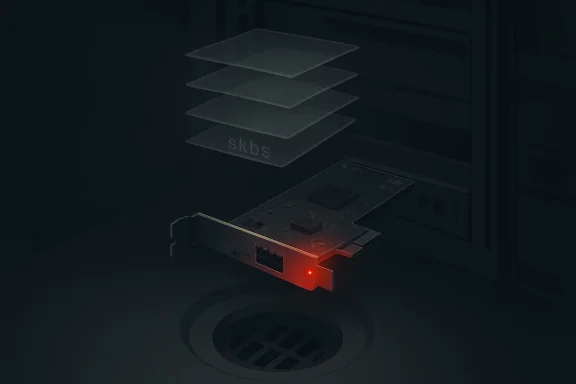
The flaw addressed here involves the asynchronous decryption path. When the kernel asks an AEAD crypto engine to decrypt TLS records asynchronously, it must keep the encrypted input buffers alive until the engine is finished with their scatterlist data. Those socket buffers, commonly called skbs, are temporarily placed on an
The fix is conceptually simple but technically important: purge the
The problem arises when the cleanup is not tied to the function that guarantees completion. If a caller waits for async work but does not purge the queue, the kernel can retain memory that should have been freed. That is why the patch moves
This matters because there are multiple synchronization paths. The existing receive-message drain path, the
Key technical takeaways include:
By placing the purge inside
Availability flaws are sometimes underestimated because they do not immediately imply stolen data. In production, however, kernel memory pressure can degrade service reliability, trigger process failures, or contribute to system instability. For high-density servers, even a “mere” leak can become expensive.
The attack prerequisites reduce urgency for many desktop users. A single-user Linux laptop with a standard distribution kernel and no meaningful use of kTLS receive paths is unlikely to be the highest-risk environment. By contrast, multi-tenant servers, CI runners, container hosts, storage gateways, reverse proxies, and specialized appliances deserve closer scrutiny.
A reasonable prioritization model looks like this:
Memory exhaustion also combines badly with automation. If a leak can be triggered repeatedly and cheaply, a local actor may not need sophistication to cause service disruption. The defensive question is not only whether an exploit exists, but whether the vulnerable code path is reachable under normal workload patterns.
That spread is worth noting. The affected code was not confined to a single experimental branch; it reached multiple long-term and stable trees. This is normal for a kernel subsystem fix that has to be backported across maintained versions.
Administrators should avoid relying only on the headline kernel version. Distribution kernels frequently carry backports, vendor patches, and custom version strings. A kernel branded as older may include the fix, while a kernel branded as apparently close to upstream may not.
Practical verification should follow a simple sequence:
This means vulnerability scanners may produce noisy results. A scanner that only compares
For WindowsForum readers managing mixed environments, this is especially relevant. Windows endpoints, WSL2 kernels, Linux virtual machines, Kubernetes nodes, NAS appliances, routers, and security products may all expose Linux kernel versions differently. Inventory quality becomes the difference between meaningful remediation and patch theater.
But TLS inside the kernel changes the risk model. Bugs in a user-space TLS library may crash or compromise a process. Bugs in the kernel TLS layer can affect the entire host because memory ownership, socket buffers, and crypto callbacks all operate in privileged space.
The Linux implementation supports software crypto and hardware offload modes. In software mode, the CPU handles cryptography, sometimes using asynchronous crypto accelerators. In hardware mode, compatible network devices can handle encryption or decryption, with the kernel coordinating socket state, record boundaries, and offload fallback.
That layered model is powerful, but it has many edges:
In kernel networking, skbs are everywhere. They represent packet data as it moves through drivers, the TCP stack, socket queues, and protocol layers. Holding an skb one step too long is not as explosive as freeing it too early, but it still creates pressure on a resource the whole host needs.
The lesson is familiar: performance optimizations often relocate complexity rather than eliminating it. kTLS improves throughput by moving work closer to the kernel and, in some cases, hardware. The cost is that cleanup paths must be correct under synchronous success, asynchronous completion, fallback, partial failure, and future call sites.
That said, Microsoft’s ecosystem now includes a great deal of Linux. Windows Subsystem for Linux 2 runs a real Linux kernel inside a lightweight virtualized environment. Azure customers operate Linux virtual machines at massive scale. Developers use Linux containers on Windows desktops. Enterprises run Kubernetes clusters that may mix Windows and Linux nodes.
This is why the CVE is relevant to WindowsForum readers. The Windows desktop may not be vulnerable in its native networking stack, but the developer workstation, build pipeline, container host, or cloud workload attached to that desktop may still need action.
Microsoft’s WSL2 kernel releases deserve particular attention because Microsoft recently moved its WSL2 kernel line to Linux 6.18 LTS, with a release based on 6.18.20. Since upstream fixed-status discussions identify 6.18.21 as a relevant fixed point, administrators should not assume safety solely from having a recent WSL update. They should verify whether Microsoft has backported the patch or issued a newer WSL kernel package.
Recommended checks for Windows users include:
This distinction matters in enterprise developer fleets. Security dashboards often track container base images aggressively while under-reporting the host kernel used by WSL2 or the container VM. CVE-2026-23414 is a reminder that kernel provenance belongs in workstation security inventories.
The availability impact also matters for regulated environments. A denial-of-service condition may not expose personal data, but downtime can still violate service-level commitments, incident reporting thresholds, or operational resilience expectations. Security teams should classify the issue as a reliability and resource-exhaustion risk, not a confidentiality incident.
Cloud infrastructure adds another layer. Tenants generally cannot patch provider-managed kernels, but they can patch their own guest operating systems. Platform teams running self-managed Kubernetes or virtualization hosts should treat this like any other kernel update: test, stage, roll, reboot, and confirm.
Operational signals worth monitoring include:
The more subtle challenge is reboot coordination. Kernel patches do not fully take effect until the system runs the fixed kernel. Live patching may help in some vendor ecosystems, but administrators still need proof that the relevant function behavior is corrected. Installed is not the same as active.
Still, the right answer is to install kernel updates from your distribution. Desktop systems can run surprising workloads: local containers, VPN clients, developer servers, game launchers, virtualization tools, and network-heavy applications. If a distribution ships a fixed kernel, there is little reason to delay.
Enthusiasts who compile their own kernels need to pay closer attention. Custom kernels based on affected stable ranges may miss vendor backports. If you are tracking upstream stable, move to a fixed point; if you are carrying local patches, ensure the kTLS cleanup change applies cleanly.
A sensible desktop checklist is short:
The risk remains manageable, but home lab operators should adopt enterprise habits here. Track kernel versions, schedule reboots, and document customizations. The systems that get forgotten are usually the ones with the oddest kernel builds.
For example, an enterprise distribution may report a kernel version that appears older than an upstream fixed release but still contains the security fix. The only reliable answer comes from the vendor’s advisory, changelog, or source package. Security teams should document how their scanners account for backports.
This is especially important for appliances. Storage devices, firewalls, load balancers, backup gateways, and observability platforms may embed Linux kernels without exposing clear package metadata. Vendors may also bundle fixes into firmware updates rather than conventional kernel packages.
Questions to ask vendors include:
Security teams should tune detection logic around package advisories where possible. For custom kernels, maintain an internal bill of materials that tracks upstream base, stable patch level, and local commits. That may sound tedious, but kernel CVEs make the value obvious.
When cleanup is distributed across multiple callers, each caller must understand the full lifetime model. That creates fragility, especially when new paths are added. The CVE description explicitly references a later batch async decryption path, which is precisely the type of evolution that exposes scattered cleanup assumptions.
This is a familiar pattern across systems programming. The function that acquires a resource should have a clear partner that releases it, or the function that establishes completion should discharge temporary ownership. Anything else tends to rot as call graphs grow.
The design improvements are clear:
Asynchronous code magnifies that risk. A buffer cannot be freed while another engine may still read it, but it must not remain pinned after the engine is done. The safe interval is narrow, and the code must prove where that interval ends.
Next, map those kernels against vendor advisories rather than raw upstream numbers alone. If your environment uses distribution kernels, use distribution security metadata. If your environment uses custom kernels, compare directly with upstream stable commits or fixed release points.
After patching, verify the active kernel. Many organizations install kernel updates successfully but delay reboot for weeks. For an availability-focused kernel flaw, the residual risk remains until the vulnerable kernel is no longer running.
A practical response plan:
For most organizations, the right path is boring and effective: apply the vendor kernel update, reboot, and verify. Kernel memory leaks are not a place to get clever unless operational constraints leave no alternative.
The second watch point is Microsoft’s WSL2 kernel cadence. With WSL2 moving into newer long-term Linux kernel territory, Windows developers are more exposed to the ordinary rhythm of Linux kernel CVEs. That is not a criticism of WSL2; it is a consequence of WSL2 becoming a serious Linux environment rather than a compatibility toy.
Teams should track the following over the next patch cycle:
CVE-2026-23414 is a modest vulnerability with an outsized teaching value: when encrypted networking moves into the kernel, memory lifetime rules become part of the security boundary. The fix is small, but the operational lesson is broad: inventory every Linux kernel you run, including the ones hidden behind Windows tooling, containers, appliances, and cloud images. Organizations that treat kernel maintenance as a routine reliability discipline will absorb this CVE easily; those that treat Linux kernels as invisible plumbing may find that even a medium-severity memory leak can become a real availability problem.
Source: NVD / Linux Kernel Security Update Guide - Microsoft Security Response Center
 Background
The vulnerability, tracked as CVE-2026-23414, affects the Linux kernel’s kTLS implementation, specifically the software TLS receive path in net/tls/tls_sw.c. Kernel TLS exists to move parts of TLS record handling from user space into the kernel, reducing copies and making it easier to integrate cryptographic processing with sockets, network cards, and high-throughput server workloads. That design is powerful, but it also means memory lifetime rules become unusually strict.Historically, TLS has been associated with libraries such as OpenSSL, GnuTLS, Schannel, and BoringSSL. Kernel TLS changes that boundary by letting applications complete the handshake in user space and then hand record encryption or decryption state to the kernel. In Linux, this can improve send and receive performance, support network offload, and reduce overhead for services that move large amounts of encrypted data.
The flaw addressed here involves the asynchronous decryption path. When the kernel asks an AEAD crypto engine to decrypt TLS records asynchronously, it must keep the encrypted input buffers alive until the engine is finished with their scatterlist data. Those socket buffers, commonly called skbs, are temporarily placed on an
async_hold queue so they are not freed too early.The fix is conceptually simple but technically important: purge the
async_hold queue inside tls_decrypt_async_wait() after all pending AEAD operations have completed. That centralizes cleanup in the synchronization point, rather than relying on multiple callers to remember when and how to release held buffers. In kernel engineering terms, this is less a feature change than a cleanup of ownership semantics — and ownership semantics are where many memory bugs begin.What CVE-2026-23414 Actually Fixes
The async_hold queue problem
At the center of the issue is theasync_hold queue, a temporary holding area for encrypted input skbs. These skbs remain pinned while the AEAD engine still references their scatterlist data. Once asynchronous decryption has finished, those references are no longer needed, and the buffers should be released.The problem arises when the cleanup is not tied to the function that guarantees completion. If a caller waits for async work but does not purge the queue, the kernel can retain memory that should have been freed. That is why the patch moves
__skb_queue_purge(&ctx->async_hold) into tls_decrypt_async_wait().This matters because there are multiple synchronization paths. The existing receive-message drain path, the
-EBUSY fallback in tls_do_decryption(), and a newer batch read path all need the same cleanup guarantee. Having each site manage the purge independently invites inconsistent behavior.Key technical takeaways include:
- The bug is a memory leak, not a data disclosure issue.
- The affected code is in Linux kernel TLS, not ordinary user-space TLS libraries.
- The impact is availability, because leaked skbs can consume kernel memory.
- The attack vector is local, requiring low privileges according to the NVD assessment.
- The fix centralizes cleanup at the point where async operations are known to be complete.
Why centralization matters
Kernel bugs often come from mismatched assumptions between helper functions and their callers. One path assumes another path will clean up; another path assumes cleanup happens only after a full async flow; a fallback path quietly does neither. CVE-2026-23414 fits that familiar pattern.By placing the purge inside
tls_decrypt_async_wait(), the kernel makes a clearer promise: if the function returns, pending AEAD work is done and held skbs can be released. That is a stronger invariant, and stronger invariants make future changes safer. This is the kind of patch that prevents the next bug as much as it fixes the current one.Severity, Scoring, and Practical Exploitability
Medium does not mean meaningless
NVD lists CVE-2026-23414 as CVSS 3.1 5.5 medium, with a vector indicating local access, low attack complexity, low privileges required, no user interaction, unchanged scope, no confidentiality impact, no integrity impact, and high availability impact. That scoring tells us a great deal about the likely operational risk. The vulnerability is not currently framed as a remote compromise path, but it can matter where local users, containers, services, or constrained workloads can trigger the vulnerable path repeatedly.Availability flaws are sometimes underestimated because they do not immediately imply stolen data. In production, however, kernel memory pressure can degrade service reliability, trigger process failures, or contribute to system instability. For high-density servers, even a “mere” leak can become expensive.
The attack prerequisites reduce urgency for many desktop users. A single-user Linux laptop with a standard distribution kernel and no meaningful use of kTLS receive paths is unlikely to be the highest-risk environment. By contrast, multi-tenant servers, CI runners, container hosts, storage gateways, reverse proxies, and specialized appliances deserve closer scrutiny.
A reasonable prioritization model looks like this:
- Highest priority: shared Linux hosts where untrusted or semi-trusted users can run local code.
- High priority: container platforms with workloads that can exercise kernel TLS paths.
- Moderate priority: servers using kTLS for encrypted high-throughput network services.
- Lower priority: single-user systems with no exposed local multi-user boundary.
- Special review: WSL2, appliances, and custom kernels that may lag upstream stable releases.
Local attack surfaces are still attack surfaces
The local nature of this CVE should not be read as harmless. Modern infrastructure frequently gives local execution to build jobs, containers, plug-ins, serverless runtimes, monitoring agents, or customer-supplied workloads. In those environments, “local” is often a business boundary rather than a trusted administrative boundary.Memory exhaustion also combines badly with automation. If a leak can be triggered repeatedly and cheaply, a local actor may not need sophistication to cause service disruption. The defensive question is not only whether an exploit exists, but whether the vulnerable code path is reachable under normal workload patterns.
Affected Kernel Lines and Patch Status
The version ranges that matter
The NVD analysis identifies vulnerable Linux kernel ranges across several supported and development lines. The listed affected versions include kernel 6.18, 7.0 release candidates, and ranges in the 6.1, 6.6, 6.12, 6.17, 6.18, and 6.19 families. Fixed points include versions such as 6.1.168, 6.6.131, 6.12.80, 6.18.21, and 6.19.11, while the 7.0 development line is treated separately around release-candidate history.That spread is worth noting. The affected code was not confined to a single experimental branch; it reached multiple long-term and stable trees. This is normal for a kernel subsystem fix that has to be backported across maintained versions.
Administrators should avoid relying only on the headline kernel version. Distribution kernels frequently carry backports, vendor patches, and custom version strings. A kernel branded as older may include the fix, while a kernel branded as apparently close to upstream may not.
Practical verification should follow a simple sequence:
- Identify the running kernel with
uname -aand distribution package metadata. - Check the distribution’s kernel security advisory or changelog for CVE-2026-23414.
- Confirm whether the relevant stable patch was backported.
- Reboot into the fixed kernel after installation.
- Retire old boot entries where operational policy allows.
Why CPE entries can be confusing
The CPE list for this CVE is useful but imperfect. CPEs describe broad product-version applicability, while real Linux deployments are shaped by distribution maintenance practices. Enterprise vendors commonly ship kernels with heavily backported fixes that do not match upstream version numbers cleanly.This means vulnerability scanners may produce noisy results. A scanner that only compares
6.18.20 against 6.18.21 may flag a system even if the vendor has backported the patch. Conversely, a custom kernel may appear safe in inventory but lack the exact fix.For WindowsForum readers managing mixed environments, this is especially relevant. Windows endpoints, WSL2 kernels, Linux virtual machines, Kubernetes nodes, NAS appliances, routers, and security products may all expose Linux kernel versions differently. Inventory quality becomes the difference between meaningful remediation and patch theater.
Why kTLS Is a Special Case
TLS moved closer to the kernel
Kernel TLS exists because encrypted networking became too central and too performance-sensitive to live exclusively in user-space libraries. For large data transfers, reducing copies and coordinating with network offload can produce measurable gains. That is why kTLS is attractive for web servers, proxies, storage systems, databases, and internal service meshes.But TLS inside the kernel changes the risk model. Bugs in a user-space TLS library may crash or compromise a process. Bugs in the kernel TLS layer can affect the entire host because memory ownership, socket buffers, and crypto callbacks all operate in privileged space.
The Linux implementation supports software crypto and hardware offload modes. In software mode, the CPU handles cryptography, sometimes using asynchronous crypto accelerators. In hardware mode, compatible network devices can handle encryption or decryption, with the kernel coordinating socket state, record boundaries, and offload fallback.
That layered model is powerful, but it has many edges:
- User space performs the handshake and passes keys to the kernel.
- The TCP stack receives encrypted data as socket buffers.
- The TLS ULP layer tracks record boundaries and cryptographic state.
- The crypto API may process AEAD requests asynchronously.
- Network devices may participate through hardware offload.
- Fallback paths must remain correct when offload or async processing fails.
Small lifetime bugs can have large blast radii
The bug behind CVE-2026-23414 is not a broken cipher or authentication bypass. It is a memory lifetime issue in the plumbing that supports decryption. That makes it less glamorous but not less real.In kernel networking, skbs are everywhere. They represent packet data as it moves through drivers, the TCP stack, socket queues, and protocol layers. Holding an skb one step too long is not as explosive as freeing it too early, but it still creates pressure on a resource the whole host needs.
The lesson is familiar: performance optimizations often relocate complexity rather than eliminating it. kTLS improves throughput by moving work closer to the kernel and, in some cases, hardware. The cost is that cleanup paths must be correct under synchronous success, asynchronous completion, fallback, partial failure, and future call sites.
Windows, WSL2, and Microsoft Ecosystem Impact
Not a Windows Schannel vulnerability
For Windows users, the first clarification is important: CVE-2026-23414 is a Linux kernel vulnerability, not a flaw in Windows Schannel, the Windows TCP/IP stack, or Microsoft’s native TLS implementation. A standard Windows 10 or Windows 11 installation is not affected merely because it uses TLS. The CVE applies where the Linux kernel’s TLS implementation is present and reachable.That said, Microsoft’s ecosystem now includes a great deal of Linux. Windows Subsystem for Linux 2 runs a real Linux kernel inside a lightweight virtualized environment. Azure customers operate Linux virtual machines at massive scale. Developers use Linux containers on Windows desktops. Enterprises run Kubernetes clusters that may mix Windows and Linux nodes.
This is why the CVE is relevant to WindowsForum readers. The Windows desktop may not be vulnerable in its native networking stack, but the developer workstation, build pipeline, container host, or cloud workload attached to that desktop may still need action.
Microsoft’s WSL2 kernel releases deserve particular attention because Microsoft recently moved its WSL2 kernel line to Linux 6.18 LTS, with a release based on 6.18.20. Since upstream fixed-status discussions identify 6.18.21 as a relevant fixed point, administrators should not assume safety solely from having a recent WSL update. They should verify whether Microsoft has backported the patch or issued a newer WSL kernel package.
Recommended checks for Windows users include:
- Run
wsl --statusto identify the WSL version and kernel information. - Run
uname -ainside each WSL distribution to see the active Linux kernel. - Check whether a custom WSL kernel is configured through
.wslconfig. - Update WSL through supported Microsoft channels rather than relying on stale packaged kernels.
- Reboot or shut down WSL after updating so the new kernel actually loads.
Containers blur the line
Docker Desktop, Kubernetes tooling, and CI systems can make Linux kernel exposure less obvious on Windows machines. Containers share the host kernel, so updating a user-space distribution image is not enough. If the kernel underneath the Linux environment is vulnerable, containers running newer Ubuntu, Debian, Fedora, Alpine, or Azure Linux images do not automatically solve the problem.This distinction matters in enterprise developer fleets. Security dashboards often track container base images aggressively while under-reporting the host kernel used by WSL2 or the container VM. CVE-2026-23414 is a reminder that kernel provenance belongs in workstation security inventories.
Enterprise Risk: Servers, Clouds, and Multi-Tenant Hosts
Where the CVE becomes operationally meaningful
Enterprise Linux environments are the natural place to prioritize CVE-2026-23414. The most relevant systems are those where local users or workloads are not fully trusted and where kernel TLS paths may be reachable. That includes shared development hosts, build farms, container platforms, managed hosting, research clusters, and certain edge appliances.The availability impact also matters for regulated environments. A denial-of-service condition may not expose personal data, but downtime can still violate service-level commitments, incident reporting thresholds, or operational resilience expectations. Security teams should classify the issue as a reliability and resource-exhaustion risk, not a confidentiality incident.
Cloud infrastructure adds another layer. Tenants generally cannot patch provider-managed kernels, but they can patch their own guest operating systems. Platform teams running self-managed Kubernetes or virtualization hosts should treat this like any other kernel update: test, stage, roll, reboot, and confirm.
Operational signals worth monitoring include:
- Unexpected kernel memory growth on hosts handling encrypted traffic.
- Increased socket-buffer pressure or networking memory warnings.
- Repeated local workloads exercising TLS receive paths under unusual patterns.
- Container nodes with delayed kernel maintenance windows.
- Custom kernels pinned below fixed stable versions.
Patch management is the real control
There is no practical configuration-only mitigation that should replace patching. Disabling kTLS may reduce exposure in some environments, but doing so can affect performance, application behavior, or hardware offload assumptions. Most organizations will be better served by applying vendor kernel updates.The more subtle challenge is reboot coordination. Kernel patches do not fully take effect until the system runs the fixed kernel. Live patching may help in some vendor ecosystems, but administrators still need proof that the relevant function behavior is corrected. Installed is not the same as active.
Consumer and Enthusiast Impact
Desktop Linux users should update, not panic
For typical desktop Linux users, CVE-2026-23414 is a patch-and-move-on issue. The flaw requires local privileges and affects a specialized kernel TLS path. That makes it far less urgent than a browser zero-day, a Wi-Fi remote code execution bug, or an exposed service vulnerability.Still, the right answer is to install kernel updates from your distribution. Desktop systems can run surprising workloads: local containers, VPN clients, developer servers, game launchers, virtualization tools, and network-heavy applications. If a distribution ships a fixed kernel, there is little reason to delay.
Enthusiasts who compile their own kernels need to pay closer attention. Custom kernels based on affected stable ranges may miss vendor backports. If you are tracking upstream stable, move to a fixed point; if you are carrying local patches, ensure the kTLS cleanup change applies cleanly.
A sensible desktop checklist is short:
- Apply distribution kernel updates when available.
- Reboot after updating to load the new kernel.
- Check custom kernel builds against the fixed stable tree.
- Avoid assuming container image updates fix host kernel flaws.
- Keep WSL2 and Linux VMs updated separately on Windows systems.
Why home labs should care
Home labs increasingly resemble small enterprise environments. A Proxmox host, NAS appliance, Kubernetes cluster, reverse proxy, and WSL2 development machine may all sit on the same network. A medium local DoS issue becomes more interesting when untrusted plug-ins, containers, or public-facing services are involved.The risk remains manageable, but home lab operators should adopt enterprise habits here. Track kernel versions, schedule reboots, and document customizations. The systems that get forgotten are usually the ones with the oddest kernel builds.
Supply Chain and Distribution Considerations
Vendor backports complicate simple answers
Linux distribution security is not just upstream version chasing. Red Hat, Canonical, SUSE, Debian, Fedora, Arch, Azure Linux, and appliance vendors each maintain kernels differently. Some ship near-upstream kernels; others heavily backport fixes into older version lines. That means the fixed version number alone is not authoritative.For example, an enterprise distribution may report a kernel version that appears older than an upstream fixed release but still contains the security fix. The only reliable answer comes from the vendor’s advisory, changelog, or source package. Security teams should document how their scanners account for backports.
This is especially important for appliances. Storage devices, firewalls, load balancers, backup gateways, and observability platforms may embed Linux kernels without exposing clear package metadata. Vendors may also bundle fixes into firmware updates rather than conventional kernel packages.
Questions to ask vendors include:
- Is CVE-2026-23414 applicable to your shipped kernel configuration?
- Does your product enable Linux kernel TLS receive handling?
- Has the upstream fix been backported?
- Which firmware or package version contains the fix?
- Is a reboot or service restart required?
- How can customers verify the running fixed build?
Scanner results need interpretation
The CPE entry may cause both false positives and false negatives. If a scanner simply compares kernel numbers, it can miss a backported fix or flag a safe vendor kernel. Conversely, if it trusts product branding without inspecting actual packages, it can miss custom or stale kernels.Security teams should tune detection logic around package advisories where possible. For custom kernels, maintain an internal bill of materials that tracks upstream base, stable patch level, and local commits. That may sound tedious, but kernel CVEs make the value obvious.
Technical Lessons for Kernel Developers
Cleanup belongs where completion is guaranteed
The most important engineering lesson from CVE-2026-23414 is that cleanup should live at the point of certainty.tls_decrypt_async_wait() is the function that waits for pending async decryptions. Therefore, it is the natural place to release skbs that existed only to keep async decryptions safe.When cleanup is distributed across multiple callers, each caller must understand the full lifetime model. That creates fragility, especially when new paths are added. The CVE description explicitly references a later batch async decryption path, which is precisely the type of evolution that exposes scattered cleanup assumptions.
This is a familiar pattern across systems programming. The function that acquires a resource should have a clear partner that releases it, or the function that establishes completion should discharge temporary ownership. Anything else tends to rot as call graphs grow.
The design improvements are clear:
- Centralize release logic in synchronization helpers.
- Make ownership transfer explicit in function contracts.
- Treat fallback paths as first-class paths, not rare exceptions.
- Add comments around partial-failure cleanup where state is non-obvious.
- Test asynchronous and synchronous modes separately.
- Exercise error paths, not only successful high-throughput paths.
The bug class is broader than TLS
CWE-401, “Missing Release of Memory after Effective Lifetime,” appears simple, but in kernels it can be subtle. The resource is not always a heap allocation with an obviousfree(). It may be a reference count, page pin, skb clone, DMA mapping, crypto request, file reference, or delayed work item.Asynchronous code magnifies that risk. A buffer cannot be freed while another engine may still read it, but it must not remain pinned after the engine is done. The safe interval is narrow, and the code must prove where that interval ends.
Detection, Response, and Mitigation
What defenders should do now
The first step is inventory. Identify Linux kernels in servers, VMs, WSL2 installations, CI runners, Kubernetes nodes, appliances, and embedded systems. Do not stop at obvious Linux machines; include Windows developer workstations that run WSL2 or Linux-backed container tooling.Next, map those kernels against vendor advisories rather than raw upstream numbers alone. If your environment uses distribution kernels, use distribution security metadata. If your environment uses custom kernels, compare directly with upstream stable commits or fixed release points.
After patching, verify the active kernel. Many organizations install kernel updates successfully but delay reboot for weeks. For an availability-focused kernel flaw, the residual risk remains until the vulnerable kernel is no longer running.
A practical response plan:
- Inventory affected kernel lines across production, development, and workstation fleets.
- Check vendor advisories for backported fixes and package names.
- Prioritize multi-tenant and container hosts before single-user systems.
- Deploy fixed kernels through normal update channels.
- Reboot into the fixed kernel and confirm active version.
- Review monitoring for memory pressure or unusual network-buffer behavior.
- Update vulnerability scanner exceptions to reflect verified backports.
Mitigation is secondary to remediation
If patching must be delayed, reducing exposure may involve limiting local untrusted workloads or disabling features that rely on kTLS where feasible. However, such mitigations are environment-specific and can introduce performance or compatibility trade-offs. They should be temporary, documented, and validated.For most organizations, the right path is boring and effective: apply the vendor kernel update, reboot, and verify. Kernel memory leaks are not a place to get clever unless operational constraints leave no alternative.
Strengths and Opportunities
CVE-2026-23414 highlights several positive aspects of the Linux security ecosystem: a narrow bug was identified, assigned a CVE, documented with affected ranges, and addressed through stable-tree patches across multiple maintained branches. The fix also improves future maintainability by simplifying cleanup semantics rather than adding another one-off purge at another call site.- The fix strengthens a central invariant: after
tls_decrypt_async_wait()returns, held skbs can be released. - The impact is clearly scoped around availability rather than confidentiality or integrity.
- Stable kernel backports are available, giving vendors a straightforward remediation path.
- The CVE encourages better kTLS testing, especially around async fallback and partial failure.
- Enterprise teams gain a useful inventory prompt for WSL2, containers, and custom kernels.
- The patch reduces future regression risk by centralizing cleanup.
- Security scanners can improve Linux kernel handling by refining backport-aware detection.
Risks and Concerns
The main concern is not that CVE-2026-23414 will become the next internet-scale emergency. The concern is that it may be overlooked because it is medium severity, local, and buried in a specialized kernel subsystem. That is exactly how reliability bugs can linger in developer machines, appliances, container hosts, and kernels maintained outside standard distribution channels.- Medium severity may delay patching on systems where availability matters.
- Local access is often available in CI, container, hosting, and research environments.
- Scanner output may be noisy because vendor backports complicate version matching.
- WSL2 users may not realize they run a real Linux kernel that needs separate attention.
- Custom kernels can miss stable fixes even when the base distribution is current.
- Appliance vendors may lag in publishing firmware updates or clear applicability statements.
- Kernel updates require reboots, which remain a persistent operational bottleneck.
What to Watch Next
The next thing to watch is vendor advisory coverage. Enterprise distributions and cloud images will likely handle this through normal kernel update channels, but the timing and version labels will vary. Administrators should pay attention to distribution-specific statements rather than relying only on upstream fixed numbers.The second watch point is Microsoft’s WSL2 kernel cadence. With WSL2 moving into newer long-term Linux kernel territory, Windows developers are more exposed to the ordinary rhythm of Linux kernel CVEs. That is not a criticism of WSL2; it is a consequence of WSL2 becoming a serious Linux environment rather than a compatibility toy.
Teams should track the following over the next patch cycle:
- Distribution kernel advisories confirming CVE-2026-23414 remediation.
- Updated WSL2 kernel releases that move beyond or patch the affected 6.18 range.
- Cloud image refreshes for Linux VM templates and marketplace appliances.
- Scanner plugin updates that distinguish vulnerable upstream versions from vendor-fixed builds.
- Any public exploit discussion showing practical ways to trigger sustained memory pressure.
CVE-2026-23414 is a modest vulnerability with an outsized teaching value: when encrypted networking moves into the kernel, memory lifetime rules become part of the security boundary. The fix is small, but the operational lesson is broad: inventory every Linux kernel you run, including the ones hidden behind Windows tooling, containers, appliances, and cloud images. Organizations that treat kernel maintenance as a routine reliability discipline will absorb this CVE easily; those that treat Linux kernels as invisible plumbing may find that even a medium-severity memory leak can become a real availability problem.
Source: NVD / Linux Kernel Security Update Guide - Microsoft Security Response Center
