

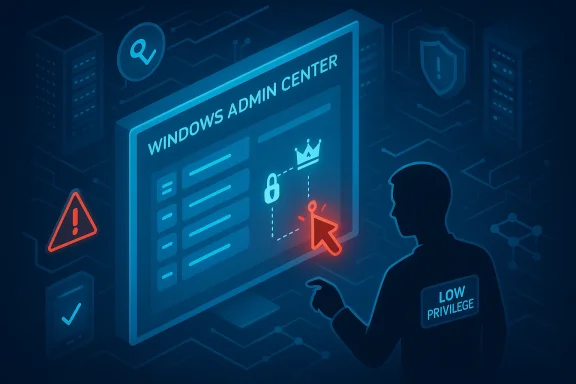
A newly disclosed flaw in Windows Admin Center (WAC) — tracked as CVE‑2026‑26119 and carrying a CVSS score reported as 8.8 — creates a real and immediate risk: an authenticated but low‑privileged user could escalate their privileges across an enterprise management plane and inherit the authority of the account under which WAC runs. That outcome turns a central operations dashboard into an attack pivot, and it demands urgent, practical action from Windows administrators, security teams, and infrastructure owners. (techrepublic.com)
Background
Windows Admin Center is Microsoft’s locally deployed, browser‑based management console for Windows Server, clusters, virtual machines, and related infrastructure services. It is frequently installed as a highly privileged management surface that consolidates administrative workflows from many hosts into a single interface — exactly the kind of tool that, when compromised, yields amplified impact.The vulnerability CVE‑2026‑26119 is described by Microsoft as an improper authentication defect (CWE‑287) that allows an authorized attacker to elevate privileges over a network. Microsoft’s advisory and multiple public trackers indicate the issue affects WAC version 2.6.4 (and earlier where applicable) and was disclosed in mid‑February 2026. (techrepublic.com)
Why this matters: tools like WAC typically run with elevated service accounts and integrate with managed servers using high‑privilege credentials. An authentication bypass or insufficient re‑validation of privileges inside that management plane can let an attacker who already has some legitimate access quietly obtain administrative control across the estate — without needing to exploit a remote code execution bug or chain multiple failures. That’s the core risk profile of CVE‑2026‑26119 as reported by vendors and security outlets. (techrepublic.com)
What the advisory and trackers say (short, verifiable facts)
- Vulnerability: CVE‑2026‑26119, described as improper authentication (CWE‑287).
- Affected product/version: Windows Admin Center — publicly called out against release 2.6.4. (techrepublic.com)
- Severity: Widely reported as CVSS 8.8 (high/near‑critical).
- Attack prerequisites: An attacker must already have authenticated access (low‑privileged credentials) to WAC or an exposed WAC instance. No additional user interaction is required once authenticated. (techrepublic.com)
- Exploitation status: As of the initial advisories, no confirmed active exploitation in the wild has been publicly reported by Microsoft; however, vendors warn that exploitation is plausible and recommend immediate remediation. (techrepublic.com)
How the flaw works — a technical view
At a high level, CVE‑2026‑26119 is not a memory corruption or remote code execution hole; it is an authentication/authorization failure inside a management plane that trusts a previously authenticated session or fails to re‑check authorization for sensitive operations.- Windows Admin Center exposes many API endpoints to perform administrative actions across systems. If those endpoints rely on the initial authentication context without consistent, per‑action authorization checks, a malicious actor with low‑privileged credentials can craft API calls that the server incorrectly treats as permitted.
- The exploitation model frequently observed with WAC‑class issues is authenticated API abuse: intercept a legitimate request, modify parameters or target endpoints, or construct new requests that invoke privileged operations. Because the management platform is allowed to perform those privileged operations on behalf of its authenticated user, the server may execute the elevated action if internal authorization checks are insufficient.
Realistic attack scenarios
- A help‑desk or junior operator with legitimate WAC login rights crafts or replays modified API requests to trigger privileged management actions (user creation, configuration changes, role assignment). Because WAC performs those actions using its privileged service context, the operator escalates to admin across managed servers.
- An attacker obtains a low‑privilege account through phishing or credential reuse. That account has access to WAC (as many orgs grant read or limited write access widely). The attacker uses WAC’s interface/API to escalate privileges centrally, then moves laterally with those elevated credentials. (techrepublic.com)
- A compromised developer machine that retains WAC credentials (token, cookie, or stored session) is used as an internal pivot to call WAC endpoints and perform privileged actions, including adding backdoors, disabling protections, or exfiltrating data. Because the actions are performed through WAC, activity may initially blend with legitimate administrative operations.
Immediate mitigations — what every admin should do today
If you operate Windows Admin Center in production, treat this advisory as high urgency. The following steps are prioritized from immediate (minutes–hours) to short‑term (hours–days).- Patch first
- Identify all WAC instances and upgrade them to the patched version immediately as per Microsoft’s guidance. Validate the version metadata on each host after the update. Patching is the definitive fix for CVE‑2026‑26119. (techrepublic.com)
- Reduce exposure now
- Remove internet‑facing access to WAC instances. If any are publicly reachable, take them offline or restrict access via a management VPN or strict firewall rules.
- Segment WAC hosts into a hardened management VLAN/subnet and restrict access to a small list of administrative jump hosts. (techrepublic.com)
- Enforce least privilege and JIT/JEA
- Remove standing administrative privileges where possible.
- Adopt just‑in‑time (JIT) access or just‑enough‑administration (JEA) patterns so users gain elevated rights only when needed and for limited durations. (techrepublic.com)
- Require Multi‑Factor Authentication (MFA)
- Ensure every account that can log into WAC requires strong MFA; revoke any persistent tokens that aren’t MFA‑protected. (techrepublic.com)
- Harden hosts and reduce attack surface
- Apply OS‑level security baselines to WAC hosts, disable unneeded services, and enforce local account hardening and patching. (techrepublic.com)
- Boost logging, monitoring, and detection
- Turn on verbose authentication and operation auditing for WAC. Look for anomalous API calls, privilege changes, and unusual sequencing of management operations.
- Create temporary hunt rules to detect atypical user‑agent strings, bulk managerial changes, or administrative operations executed outside business hours. (techrepublic.com)
- Prepare incident playbooks
- Update IR runbooks to cover management‑plane compromise: token revocation, account rotation, host isolation, and rebuild plans for compromised management nodes. Exercise the plan with tabletop drills. (techrepublic.com)
Detection guidance — what to look for in logs and telemetry
- Unexpected privileged operations: creation of high‑privilege service accounts, changes to role assignments, or new delegation policies that originate from WAC IPs or the WAC host itself.
- Anomalous API patterns: requests to management endpoints with parameters that escalate privileges (for example, endpoints that should be restricted to administrators being invoked by non‑admin authenticated sessions).
- Session reuse or token abuse: long‑lived sessions, session reuse from different source IPs, or simultaneous sessions for the same user from geographically disparate locations.
- Lateral movement indicators: new SMB/WinRM connections initiated by the WAC host or by the account under which WAC integrates with managed servers.
- Unusual timing: administrative commands executed during off‑hours or under service accounts at times inconsistent with normal operations.
Why management‑plane vulnerabilities are uniquely dangerous
- Centralized control: WAC is a central touchpoint that speaks to many servers. A flaw in WAC scales beyond one host.
- Privilege amplification: Management tools often run with service accounts that hold broad rights. Exploiting the management plane can yield enterprise‑level authority.
- Telemetry ambiguity: Administrative actions invoked through a legitimate management console often appear normal to SIEMs and SOC analysts, making detection harder.
- Chaining potential: A management‑plane compromise is an excellent staging step for chained attacks that include identity compromise, service account takeover, and tenant/resource abuse.
Vendor communication and disclosure timeline (what we can verify)
- Microsoft published an advisory for CVE‑2026‑26119 in mid‑February 2026; trackers and outlets republished and summarized the vendor guidance the same week. The NVD entry and vendor advisory were updated around the same timeframe.
- Tech press outlets (TechRepublic, Golem, CybersecurityNews and others) rapidly echoed Microsoft’s guidance, focusing on the practical implications and recommended mitigations. Those outlets provide helpful operational checklists but rely on Microsoft for the vulnerability’s canonical description. (techrepublic.com)
Practical hardening checklist for Windows Admin Center
- Inventory
- 1.) Discover every WAC instance (on‑prem, cloud‑connected, pilot/test). Don’t forget lab and edge installs.
- 2.) Record hostnames, IPs, versions, service accounts, and integration points (Azure/Entra, Arc, extension modules).
- Immediate response
- 1.) Patch to the vendor‑fixed release and verify via product version output or file hashes.
- 2.) If patching cannot be immediate, restrict access with network ACLs, apply firewall rules, and remove internet exposure.
- Identity and access
- 1.) Require MFA and conditional access for any account that can reach WAC.
- 2.) Replace standing service account access with managed identities, and rotate credentials after incident triage.
- Operational hygiene
- 1.) Disable unused WAC extensions and APIs; reduce plugin surface area.
- 2.) Enforce host hardening and OS baseline compliance for WAC servers.
- Monitoring and IR
- 1.) Enable and centralize WAC audit logs. Retain logs for 90+ days for forensic needs.
- 2.) Update IR runbooks for management‑plane compromise scenarios, including token revocation and WAC host rebuild playbooks.
- Long term
- 1.) Move to a hardened administration model: isolated bastion hosts, ephemeral admin sessions via PAM/JIT tooling, and strict least‑privilege models.
- 2.) Periodically red team management plane attack simulations to validate detection and response capability.
Broader implications: identity, zero trust, and vendor trust
CVE‑2026‑26119 is another reminder that identity and management planes are top‑priority security domains. The vulnerability reinforces three enduring policy conclusions:- Identity is the new perimeter. If an authenticated low‑privileged user can escalate via a management plane, identity controls (MFA, conditional access, session management) become the most effective wall. (techrepublic.com)
- Zero‑trust for admin planes. Treat administrative tools as untrusted endpoints: require device compliance checks, MFA, and microsegmentation even for internal access.
- Supply chain and update discipline. Rapid patching and trusted update pipelines for management tools are non‑negotiable — the same tools that help you maintain systems must themselves be maintained securely.
Risk analysis: strengths, weaknesses, and residual risk
Strengths of the current response model- Microsoft’s advisory and associated CVE publication made the issue public quickly, enabling administrators to act.
- Multiple vendor and media sources replicated guidance and produced pragmatic mitigation steps for operators to implement quickly. (techrepublic.com)
- WAC is widely used and often reachable from broad administrative networks; any delay in patching increases enterprise risk.
- Detection is difficult because attacks performed through WAC look like legitimate administrative activity; false negatives are likely without improved correlation and contextual signals.
- Even after patching, organizations must assume the possibility of pre‑patch compromise. Validate integrity of WAC hosts, rotate sensitive service credentials, and hunt for indicators of prior abuse.
- Long‑tail risk remains where older WAC instances persist in labs or remote sites. Continuous inventory and automated patch enforcement reduce that residual risk. (techrepublic.com)
How defenders should prioritize (operational verdict)
- Patch all WAC instances: top priority.
- Simultaneously restrict network exposure and enforce MFA: immediate stopgap.
- Hunt for indicators of compromise and review recent WAC activity: short term.
- Rotate service credentials and enforce least privilege and ephemeral admin access: medium term.
- Embed WAC into hardened admin architecture and test IR playbooks: longer term.
Closing: the operational takeaway
CVE‑2026‑26119 is a textbook example of why centralized management tools must be treated as high‑assurance assets. The vulnerability’s core danger is not exotic exploitation techniques — it is the simple reality that a trusted control plane with insufficient authorization checks can grant an adversary the keys to the kingdom.Patch Windows Admin Center now, fence off management interfaces, and assume that any management tool can be an attack surface. Reinforce identity controls, deploy just‑in‑time administrative access, and prepare your detection and incident‑response teams for management‑plane scenarios. Those combined actions will both close the hole and reduce the damage if another management‑plane incident appears.
For admins: start with an immediate inventory and patch sweep of all WAC instances, then implement the compensating access and monitoring controls outlined above. For security leaders: elevate management plane protections in your architecture and make ephemeral, auditable admin access the default posture — not the exception. (techrepublic.com)
Source: TechRepublic Microsoft: Critical Windows Admin Center Flaw Allows Privilege Escalation
