

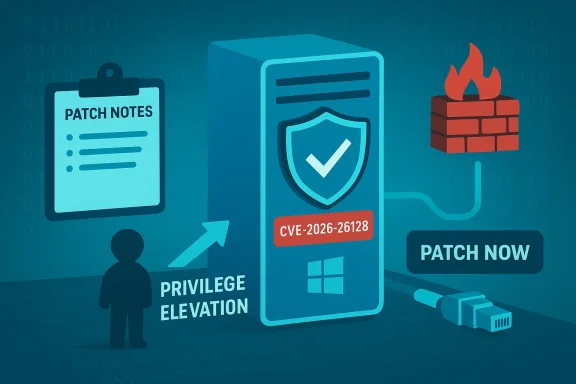
Microsoft has cataloged CVE-2026-26128 as an elevation-of-privilege defect in the Windows SMB Server that allows an authorized (local) attacker to escalate privileges on affected systems — an urgent operational risk for any organization that does not treat local-attack vectors and SMB components as high-value hardening targets. (cvefeed.io)
The Server Message Block (SMB) protocol is the backbone of Windows file sharing, named-pipe IPC, remote administration, and a surprising number of inter-process communications inside modern Windows deployments. Over the last several years, SMB has repeatedly been the subject of high-impact advisories and active-exploitation campaigns; Microsoft’s own security update tooling and external trackers make it clear that any SMB server weakness merits immediate triage and a conservative incident-response posture.
CVE-2026-26128 was published to vendor and community trackers on March 10, 2026. The public description is concise: an improper authentication weakness (CWE‑287) in the Windows SMB Server that can be leveraged by an authorized attacker to elevate privileges locally. Multiple independent CVE aggregators and vulnerability databases record a CVSS v3.1 base score of 7.8 (High) and classify the vector as local with low complexity and low privileges required. (cvefeed.io)
Microsoft’s Security Update Guide lists the CVE as the vendor-of-record, meaning the company recod the issue via its Update Guide infrastructure. That vendor acknowledgment is operationally significant — it signals an authoritative confirmation that the vulnerability exists and that mapping to updates / KBs will be provided through the standard MSRC channels.
Operational interpretation:
Caveat: Microsoft’s Update Guide intentionally omits low-level exploit mechanics until fixes are deployed and mitigations are stable. That means the precise sequence (specific SMB commands or authentication tokens involved) is not publicly documented at the time of writing; defenders must therefore base detection and mitigation on the broader class of authentication and authorization hardening rather than single-packet signatures.
Conclusion
CVE‑2026‑26128 is a verified Windows SMB Server elevation‑of‑privilege issue (CWE‑287) with a CVSS 3.1 base score of 7.8 and a vendor-tracked entry in Microsoft’s Security Update Guide. Defenders should treat the vulnerability as real and actionable: inventory affected systems, apply vendor patches as soon as the appropriate KBs are available, implement compensating network and authentication controls while patches are staged, and expand hunting and detection for behavioral indicators of local privilege escalation. Microsoft’s confidence/acknowledgment signal in the Update Guide makes prompt remediation the prudent and defensible operational posture. (cvefeed.io)
Source: MSRC Security Update Guide - Microsoft Security Response Center
 Background / Overview
The Server Message Block (SMB) protocol is the backbone of Windows file sharing, named-pipe IPC, remote administration, and a surprising number of inter-process communications inside modern Windows deployments. Over the last several years, SMB has repeatedly been the subject of high-impact advisories and active-exploitation campaigns; Microsoft’s own security update tooling and external trackers make it clear that any SMB server weakness merits immediate triage and a conservative incident-response posture.CVE-2026-26128 was published to vendor and community trackers on March 10, 2026. The public description is concise: an improper authentication weakness (CWE‑287) in the Windows SMB Server that can be leveraged by an authorized attacker to elevate privileges locally. Multiple independent CVE aggregators and vulnerability databases record a CVSS v3.1 base score of 7.8 (High) and classify the vector as local with low complexity and low privileges required. (cvefeed.io)
Microsoft’s Security Update Guide lists the CVE as the vendor-of-record, meaning the company recod the issue via its Update Guide infrastructure. That vendor acknowledgment is operationally significant — it signals an authoritative confirmation that the vulnerability exists and that mapping to updates / KBs will be provided through the standard MSRC channels.
What we know — technical facts verified
- Description: Improper authentication in Windows SMB Server allows an authorized attacker to elevate privileges locally. (cvefeed.io)
- Common Weakness: CWE‑287 (Improper Authentication) — the server does not correctly verify an asserted identity or authentication token. (cvedetails.com)
- CVSS v3.1: 7.8 (High) with vector indicating a local attack vector (AV:L), low attack complexity (AC:L), and low privileges required (PR:L). Confidentiality, integrity, and availability impacts are all scored High in the vendor-supplied vector. (cvefeed.io)
- Attackability: The public records classify the flaw as a local elevation-of-privilege (EoP) — not a pre-authenticated remote remote code-execution vector — meaning the attack begins from a foothold on the target host or from an authenticated channel to the SMB server. (cvefeed.io)
- Exploit details: As of publication, neither a public proof-of-concept (PoC) nor broad public technical writeups are widely available in static mirrors; Microsoft’s Update Guide entry is the authoritative reference for mappings and vendor guidance. (cvefeed.io)
Why this matters: attack surface and real-world risk
SMB is both ubiquitous and historically attractive to attackers for several reasons:- SMB endpoints frequently run with elevated privileges or mediate access to privileged namespaces (file system, named pipes, RPC interfaces). A local authentication bypass can therefore provide a direct path to escalated rights.
- Even when SMB is not exposed to utinely reachable across internal networks and multi-tenant management planes — an adversary who obtains a low-privileged local account, or tricks a service into authenticating, can leverage EoP bugs to escalate lateral footholds into full host control.
- Microsoft’s vendor acknowledgment combined with limited public technical detail is a double-edged signal: it confirms the flaw exists while withholding low-level exploit mechanics. That secrecy reduces immediate attacker playbooks in the short term, but historically patch diffs and vendor fixes can be reverse-engineered — increasing the risk of public exploit code appearing after patches ship.
The MSRC “confidence” metric and why it shapes response
Microsoft’s Security Update Guide uses a vendor-side confidence metric to indicate how certain the vendor is abouterability exists, and (b) how much technical detail is safe or appropriate to publish. That confidence signal matters to defenders: a vendor-confirmed CVE with high confidence should be treated as authoritative even when the vendor intentionally limits technical disclosure. The guidance is exp“measures the degree of confidence in the existence of the vulnerability and the credibility of the known technical details,” and can reflect stages from unverified reports to fully corroborated vendor confirmation.Operational interpretation:
- If Microsoft lists a CVE in the Update Guide and flags it with a vendor-acknowledgement, treat the vulnerability as real and prioritize inventory and remediation, even if exploit details are sparse.
- Limited public disclosure reduces immediate exploitation risk from unsophisticated attackers but increases the probability that skilled actors will attempt reverse-engineering of fixes or exploit-creation. Historically this is a common window of risk immediately after a vendor release.
Technical analysis — plausible root causes and exploitation model
The public summary identifies improper authentication as the root weakness (CWE‑287), which covers a family of flaws where the server either fails to fully validate a presented credential, accepts malformed authentication tokens, or incorrectly authorizes a principal after authentication. In the SMB context, practical exploitation paths can include:- Forged or manipulated SMB session negotiation/authentication exchanges that result in unauthorized impersonation or token elevation inside the server process.
- A privileged service incorrectly mapping authenticated sessions to elevated tokens or failing to enforce access checks for privileged operations invoked over SMB named pipes or RPC endpoints.
- Abuse of server logic that treats certain authentication attributes as authoritative when they can be influenced by an attacker who already holds some account on the host or network.
Caveat: Microsoft’s Update Guide intentionally omits low-level exploit mechanics until fixes are deployed and mitigations are stable. That means the precise sequence (specific SMB commands or authentication tokens involved) is not publicly documented at the time of writing; defenders must therefore base detection and mitigation on the broader class of authentication and authorization hardening rather than single-packet signatures.
Detection and hunting — practical steps for defenders
Detecting successful exploitation of a local privilege escalation is intrinsically harder than detecting remote network intrusions because the activity originates from legitimate local processes. Still, practical detection and situational-awareness steps include:- Audit for anomalous process creation and token elevation events that correlate to SMB server processes (for example, abnormal child processes launched by services that interact with the SMB stack). Leverage EDR/NGAV telemetry to flag creation of command shells or scheduled tasks under SYSTEM that were spawned shortly after a local SMB interaction.
- Monitor Windows Event Logs for suspicious privilege assignment events, token creation anomalies, or event sequences where a low-privilege user transititexts. Correlate with SMB-related logs and session activity.
- Hunt for abnormal SMB client/server authentication patterns such as repeated authentication attempts, unexpected NTLM/Negotiate fallbacks, or unusual dialect negotiation that might indicate crafted authentication exchanges.
- Use EDR indicators to watch for processes that access sensitive files or registry hives shortly after interacting with SMB endpoints — privilege escalations often precede credential-dumping or lateral-movement attempts.
- Check for newly created or changed scheduled tasks, service registrations, or modifications to autorun locations that coincide with suspicious local SMB sessions.
Immediate mitigation and patching guidance (operational playbook)
- Inventory and prioritize:
- Enumerate Windows hosts and servers likely to run the SMB Server role (file servers, domain controllers, file-share endpoints, print servers).
- Prioritize systems with high privilege exposure (DCs, management hosts, admin workstations) and those that accept logins from untrusted users or services.
- Apply vendor fixes:
- Consult Microsoft’s Security Update Guide to map CVE‑2026‑26128 to the per‑SKU KB updates for your estate and schedule an expedited patching wave. Microsoft will publish the KB mappings and packages through the Update Guide; treat that mapping as authoritative.
- Test patches in a staging environment where possible, then roll out in prioritized stages.
- Compensating controls (while patching is validated):
- Restrict SMB exposure:
- Block SMB ports (TCP 445 and 139) at network boundaries where SMB is not required.
- Isolate SMB services to internal VLANs / host-based firewalls and restrict access to only the minimum set of clients.
- Enforce authentication hardening:
- Ensure SMB signing is enforced where feasible and disable insecure negotiation fallbacks.
- Harden NTLM/Negotiate policies and prefer Kerberos where possible.
- Reduce local attack surface:
- Remove unnecessary local administrative privileges from user accounts.
- Apply LAPS or other local-account management tools to reduce credential reuse.
- Post-patch validation:
- Confirm patch installation via vendor KB mappings and automated inventory tooling.
- Re-scan affected hosts for lateral movement and indicators of compromise (IOC) such as unusual logins, system modifications, or the presence of post‑exploitation artifacts.
- Communication and logging:
- Inform system owners and admin teams of the isimeline, and any necessary emergency maintenance windows.
- Increase logging verbosity around authentication, SMB sessions, and process creation for a window after patching.
- Identify SMB Server hosts and their role and exposure.
- Map each host to the MSRC KB(s) for CVE-2026-26128.
- Test and deploy patches in priority order.
- Apply compensating network and authentication mitigations while patches are staged.
- Hunt for indicators, finalize containment, and document actions.
Why you can’t “wait and see” (and what could go wrong)
Several operational realities make immediate action preferable:- Vendor confirmation plus limited technical disclosure presents a window where skilled adversaries can reverse-engineer patches or analyze differences between patched and unpatched binaries to craft reliable exploits. That post-patch reverse-engineering historically leads to publicly released PoCs and exploit modules.
- Because the vulnerability provides a local privilege escalation, even low‑risk footholds (malicious macros, compromised low‑privilege accounts, or misconfigured services) can be amplified quickly. Attacks that begin as low-skill phishing can escalate to enterprise-impacting compromises after successful EoP.
- SMB-related vulnerabilities are attractive to ransomware and advanced persistent threat (APT) groups due to their utility for lateral movement and data theft. Any delay in patching or hardening increases the organization’s exposure period.
Long-term hardening beyond patching
Patching addresses the specific defect, but lasting resilience requires configuration and architectural changes to reduce the SMB attack surface:- Network segmentation: isolate file servers and SMB endpoints to specific subnets or VLANs and enforce strict access control.
- Least privilege: minimize the set of accounts with local admin privileges; adopt just‑in‑time and just‑enough‑access controls.
- Authentication upgrades: prefer Kerberos authentication and require SMB signing; disable SMBv1 entirely.
- Continuous detection: invest in comprehensive EDR and identity-telemetry correlation that can detect privilege-escalation indicators early.
- Patch automation: maintain up-to-date inventories and a tested, automated patch pipeline to reduce the time between vendor publication and estate-wide remediation.
- To IT operations: map and patch — identify affected SKUs via Microsoft’s Update Guide and schedule the patch wave now. Do not assume “local-only” means low-risk.
- To security operations (SOC): increase hunting and retention windows for authentication and process telemetry, and prepare playbooks to investigate suspicious elevations to SYSTEM.
- To leadership: explain the risk succinctly — this is an SMB server EoP (CVE‑2026‑26128, CVSS 7.8) that can turn modest footholds into host takeover. Prioritize remediation to avoid downstream incident costs.
Closing analysis: strengths, unknowns, and recommended posture
Strengths in the vendor response:- Microsoft has cataloged the CVE in its Security Update Guide and assigned a CVSS vector, providing an authoritative basis for remediation planning. That vendor acknowledgment materially reduces uncertainty about existence and severity. (cvefeed.io)
- Microsoft and other public trackers have intentionally limited the release of low-level exploit details. While this reduces immediate public exploitability from unsophisticated actors, it also creates a time window where skilled adversaries may focus efforts on reverse-engineering patches or weaponizing the defect after fixes are published. Defenders must therefore assume a non-trivial exploitation risk even before PoCs appear publicly.
- Treat CVE‑2026‑26128 as a high-priority item: inventory affected SMB Server hosts, map to Microsoft KBs, and schedule immediate patching and validation.
- While rolling patches, apply network and authentication hardening, raise detection sensitivity, and perform targeted hunts for privilege-escalation indicators.
- Document the remediation steps, increase monitoring windows for critical hosts, and be prepared to conduct post-patch reverse-engineering or deep forensic checks if suspicious activity is observed.
Conclusion
CVE‑2026‑26128 is a verified Windows SMB Server elevation‑of‑privilege issue (CWE‑287) with a CVSS 3.1 base score of 7.8 and a vendor-tracked entry in Microsoft’s Security Update Guide. Defenders should treat the vulnerability as real and actionable: inventory affected systems, apply vendor patches as soon as the appropriate KBs are available, implement compensating network and authentication controls while patches are staged, and expand hunting and detection for behavioral indicators of local privilege escalation. Microsoft’s confidence/acknowledgment signal in the Update Guide makes prompt remediation the prudent and defensible operational posture. (cvefeed.io)
Source: MSRC Security Update Guide - Microsoft Security Response Center
