

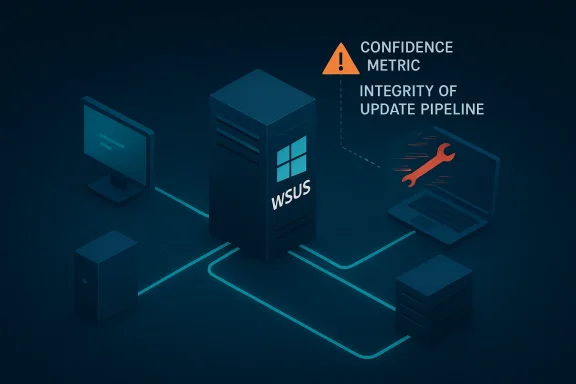
Microsoft’s description for CVE-2026-26154 points to a WSUS tampering vulnerability, and the language around it matters as much as the identifier itself. The short version of the metric you highlighted is that Microsoft is signaling how certain it is that the bug exists and how much technical detail it is prepared to publish. In practical terms, that affects both urgency and the amount of defensive knowledge available to attackers.
Windows Server Update Services sits in a sensitive place in many enterprises: it is a trusted distribution layer for Microsoft patches, metadata, and update decisions. A tampering flaw in WSUS is therefore more than an ordinary server bug. If an attacker can interfere with the integrity of that distribution chain, the blast radius can extend from a single server to a fleet of managed endpoints.
That is why WSUS issues tend to receive outsized attention from defenders even before every technical detail is public. The service is not just another Windows role; it is often one of the few systems allowed to influence patching across critical environments. A compromise here can have second-order effects well beyond the server itself.
Microsoft’s Security Update Guide is designed to communicate those differences through structured vulnerability data, including CVSS-related information and confidence signals. Microsoft’s glossary says the confidence metric measures the confidence in the existence of the vulnerability and the credibility of the technical details, which is the exact kind of signal that helps admins decide whether to treat a disclosure as fully corroborated or still partially provisional.
There is also a broader historical pattern here. Microsoft has long used its Security Update Guide, advisories, and release notes to help administrators separate confirmed vulnerabilities from uncertain reports, and to match the level of detail to the maturity of the disclosure. That model matters because not every CVE arrives with the same amount of root-cause analysis, proof-of-concept code, or exploitable technical precision.
That changes how risk should be read. A vulnerability in a line-of-business application may end at that application. A vulnerability in WSUS can influence patch posture, compliance reporting, and potentially endpoint trust in the update process itself.
The confidence or report-confidence concept is not unique to Microsoft. The broader CVSS ecosystem has long used temporal or threat-oriented measures to describe whether a vulnerability is merely suspected, partially understood, or fully confirmed. FIRST’s CVSS documentation explains that report confidence measures the degree of confidence in the existence of the vulnerability and the credibility of its report.
Microsoft’s current phrasing is slightly different from the older CVSS language, but the operational meaning is close: confirmed defects deserve immediate attention, while vague or only partially understood issues may require additional verification. The important nuance is not that an unconfirmed issue is harmless; it is that defenders should understand how much of the exploit story is firm versus inferred.
The WSUS angle raises the stakes further because update infrastructure is foundational. Microsoft has repeatedly recommended using WSUS and related management systems as part of enterprise patch deployment, which means any vulnerability in that ecosystem can affect not just a server, but the orchestration layer that keeps the rest of the environment current.
In security terms, this is a control-plane problem, not merely a data-plane bug. When the control plane is compromised, defenders can end up chasing symptoms on endpoints while the real problem sits upstream in the management infrastructure.
That is useful to defenders because it affects next steps. A highly confident, technically detailed disclosure usually warrants immediate patching and threat hunting. A lower-confidence notice may still warrant inventory review, but perhaps with more caution around assumptions and mitigations.
Even so, the naming is revealing. “WSUS Tampering Vulnerability” strongly suggests integrity compromise rather than simple denial of service or information disclosure. In plain English, the risk is that something in the update chain can be altered, forged, or subverted in a way that changes what clients receive or believe. That is far more serious than a localized crash.
The lack of immediately visible detail should not be mistaken for a lack of seriousness. Microsoft has historically published terse entries when it wants customers to patch quickly without advertising unnecessary exploit mechanics. That is a defensible strategy when the goal is risk reduction, not academic transparency.
It is also worth noting that Microsoft’s modern vulnerability publishing pipeline now includes machine-readable CSAF files in addition to the Security Update Guide, giving customers a more structured way to ingest CVE data at scale. That is relevant because large enterprises rarely read a single CVE page in isolation; they ingest advisories into tooling, dashboards, and ticketing systems.
That does not automatically mean remote code execution on the WSUS host itself, but it often means something equally dangerous from an enterprise viewpoint: the ability to corrupt what clients trust. In many environments, that is enough to justify emergency response.
That said, sparse details are not the same as uncertainty about existence. The core point of the confidence metric is to distinguish how sure we are from how much we are saying. Those are related, but not identical, questions.
The most immediate concern is loss of integrity in patch delivery. If attackers can influence the WSUS feed, enterprises may deploy malicious content, miss critical fixes, or receive a false sense of compliance while endpoints remain vulnerable. That combination is especially dangerous because it undermines both security and governance at once.
This also creates a detection challenge. Security teams may assume their environments are protected because patch reports show successful synchronization or deployment. If the source of truth is compromised, those reports can become misleading rather than reassuring.
The risk is even higher in organizations that centralize patching heavily or use WSUS as a bridge to disconnected networks. In those settings, WSUS is not just convenient; it is part of the core distribution fabric. A tampering issue there can become a strategic problem.
In a mature environment, the question is not merely whether WSUS is patched. It is whether the organization can independently validate update provenance, content integrity, and administrative access to the server and its distribution chain.
The reason is simple: smaller organizations often lean on centralized management tools to simplify operations. If that central point is compromised, they may not have alternate update paths, dedicated monitoring, or forensic readiness to detect tampering quickly.
There is also a behavioral issue. Smaller IT shops sometimes assume that because an update server is internal, it is inherently safe. That assumption is precisely what a tampering vulnerability can exploit.
A tampering issue can also affect trust in the patch process itself. If staff stop trusting WSUS, they may delay updates broadly, which ironically increases exposure to unrelated vulnerabilities. That creates a dangerous feedback loop.
The confidence metric is part of that balancing act. It tells customers whether the report is a confirmed issue, a well-supported finding, or something still partly speculative. That helps security teams avoid overreacting to rumors while still treating confirmed defects with the seriousness they deserve.
Microsoft has also moved toward more machine-readable publication formats, including CSAF, which should make enterprise automation easier. That matters because many organizations now ingest vulnerability information into SIEMs, EDRs, asset systems, and patch orchestration platforms rather than reading advisories manually.
This is especially relevant for a WSUS issue. If the vulnerability affects the update distribution layer, then the response tooling itself may depend on the same infrastructure being evaluated. That creates an unusual need for out-of-band validation.
That may frustrate researchers who want more technical depth, but it is a sensible default for infrastructure bugs with broad downstream effects.
For CVE-2026-26154, the very fact that Microsoft has a named entry for the issue is itself a strong signal that the vulnerability is real enough to prioritize, regardless of how much exploit detail is public today.
The exact exploit path is not public here, so any specific attack narrative should be treated cautiously. Still, the general classes of abuse are easy to understand: altering update metadata, injecting malicious payloads, suppressing security fixes, or using the update workflow as a disguise for persistence. Those are strategic outcomes, not just tactical ones.
An attacker does not necessarily need to weaponize the bug in the most dramatic way. Sometimes the value lies in quietly degrading trust, delaying patches, or creating a blind spot for other operations. That is what makes tampering vulnerabilities so concerning.
That makes it especially dangerous in environments that assume update traffic is inherently benign. Attackers often succeed not by breaking security controls head-on, but by abusing the trust that those controls depend on.
Next, teams should treat update infrastructure like critical infrastructure, not a routine utility. That means privileged access review, service account scrutiny, network segmentation, and logging that is good enough to reconstruct content flow if something looks odd. The challenge is to make tampering harder and more visible.
It is also wise to check for unusual update behavior in both directions: missing updates that should have arrived, and updates or metadata that do not match the normal patching cadence. Absence of expected updates can be as important as the presence of malicious ones.
This is also one of those cases where endpoint telemetry alone is not enough. The problem may begin in the infrastructure tier, so defenders need visibility into the distribution source as well as the client side.
That said, the bigger competitive story is not that Microsoft is uniquely exposed. Rather, it is that any centralized trust-and-distribute model inherits high consequences when integrity is challenged. The vendors that win in this market are the ones that make trust easier to verify and damage easier to contain.
For security vendors, this is an opportunity. Products that can independently validate update provenance, monitor WSUS behavior, or detect content tampering become more valuable after incidents like this. The same is true for managed service providers that can offer hardening and forensic readiness around patch infrastructure.
That is a rational response, but it comes with cost. More layers of verification can mean slower patching, more operational friction, and more administrative overhead. Security teams will need to balance those tradeoffs carefully.
In other words, vendors and customers alike are being pushed toward systems that can answer not just “Did the patch install?” but “Can we prove where it came from and that it was not altered in transit?”
The wider opportunity is to use this event as a reason to harden the entire update pipeline. Organizations that treat WSUS as critical infrastructure can improve both security and resilience at the same time.
There is also the risk of overconfidence in compliance reports. If the reporting source is compromised, dashboards can produce reassuring but misleading outputs. In a mature incident, false comfort can be almost as harmful as the original vulnerability.
That makes incident preparation especially important. If this CVE is confirmed in a production environment, the quality of the evidence trail will determine how fast teams can recover.
The other thing to watch is whether Microsoft provides additional guidance beyond the bare CVE entry. For infrastructure vulnerabilities, the difference between “install this update” and “adjust your deployment process in this order” can be significant. Enterprises should expect that the operational guidance may matter as much as the patch itself.
The most important question is whether this remains a narrow WSUS integrity issue or turns out to be part of a broader chain involving authentication, content validation, or administrative abuse. If the latter, defenders may need to revisit assumptions about how much trust they place in internal patch orchestration.
Source: MSRC Security Update Guide - Microsoft Security Response Center
 Overview
Windows Server Update Services sits in a sensitive place in many enterprises: it is a trusted distribution layer for Microsoft patches, metadata, and update decisions. A tampering flaw in WSUS is therefore more than an ordinary server bug. If an attacker can interfere with the integrity of that distribution chain, the blast radius can extend from a single server to a fleet of managed endpoints.That is why WSUS issues tend to receive outsized attention from defenders even before every technical detail is public. The service is not just another Windows role; it is often one of the few systems allowed to influence patching across critical environments. A compromise here can have second-order effects well beyond the server itself.
Microsoft’s Security Update Guide is designed to communicate those differences through structured vulnerability data, including CVSS-related information and confidence signals. Microsoft’s glossary says the confidence metric measures the confidence in the existence of the vulnerability and the credibility of the technical details, which is the exact kind of signal that helps admins decide whether to treat a disclosure as fully corroborated or still partially provisional.
There is also a broader historical pattern here. Microsoft has long used its Security Update Guide, advisories, and release notes to help administrators separate confirmed vulnerabilities from uncertain reports, and to match the level of detail to the maturity of the disclosure. That model matters because not every CVE arrives with the same amount of root-cause analysis, proof-of-concept code, or exploitable technical precision.
Why WSUS issues are different
WSUS is built for trust, so abuse of that trust is especially dangerous. An attacker who tampers with WSUS behavior is not necessarily looking for a flashy one-shot exploit; they may be trying to manipulate the update pipeline, suppress remediation, or introduce malicious content into what defenders assume is a reliable source.That changes how risk should be read. A vulnerability in a line-of-business application may end at that application. A vulnerability in WSUS can influence patch posture, compliance reporting, and potentially endpoint trust in the update process itself.
- WSUS often has broad administrative reach.
- Update infrastructure is usually heavily trusted internally.
- Tampering can create persistence, disruption, or blind spots.
- A weakness here can become a force multiplier for other attacks.
Background
Microsoft began publishing vulnerability information in a more structured way to help customers interpret severity, confidence, and exploitability without having to reverse-engineer each advisory from scratch. The modern Security Update Guide and related MSRC pages reflect that effort, pairing CVE records with contextual data so customers can prioritize smarter.The confidence or report-confidence concept is not unique to Microsoft. The broader CVSS ecosystem has long used temporal or threat-oriented measures to describe whether a vulnerability is merely suspected, partially understood, or fully confirmed. FIRST’s CVSS documentation explains that report confidence measures the degree of confidence in the existence of the vulnerability and the credibility of its report.
Microsoft’s current phrasing is slightly different from the older CVSS language, but the operational meaning is close: confirmed defects deserve immediate attention, while vague or only partially understood issues may require additional verification. The important nuance is not that an unconfirmed issue is harmless; it is that defenders should understand how much of the exploit story is firm versus inferred.
The WSUS angle raises the stakes further because update infrastructure is foundational. Microsoft has repeatedly recommended using WSUS and related management systems as part of enterprise patch deployment, which means any vulnerability in that ecosystem can affect not just a server, but the orchestration layer that keeps the rest of the environment current.
The trust problem in update services
Trust is the defining feature of an update server. Clients are built to accept content, policy, and metadata from it without the skepticism they would apply to a random internet host. That means tampering vulnerabilities are especially dangerous because they aim at the assumption that the update source itself is authoritative.In security terms, this is a control-plane problem, not merely a data-plane bug. When the control plane is compromised, defenders can end up chasing symptoms on endpoints while the real problem sits upstream in the management infrastructure.
What the confidence metric signals
The metric you quoted is fundamentally about two things: certainty and disclosure quality. Microsoft is saying, in effect, how confidently it can stand behind the existence of the issue and how much it is willing to tell the public about the technical mechanics.That is useful to defenders because it affects next steps. A highly confident, technically detailed disclosure usually warrants immediate patching and threat hunting. A lower-confidence notice may still warrant inventory review, but perhaps with more caution around assumptions and mitigations.
What We Know So Far
At the time of writing, the public MSRC page for CVE-2026-26154 is the anchor point, but its live HTML view is not easily readable without JavaScript. That means the publicly accessible metadata is limited in this context, and any further technical specifics would require the fully rendered Security Update Guide entry or associated MSRC data channels. (msrc.microsoft.com)Even so, the naming is revealing. “WSUS Tampering Vulnerability” strongly suggests integrity compromise rather than simple denial of service or information disclosure. In plain English, the risk is that something in the update chain can be altered, forged, or subverted in a way that changes what clients receive or believe. That is far more serious than a localized crash.
The lack of immediately visible detail should not be mistaken for a lack of seriousness. Microsoft has historically published terse entries when it wants customers to patch quickly without advertising unnecessary exploit mechanics. That is a defensible strategy when the goal is risk reduction, not academic transparency.
It is also worth noting that Microsoft’s modern vulnerability publishing pipeline now includes machine-readable CSAF files in addition to the Security Update Guide, giving customers a more structured way to ingest CVE data at scale. That is relevant because large enterprises rarely read a single CVE page in isolation; they ingest advisories into tooling, dashboards, and ticketing systems.
Integrity impact is the key clue
A tampering vulnerability typically implies that the attacker can alter trusted content, influence policy, or modify the behavior of a system that is supposed to be authoritative. For WSUS, that can mean malicious updates, poisoned metadata, or other forms of supply-chain-style interference.That does not automatically mean remote code execution on the WSUS host itself, but it often means something equally dangerous from an enterprise viewpoint: the ability to corrupt what clients trust. In many environments, that is enough to justify emergency response.
Why details may be sparse
There are several reasons Microsoft may keep the early public description relatively narrow. The issue may still be under coordinated disclosure, the exploit path may be sensitive, or Microsoft may simply be minimizing the amount of actionable detail available to would-be attackers.That said, sparse details are not the same as uncertainty about existence. The core point of the confidence metric is to distinguish how sure we are from how much we are saying. Those are related, but not identical, questions.
Enterprise Impact
For enterprise administrators, a WSUS tampering bug sits squarely in the category of high-consequence infrastructure risk. WSUS is often trusted for desktop, server, and branch-office patch orchestration, and that means compromise can ripple through maintenance windows, compliance baselines, and rollback planning. The business impact can therefore exceed the technical impact of the server itself.The most immediate concern is loss of integrity in patch delivery. If attackers can influence the WSUS feed, enterprises may deploy malicious content, miss critical fixes, or receive a false sense of compliance while endpoints remain vulnerable. That combination is especially dangerous because it undermines both security and governance at once.
This also creates a detection challenge. Security teams may assume their environments are protected because patch reports show successful synchronization or deployment. If the source of truth is compromised, those reports can become misleading rather than reassuring.
Operational consequences
A compromised WSUS environment can force organizations into awkward recovery choices. They may need to isolate update infrastructure, revalidate catalogs, inspect content flows, and verify client trust relationships before resuming normal patch cycles. Those steps are time-consuming, and they often intersect with already-packed maintenance windows.The risk is even higher in organizations that centralize patching heavily or use WSUS as a bridge to disconnected networks. In those settings, WSUS is not just convenient; it is part of the core distribution fabric. A tampering issue there can become a strategic problem.
- Patch assurance can be undermined.
- Compliance evidence can become unreliable.
- Malware distribution could masquerade as legitimate maintenance.
- Incident response may need to start at the infrastructure layer, not the endpoint layer.
Internal trust boundaries matter
Many enterprises treat update infrastructure as implicitly trusted once it is inside the network. That is a reasonable operational shortcut, but it is also a security assumption that attackers love to exploit. A WSUS tampering issue directly targets that assumption.In a mature environment, the question is not merely whether WSUS is patched. It is whether the organization can independently validate update provenance, content integrity, and administrative access to the server and its distribution chain.
Consumer and SMB Impact
Consumers generally do not run WSUS, so the direct impact is much smaller for home users. Small and midsize businesses, however, often use the same update patterns as larger enterprises but with less security staff and fewer layers of validation. For them, a WSUS flaw can be disproportionately damaging.The reason is simple: smaller organizations often lean on centralized management tools to simplify operations. If that central point is compromised, they may not have alternate update paths, dedicated monitoring, or forensic readiness to detect tampering quickly.
There is also a behavioral issue. Smaller IT shops sometimes assume that because an update server is internal, it is inherently safe. That assumption is precisely what a tampering vulnerability can exploit.
SMB priorities
For SMBs, response often needs to be pragmatic rather than elaborate. The focus should be on confirming whether WSUS is deployed, verifying whether the relevant update is available, and checking whether update traffic or content has been anomalous. In many cases, the safest move is to patch first and investigate immediately after.A tampering issue can also affect trust in the patch process itself. If staff stop trusting WSUS, they may delay updates broadly, which ironically increases exposure to unrelated vulnerabilities. That creates a dangerous feedback loop.
Why small environments can feel bigger pain
SMBs often have fewer redundant systems and less documentation around update infrastructure. If WSUS has to be taken offline or rebuilt, the operational cost can be outsized.- Fewer admins means slower validation.
- Less telemetry means weaker detection.
- Less redundancy means longer disruption.
- More reliance on a single update path means bigger recovery pain.
Microsoft’s Disclosure Model
Microsoft’s modern disclosure model tries to balance transparency with operational security. The company publishes CVEs, severity, CVSS information, and guidance, but it does not always publish the same level of technical depth for every issue. That is intentional, and for good reason.The confidence metric is part of that balancing act. It tells customers whether the report is a confirmed issue, a well-supported finding, or something still partly speculative. That helps security teams avoid overreacting to rumors while still treating confirmed defects with the seriousness they deserve.
Microsoft has also moved toward more machine-readable publication formats, including CSAF, which should make enterprise automation easier. That matters because many organizations now ingest vulnerability information into SIEMs, EDRs, asset systems, and patch orchestration platforms rather than reading advisories manually.
This is especially relevant for a WSUS issue. If the vulnerability affects the update distribution layer, then the response tooling itself may depend on the same infrastructure being evaluated. That creates an unusual need for out-of-band validation.
The tradeoff between detail and safety
Publishing too much exploit detail too early can hand attackers a roadmap. Publishing too little can leave defenders uncertain about what to check or how to scope exposure. Microsoft’s approach is to keep the official channel useful enough for defenders while limiting the amount of step-by-step offensive guidance.That may frustrate researchers who want more technical depth, but it is a sensible default for infrastructure bugs with broad downstream effects.
Why the metric matters to defenders
A confidence metric is not just a scoring footnote. It helps answer the question: should we treat this as a confirmed operational risk or as a watchlist item awaiting more corroboration?For CVE-2026-26154, the very fact that Microsoft has a named entry for the issue is itself a strong signal that the vulnerability is real enough to prioritize, regardless of how much exploit detail is public today.
How Attackers Could Benefit
A tampering issue in WSUS could be attractive to attackers because it offers leverage. Instead of attacking one endpoint at a time, an adversary may be able to influence an internal update channel that many systems already trust. That is the kind of asymmetry attackers love.The exact exploit path is not public here, so any specific attack narrative should be treated cautiously. Still, the general classes of abuse are easy to understand: altering update metadata, injecting malicious payloads, suppressing security fixes, or using the update workflow as a disguise for persistence. Those are strategic outcomes, not just tactical ones.
An attacker does not necessarily need to weaponize the bug in the most dramatic way. Sometimes the value lies in quietly degrading trust, delaying patches, or creating a blind spot for other operations. That is what makes tampering vulnerabilities so concerning.
Possible abuse patterns
Even without public exploit details, defenders should think in terms of outcome rather than implementation. If an attacker can tamper with the WSUS trust chain, they may be able to:- Redirect clients toward unsafe or unapproved content.
- Prevent critical updates from reaching endpoints.
- Make patch reporting appear healthier than it is.
- Hide persistence inside routine maintenance traffic.
- Buy time for lateral movement elsewhere in the network.
The supply-chain lens
This kind of bug should be understood through a supply-chain security lens, even if it is not a classic software supply-chain compromise. WSUS is a delivery mechanism for trusted code and metadata, so a flaw here affects the integrity of distribution.That makes it especially dangerous in environments that assume update traffic is inherently benign. Attackers often succeed not by breaking security controls head-on, but by abusing the trust that those controls depend on.
Defensive Priorities
The first priority is obvious: identify whether WSUS is present and whether the affected version or configuration is in use. That sounds basic, but many organizations discover too late that update infrastructure has drifted from the documented baseline. In a large fleet, even a single forgotten WSUS instance can become the weak link.Next, teams should treat update infrastructure like critical infrastructure, not a routine utility. That means privileged access review, service account scrutiny, network segmentation, and logging that is good enough to reconstruct content flow if something looks odd. The challenge is to make tampering harder and more visible.
It is also wise to check for unusual update behavior in both directions: missing updates that should have arrived, and updates or metadata that do not match the normal patching cadence. Absence of expected updates can be as important as the presence of malicious ones.
A practical response sequence
A concise defensive sequence is often the most useful:- Confirm whether WSUS is deployed and exposed.
- Verify Microsoft’s latest advisory and patch status.
- Review update synchronization logs for anomalies.
- Validate administrative access and service permissions.
- Inspect client patch results for inconsistency.
- Isolate or rebuild the server if compromise is suspected.
- Re-approve update content only after integrity is reestablished.
Telemetry matters
Logging is only useful if it captures the right events. Security teams should make sure WSUS-related logs, Windows event data, and network telemetry are retained long enough for post-incident analysis. If tampering is suspected, short retention windows can erase the evidence trail before it is examined.This is also one of those cases where endpoint telemetry alone is not enough. The problem may begin in the infrastructure tier, so defenders need visibility into the distribution source as well as the client side.
Competitive and Market Implications
The existence of a WSUS tampering issue also has broader market implications. Microsoft’s patch management ecosystem competes indirectly with third-party endpoint management and update orchestration tools, and trust is one of the main differentiators in that space. If update infrastructure is seen as fragile, customers become more likely to diversify their tooling or add extra validation layers.That said, the bigger competitive story is not that Microsoft is uniquely exposed. Rather, it is that any centralized trust-and-distribute model inherits high consequences when integrity is challenged. The vendors that win in this market are the ones that make trust easier to verify and damage easier to contain.
For security vendors, this is an opportunity. Products that can independently validate update provenance, monitor WSUS behavior, or detect content tampering become more valuable after incidents like this. The same is true for managed service providers that can offer hardening and forensic readiness around patch infrastructure.
Enterprise buying behavior
After a vulnerability like this, enterprises often reassess whether they rely too heavily on a single management plane. Some will choose additional monitoring; others may segment WSUS more aggressively or tighten approval workflows. A few may even reduce the scope of centralized update control for particularly sensitive environments.That is a rational response, but it comes with cost. More layers of verification can mean slower patching, more operational friction, and more administrative overhead. Security teams will need to balance those tradeoffs carefully.
Why trust becomes a product feature
The market increasingly treats trust as a measurable feature rather than an implied default. That means auditability, provenance, and tamper evidence are becoming differentiators, not just compliance checkboxes. A WSUS tampering flaw reinforces that trend.In other words, vendors and customers alike are being pushed toward systems that can answer not just “Did the patch install?” but “Can we prove where it came from and that it was not altered in transit?”
Strengths and Opportunities
The most encouraging thing about Microsoft’s current disclosure approach is that it gives defenders a structured way to interpret the issue instead of forcing them to guess. The combination of a named CVE, a category label, and a confidence-oriented explanation is much better than an ambiguous rumor. That helps the right teams move faster and with more discipline.The wider opportunity is to use this event as a reason to harden the entire update pipeline. Organizations that treat WSUS as critical infrastructure can improve both security and resilience at the same time.
- Better patch governance through stricter approval and validation steps.
- Stronger logging around synchronization, approvals, and client reporting.
- Improved segmentation of update infrastructure from general-purpose networks.
- Tighter admin controls for privileged access to WSUS and related services.
- More resilient recovery plans if the update server has to be rebuilt.
- Greater use of machine-readable advisories for automation and inventory correlation.
- Increased executive awareness that patch infrastructure is part of the attack surface.
Risks and Concerns
The biggest concern is that organizations may underestimate a tampering issue because it does not always look like a traditional endpoint exploit. If defenders focus only on crashed services or visible malware, they may miss the deeper problem: corrupted trust in the update channel. That is why these bugs can linger longer than they should.There is also the risk of overconfidence in compliance reports. If the reporting source is compromised, dashboards can produce reassuring but misleading outputs. In a mature incident, false comfort can be almost as harmful as the original vulnerability.
- Silent manipulation of update content or metadata.
- Delayed detection because the infrastructure is trusted by default.
- False compliance signals that mask incomplete patching.
- Operational disruption if WSUS has to be isolated or rebuilt.
- Broader blast radius if a single WSUS instance serves many systems.
- Privilege escalation risk if the tampering path also exposes administrative controls.
- Patch hesitation if staff lose confidence in the update process.
The hard part: proving absence
One of the hardest security problems is proving that nothing bad happened inside a trusted distribution layer. Without strong logs, integrity checks, and baseline comparisons, defenders may be unable to demonstrate that update content was untouched.That makes incident preparation especially important. If this CVE is confirmed in a production environment, the quality of the evidence trail will determine how fast teams can recover.
Looking Ahead
The next stage is likely to be more about remediation than speculation. Once Microsoft publishes fuller advisory details, defenders will need to map the affected versions, confirm exposure, and determine whether any compensating controls are already in place. If the issue touches the update content path rather than just a peripheral management function, the urgency will rise again.The other thing to watch is whether Microsoft provides additional guidance beyond the bare CVE entry. For infrastructure vulnerabilities, the difference between “install this update” and “adjust your deployment process in this order” can be significant. Enterprises should expect that the operational guidance may matter as much as the patch itself.
The most important question is whether this remains a narrow WSUS integrity issue or turns out to be part of a broader chain involving authentication, content validation, or administrative abuse. If the latter, defenders may need to revisit assumptions about how much trust they place in internal patch orchestration.
- Patch availability and scope for affected WSUS versions.
- Any mitigation guidance Microsoft adds to the advisory.
- Whether exploitation details become public or remain sparse.
- Evidence of real-world abuse or related telemetry from defenders.
- Updated scoring or clarifications in the Security Update Guide.
- Enterprise response patterns, especially in organizations that centralize patching heavily.
Source: MSRC Security Update Guide - Microsoft Security Response Center
Last edited:
