

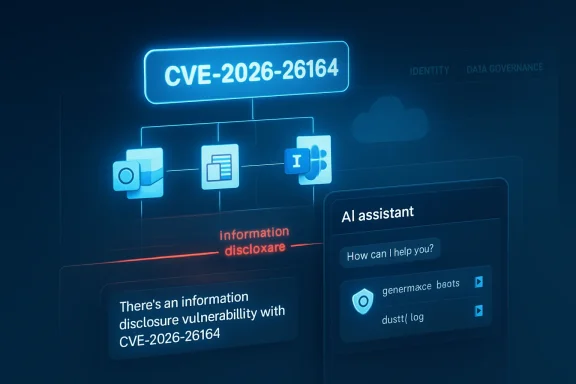
Microsoft has published CVE-2026-26164 as a Microsoft 365 Copilot information disclosure vulnerability in its Security Update Guide, identifying it as a cloud-era security issue where Copilot could expose information over a network rather than a traditional Windows patching problem. The important part is not only the label on the CVE, but the confidence Microsoft attaches to the report. In AI-assisted productivity systems, “information disclosure” is no longer a narrow bug class; it is a test of whether enterprise permissions, data classification, and model-facing retrieval systems behave as administrators think they do. That makes this CVE less a one-off advisory than another warning flare over the way Copilot turns existing Microsoft 365 data hygiene into an operational security boundary.
For years, Microsoft’s monthly security rhythm trained administrators to think in packages: Windows cumulative updates, Office updates, Exchange emergency fixes, firmware advisories, and the occasional out-of-band fire drill. CVE-2026-26164 belongs to a newer category. It is a Microsoft 365 Copilot vulnerability, which means the affected surface is not a single executable sitting on a laptop but a service layer woven through mailboxes, documents, chats, Graph-connected content, and enterprise identity.
That distinction matters because Copilot is not merely another feature inside Office. It is a query engine for the organization, dressed in conversational clothing. When it works as advertised, it can summarize meetings, draft documents, search across mail and files, and compress institutional knowledge into a few paragraphs. When something goes wrong, the failure mode is not always code execution or denial of service. Sometimes the failure mode is that the wrong information becomes answerable.
Microsoft’s description places CVE-2026-26164 in the information disclosure family, and the user-supplied MSRC language around confidence is especially revealing. The metric in question measures how certain the vulnerability is and how credible the known technical details are. In plainer terms: does the industry merely suspect a weakness, has independent research narrowed the likely cause, or has the vendor effectively confirmed the bug?
That metric is easy to skim past, but it is the moral center of this advisory. In conventional vulnerability management, severity tells defenders how bad a bug could be. Confidence tells them how real the bug is. In Copilot’s case, that second question carries extra weight because attackers do not always need a weaponized exploit chain if the system itself can be induced, misconfigured, or allowed to retrieve sensitive material.
That is not bureaucratic hair-splitting. It changes how defenders should respond. A vulnerability whose existence is vendor-confirmed, even if the exploit details remain sparse, deserves a different place in the queue than an unverified rumor circulating through screenshots and reposts. Conversely, a dramatic-sounding advisory with low confidence should not automatically displace more certain risks.
CVE-2026-26164 sits in a category where confidence becomes unusually important because the technical details are likely to be limited. Microsoft does not need to publish a recipe for abusing Copilot retrieval behavior in order to warn customers that information disclosure is possible. In fact, the less public detail there is, the more defenders have to read the surrounding metadata carefully.
This is where many organizations still stumble. They treat CVEs as patch tickets, not as risk narratives. A Copilot vulnerability should force a broader reading: what data can Copilot reach, whose identity is being used, what labels are enforced, what logs exist, and whether administrators can prove that sensitive material stayed inside intended boundaries.
That is why information disclosure bugs in Copilot feel different from older Office flaws. A malformed document exploit is typically a story about malicious content crossing a trust boundary. A Copilot disclosure issue can be a story about a trusted service crossing an expectation boundary. The system may be authenticated, integrated, and enterprise-approved while still returning information in ways the business did not anticipate.
This distinction should make administrators more skeptical of comforting language around “no customer action required” when cloud services are fixed server-side. A server-side fix may close the vulnerability, but it does not necessarily answer the incident-response questions that follow. Was data exposed? Which users could have triggered it? Were prompts, responses, or retrieval events logged with enough fidelity to investigate?
Microsoft’s cloud model has clear advantages here. The company can remediate many service-side vulnerabilities without waiting for every endpoint to update. But that same model shifts customer responsibility from patch deployment toward verification, governance, and audit. The patch may be Microsoft’s job; the assurance problem still belongs to the tenant owner.
In AI-connected productivity suites, disclosure can mean something far more consequential. It can mean the assistant summarizes confidential mail, surfaces restricted project documents, blends sensitive context into an answer, or reveals enough about internal processes to help an attacker plan the next move. The damage may not arrive as a shell prompt. It may arrive as knowledge.
That makes Copilot vulnerabilities difficult to score emotionally. A CVSS rating can quantify confidentiality impact, attack complexity, privileges required, and user interaction. It cannot fully capture the business meaning of a summarized acquisition memo, an HR investigation, legal strategy, customer data, or source-code discussion appearing in a context where it should not.
The enterprise risk is not merely that Copilot might leak secrets to the public internet. Microsoft’s architecture and enterprise data protection commitments are designed to prevent that kind of cartoon scenario. The subtler risk is internal overexposure: the wrong employee, contractor, compromised account, or automated workflow receiving information that policy intended to fence off.
Copilot’s attack surface is partly code, partly identity, partly content governance, and partly user behavior. A vulnerability in that ecosystem may be fixed centrally, but the risk assessment has to ask how the service was configured and what the organization allowed it to index. Administrators cannot treat Copilot as a desktop add-in with better branding.
The first operational question is whether Copilot is enabled broadly or only for controlled groups. The second is whether the organization has performed a permissions review before rollout. The third is whether labels, DLP policies, and retention rules are actually enforced in the places Copilot retrieves from. The fourth is whether logs provide enough detail to reconstruct exposure after a vulnerability advisory lands.
Those questions are not glamorous, but they are the difference between “Microsoft fixed it” and “we understand our exposure.” CVE-2026-26164 should push organizations toward the latter standard. A cloud fix closes a door; it does not automatically tell you who walked through it before the lock changed.
That permission inheritance is the feature Microsoft emphasizes because it lets the company argue that Copilot respects existing access controls. In principle, that is the right design. In practice, inherited permissions are only as good as the environment they inherit from. If a SharePoint site has become the digital equivalent of an unlocked filing cabinet, Copilot can make the unlocked cabinet searchable in seconds.
CVE-2026-26164’s information disclosure framing belongs in that context. Whether the root cause is input validation, retrieval handling, policy enforcement, prompt processing, or some other service behavior, the business-level failure is the same: information becomes available outside the expected path. That is a boundary failure even if no malware runs and no endpoint crashes.
The temptation is to demand that Microsoft make Copilot “safe” in the abstract. The harder reality is that no vendor can fully compensate for years of permission sprawl inside a tenant. Microsoft owns the service’s secure behavior. Customers own the data estate Copilot is allowed to see. The vulnerability sits at the seam between those responsibilities.
But sparse detail creates its own risk. If administrators do not know whether a vulnerability requires a malicious prompt, a crafted document, a compromised account, a particular connector, or a specific policy configuration, they are left to make broad assumptions. The result is either complacency or panic, neither of which improves security.
This is where report confidence becomes a practical tool. A confirmed vulnerability with limited technical detail should be treated as real even if defenders cannot reproduce it. The absence of a public proof of concept is not evidence of safety. It may simply mean the disclosure process is doing its job.
For IT teams, the right response is not to wait for exploit write-ups. It is to examine the control plane around Copilot: licensing scope, access reviews, Purview configuration, sensitivity labels, DLP enforcement, audit logging, and conditional access. If the bug turns out to be narrow, that work still improves security. If it turns out to be broader, the organization is not starting from zero.
A tenant with disciplined access controls, current group memberships, meaningful sensitivity labels, and reviewed sharing links is better positioned to absorb a Copilot disclosure issue. A tenant where “Everyone except external users” has accumulated access across years of projects is not. The same vulnerability can produce radically different outcomes depending on the estate beneath it.
This is the inverse of many endpoint vulnerabilities. With a Windows kernel flaw, two organizations running the same build may have roughly comparable exposure. With Copilot, two organizations using the same service can have very different risk because the service’s useful power comes from customer-specific data. The vulnerability may be Microsoft’s, but the blast radius is partly yours.
That is not victim-blaming. It is threat modeling. AI assistants make latent permission errors actionable at conversational speed. CVE-2026-26164 should be read as another argument for cleaning up the substrate before expanding the assistant.
That does not mean every Copilot CVE becomes a mass-exploitation event. Many cloud service vulnerabilities are fixed before broad abuse is possible. But attackers do not only copy public proof-of-concept code. They infer. They test adjacent behaviors. They look for tenants with poor governance, weak monitoring, and permissive sharing.
The defender’s advantage is that the same advisory can trigger preventive hardening. Organizations do not need to know the exact exploit path to reduce the value of any future Copilot disclosure. They can limit who has Copilot, reduce oversharing, enforce labels, restrict risky connectors, and monitor unusual retrieval or response patterns.
That is the essential asymmetry of this class of vulnerability. Attackers hunt for the richest context. Defenders can make the context less casually available. Copilot does not create all the sensitive data; it changes the economics of finding it.
That means the response should not stop at the vulnerability management queue. If Copilot had access to sensitive repositories, organizations should decide in advance what evidence would be needed to assess exposure. They should know which logs show prompts, retrieval events, response generation, and policy decisions. They should also know how long those logs are retained.
The worst time to discover logging gaps is after an advisory. Many organizations have learned this lesson with email compromise, OAuth abuse, and cloud storage exposure. Copilot adds another layer: the user-facing answer may be a generated synthesis, not a direct file download. Investigators need to understand both the source material and the generated output.
This is why AI governance cannot be a slide deck exercise. It has to include operational evidence. If a regulator, customer, or board asks whether sensitive information was exposed through Copilot, “Microsoft patched the service” is not a complete answer.
But the cloud model still compresses accountability in uncomfortable ways. Customers may not receive the same artifact they get with a Windows update. There may be no KB package to deploy, no file version to verify, and no easy lab reproduction. The service changes, the advisory updates, and customers must trust the vendor’s description of both impact and remediation.
That trust is not optional, but it should not be blind. Enterprise customers should press for clearer tenant-specific exposure guidance when AI services are involved. They need to know whether a vulnerability affected all tenants or only certain configurations, whether exploitation was observed, whether logs can identify impacted users, and whether Microsoft will provide notifications beyond the public CVE page.
CVE-2026-26164 is therefore part of a larger negotiation between SaaS convenience and enterprise assurance. The more Microsoft asks customers to embed Copilot into daily work, the more it must make Copilot’s security behavior explainable when things go wrong.
There is disclosure caused by excessive permissions. There is disclosure caused by flawed policy enforcement. There is disclosure caused by malicious or hidden instructions in content. There is disclosure caused by connectors pulling in data from systems with weaker controls. There is disclosure caused by logs, prompts, or generated responses being retained in unexpected places.
Each of those risks has different owners and mitigations. Identity teams can tighten group access. Records teams can classify and label sensitive material. Security teams can monitor prompts and anomalous behavior. Legal teams can define categories of content that should not be exposed to AI tools. Business units can decide where productivity gains justify controlled rollout.
The lazy version of AI governance says “turn Copilot on” or “turn Copilot off.” The mature version asks where Copilot is useful, what data it needs, which users should have it, and how the organization will know if the boundary fails. CVE-2026-26164 is another reason to choose the mature version.
Source: MSRC Security Update Guide - Microsoft Security Response Center
 Microsoft’s Copilot Security Story Now Runs Through the CVE Database
For years, Microsoft’s monthly security rhythm trained administrators to think in packages: Windows cumulative updates, Office updates, Exchange emergency fixes, firmware advisories, and the occasional out-of-band fire drill. CVE-2026-26164 belongs to a newer category. It is a Microsoft 365 Copilot vulnerability, which means the affected surface is not a single executable sitting on a laptop but a service layer woven through mailboxes, documents, chats, Graph-connected content, and enterprise identity.That distinction matters because Copilot is not merely another feature inside Office. It is a query engine for the organization, dressed in conversational clothing. When it works as advertised, it can summarize meetings, draft documents, search across mail and files, and compress institutional knowledge into a few paragraphs. When something goes wrong, the failure mode is not always code execution or denial of service. Sometimes the failure mode is that the wrong information becomes answerable.
Microsoft’s description places CVE-2026-26164 in the information disclosure family, and the user-supplied MSRC language around confidence is especially revealing. The metric in question measures how certain the vulnerability is and how credible the known technical details are. In plainer terms: does the industry merely suspect a weakness, has independent research narrowed the likely cause, or has the vendor effectively confirmed the bug?
That metric is easy to skim past, but it is the moral center of this advisory. In conventional vulnerability management, severity tells defenders how bad a bug could be. Confidence tells them how real the bug is. In Copilot’s case, that second question carries extra weight because attackers do not always need a weaponized exploit chain if the system itself can be induced, misconfigured, or allowed to retrieve sensitive material.
The Confidence Metric Is a Risk Signal, Not a Footnote
The text supplied from MSRC is the language of CVSS report confidence: a measure of belief in the vulnerability’s existence and the trustworthiness of the technical description. It acknowledges an awkward reality of modern vulnerability disclosure. Sometimes the industry knows there is a problem before it knows exactly where the problem lives.That is not bureaucratic hair-splitting. It changes how defenders should respond. A vulnerability whose existence is vendor-confirmed, even if the exploit details remain sparse, deserves a different place in the queue than an unverified rumor circulating through screenshots and reposts. Conversely, a dramatic-sounding advisory with low confidence should not automatically displace more certain risks.
CVE-2026-26164 sits in a category where confidence becomes unusually important because the technical details are likely to be limited. Microsoft does not need to publish a recipe for abusing Copilot retrieval behavior in order to warn customers that information disclosure is possible. In fact, the less public detail there is, the more defenders have to read the surrounding metadata carefully.
This is where many organizations still stumble. They treat CVEs as patch tickets, not as risk narratives. A Copilot vulnerability should force a broader reading: what data can Copilot reach, whose identity is being used, what labels are enforced, what logs exist, and whether administrators can prove that sensitive material stayed inside intended boundaries.
Copilot Makes Old Permission Mistakes Newly Visible
The uncomfortable truth about Microsoft 365 Copilot is that it often exposes the security posture organizations already had. Overshared SharePoint sites, stale Teams memberships, permissive OneDrive links, weak sensitivity labeling, and poorly governed mail retention were all problems before generative AI arrived. Copilot changes the blast radius because it lowers the effort required to discover and summarize what a user is already able to access.That is why information disclosure bugs in Copilot feel different from older Office flaws. A malformed document exploit is typically a story about malicious content crossing a trust boundary. A Copilot disclosure issue can be a story about a trusted service crossing an expectation boundary. The system may be authenticated, integrated, and enterprise-approved while still returning information in ways the business did not anticipate.
This distinction should make administrators more skeptical of comforting language around “no customer action required” when cloud services are fixed server-side. A server-side fix may close the vulnerability, but it does not necessarily answer the incident-response questions that follow. Was data exposed? Which users could have triggered it? Were prompts, responses, or retrieval events logged with enough fidelity to investigate?
Microsoft’s cloud model has clear advantages here. The company can remediate many service-side vulnerabilities without waiting for every endpoint to update. But that same model shifts customer responsibility from patch deployment toward verification, governance, and audit. The patch may be Microsoft’s job; the assurance problem still belongs to the tenant owner.
Information Disclosure Is the AI Era’s Most Underestimated Failure Mode
Security teams tend to prioritize bugs that sound cinematic: remote code execution, privilege escalation, wormable network flaws, authentication bypasses. Information disclosure often reads like a lesser cousin. That hierarchy made more sense when disclosure meant a memory leak, an exposed file path, or an error message revealing too much detail.In AI-connected productivity suites, disclosure can mean something far more consequential. It can mean the assistant summarizes confidential mail, surfaces restricted project documents, blends sensitive context into an answer, or reveals enough about internal processes to help an attacker plan the next move. The damage may not arrive as a shell prompt. It may arrive as knowledge.
That makes Copilot vulnerabilities difficult to score emotionally. A CVSS rating can quantify confidentiality impact, attack complexity, privileges required, and user interaction. It cannot fully capture the business meaning of a summarized acquisition memo, an HR investigation, legal strategy, customer data, or source-code discussion appearing in a context where it should not.
The enterprise risk is not merely that Copilot might leak secrets to the public internet. Microsoft’s architecture and enterprise data protection commitments are designed to prevent that kind of cartoon scenario. The subtler risk is internal overexposure: the wrong employee, contractor, compromised account, or automated workflow receiving information that policy intended to fence off.
The Patch Tuesday Mindset Is Too Small for Copilot
Traditional vulnerability management is built around assets. You inventory devices, detect missing patches, assign severity, deploy updates, and report compliance. That model is still necessary, but it is not sufficient for AI systems embedded in SaaS platforms.Copilot’s attack surface is partly code, partly identity, partly content governance, and partly user behavior. A vulnerability in that ecosystem may be fixed centrally, but the risk assessment has to ask how the service was configured and what the organization allowed it to index. Administrators cannot treat Copilot as a desktop add-in with better branding.
The first operational question is whether Copilot is enabled broadly or only for controlled groups. The second is whether the organization has performed a permissions review before rollout. The third is whether labels, DLP policies, and retention rules are actually enforced in the places Copilot retrieves from. The fourth is whether logs provide enough detail to reconstruct exposure after a vulnerability advisory lands.
Those questions are not glamorous, but they are the difference between “Microsoft fixed it” and “we understand our exposure.” CVE-2026-26164 should push organizations toward the latter standard. A cloud fix closes a door; it does not automatically tell you who walked through it before the lock changed.
Microsoft Is Selling an Assistant, but Admins Are Managing a Search Boundary
The most useful way to think about Microsoft 365 Copilot is not as a chatbot. It is a highly privileged semantic interface layered over Microsoft Graph. Users ask natural-language questions, and Copilot attempts to retrieve, reason over, and generate responses from content the user is permitted to access.That permission inheritance is the feature Microsoft emphasizes because it lets the company argue that Copilot respects existing access controls. In principle, that is the right design. In practice, inherited permissions are only as good as the environment they inherit from. If a SharePoint site has become the digital equivalent of an unlocked filing cabinet, Copilot can make the unlocked cabinet searchable in seconds.
CVE-2026-26164’s information disclosure framing belongs in that context. Whether the root cause is input validation, retrieval handling, policy enforcement, prompt processing, or some other service behavior, the business-level failure is the same: information becomes available outside the expected path. That is a boundary failure even if no malware runs and no endpoint crashes.
The temptation is to demand that Microsoft make Copilot “safe” in the abstract. The harder reality is that no vendor can fully compensate for years of permission sprawl inside a tenant. Microsoft owns the service’s secure behavior. Customers own the data estate Copilot is allowed to see. The vulnerability sits at the seam between those responsibilities.
Sparse Technical Detail Is a Defensive Problem
Security advisories often disclose less than defenders want, and for understandable reasons. Publishing exploit mechanics too early can arm attackers. Cloud service vulnerabilities may involve internal architecture that vendors will not describe publicly. AI-related weaknesses may be especially sensitive because prompt chains, retrieval paths, and policy bypasses can be easy to imitate once explained.But sparse detail creates its own risk. If administrators do not know whether a vulnerability requires a malicious prompt, a crafted document, a compromised account, a particular connector, or a specific policy configuration, they are left to make broad assumptions. The result is either complacency or panic, neither of which improves security.
This is where report confidence becomes a practical tool. A confirmed vulnerability with limited technical detail should be treated as real even if defenders cannot reproduce it. The absence of a public proof of concept is not evidence of safety. It may simply mean the disclosure process is doing its job.
For IT teams, the right response is not to wait for exploit write-ups. It is to examine the control plane around Copilot: licensing scope, access reviews, Purview configuration, sensitivity labels, DLP enforcement, audit logging, and conditional access. If the bug turns out to be narrow, that work still improves security. If it turns out to be broader, the organization is not starting from zero.
The Real Blast Radius Is Tenant Hygiene
Every Copilot discussion eventually returns to the same unglamorous phrase: data governance. It is the part of the AI story that executives least want to fund and administrators most need. CVE-2026-26164 reinforces why.A tenant with disciplined access controls, current group memberships, meaningful sensitivity labels, and reviewed sharing links is better positioned to absorb a Copilot disclosure issue. A tenant where “Everyone except external users” has accumulated access across years of projects is not. The same vulnerability can produce radically different outcomes depending on the estate beneath it.
This is the inverse of many endpoint vulnerabilities. With a Windows kernel flaw, two organizations running the same build may have roughly comparable exposure. With Copilot, two organizations using the same service can have very different risk because the service’s useful power comes from customer-specific data. The vulnerability may be Microsoft’s, but the blast radius is partly yours.
That is not victim-blaming. It is threat modeling. AI assistants make latent permission errors actionable at conversational speed. CVE-2026-26164 should be read as another argument for cleaning up the substrate before expanding the assistant.
Attackers Do Not Need the Whole Exploit to Learn From the Advisory
One reason Microsoft’s confidence language matters is that adversaries read advisories too. A confirmed information disclosure vulnerability in M365 Copilot tells attackers where to focus, even without technical details. It says the category is real, the product surface is worth attention, and the defensive model may have seams.That does not mean every Copilot CVE becomes a mass-exploitation event. Many cloud service vulnerabilities are fixed before broad abuse is possible. But attackers do not only copy public proof-of-concept code. They infer. They test adjacent behaviors. They look for tenants with poor governance, weak monitoring, and permissive sharing.
The defender’s advantage is that the same advisory can trigger preventive hardening. Organizations do not need to know the exact exploit path to reduce the value of any future Copilot disclosure. They can limit who has Copilot, reduce oversharing, enforce labels, restrict risky connectors, and monitor unusual retrieval or response patterns.
That is the essential asymmetry of this class of vulnerability. Attackers hunt for the richest context. Defenders can make the context less casually available. Copilot does not create all the sensitive data; it changes the economics of finding it.
Compliance Teams Should Not Treat This as a Pure Security Ticket
Information disclosure vulnerabilities land awkwardly between security, compliance, legal, and records management. A remote code execution bug usually has a straightforward owner. A Copilot disclosure issue may implicate regulated data, contractual confidentiality, internal investigations, export-controlled material, or legal privilege.That means the response should not stop at the vulnerability management queue. If Copilot had access to sensitive repositories, organizations should decide in advance what evidence would be needed to assess exposure. They should know which logs show prompts, retrieval events, response generation, and policy decisions. They should also know how long those logs are retained.
The worst time to discover logging gaps is after an advisory. Many organizations have learned this lesson with email compromise, OAuth abuse, and cloud storage exposure. Copilot adds another layer: the user-facing answer may be a generated synthesis, not a direct file download. Investigators need to understand both the source material and the generated output.
This is why AI governance cannot be a slide deck exercise. It has to include operational evidence. If a regulator, customer, or board asks whether sensitive information was exposed through Copilot, “Microsoft patched the service” is not a complete answer.
Microsoft’s Transparency Has Improved, but the Cloud Still Compresses Accountability
Microsoft deserves some credit for pushing cloud service vulnerabilities into formal CVE channels. Historically, many SaaS security fixes disappeared into service health notices, private customer communications, or vague “we improved reliability” language. Publishing CVEs for cloud issues gives defenders a common identifier, a risk vocabulary, and a way to track patterns over time.But the cloud model still compresses accountability in uncomfortable ways. Customers may not receive the same artifact they get with a Windows update. There may be no KB package to deploy, no file version to verify, and no easy lab reproduction. The service changes, the advisory updates, and customers must trust the vendor’s description of both impact and remediation.
That trust is not optional, but it should not be blind. Enterprise customers should press for clearer tenant-specific exposure guidance when AI services are involved. They need to know whether a vulnerability affected all tenants or only certain configurations, whether exploitation was observed, whether logs can identify impacted users, and whether Microsoft will provide notifications beyond the public CVE page.
CVE-2026-26164 is therefore part of a larger negotiation between SaaS convenience and enterprise assurance. The more Microsoft asks customers to embed Copilot into daily work, the more it must make Copilot’s security behavior explainable when things go wrong.
The Copilot Risk Register Needs to Get More Specific
Many organizations already have an AI risk register, but too many entries are vague: data leakage, hallucination, compliance risk, user error. CVE-2026-26164 argues for sharper categories. “Information disclosure through Copilot” should not be a single line item. It should be decomposed into failure modes that can be tested and governed.There is disclosure caused by excessive permissions. There is disclosure caused by flawed policy enforcement. There is disclosure caused by malicious or hidden instructions in content. There is disclosure caused by connectors pulling in data from systems with weaker controls. There is disclosure caused by logs, prompts, or generated responses being retained in unexpected places.
Each of those risks has different owners and mitigations. Identity teams can tighten group access. Records teams can classify and label sensitive material. Security teams can monitor prompts and anomalous behavior. Legal teams can define categories of content that should not be exposed to AI tools. Business units can decide where productivity gains justify controlled rollout.
The lazy version of AI governance says “turn Copilot on” or “turn Copilot off.” The mature version asks where Copilot is useful, what data it needs, which users should have it, and how the organization will know if the boundary fails. CVE-2026-26164 is another reason to choose the mature version.
The Copilot CVE That Turns Governance Into a Security Control
The practical lesson from CVE-2026-26164 is not that Microsoft 365 Copilot is uniquely unsafe. It is that AI assistants make information architecture a first-class security control. Organizations that want Copilot’s productivity benefits have to treat permissions, labels, and auditability as part of the deployment, not cleanup work for later.- CVE-2026-26164 is an information disclosure vulnerability in Microsoft 365 Copilot, which places the risk in the service and data-access layer rather than in a conventional endpoint patching lane.
- The report-confidence language matters because it tells defenders how much weight to give the advisory even when public technical details are limited.
- A server-side Microsoft fix may resolve the vulnerable behavior, but customers still need to assess tenant exposure, logging, and data governance.
- Copilot inherits the strengths and weaknesses of the Microsoft 365 environment beneath it, including overshared files, stale groups, and inconsistent sensitivity labeling.
- Information disclosure in AI-assisted systems can be more damaging than the phrase suggests because generated answers can synthesize sensitive material across multiple sources.
- The safest Copilot deployments will be the ones that pair limited rollout with access reviews, Purview policy enforcement, logging, and a tested incident-response process.
Source: MSRC Security Update Guide - Microsoft Security Response Center
