

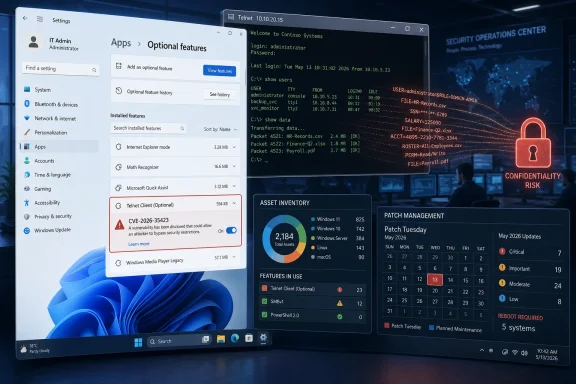
Telnet Is Still Here Because Compatibility Never Really Dies
The first temptation is to ask why Windows 11 still has a Telnet Client at all. The answer is the same one that explains half of Windows’ attack surface: enterprise compatibility is a product feature, not a museum exhibit. Microsoft can discourage Telnet, bury it behind optional-feature dialogs, and make it absent from ordinary consumer workflows, but it cannot pretend that industrial gear, embedded systems, lab devices, and aging network appliances vanished because the security industry moved on.
That is why a Telnet Client vulnerability in 2026 is not quite the punchline it seems. On a clean personal Windows 11 laptop, the feature is usually not part of the daily threat model. In an organization with inherited scripts, gold images, help-desk runbooks, and network teams that still test ports with whatever tool is already on the machine, it becomes a different story.
Telnet’s original sin is not merely age. It is that Telnet was designed for a different security universe, one where plaintext sessions across trusted networks were acceptable operational tradecraft. SSH replaced it for good reasons, but replacement is not eradication, and Windows has always been unusually good at preserving the bridge back to yesterday.
The practical risk around CVE-2026-35423 therefore begins with inventory. If the Telnet Client is not enabled, the vulnerability is unlikely to matter on that endpoint. If it is enabled on administrative workstations, jump boxes, lab machines, or systems used to interact with legacy equipment, the question shifts from “Who uses Telnet?” to “Who can make this client talk to something hostile?”
Information Disclosure Is the Quiet Class of Windows Bugs
Information disclosure vulnerabilities rarely get the same attention as remote code execution or elevation-of-privilege flaws. They do not sound like an attacker popping a shell, stealing a domain admin token, or detonating ransomware. But disclosure bugs often become useful because they answer questions an attacker should not be able to ask.
The phrase can cover a wide range of outcomes. At the low end, it might mean revealing limited process, memory, file, configuration, or network-state information under constrained conditions. At the high end, disclosure can expose secrets, weaken address-space protections, leak authentication material, or provide the missing ingredient for a chained attack.
For CVE-2026-35423, Microsoft’s public naming tells us the affected component and impact class, but not a rich technical narrative. That is normal for many Security Update Guide entries, especially when Microsoft wants customers to patch without handing would-be attackers a recipe. The absence of detail is not proof of severity, but it is also not proof of safety.
This is where security teams have to resist a bad habit: treating vulnerability labels as complete risk statements. “Information disclosure” is a category, not an outcome. “Telnet Client” is a component, not an exposure map. “Windows 11” is a platform, not a statement about which machines in your estate actually have the feature enabled.
Microsoft’s Confidence Signal Is Doing More Work Than It Seems
The text supplied with the vulnerability points to a confidence metric: how certain the industry should be that a vulnerability exists, how credible the known technical details are, and how much knowledge attackers may already have. That metric is easy to overlook because it does not patch a system or raise a firewall rule. But it changes how defenders should read the advisory.
A vulnerability whose existence is only rumored is different from one confirmed by a vendor. A flaw described in vague public chatter is different from one with reproducible technical research. A bug acknowledged by Microsoft and assigned a CVE sits in a more concrete place on the risk spectrum, even when exploit details are deliberately sparse.
That matters because defenders live in the gap between certainty and action. Patch too slowly, and the estate becomes a target of opportunity. Patch too recklessly, and the help desk inherits broken workflows from an update nobody tested against real business use. Confidence metrics are one of the subtle mechanisms vendors use to tell administrators whether they are dealing with smoke, fire, or a fire whose blueprint is already circulating.
For WindowsForum readers, the lesson is not that CVE-2026-35423 is automatically catastrophic. It is that Microsoft’s acknowledgement moves the issue out of the rumor bucket. The feature may be legacy, the impact may be confidentiality, and the exposed population may be narrower than a core Windows subsystem — but the vulnerability is real enough to belong in patch planning.
The Attack Surface Is Optional Until Someone Enables It
Windows optional features create a strange kind of administrative blind spot. They are official, supported, and often easy to enable, but they are not always tracked with the same seriousness as installed applications. A software inventory tool might flag Chrome, 7-Zip, or Java immediately while leaving Windows feature state to a separate configuration-management layer.
That is a problem for Telnet because the client is often enabled for convenience. A network engineer needs to test a banner. A technician is following an old procedure. A lab image includes it because “we might need it someday.” Years later, that one-off decision becomes a quiet configuration baseline.
The fix is not complicated, but the politics can be. If no documented workflow requires Telnet, remove the feature. If a workflow does require it, identify the machines, constrain who uses them, and consider whether a modern alternative is finally possible. The worst posture is the middle one: Telnet is available everywhere, nobody owns it, and security teams assume it is absent because the modern standard is SSH.
Windows administrators can verify optional feature state through PowerShell or DISM rather than relying on memory. Microsoft’s own management guidance has long treated optional features as manageable components: they can be queried, enabled, disabled, or hidden through tooling, and Intune can help run scripts across managed clients. That makes Telnet exposure a solvable problem, provided someone decides it is worth solving.
Patch Tuesday Turns Legacy Debt Into a Calendar Event
CVE-2026-35423 landed on a Patch Tuesday, which is Microsoft’s way of converting sprawling software risk into a monthly ritual. That ritual is imperfect, but it is still one of the few reasons enterprise Windows security has any rhythm at all. The calendar gives defenders a predictable window to triage, test, deploy, and watch for fallout.
The difficulty is that Patch Tuesday bundles the spectacular with the mundane. A critical remote-code-execution bug in a server product competes for attention with an information disclosure issue in a client feature. Security teams build dashboards, dashboards sort by severity, and lower-drama vulnerabilities drift toward the bottom.
That approach can make sense when resources are limited. But it can also overfit to CVSS scoring and underfit to environmental reality. A medium-severity client bug on a privileged administrator workstation may be more relevant than a high-severity flaw in a product the organization does not run.
Telnet Client fits that uncomfortable middle ground. For many Windows 11 users, patching through the normal cumulative update channel is enough. For administrators, the smarter move is to pair the patch with a feature-state review, because the vulnerability is a symptom of a broader configuration question: why is this component present at all?
The Real Risk Is Chaining, Not Telnet Nostalgia
Modern attacks rarely depend on a single vulnerability behaving like a magic key. More often, attackers assemble partial advantages: a foothold here, a leaked token there, a bypass in one component, a misconfiguration in another. Information disclosure bugs are useful because they can turn uncertainty into knowledge.
That does not mean CVE-2026-35423 is known to be part of an active exploit chain. Microsoft’s public entry, as available at publication time, does not provide enough evidence to make that claim. But defenders should think in terms of attacker economics, not just advisory labels. If a flaw can reveal something that makes the next step easier, it earns attention.
The Telnet Client angle also raises a social-engineering possibility. Client-side bugs often require a target to initiate a connection, open a crafted file, browse to a malicious page, or otherwise interact with attacker-controlled content. Without Microsoft publishing exploit mechanics, we should not pretend to know the trigger. Still, any bug in a client used to connect outward invites administrators to consider whether hostile endpoints, fake devices, or manipulated network services could be part of the story.
That is why the safest operational guidance is boring and effective: patch, remove the feature where it is not needed, and avoid using Telnet from privileged machines. The first action fixes the known flaw. The second reduces the next one. The third acknowledges that old diagnostic habits can become modern attack paths.
Windows 11’s Modern Shell Still Carries Old Tools
Windows 11 is marketed as a modern operating system, but it remains a layered artifact. Beneath the centered taskbar and security branding sits decades of compatibility machinery. Some of that machinery is essential. Some of it is merely tolerated. The hard part for Microsoft is that the same backward compatibility customers praise during migrations becomes attack surface they curse during incident response.
Telnet is not alone in that category. Windows has long shipped or supported legacy protocols, compatibility shims, administrative utilities, and optional components whose value depends entirely on context. In a home environment, they may be irrelevant. In a regulated enterprise, they may be prohibited. In an industrial site, they may be the only thing keeping a production process observable without a vendor visit.
That is the tension Microsoft cannot fully resolve from Redmond. Removing legacy components outright breaks customers. Keeping them around creates a patching obligation. Making them optional reduces default exposure, but only if organizations manage optionality as a security control rather than a convenience switch.
CVE-2026-35423 sits precisely in that tension. It is not a referendum on Windows 11 as a whole. It is a reminder that Windows’ security posture is not just the kernel, Defender, virtualization-based security, or hardware-backed credentials. It is also the long tail of features an administrator can enable in fifteen seconds and forget for fifteen months.
Home Users Should Patch; Admins Should Inventory
For ordinary Windows 11 users, the advice is straightforward: install the May 2026 security update through Windows Update when it is offered. If the Telnet Client was never enabled, there is little reason to panic. If it was enabled for a one-time test years ago, disable it unless there is a real need.
For IT departments, the job is broader. Start with patch compliance, but do not stop there. Query endpoints for optional feature state, especially on administrative workstations, engineering laptops, shared lab machines, and images used outside the standard corporate desktop build. A vulnerability like this is useful because it gives security teams a concrete reason to clean up a vague legacy risk.
There is also a policy lesson here. If an organization permits Telnet because one team occasionally needs it, that exception should be visible, documented, and scoped. If Telnet is banned, enforcement should not depend on hope. Windows provides enough management hooks to make optional-feature drift detectable.
The more mature response is to turn CVE-2026-35423 into a control check. Can you identify every Windows 11 machine with Telnet Client enabled? Can you explain why each one needs it? Can you remove it at scale if the answer is no? Those questions matter more than the advisory’s sparse technical prose.
The Signal From a Small CVE Is Larger Than the Bug
Security teams love the language of prioritization, but prioritization often becomes a way to ignore anything that does not arrive wearing a siren. CVE-2026-35423 is the sort of vulnerability that tests whether a program can handle nuance. It is not the biggest Windows flaw of the year. It may not be exploited in the wild. It may affect a feature absent from most endpoints.
And yet it points directly at three chronic weaknesses: incomplete asset visibility, unmanaged optional features, and the persistence of legacy protocols in modern environments. Those are not hypothetical problems. They are the everyday conditions that turn modest CVEs into incident footnotes.
Microsoft’s limited public detail also means defenders should be careful with certainty. We know the named component, the impact category, and the vendor acknowledgement. We do not have enough public information to describe the vulnerable code path, exploit preconditions, or real-world attacker interest with confidence. That uncertainty is not a reason to freeze; it is a reason to make the response proportionate.
The proportionate response is not emergency change control for every Windows 11 desktop unless your environment has unusual exposure. It is timely cumulative patching, targeted discovery, and removal of unnecessary Telnet Client installs. In other words, the right answer is operational hygiene sharpened by a specific CVE.
The Telnet Client Bug Hands IT a Small but Useful Audit
CVE-2026-35423 is valuable because it gives administrators a narrow, actionable task instead of another abstract warning about legacy risk. The vulnerability should move through the normal patch process, but it should also trigger a quick review of where Telnet Client exists and whether it still earns its place on Windows 11 machines.
- Organizations should deploy the May 2026 Windows security updates through their normal rings after appropriate testing.
- Administrators should query managed Windows 11 endpoints for the Telnet Client optional feature rather than assuming it is absent.
- Machines that do not have a documented Telnet requirement should have the client disabled or removed from the standard build.
- Systems that still need Telnet should be treated as exceptions, with usage limited to defined workflows and preferably kept away from privileged daily-driver workstations.
- Security teams should treat the advisory’s confidence signal as confirmation that the vulnerability is real, while avoiding unsupported claims about exploitation mechanics.
The broader Windows story is that legacy does not disappear when it becomes embarrassing; it disappears when someone inventories it, owns it, and retires it. CVE-2026-35423 may prove to be a modest information disclosure bug in an optional client, but modest bugs are often the best prompts for overdue cleanup. If Microsoft keeps carrying compatibility forward, Windows administrators will have to keep deciding which pieces of that past still belong on tomorrow’s machines.