

Microsoft has published CVE-2026-35419 as a Windows DWM Core Library information disclosure vulnerability in the Security Update Guide, describing a flaw in a core desktop-composition component that could allow an attacker to obtain information rather than directly execute code or gain administrator privileges. That wording matters because DWM is not an obscure corner of Windows; it is part of the machinery that draws the modern desktop. The interesting story is not that every information disclosure bug is catastrophic. It is that Microsoft’s own metadata tells defenders how much is known, how much is not being said, and why a “mere leak” in a graphical subsystem can still deserve prompt attention.
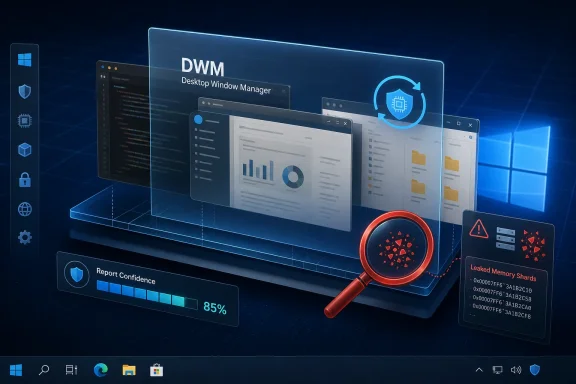
The excerpt attached to CVE-2026-35419 is the definition of Report Confidence, one of the less glamorous but more useful vulnerability-scoring concepts. It measures how certain the scorer is that the vulnerability exists and how credible the public technical details are. In plain English, it separates “someone saw weird behavior” from “the vendor has confirmed the bug and issued a fix.”
That distinction is not bureaucratic trivia. For defenders, a confirmed vendor advisory is a different animal from a rumor, a crash report, or a speculative reverse-engineering thread. When Microsoft assigns a CVE in the Security Update Guide and ties it to Windows servicing, the vulnerability has crossed the threshold from possibility to operational fact.
The uncomfortable part is that confidence is not the same thing as completeness. Microsoft may confirm the existence of a DWM information disclosure bug without publishing the precise code path, exploit primitive, or memory structure involved. That is normal for Patch Tuesday advisories, but it leaves administrators with a familiar asymmetry: attackers can diff patches and experiment, while defenders must prioritize from a sparse public record.
That is why the Report Confidence language is worth reading closely. It is a reminder that the advisory’s certainty comes from vendor acknowledgment, not necessarily from a public technical paper. The bug is real; the public details may still be intentionally thin.
That makes DWM vulnerabilities interesting for a reason that is easy to underestimate. A browser bug, a kernel bug, and a DWM bug may sit in very different layers, but DWM is still a privileged and heavily exercised system component. It touches user sessions constantly, and it has to mediate between applications, graphics drivers, memory buffers, and the Windows session model.
Information disclosure in such a component is rarely glamorous on its own. The phrase does not carry the same heat as “remote code execution” or “privilege escalation.” But Windows exploitation often works as a chain, and information disclosure bugs can provide the missing link in that chain.
Modern operating systems are built around mitigation layers: address randomization, memory protections, process isolation, integrity levels, sandboxing, and carefully constrained interfaces between user and kernel space. A leak that reveals memory addresses, object layouts, handles, or data from another context may not be the final exploit, but it can make the final exploit more reliable. In that sense, information disclosure is often less like a stolen document and more like a map of the building.
That habit can be rational, but it becomes lazy when the affected component is broad, local, and useful to exploit developers. A local information disclosure bug in DWM may require the attacker to already have some foothold on the system. Yet many real intrusions begin exactly there: a malicious document, a browser sandbox escape attempt, a low-privilege implant, a compromised user account, or a malicious insider running code in a normal desktop session.
The question is not whether CVE-2026-35419 lets an unauthenticated attacker take over a machine from across the internet. Based on Microsoft’s classification, that is not the story. The question is whether it gives an attacker who is already executing locally a cleaner path around Windows defenses.
This is where patch management gets more subtle than score sorting. An information disclosure vulnerability with a modest score can be strategically useful if it helps bypass Address Space Layout Randomization or reveals sensitive process or kernel-adjacent state. Conversely, a scary-looking bug can be less urgent if it affects a disabled feature on a small number of machines. The label is a starting point, not a verdict.
For CVE-2026-35419, the presence of a Microsoft Security Update Guide entry is itself a strong signal. Vendor confirmation means the affected technology owner recognizes the vulnerability and is publishing remediation guidance through its normal security channel. That does not mean every scanner feed, third-party database, or blog post has all the details right, but it does mean defenders should not treat the CVE as speculative.
The more interesting operational lesson is that Report Confidence also hints at attacker knowledge. The more confirmed and technically detailed a vulnerability becomes, the easier it is for attackers to reason about it. Even when Microsoft withholds exploit internals, the patch itself becomes a research artifact after release.
Patch diffing is not magic, but it is routine. Researchers and adversaries compare old and new binaries, inspect changed functions, and look for modified checks, initialization paths, or memory handling. For Windows components that ship broadly, a single cumulative update can provide the clues needed to reconstruct the bug class.
That means the publication of a confirmed advisory starts a clock. The absence of a public proof of concept on day one is good news, but it is not a permanent shield. Once a fix exists, the vulnerability becomes easier to study on unpatched systems.
That explains why CVE entries often feel frustratingly thin. Administrators want to know what data could leak, what privileges are required, whether exploitation is practical, and whether mitigations exist short of patching. Microsoft’s standard advisory format often answers some of those questions indirectly through CVSS vectors and product tables, while leaving the exploit mechanics unstated.
There is a good-faith reason for that restraint. Publishing detailed exploitation notes for a widely deployed Windows component can accelerate abuse against machines that will remain unpatched for days, weeks, or months. But there is also a cost: defenders are left interpreting risk through metadata and experience.
CVE-2026-35419 sits squarely in that tension. The advisory tells administrators enough to know that DWM is affected and that information disclosure is the impact. It does not, at least from the public-facing summary, provide the kind of technical color that would let every organization model the bug with high precision.
That is why the right response is neither panic nor dismissal. The right response is disciplined patch validation, exposure mapping, and prioritization based on where interactive Windows sessions matter most.
Those systems are not equal. A DWM information disclosure bug on a lightly used family PC is one thing. The same class of bug on a privileged access workstation used to administer domain controllers is another. A VDI host serving many users introduces still another risk model, especially if session isolation, graphics acceleration, or profile handling are part of the environment.
Security teams should also remember that local vulnerabilities are often post-exploitation tools. Attackers who land through phishing, stolen credentials, or a browser chain frequently need to understand the host, bypass mitigations, harvest secrets, or move laterally. A local information leak may support those goals even if it does not provide a standalone compromise path.
For Windows enthusiasts, the lesson is simpler but still important. Keep cumulative updates current, especially on systems used for sensitive browsing, password management, development, cryptocurrency wallets, remote administration, or work accounts. The machines that matter most are not always the servers in the rack; sometimes they are the endpoints where credentials and sessions accumulate.
CVE-2026-35419 should be read in that tradition. On its face, an information disclosure issue in DWM is not a wormable network disaster. But attackers rarely need every bug to be dramatic. They need the right bug at the right stage.
This is especially true for components that are present across Windows versions and exercised in ordinary use. DWM is not a niche optional package that defenders can easily remove. It is part of the user experience and session architecture. That broad presence gives even medium-looking vulnerabilities a wide potential population of targets.
The defensive counterargument is also fair. Without public exploit details, known exploitation, or a higher-impact classification, CVE-2026-35419 should not displace actively exploited remote-code-execution flaws in internet-facing software. Prioritization still matters. But it should remain inside the regular Windows update cadence, not fall into the “we’ll get to it someday” pile.
DWM bugs are a useful test of endpoint discipline because there is usually no elegant workaround. You cannot meaningfully disable the modern Windows compositor across ordinary desktops as a security strategy. You cannot firewall it off from the local session. You patch, you validate, and you monitor.
The highest-priority groups are predictable. Privileged access workstations should be near the front because they concentrate administrative power. Shared desktop and VDI environments deserve attention because one host or image can affect many users. Developer and engineering machines matter because they often handle source code, signing material, secrets, build systems, and privileged cloud access.
For smaller businesses, the lesson is less formal but just as direct. Do not let Windows Update drift indefinitely because the advisory does not sound scary. Information disclosure vulnerabilities are exactly the kind of issue that disappear into the background until they become part of a larger intrusion story.
The main exception is for users who intentionally defer updates for gaming stability, driver concerns, or compatibility reasons. That caution is understandable, particularly on systems with unusual graphics stacks or professional software. But deferral should be measured in days, not months, and it should be paired with basic rollback planning.
DWM’s relationship with graphics drivers may make some enthusiasts especially cautious. A cumulative update that touches the desktop stack can occasionally coincide with display oddities, driver regressions, or multi-monitor annoyances. Those are real operational concerns, but they do not erase the security value of the fix.
The better compromise is to update deliberately. Create a restore point or system image if the machine is mission-critical, update graphics drivers from trusted channels if needed, install the Windows security update, and verify that sleep, wake, HDR, refresh rate, and multi-monitor behavior still work. Security hygiene and enthusiast caution do not have to be enemies.
But it says enough. A core Windows component has an information disclosure vulnerability. Microsoft has acknowledged it through its security process. The confidence framing tells defenders that this is not merely a rumor, even if the technical internals remain private.
That combination should push the vulnerability into normal expedited patching rather than emergency improvisation. Organizations with mature programs already have tiers for this: faster deployment for privileged endpoints and broadly exposed user populations, then the rest of the fleet through established rings. Organizations without that maturity should treat the CVE as another reminder that Windows patch management is not an occasional chore; it is infrastructure.
The most dangerous reading is the dismissive one. “Only information disclosure” has aged badly in too many exploit chains. The phrase should reduce panic, not remove urgency.
Source: MSRC Security Update Guide - Microsoft Security Response Center
 Microsoft’s Quiet DWM Advisory Is Really About Trust in the Details
The excerpt attached to CVE-2026-35419 is the definition of Report Confidence, one of the less glamorous but more useful vulnerability-scoring concepts. It measures how certain the scorer is that the vulnerability exists and how credible the public technical details are. In plain English, it separates “someone saw weird behavior” from “the vendor has confirmed the bug and issued a fix.”That distinction is not bureaucratic trivia. For defenders, a confirmed vendor advisory is a different animal from a rumor, a crash report, or a speculative reverse-engineering thread. When Microsoft assigns a CVE in the Security Update Guide and ties it to Windows servicing, the vulnerability has crossed the threshold from possibility to operational fact.
The uncomfortable part is that confidence is not the same thing as completeness. Microsoft may confirm the existence of a DWM information disclosure bug without publishing the precise code path, exploit primitive, or memory structure involved. That is normal for Patch Tuesday advisories, but it leaves administrators with a familiar asymmetry: attackers can diff patches and experiment, while defenders must prioritize from a sparse public record.
That is why the Report Confidence language is worth reading closely. It is a reminder that the advisory’s certainty comes from vendor acknowledgment, not necessarily from a public technical paper. The bug is real; the public details may still be intentionally thin.
DWM Is the Desktop’s Compositor, Not a Decorative Add-On
Desktop Window Manager began as the compositing engine behind the Aero era, but in current Windows it is simply part of how the graphical shell works. It manages composition, surfaces, window effects, rendering coordination, and the visual isolation of application windows. If Windows is showing you overlapping windows, animations, thumbnails, or modern display transitions, DWM is in the room.That makes DWM vulnerabilities interesting for a reason that is easy to underestimate. A browser bug, a kernel bug, and a DWM bug may sit in very different layers, but DWM is still a privileged and heavily exercised system component. It touches user sessions constantly, and it has to mediate between applications, graphics drivers, memory buffers, and the Windows session model.
Information disclosure in such a component is rarely glamorous on its own. The phrase does not carry the same heat as “remote code execution” or “privilege escalation.” But Windows exploitation often works as a chain, and information disclosure bugs can provide the missing link in that chain.
Modern operating systems are built around mitigation layers: address randomization, memory protections, process isolation, integrity levels, sandboxing, and carefully constrained interfaces between user and kernel space. A leak that reveals memory addresses, object layouts, handles, or data from another context may not be the final exploit, but it can make the final exploit more reliable. In that sense, information disclosure is often less like a stolen document and more like a map of the building.
“Information Disclosure” Is a Severity Label, Not a Comfort Blanket
Security teams have learned to triage by class, and that is both necessary and dangerous. Remote code execution usually jumps the queue. Elevation of privilege comes next, especially when exploitation is known or likely. Information disclosure often gets pushed down, particularly when there is no public exploit and no obvious internet-facing exposure.That habit can be rational, but it becomes lazy when the affected component is broad, local, and useful to exploit developers. A local information disclosure bug in DWM may require the attacker to already have some foothold on the system. Yet many real intrusions begin exactly there: a malicious document, a browser sandbox escape attempt, a low-privilege implant, a compromised user account, or a malicious insider running code in a normal desktop session.
The question is not whether CVE-2026-35419 lets an unauthenticated attacker take over a machine from across the internet. Based on Microsoft’s classification, that is not the story. The question is whether it gives an attacker who is already executing locally a cleaner path around Windows defenses.
This is where patch management gets more subtle than score sorting. An information disclosure vulnerability with a modest score can be strategically useful if it helps bypass Address Space Layout Randomization or reveals sensitive process or kernel-adjacent state. Conversely, a scary-looking bug can be less urgent if it affects a disabled feature on a small number of machines. The label is a starting point, not a verdict.
Report Confidence Is the Metric Defenders Usually Read Too Late
The Report Confidence metric has an unglamorous job: it tells you how much faith to place in the vulnerability description. If confidence is low, organizations may reasonably wait for corroboration unless exposure is severe. If confidence is high, the debate shifts from “is this real?” to “how fast can we safely remediate?”For CVE-2026-35419, the presence of a Microsoft Security Update Guide entry is itself a strong signal. Vendor confirmation means the affected technology owner recognizes the vulnerability and is publishing remediation guidance through its normal security channel. That does not mean every scanner feed, third-party database, or blog post has all the details right, but it does mean defenders should not treat the CVE as speculative.
The more interesting operational lesson is that Report Confidence also hints at attacker knowledge. The more confirmed and technically detailed a vulnerability becomes, the easier it is for attackers to reason about it. Even when Microsoft withholds exploit internals, the patch itself becomes a research artifact after release.
Patch diffing is not magic, but it is routine. Researchers and adversaries compare old and new binaries, inspect changed functions, and look for modified checks, initialization paths, or memory handling. For Windows components that ship broadly, a single cumulative update can provide the clues needed to reconstruct the bug class.
That means the publication of a confirmed advisory starts a clock. The absence of a public proof of concept on day one is good news, but it is not a permanent shield. Once a fix exists, the vulnerability becomes easier to study on unpatched systems.
The Patch Tuesday Machine Makes Sparse Advisories Inevitable
Microsoft’s Security Update Guide is designed for scale, not narrative. It has to describe dozens or sometimes well over a hundred vulnerabilities across Windows, Office, Azure, developer tools, browsers, and server products. It must be accurate enough for defenders, restrained enough not to hand attackers an exploit recipe, and structured enough for vulnerability management systems to ingest.That explains why CVE entries often feel frustratingly thin. Administrators want to know what data could leak, what privileges are required, whether exploitation is practical, and whether mitigations exist short of patching. Microsoft’s standard advisory format often answers some of those questions indirectly through CVSS vectors and product tables, while leaving the exploit mechanics unstated.
There is a good-faith reason for that restraint. Publishing detailed exploitation notes for a widely deployed Windows component can accelerate abuse against machines that will remain unpatched for days, weeks, or months. But there is also a cost: defenders are left interpreting risk through metadata and experience.
CVE-2026-35419 sits squarely in that tension. The advisory tells administrators enough to know that DWM is affected and that information disclosure is the impact. It does not, at least from the public-facing summary, provide the kind of technical color that would let every organization model the bug with high precision.
That is why the right response is neither panic nor dismissal. The right response is disciplined patch validation, exposure mapping, and prioritization based on where interactive Windows sessions matter most.
Desktop Bugs Still Matter in a Cloud-Managed Windows World
It is tempting to think of DWM as a consumer-desktop concern: laptops, gaming rigs, workstations, and the visible Windows shell. In enterprise environments, however, the desktop is everywhere. It is on developer machines, help desk systems, privileged admin workstations, VDI pools, jump boxes, kiosks, engineering workstations, and Windows Server installations with desktop experience enabled.Those systems are not equal. A DWM information disclosure bug on a lightly used family PC is one thing. The same class of bug on a privileged access workstation used to administer domain controllers is another. A VDI host serving many users introduces still another risk model, especially if session isolation, graphics acceleration, or profile handling are part of the environment.
Security teams should also remember that local vulnerabilities are often post-exploitation tools. Attackers who land through phishing, stolen credentials, or a browser chain frequently need to understand the host, bypass mitigations, harvest secrets, or move laterally. A local information leak may support those goals even if it does not provide a standalone compromise path.
For Windows enthusiasts, the lesson is simpler but still important. Keep cumulative updates current, especially on systems used for sensitive browsing, password management, development, cryptocurrency wallets, remote administration, or work accounts. The machines that matter most are not always the servers in the rack; sometimes they are the endpoints where credentials and sessions accumulate.
The Risk Is in the Chain, Not the Single Link
The history of Windows exploitation is full of chains. A memory corruption bug becomes reliable because an information disclosure bug defeats randomization. A sandbox escape becomes useful because a local privilege escalation follows it. A phishing lure becomes a domain incident because the initial endpoint yields secrets, tokens, or administrative footholds.CVE-2026-35419 should be read in that tradition. On its face, an information disclosure issue in DWM is not a wormable network disaster. But attackers rarely need every bug to be dramatic. They need the right bug at the right stage.
This is especially true for components that are present across Windows versions and exercised in ordinary use. DWM is not a niche optional package that defenders can easily remove. It is part of the user experience and session architecture. That broad presence gives even medium-looking vulnerabilities a wide potential population of targets.
The defensive counterargument is also fair. Without public exploit details, known exploitation, or a higher-impact classification, CVE-2026-35419 should not displace actively exploited remote-code-execution flaws in internet-facing software. Prioritization still matters. But it should remain inside the regular Windows update cadence, not fall into the “we’ll get to it someday” pile.
Enterprise IT Should Treat This as a Hygiene Test
For managed environments, the practical question is not whether to patch. It is whether the organization’s Windows servicing process can absorb yet another component-level advisory without drama. That means testing cumulative updates, watching known-issue channels, confirming deployment rings, and measuring actual install state rather than assuming success because a policy exists.DWM bugs are a useful test of endpoint discipline because there is usually no elegant workaround. You cannot meaningfully disable the modern Windows compositor across ordinary desktops as a security strategy. You cannot firewall it off from the local session. You patch, you validate, and you monitor.
The highest-priority groups are predictable. Privileged access workstations should be near the front because they concentrate administrative power. Shared desktop and VDI environments deserve attention because one host or image can affect many users. Developer and engineering machines matter because they often handle source code, signing material, secrets, build systems, and privileged cloud access.
For smaller businesses, the lesson is less formal but just as direct. Do not let Windows Update drift indefinitely because the advisory does not sound scary. Information disclosure vulnerabilities are exactly the kind of issue that disappear into the background until they become part of a larger intrusion story.
Home Users Should Not Overthink the Label
For home users, CVE names and CVSS submetrics can make security feel more complicated than it needs to be. If Windows Update offers a cumulative security update that includes the fix, install it after a reasonable backup and restart window. That is the whole playbook for most people.The main exception is for users who intentionally defer updates for gaming stability, driver concerns, or compatibility reasons. That caution is understandable, particularly on systems with unusual graphics stacks or professional software. But deferral should be measured in days, not months, and it should be paired with basic rollback planning.
DWM’s relationship with graphics drivers may make some enthusiasts especially cautious. A cumulative update that touches the desktop stack can occasionally coincide with display oddities, driver regressions, or multi-monitor annoyances. Those are real operational concerns, but they do not erase the security value of the fix.
The better compromise is to update deliberately. Create a restore point or system image if the machine is mission-critical, update graphics drivers from trusted channels if needed, install the Windows security update, and verify that sleep, wake, HDR, refresh rate, and multi-monitor behavior still work. Security hygiene and enthusiast caution do not have to be enemies.
The Advisory Says Less Than Defenders Want, But Enough to Act
The public description of CVE-2026-35419 does not turn DWM into a smoking crater. It does not say that attackers can remotely compromise Windows machines over the network. It does not, from the available summary, describe active exploitation in the wild or provide proof-of-concept mechanics.But it says enough. A core Windows component has an information disclosure vulnerability. Microsoft has acknowledged it through its security process. The confidence framing tells defenders that this is not merely a rumor, even if the technical internals remain private.
That combination should push the vulnerability into normal expedited patching rather than emergency improvisation. Organizations with mature programs already have tiers for this: faster deployment for privileged endpoints and broadly exposed user populations, then the rest of the fleet through established rings. Organizations without that maturity should treat the CVE as another reminder that Windows patch management is not an occasional chore; it is infrastructure.
The most dangerous reading is the dismissive one. “Only information disclosure” has aged badly in too many exploit chains. The phrase should reduce panic, not remove urgency.
The DWM Signal Administrators Should Not Miss
CVE-2026-35419 is a useful case study because it forces defenders to read between severity labels without inventing facts. The advisory is narrow, but the affected component is central. The impact is not code execution, but the class can support code execution elsewhere. The public detail is limited, but vendor confirmation makes the issue actionable.- CVE-2026-35419 affects the Windows DWM Core Library and is classified as an information disclosure vulnerability.
- The practical risk is most relevant to systems where an attacker may already have local code execution or access to an interactive Windows session.
- The Report Confidence concept matters because it distinguishes a confirmed vendor-recognized vulnerability from an uncertain or poorly corroborated report.
- Administrators should prioritize privileged workstations, VDI environments, shared desktops, and systems used for sensitive administration or development.
- Home users should install the relevant cumulative Windows update through normal update channels rather than trying to manually interpret exploit mechanics.
- The absence of public exploit details should not be mistaken for proof that the bug is unimportant or impossible to weaponize.
Source: MSRC Security Update Guide - Microsoft Security Response Center
