

Microsoft has assigned CVE-2026-33823 to an information disclosure vulnerability in the Microsoft Team Events Portal, with the public advisory available through the Microsoft Security Response Center as of May 8, 2026. The important story is not that another cloud-facing Microsoft property has a CVE; it is that defenders are being asked to act on a vulnerability whose public technical shape remains deliberately thin. In that gap, the report confidence metric becomes more than a scoring footnote. It is the difference between treating a CVE as a confirmed operational risk and treating it as a rumor with a tracking number.
CVE-2026-33823 sits in a familiar modern category: information disclosure in a Microsoft-hosted collaboration or events service. That sounds less dramatic than remote code execution, but for cloud services the blast radius of disclosure is often bound up with identity, tenant boundaries, meeting metadata, registration workflows, and access-control assumptions. The phrase “information disclosure” is broad enough to cover anything from benign metadata leakage to exposure that materially helps an attacker stage a second step.
The public record, at least from the advisory surface, does not appear to hand defenders a root-cause analysis, exploit recipe, or detailed affected-version matrix in the old desktop-software sense. That is increasingly normal for Microsoft cloud CVEs. When the affected technology is a hosted service, remediation may already be deployed server-side, and the advisory becomes a signal to customers rather than a patch-installation checklist.
That is useful, but it is also unsatisfying. Administrators are trained to ask operational questions: Was my tenant affected? Was data exposed? Do I need to rotate secrets, review audit logs, change conditional access, or notify users? A terse CVE often answers only the first-order question — “does Microsoft acknowledge a vulnerability?” — while leaving the second-order questions to risk management.
This is where report confidence matters. If Microsoft has acknowledged the issue, the vulnerability’s existence is not speculative. But the credibility of the public technical details may still be low, not because the vendor is hiding everything for no reason, but because publishing exploit-relevant detail can convert a contained cloud bug into a reproducible playbook.
A disclosure bug in an events portal may not hand an attacker a shell, but it could reveal who attended an event, who registered, which tenant or organization hosted it, what email addresses were used, what links or tokens were generated, or what internal titles and affiliations appeared in event data. None of those possibilities should be assumed for CVE-2026-33823 without confirmation. The point is that the vulnerability class itself lives in the terrain attackers already mine for social engineering and lateral movement.
Microsoft Teams and adjacent event tooling occupy a particularly sensitive place in enterprise life. They are not just chat clients or webinar front ends; they are identity-mediated business surfaces where employees, partners, prospects, vendors, and external guests meet. That makes metadata valuable. A leaked attendee roster can be a phishing list. A leaked event title can reveal a merger, incident response exercise, product launch, legal matter, or internal restructuring.
The industry still treats confidentiality failures as softer than integrity or availability failures because the damage is harder to observe. A crashed server announces itself. A stolen list of executives registered for a private briefing does not. The absence of visible disruption is not the same as the absence of harm.
For CVE-2026-33823, Microsoft’s acknowledgement gives the vulnerability institutional weight. It is not merely a third-party rumor, a scraped database entry, or an unverified researcher claim. But acknowledgement does not automatically mean the public has enough information to model exploitability with precision.
That asymmetry is the core dilemma of modern vulnerability response. Vendors know more than they publish. Attackers may know more than defenders. Defenders must decide before they know enough. Report confidence, properly read, is a measurement of that uncomfortable middle state.
The metric also hints at adversary readiness. If only the existence of the vulnerability is public, opportunistic attackers may have little to work with beyond the product name and vulnerability class. If technical details are corroborated elsewhere, the window narrows. If a proof of concept appears, the CVE moves from “monitor” to “assume scanning or exploitation attempts are imminent,” even if the base severity score does not change.
A Microsoft Team Events Portal vulnerability is not something most administrators patch by downloading an update from the catalog. If Microsoft remediates it service-side, the local action may be limited to review, monitoring, and tenant hygiene. That can feel like “nothing to do,” but the better reading is “nothing to install.”
This distinction is increasingly important. In the cloud era, the customer’s security work shifts from binary patch state to exposure management. Did the service have external users? Were events public or private? Are audit logs retained long enough? Are guest access policies permissive? Are event organizers trained to avoid embedding sensitive data into titles, descriptions, and registration fields?
Cloud remediation also creates a communication problem. If Microsoft fixes a flaw before publishing a CVE, customers may wonder why they are hearing about it after the fact. If Microsoft publishes too much detail before full mitigation, it risks arming attackers. If it publishes too little, defenders complain that they cannot make informed decisions. All three complaints can be valid at the same time.
Attackers rarely need one spectacular bug when several small disclosures can be chained together. A portal leak might provide names and roles. A public profile might supply job function. A breached marketing list might provide email addresses. A convincing Teams-themed phish might then harvest credentials or session tokens. The initial disclosure may look modest in isolation while becoming meaningful in a campaign.
This is why defenders should resist the urge to grade CVE-2026-33823 only by its most literal description. “Information disclosure” is the beginning of the sentence, not the end. The real question is what information, in whose tenant, under what authentication conditions, and whether access crossed a boundary the customer reasonably believed was enforced.
Until those answers are public, the responsible posture is neither panic nor dismissal. It is scoped review. Organizations that use Microsoft-hosted event capabilities for internal-only briefings, executive meetings, regulated customer communications, or incident-response exercises should treat the advisory as a prompt to inspect process, not merely a line item in a vulnerability scanner.
But machine-readable does not always mean decision-ready. A CVE can have a clean title, a severity score, a weakness classification, and a vendor acknowledgement while still leaving defenders unable to answer the practical question: “What should we do differently today?” This is especially true for cloud services, where the remediation state may be invisible from the customer side.
The situation is not unique to Microsoft. Every major SaaS provider faces the same tradeoff. Publish too much, and attackers benefit. Publish too little, and customers lose trust. The cloud has made vulnerability disclosure less like distributing a patch and more like narrating a managed incident without revealing the attack path.
For WindowsForum readers, the lesson is to treat advisory metadata as a starting point. CVSS tells you how the vulnerability is modeled. The report confidence metric tells you how much faith to place in the existence and public details. The product name tells you where to look. None of those fields, alone, tells you whether your organization’s business process turned a medium-looking disclosure into a meaningful exposure.
That matters because the people who create events are often not the people who read MSRC advisories. A central security team may know about the CVE while the communications team continues to run executive webinars with sensitive internal titles. Cloud security increasingly fails at these organizational seams, not just at the technical boundary.
Admins should also review logging assumptions. Microsoft 365 audit logs are only useful if the right workloads are captured, retention is adequate, and someone knows what normal event access looks like. If a portal vulnerability disclosed information without generating obvious user activity, logs may not provide a perfect answer. But the exercise still forces an organization to understand whether it could investigate such a claim at all.
The strongest response is not to invent emergency controls around a single sparse advisory. It is to make sure event data is classified sensibly, external sharing is intentional, guest access is governed, and sensitive internal context is not casually placed into fields that were designed for broad communication. CVE-2026-33823 is a reminder that collaboration metadata is still data.
That does not mean CVE-2026-33823 is being exploited, or that attackers have a working method. It means defenders should understand how public breadcrumbs get used. The title alone identifies a Microsoft events surface and a confidentiality impact. For a capable researcher or adversary, that may be enough to begin testing assumptions around registration flows, authorization checks, invitation links, tenant isolation, and cached event assets.
This is the uncomfortable side effect of CVE transparency. Publishing less detail reduces immediate copycat risk, but publishing any CVE inevitably points attention somewhere. The answer is not secrecy. It is speed, monitoring, and layered controls that assume individual service boundaries may occasionally fail.
For enterprises, the ambiguity should drive prioritization by business context. If your organization barely uses the affected portal, the risk may be modest. If you use it for closed-door partner events, regulated briefings, private customer sessions, or leadership communications, the same advisory deserves more scrutiny. Severity is not just a number; it is the intersection between a flaw and your usage.
That does not mean artificial intelligence magically discovers every bug. But it changes the economics of exploration. A vulnerability title that once would have required manual brainstorming can now seed automated checks across endpoints, parameters, permission states, and user roles. The known technical details may be thin, but the cost of guessing has fallen.
This makes report confidence more strategically important. A confirmed vendor advisory tells attackers that there is something real to hunt for. If the public details are sparse, defenders may not know exactly what to block, but attackers may still know enough to look. The asymmetry is sharper than it was in the pre-automation era.
For Microsoft and other cloud vendors, this is an argument for faster customer-facing clarity after mitigation. Once the immediate exploit risk has passed, customers need more than a title and a score. They need bounded impact statements: what classes of data, what customer configurations, what time window, and what evidence would indicate exposure. Without that, the advisory lifecycle ends too early for the people responsible for risk.
Source: MSRC Security Update Guide - Microsoft Security Response Center
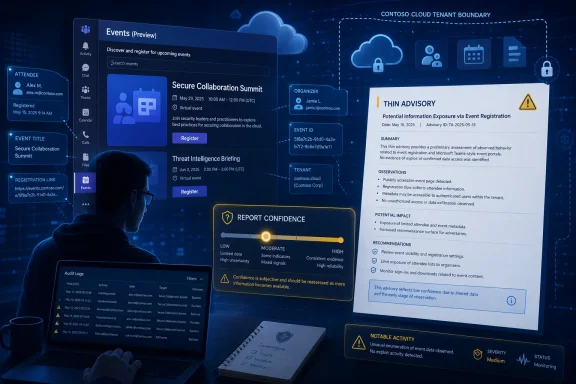 Microsoft’s Sparse CVE Tells IT Exactly What It Does Not Know
CVE-2026-33823 sits in a familiar modern category: information disclosure in a Microsoft-hosted collaboration or events service. That sounds less dramatic than remote code execution, but for cloud services the blast radius of disclosure is often bound up with identity, tenant boundaries, meeting metadata, registration workflows, and access-control assumptions. The phrase “information disclosure” is broad enough to cover anything from benign metadata leakage to exposure that materially helps an attacker stage a second step.The public record, at least from the advisory surface, does not appear to hand defenders a root-cause analysis, exploit recipe, or detailed affected-version matrix in the old desktop-software sense. That is increasingly normal for Microsoft cloud CVEs. When the affected technology is a hosted service, remediation may already be deployed server-side, and the advisory becomes a signal to customers rather than a patch-installation checklist.
That is useful, but it is also unsatisfying. Administrators are trained to ask operational questions: Was my tenant affected? Was data exposed? Do I need to rotate secrets, review audit logs, change conditional access, or notify users? A terse CVE often answers only the first-order question — “does Microsoft acknowledge a vulnerability?” — while leaving the second-order questions to risk management.
This is where report confidence matters. If Microsoft has acknowledged the issue, the vulnerability’s existence is not speculative. But the credibility of the public technical details may still be low, not because the vendor is hiding everything for no reason, but because publishing exploit-relevant detail can convert a contained cloud bug into a reproducible playbook.
“Information Disclosure” Is the Most Underestimated Severity Bucket
Security teams tend to triage by headline severity. Remote code execution gets the war room, privilege escalation gets the emergency change window, and information disclosure often gets a meeting invite. That instinct is understandable, but in identity-heavy cloud systems it can be dangerously outdated.A disclosure bug in an events portal may not hand an attacker a shell, but it could reveal who attended an event, who registered, which tenant or organization hosted it, what email addresses were used, what links or tokens were generated, or what internal titles and affiliations appeared in event data. None of those possibilities should be assumed for CVE-2026-33823 without confirmation. The point is that the vulnerability class itself lives in the terrain attackers already mine for social engineering and lateral movement.
Microsoft Teams and adjacent event tooling occupy a particularly sensitive place in enterprise life. They are not just chat clients or webinar front ends; they are identity-mediated business surfaces where employees, partners, prospects, vendors, and external guests meet. That makes metadata valuable. A leaked attendee roster can be a phishing list. A leaked event title can reveal a merger, incident response exercise, product launch, legal matter, or internal restructuring.
The industry still treats confidentiality failures as softer than integrity or availability failures because the damage is harder to observe. A crashed server announces itself. A stolen list of executives registered for a private briefing does not. The absence of visible disruption is not the same as the absence of harm.
The Report Confidence Metric Is a Warning Label for Defenders
The user-facing definition of report confidence is unusually honest: it measures how sure we are that the vulnerability exists and how credible the known technical details are. That sounds academic until you are the person deciding whether to escalate a ticket at 2 a.m. A vulnerability with confirmed existence but thin technical detail creates a different operational posture than a vulnerability with a public proof of concept and reproducible exploit chain.For CVE-2026-33823, Microsoft’s acknowledgement gives the vulnerability institutional weight. It is not merely a third-party rumor, a scraped database entry, or an unverified researcher claim. But acknowledgement does not automatically mean the public has enough information to model exploitability with precision.
That asymmetry is the core dilemma of modern vulnerability response. Vendors know more than they publish. Attackers may know more than defenders. Defenders must decide before they know enough. Report confidence, properly read, is a measurement of that uncomfortable middle state.
The metric also hints at adversary readiness. If only the existence of the vulnerability is public, opportunistic attackers may have little to work with beyond the product name and vulnerability class. If technical details are corroborated elsewhere, the window narrows. If a proof of concept appears, the CVE moves from “monitor” to “assume scanning or exploitation attempts are imminent,” even if the base severity score does not change.
Cloud CVEs Have Broken the Old Patch Tuesday Mental Model
The traditional Windows vulnerability story has a clean rhythm. Microsoft publishes a CVE, releases a patch, administrators test the patch, deployment rings roll outward, and the residual risk declines as coverage rises. That model still matters for Windows clients, servers, Office, SQL Server, Exchange, and plenty of on-premises components. But it maps poorly onto cloud services.A Microsoft Team Events Portal vulnerability is not something most administrators patch by downloading an update from the catalog. If Microsoft remediates it service-side, the local action may be limited to review, monitoring, and tenant hygiene. That can feel like “nothing to do,” but the better reading is “nothing to install.”
This distinction is increasingly important. In the cloud era, the customer’s security work shifts from binary patch state to exposure management. Did the service have external users? Were events public or private? Are audit logs retained long enough? Are guest access policies permissive? Are event organizers trained to avoid embedding sensitive data into titles, descriptions, and registration fields?
Cloud remediation also creates a communication problem. If Microsoft fixes a flaw before publishing a CVE, customers may wonder why they are hearing about it after the fact. If Microsoft publishes too much detail before full mitigation, it risks arming attackers. If it publishes too little, defenders complain that they cannot make informed decisions. All three complaints can be valid at the same time.
The Real Risk Is Not the Portal, but the Trust Graph Around It
The Microsoft Team Events Portal is best understood not as an isolated website, but as part of the Microsoft 365 trust graph. It intersects with identity, calendars, meetings, external sharing, organizational branding, user profiles, and sometimes marketing or customer engagement workflows. That surrounding context is what makes an information disclosure CVE worth more attention than the label might suggest.Attackers rarely need one spectacular bug when several small disclosures can be chained together. A portal leak might provide names and roles. A public profile might supply job function. A breached marketing list might provide email addresses. A convincing Teams-themed phish might then harvest credentials or session tokens. The initial disclosure may look modest in isolation while becoming meaningful in a campaign.
This is why defenders should resist the urge to grade CVE-2026-33823 only by its most literal description. “Information disclosure” is the beginning of the sentence, not the end. The real question is what information, in whose tenant, under what authentication conditions, and whether access crossed a boundary the customer reasonably believed was enforced.
Until those answers are public, the responsible posture is neither panic nor dismissal. It is scoped review. Organizations that use Microsoft-hosted event capabilities for internal-only briefings, executive meetings, regulated customer communications, or incident-response exercises should treat the advisory as a prompt to inspect process, not merely a line item in a vulnerability scanner.
Microsoft’s Transparency Push Still Leaves a Cloud-Sized Gap
Microsoft has spent the last few years trying to make vulnerability communication more standardized, more machine-readable, and more aligned with CVSS and CWE conventions. That work matters. Security teams need structured data they can ingest into ticketing systems, exposure-management platforms, and executive dashboards. The old era of prose-only advisories was not enough.But machine-readable does not always mean decision-ready. A CVE can have a clean title, a severity score, a weakness classification, and a vendor acknowledgement while still leaving defenders unable to answer the practical question: “What should we do differently today?” This is especially true for cloud services, where the remediation state may be invisible from the customer side.
The situation is not unique to Microsoft. Every major SaaS provider faces the same tradeoff. Publish too much, and attackers benefit. Publish too little, and customers lose trust. The cloud has made vulnerability disclosure less like distributing a patch and more like narrating a managed incident without revealing the attack path.
For WindowsForum readers, the lesson is to treat advisory metadata as a starting point. CVSS tells you how the vulnerability is modeled. The report confidence metric tells you how much faith to place in the existence and public details. The product name tells you where to look. None of those fields, alone, tells you whether your organization’s business process turned a medium-looking disclosure into a meaningful exposure.
Administrators Should Read This as a Tenant-Hygiene Test
The practical response to CVE-2026-33823 should begin with inventory. Not asset inventory in the old server-room sense, but workflow inventory. Which teams use Microsoft event tooling? Are events run by IT, communications, marketing, HR, legal, or individual departments? Are external attendees common? Are registration pages or event links distributed publicly?That matters because the people who create events are often not the people who read MSRC advisories. A central security team may know about the CVE while the communications team continues to run executive webinars with sensitive internal titles. Cloud security increasingly fails at these organizational seams, not just at the technical boundary.
Admins should also review logging assumptions. Microsoft 365 audit logs are only useful if the right workloads are captured, retention is adequate, and someone knows what normal event access looks like. If a portal vulnerability disclosed information without generating obvious user activity, logs may not provide a perfect answer. But the exercise still forces an organization to understand whether it could investigate such a claim at all.
The strongest response is not to invent emergency controls around a single sparse advisory. It is to make sure event data is classified sensibly, external sharing is intentional, guest access is governed, and sensitive internal context is not casually placed into fields that were designed for broad communication. CVE-2026-33823 is a reminder that collaboration metadata is still data.
Attackers Love Ambiguity More Than Severity Scores
The security industry often imagines attackers sorting vulnerabilities by CVSS score. Some do. But attackers also sort by ambiguity. A vague cloud disclosure can be useful if it reveals a product area worth probing, especially when the advisory hints at a boundary failure without naming the boundary.That does not mean CVE-2026-33823 is being exploited, or that attackers have a working method. It means defenders should understand how public breadcrumbs get used. The title alone identifies a Microsoft events surface and a confidentiality impact. For a capable researcher or adversary, that may be enough to begin testing assumptions around registration flows, authorization checks, invitation links, tenant isolation, and cached event assets.
This is the uncomfortable side effect of CVE transparency. Publishing less detail reduces immediate copycat risk, but publishing any CVE inevitably points attention somewhere. The answer is not secrecy. It is speed, monitoring, and layered controls that assume individual service boundaries may occasionally fail.
For enterprises, the ambiguity should drive prioritization by business context. If your organization barely uses the affected portal, the risk may be modest. If you use it for closed-door partner events, regulated briefings, private customer sessions, or leadership communications, the same advisory deserves more scrutiny. Severity is not just a number; it is the intersection between a flaw and your usage.
The AI Era Raises the Cost of Thin Public Details
A few years ago, sparse advisory text was a meaningful speed bump. Today, it is less of one. Automated tooling, code assistants, and agentic security research workflows can turn product names and vulnerability classes into test plans quickly. The public does not need a full exploit write-up for a motivated actor to generate hypotheses.That does not mean artificial intelligence magically discovers every bug. But it changes the economics of exploration. A vulnerability title that once would have required manual brainstorming can now seed automated checks across endpoints, parameters, permission states, and user roles. The known technical details may be thin, but the cost of guessing has fallen.
This makes report confidence more strategically important. A confirmed vendor advisory tells attackers that there is something real to hunt for. If the public details are sparse, defenders may not know exactly what to block, but attackers may still know enough to look. The asymmetry is sharper than it was in the pre-automation era.
For Microsoft and other cloud vendors, this is an argument for faster customer-facing clarity after mitigation. Once the immediate exploit risk has passed, customers need more than a title and a score. They need bounded impact statements: what classes of data, what customer configurations, what time window, and what evidence would indicate exposure. Without that, the advisory lifecycle ends too early for the people responsible for risk.
The Confidence Field Is the Small Line That Should Change the Meeting
CVE-2026-33823 should not trigger theater. It should trigger disciplined questions. The value of the report confidence metric is that it reminds teams to separate three things that often get blurred: whether the vulnerability exists, whether the public understands it, and whether the organization is exposed in a meaningful way.- Microsoft’s acknowledgement means defenders should treat CVE-2026-33823 as a real vulnerability, not as an unverified database artifact.
- The sparse public detail means organizations should avoid overclaiming impact until Microsoft or credible researchers provide more specifics.
- Information disclosure in collaboration tooling can matter even when it lacks the drama of remote code execution.
- Cloud-service CVEs often require tenant review, logging checks, and process changes rather than a conventional patch deployment.
- Organizations that use Microsoft event tooling for sensitive internal or external sessions should prioritize business-context review over generic severity sorting.
- The report confidence metric is a practical reminder that attacker knowledge and defender knowledge do not always advance at the same pace.
Source: MSRC Security Update Guide - Microsoft Security Response Center
