

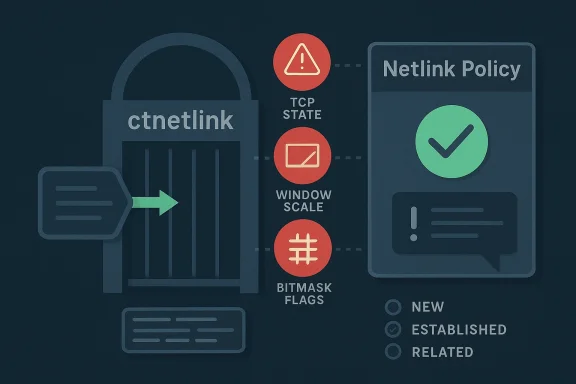
At the center of the fix is the idea that netlink policies should define what values are acceptable before the kernel ever gets to business logic. The Linux kernel documentation for netlink emphasizes policy tables for input validation, and it frames netlink as a structured user-kernel control plane rather than an informal message bus When a subsystem like conntrack uses policy metadata correctly, the parser can reject illegal values early, generate better errors, and avoid pushing invalid state into protocol logic.
This CVE is also a good example of how modern Linux security work is increasingly about hardening interfaces rather than fixing obvious crashes. The patch is described as being extracted from a broader nf-next change by Florian Westphal and then scoped to ctnetlink fat matters because it suggests the issue was discovered in the course of normal subsystem maintenance, not because an exploit was making the rounds.
The affected attributes tell the story. CTA_PROTOINFO_TCP_STATE should reject values above TCP_CONNTRACK_SYN_SENT2, not simply be checked later against a maximum constant. CTA_PROTOINFO_TCP_WSCALE_ORIGINAL and CTA_PROTOINFO_TCP_WSCALE_REPLY now reject values above TCP_MAX_WSCALE (14), which is especially important because the ctnetlink path had previously accepted a much wider range than the normal TCP option-parsing path would allow
Td out the patch. CTA_FILTER_ORIG_FLAGS and CTA_FILTER_REPLY_FLAGS now use NLA_POLICY_MASK with CTA_FILTER_F_ALL, and CTA_EXPECT_FLAGS gets a new NF_CT_EXPECT_MASK grouping for valid expectation flags In other words, the kerolicy layer what “valid” means instead of letting each code path re-implement that logic on its own.
Overview
Conntrack is one of the most important state engines in Linux networking. It tracks flows as new, established, related, or expected, and that state underpins firewalling, NAT, helper behavior, packet mangling, and a lot of orchestration plumbing that enterprise networks quietly depend on. Netfilter bugs often become security issues because they sit so close to the boundary where userspace configures packet-processing behavior, and ctnetlink is one of the main ways that state is exposed and manipulated.
What makes CVE-2026-31495 notable is that it is not primarily a bug about packet data flowing through the wire. It is about control data entering the kernel through netlink. That distinction matters because control-plane mistakes are frequently more dangerous than they first appear. A malformed value does not need to corrupt packets immediately if it can perturb state machines, trigger undefined behavior, or cause the kernel to accept invalid internal conditions.
The patch description specifically calls out a u32 shift count problem for the TCP window scale attributes. The normal TCP option parsing path already clamps the window scale value, but the ctnetlink path had accepted values from 0 to 255, which could create undefined behavior when later used as a shift operand That is the sort of bug that looks harmless t is “just” a number check, yet it can become a real correctness or availability problem once the value is used in arithmetic.
There is also a broader maintenance lesson here. Kernel networking code has accumulated many generations of interfaces, compatibility layers, and ad hoc checks. The more places that accept the same conceptual field, the more likely one path will drift from the others. Policy annotations exist precisely to reduce that drift. They let the kernel define one authoritative validation rule and reuse it everywhere.
That is why this CVE should be understood as both a fix and a cleanup. It reduces the chance of invalid input entering the subsystem, and it also makes the API more readable for future maintainers. In kernel work, that combination is often what turns a small patch into an important one.
What Changed in ctnetlink
The heart of the patch is a shift from manual validation to policy-driven validation. That sounds like a style change, but in practice it changes when and where invalid input is rejected. Instead of a deeper function discovering that a value is too large, the netlink parser itself now blocks the bad input and can explain why.
Policy over ad hoc checks
The new logic uses netlink policy annotations to constrain valid ranges and masks. That means the kernel’s generic netlink machinery can enforce boundaries before the ctnetlink implementation starts doing anything meaningful with the data. This is cleaner, and it is safer, because every caller sees the same rule set.
The description is explicit that the old code had manual range and mask validations. Those checks worked, but they were scattered and less expressive than the policy annotations now in use The policy layer is better because it is both declarative and cenOTOINFO_TCP_STATE** now rejects values above the last valid TCP conntrack state.
- CTA_PROTOINFO_TCP_WSCALE_ORIGINAL and CTA_PROTOINFO_TCP_WSCALE_REPLY are capped at 14.
- CTA_FILTER_ORIG_FLAGS and CTA_FILTER_REPLY_FLAGS use a mask policy.
- CTA_EXPECT_FLAGS now has a dedicated valid-mask definition.
Why the window-scale fix matters
The window-scale change is the most obviously dangerous piece of the patch. A TCP window-scale field is not supposed to be an arbitrary byte value in this path, and letting it wander up to 255 was asking for undefined behavior in a shift operation That is the kind of bug that can stay dormant until a caller sends a weird value, at w’s behavior can become unpredictable.
The important detail is that the normal TCP parsing path already knew how to clamp the field. The bug was not in the TCP concept itself; it was in the ctnetlink exposure of that concept. That means the vulnerability is really about inconsistent validation across interfaces, which is often how kernel bugs hide.
Extack and better failures
The other advantage of moving checks into policy is that the kernel can generate extack errors. That matters for operators and tooling because it turns a silent rejection or weird downstream effect into a comprehensible failure. Better diagnostics lower the cost of debugging and reduce the temptation to work around the kernel with brittle userspace assumptions.
This is one of those cases where security and usability align. A tighter policy means safer input handling, and a clearer error path means fewer operators will misinterpret a rejection as random breakage.
Why Netlink Policy Matters
Netlink is not just another internal transport. It is one of the kernel’s main control planes, and that means the correctness of its validation rules directly affects how safely userspace can configure kernel subsystems. When policy metadata is accurate, the parser becomes a gatekeeper instead of a passive courier.
The value of centralized validation
A central policy definition gives the kernel a single source of truth for what is valid. That is far better than duplicating checks across multiple call sites, because duplicated checks inevitably drift. One path clamps, another masks, a third forgets to validate at all, and suddenly the same logical field has three different meanings depending on how it arrived.
That drift is exactly the sort of maintenance debt that security teams hate and kernel maintainers try to eliminate. Once the policy is correct, the parser and its callers become easier to audit. The kernel documentation’s emphasis on policy tables for input validation is not theoretical; it is the operational model the subsystem is meant to follow
Why early rejection is safer
Rejecting bad data at the edge is preferable to discovering it later. A later check may still prevent damage, but it has already allowed invalid state into the subsystem. In this CVE, that distinction is particularly important because some of the affected values can be used in calculations or masks that are only safe if the input is already bounded.
Early rejection also helps contain future mistakes. If another developer later adds a code path that reuses the same attributes, the policy is already there to enforce the contract. That is a much stronger defense than relying on every future maintainer to remember a hidden invariant.
The ctnetlink path versus normal parsing
One subtle but important point in the description is that the normal TCP option parsing path already clamps the relevant values, while the ctnetlink path did not That asymmetry is often where security bugs bre safe in one context, so engineers assume the same field is safe everywhere, but a second interface exposes it with different rules.
The fix closes that gap by aligning ctnetlink with the behavior already expected elsewhere. That is not just tidy; it is how kernel interfaces become less surprising over time.
TCP State and Window-Scale Validation
The TCP-related portions of the patch are the most intuitive place to see the bug’s practical implications. The state enumeration and the window-scale fields are both bounded concepts, and treating them as unbounded integers is a classic source of invalid behavior.
TCP state as a bounded enum
CTA_PROTOINFO_TCP_STATE is now constrained so values above TCP_CONNTRACK_SYN_SENT2 are rejected at policy level, which replaces the older manual >= TCP_CONNTRACK_MAX check That is a subtle but meaningful change: the kernel is now encoding tdary of the state machine directly into the policy.
In practice, this helps prevent userspace from describing impossible conntrack states. That matters because an impossible state is not just a bad number; it is a potentially destabilizing input to logic that assumes the enumeration is valid.
Window-scale and undefined behavior
The window-scale values are more concerning because of the arithmetic angle. The patch note says the ctnetlink path accepted 0–255, while the relevant TCP path already clamps to 14 and the wider range could produce undefined behavior when used as a u32 shift count That is exactly the sort of edge case that can turn a validation bug into a correctness bat is too large is not a harmless out-of-range value. In C and C-like kernel code, it can produce undefined results, and undefined behavior is the last thing you want anywhere near a network-facing control path. Even if the outcome is “just” a bad calculation, that can cascade into incorrect state bookkeeping.
Why 14 is the right ceiling
The ceiling is not arbitrary. TCP window scaling has a real protocol-defined limit, and the patch makes sure the ctnetlink interface respects it. By enforcing TCP_MAX_WSCALE = 14, the kernel is aligning the netlink API with the protocol’s actual design constraints
- It prevents invalid values from reaching shift operations.
- It keeps ctnetlink aligned with normal TCP parsource of undefined behavior.
- It reduces the chance of future divergence across code paths.
This is a textbook example of why kernel validation should mirror protocol semantics, not merely mirror whatever historical code happened to accept.
Flags, Masks, and Safer Expectation Handling
The mask changes may look less dramatic than the TCP state fix, but they are important because mask logic is exactly where silent validation mistakes tend to hide. A mask policy is more expressive than a custom “if bits outside this set are present, reject” check, and it keeps the contract visible to both code and tooling.
FILTER flags now use a policy mask
The patch changes CTA_FILTER_ORIG_FLAGS and CTA_FILTER_REPLY_FLAGS to use NLA_POLICY_MASK with CTA_FILTER_F_ALL That removes manual mask checking from the code path and centralizes the rule in the netlink policy description.
The practical effd filter bits are accepted. That reduces the chance of unsupported or reserved bits being interpreted in unexpected ways later in the pipeline. It is also easier to maintain because the accepted set lives in one place.
EXPECT flags get a dedicated mask define
The more interesting structural change is CTA_EXPECT_FLAGS, which now uses NLA_POLICY_MASK with NF_CT_EXPECT_MASK, and the patch adds a new mask definition that groups all valid expectation flags together That is the sort of cleanup that usually pays off later even if the immediate bug looks modest.
A dedicated mask define matters because it expresses intering assumptions about which bits are legal, the code defines the valid set once and reuses it. That makes reviews easier and reduces the chance of accidental future expansion.
Why mask policy is better than hand-written validation
Hand-written bit checks are easy to get wrong in small ways. A developer might miss a bit, invert a condition, or forget to update one path when a new flag is added. With a policy mask, the kernel’s generic validation layer takes over that responsibility.
That does not just improve safety. It also improves clarity. Future maintainers can see the valid flag set immediately, and tools that inspect netlink schemas can infer the same rule without reverse-engineering conditional logic.
- Fewer duplicate checks.
- Better future-proofing.
- Clearer semantics for userspace.
- Lower risk of stale validation rules.
Why This Became a CVE
Some kernel fixes are obviously security-relevant because they lead directly to memory corruption, privilege escalation, or remote code execution. CVE-2026-31495 is subtler. Its impact comes from accepting invalid values into privileged networking logic and from one path allowing undefined behavior where another path already enforced the right bounds.
Security is not only about exploits
The Linux kernel often treats unsafe input handling as a security issue even when there is no immediate exploit narrative. That is sensible because a bad input boundary can eventually become a reliability problem, a crash condition, or a future exploitation primitive. A bug that seems “just a validation gap” is often a precondition for something worse.
This CVE fits that pattern. The description does not claim a dramatic exploitation chain, and NVD had not yet assigned a CVSS score at publication time, but the fix is still meaningful because it hardens the control plane and eliminates undefined behavior before it can spread
The undefined-behavior angle matters
The most security-sensitive detail is the window-scale path. Undefined behavior in kernel code is not just a theoretical C-languaggn that the code may behave unpredictably under attacker-controlled input. Even if the immediate effect is limited, undefined behavior is precisely the kind of thing maintainers try to stamp out.
When the patch says the value could be used as a u32 shift count, that should be read as a red flag. The kernel is relying on an arithmetic assumption that must be enforced before the value gets that far.
Why this is an input-validation CVE
The vulnerability is best understood as a netlink policy validation flaw. The code accepted values it should not have accepted, and those values could then influence logic that assumes a valid protocol state. That is a classic security boundary failure: the kernel trusted user input too far upstream.
This is also why the fix is so surgical. It does not rework conntrack itself. It just makes the parser honest about what it can accept.
Enterprise and Consumer Impact
The practical impact of a netfilter CVE depends heavily on how the system is used. On a desktop, conntrack netlink paths may never be touched directly. On a firewall, gateway, container host, or appliance, they may be part of daily operations and automation.
Enterprise exposure
Enterprise environments are the most likely to care. Firewalls, NAT gateways, Kubernetes nodes, cloud edge systems, and packet-inspection appliances all rely on conntrack behavior in one form or another. In those environments, invalid netlink input is not an academic problem; it is a path into the logic that governs packet state and network policy.
That means validation bugs can affect not only security but operational stability. A malformed control message can create troubleshooting noise, unexpected rejections, or undefined behavior in paths that operators assume are deterministic. The more important the node is to the network, the more seriously the bug should be treated.
Consumer exposure
Consumer exposure is usually lower, but not zero. A typical laptop probably does not exercise the affected ctnetlink paths frequently, if at all. Still, many consumer Linux systems are really embedded infrastructure in disguise: routers, small office gateways, lab boxes, and home servers all count.
That is why “consumer vs enterprise” is not a perfect dividing line. If a home system is acting as a network control plane, the same netfilter logic can be just as relevant as it is in a datacenter.
Why patch priority should track workload
The key question is not whether the bug has a scary CVE number. It is whether your kernel workload uses the affected interface. If you depend on conntrack-related netlink operations, especially in automation or management tooling, this is the kind of issue that should move up the patch queue.
- Firewalls and gateways have the clearest exposure.
- Container platforms may inherit the path indirectly.
- Desktop users are less likely to hit it.
- Embedded devices may be more exposed than their owners realize.
Strengths and Opportunities
The strongest aspect of this patch is that it improves both security and maintainability at the same time. It moves validation closer to the interface boundary, reduces duplicate logic, and makes the behavior easier to explain to operators and developers alike. That is exactly what good kernel hardening should do.
- Early rejection of invalid values at the netlink policy layer.
- Better extack errors for userspace debugging.
- Reduced undefined behavior in TCP window-scale handling.
- Cleaner semantics for conntrack state and flag validation.
- Less duplicated logic across ctnetlink code paths.
- Improved maintainability for future netfilter changes.
- Stronger API contracts for tools that build on netlink.
There is also a quiet strategic opportunity here. When kernel subsystems adopt policy-driven validation consistently, downstream tooling becomes more reliable because the interface contract is explicit. That makes it easier for vendors, distro maintainers, and enterprise teams to reason about what is supported and what is not.
Risks and Concerns
The main risk is underestimating the issue because it looks like a validation cleanup instead of a flashy exploit. That would be a mistake. Kernel bugs that allow invalid state into networking control paths are often more important operationally than their first description suggests, especially in fleets that depend on netfilter for policy enforcement.
- Patch lag in vendor kernels and appliance firmware.
- Hidden exposure in container, gateway, and firewall workloads.
- Assumptions of safety based on the normal TCP parsing path.
- Potential undefined behavior if invalid values reach arithmetic.
- Inconsistent backport timing across supported distributions.
- Tooling confusion if userspace expects permissive behavior.
- False confidence from the absence of an NVD severity score.
Another concern is that organizations may not realize they are using the affected path. Conntrack and netlink are infrastructure plumbing, so exposure often hides behind orchestration tooling, firewall templates, or vendor defaults. The bug may be small, but the number of places it can surface is not.
Looking Ahead
The most important thing to watch next is downstream adoption. Upstream fixes are only part of the story in Linux security, because most real systems run vendor kernels, not raw mainline trees. The exposure window remains open until distribution maintainers and appliance vendors carry the patch into their supported builds.
It is also worth watching whether this CVE prompts a broader review of ctnetlink validation. Once a subsystem has one validation inconsistency, maintainers often audit adjacent fields and related policies to make sure the same pattern does not exist elsewhere. That kind of cleanup is one of the best side effects of a well-scoped security fix.
Finally, administrators should use this as a reminder that netlink policy is not mere metadata. It is part of the security boundary. When policy annotations are accurate and complete, the kernel rejects invalid input before it can become a harder-to-debug problem later.
- Verify whether your kernel stream includes the backport.
- Check whether your environment uses ctnetlink or conntrack automation.
- Review firewall and gateway systems first.
- Look for vendor advisories that mention the specific policy fix.
- Treat netlink validation issues as operational risks, not just code hygiene.
CVE-2026-31495 is not the kind of bug that dominates headlines, but it is the kind of bug that keeps Linux networking trustworthy. By tightening the netlink policy layer, the kernel is doing exactly what mature infrastructure software should do: refusing invalid input sooner, explaining failures better, and reducing the chance that a small inconsistency turns into a larger incident later.
References
- Security Update Guide - Microsoft Security Response Center NVD / Linux Kernel