

In the Linux kernel’s Bluetooth stack, CVE-2026-31498 is the kind of bug that looks routine at first glance and then turns out to be two problems in one: a resource leak in L2CAP ERTM reconfiguration and a potential infinite loop triggered by a zero packet size. The published fix targets the kernel’s handling of reconfiguration requests for already-connected channels, plus a missing guard in SDU segmentation that can let a malformed value drive the code into unbounded memory consumption. Although NVD had not yet assigned a severity score at the time of publication, the upstream patch history and the vendor advisory framing make clear that this is a high-value stability and security correction. ulnerability lives in the Linux kernel’s Bluetooth L2CAP layer, specifically the path that handles Enhanced Retransmission Mode (ERTM) channels. L2CAP is the transport and multiplexing layer beneath many Bluetooth profiles, so defects here can affect data transfer reliability, channel reconfiguration, and memory safety across a wide range of Bluetooth workloads. In practical terms, that means the bug is not limited to one niche profile or one unusual device; it is rooted in a shared kernel subsystem used by many Bluetooth connections.
The first half ofic state-management mistake. During
The second half is more severe from arspective. The code path that parses configuration options does not enforce a minimum value for
This is not just a “cleanup” patch. code, leaks and loops often interact with real-world traffic patterns and can be turned into service degradation long before they become a crash. Bluetooth is particularly sensitive because it is often enabled by default, used by laptops and handheld systems, and exposed to nearby devices in crowded RF environments. A bug that combines resource exhaustion with state reinitialization is exactly the sort of defect that can turn into a support headache even when nobody is actively trying to weaponize it.
The function names in the CVE description tell the story.
Historically, Bluetooth vulnerabilities in operating systems have often been treated as reliability issues until the became impossible to ignore. Microsoft’s own documentation on older Windows Bluetooth stack flaws shows how packet-handling defects have previously been capable of remote code execution in affected systems, reinforcing the broader lesson that Bluetooth protocol bugs can have serious impact when they sit low enough in the stack. That history is relevant here because it explains why a zero-length guard in a transport path deserves more attention than its small code diff might suggest.
At a process level, the advisory also reflects the Linux kernel’s modern vulnerability pipeline. The issueystem and then included in NVD enrichment, while the actual remediation landed through stable kernel commits. That pattern is increasingly common for kernel Bluetooth issues: a bug is found, the fix is merged upstream, and downstream vendors later map the commit to a named CVE for customers who need actionable tracking.
There is also the problem of
The second defect is a classic input-validation failure.
This is the right architectural choice because it separates “update negotiated parameters” from “recreate the entire channel’s internal object graph.” Those are different operations, and conflating them is what caused the leak. By skipping the double-init pves state that should remain resident and prevents allocations from being orphaned every time a connected channel is tuned.
The second part of the fix adds a defensive check against zero-length segmentation. That matters even if the parser is expected to normalize input, because kernel code benefits from layered validation. A bad packet should be rejected as early as possible, but a later-stage safn unexpected edge case cannot cascade into an unbounded loop. Defense in depth is not just a policy slogan here; it is the difference between a malformed field and a stalled system.
The leak is less flashy but still meaningful. Kernel memory leaks are often dismissed as “only” stability problems, yet in a persistent subsystem like Bluetooth they can degrade long-running systems in exactly the ways administrators hate: intermittent failures, poor device responsiveness, and escalating memory pressure that is difficune protocol exchange. Over time, the leak can become the more operationally expensive problem even if the loop is the more obvious one.
There is also a trust issue around reconfiguration. The fact that this bug surfaces during live channel updates means it may be triggered in normal usage, not only by exotic packet crafting. That increases the chance that the flaw could be observed in ordinary environments where laptops, peripherals, and embedded devices repeatedly renegotiate parameters.us part*: the code path is part of normal protocol hygiene.
The issue also matters in managed environments where Bluetooth is used for conference rooms, call centers, healthcare accessories, or warehouse devices. In such deployments, a malformed configuration exchange or repeated renegotiation can have cumulative effects if the system is left up for long periods. Enterprises tend to notice leaks later than consumers do, because their machines stay on longer and their help tterns across many devices.
It is worth emphasizing that this is not just a desktop problem. Linux Bluetooth sits in servers, appliances, kiosk systems, and field devices too, especially where local wireless peripherals are part of the deployment model. In those cases, a loop or leak in the Bluetooth stack can create availability issues in devices that were never intended to be “Bluetooth computers” in the consumer sense. *That broadens the risk profile considerise response checklist
The consumer risk is amplified by the way Bluetooth is used in real life. People connect and disconnect devices constantly, move between rooms, and rely on automatic reconnection behavior. That creates exactly the kind of repeated state churn that exposes flaws in reconfiguration logic. Normal use can be enough; this is not a bug that requires an elaborate laboratory setup to matter.
At the same time, the likely remediation is straightforward. A kernel update that incable commit should resolve the issue without requiring users to change how they pair or use devices. That is reassuring, but it also means users should not wait for symptoms before updating, because the fix is preventive rather than reactive.
The WindowsForum archive itself has covered similar Linux Bluetooth issues, including memory-safety and state-management defects in L2CAP that required surgical fixes rather than sweeping rewrites. That broader pattern is important because it shows the ecosystem is not dealing with one-off accidents, but with a class of bugs created by the complexity of long-lived transport state. The security lesson is consistent: if the protocol can renegotiate, then the code must prove that reconfiguration is not treated as a second initializati
This is also why Bluetooth bugs continue to matter for Linux distributions that move quickly. Modern kernels change often, and a fix can arrive in one branch while another branch lags behind. Users may assume “Bluetooth works” until a seemingly unrelated update changes timing or state transitions and reveals a dormant flaw. The result is not just a patching problem, but a validation problem for distro maintainers and device vendors.
The patch also reinforces a healthy pattern in kernel hardening: trust protocol parsing less, not more, and make each layer independently safe. That is especially useful in Bluetooth, where devicesotiate, and reshape traffic conditions in ways that are not always predictable. The result is a stronger baseline for both reliability and security.
There is also the possibility of incomplete backporting. Kernel fixes of this kind often have to be adapted across stable branches, vendor trees, and long-term support releases. If a downstream tree carries nearby changes in L2CAP, the local backport could miss the exact guard conditions or reinit logic change that makes the patch safe. That is where “fixed upstream” and “fixed in your distro” can diverge.
Another concern is visibility. Memory leaks rarely produce one clean alert; they appear as a general decline in system behavior. That makes the bug harder to attribute, which in turn can slow remediation in environments whare misdiagnosed as firmware, peripheral, or desktop-stack problems. If you only look at symptoms, you may miss the root cause.
It will also be worth watching whether additional Bluetooth CVEs cluster around similar lifecycle assumptions. When one bug reveals a weak spot in configuration or segmentation logic, adjacent code paths often deserve a second look. In mature kernel subsystems, one fix rarely ends the story; it usually marks the beginning of a broader review of related invariants.
Finally, user feedback from distro communities can be an early indicator of whether the patch solves more than the security bug it was meant to address. If Bluetooth stability improves after the update, that will reinforce the idea that this CVE was probably affecting more systems than anyone initially noticed. If not, then rill be hiding nearby. Either way, the patch is a useful test case for how well the Linux ecosystem catches and contains subtle protocol-state failures.
Source: NVD / Linux Kernel Security Update Guide - Microsoft Security Response Center
The first half ofic state-management mistake. During
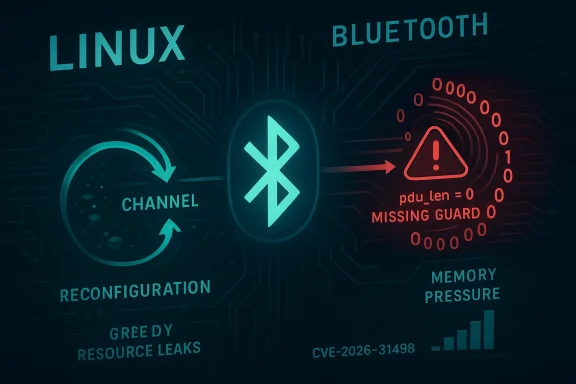
CONFIG_REQ processing, l2cap_config_req can revisit a channel that is already in BT_CONNECTED state to support reconfiguration such as MTU changes. But because the configuration-done flags are already set from the initial setup, the logic falls through to l2cap_ertm_init, which reinitializes queues and lists without freeing the old allocations and also resets chan->sdu without freeing the existing skb. That means previously allocated ERTM resources are leaked rather than reused or released cleanly.The second half is more severe from arspective. The code path that parses configuration options does not enforce a minimum value for
remote_mps, which is derived from the RFC max_pdu_size option. If that value becomes zero, l2cap_segment_sdu computes a pdu_len of zero, and the segmentation loop never decrements len. In other words, the kernel can get stuck in a non-terminating loop that keeps allocating until memory pressure becomes catastrophic. The fix adds a guard to stop that condition at the source.
 Why this matters
This is not just a “cleanup” patch. code, leaks and loops often interact with real-world traffic patterns and can be turned into service degradation long before they become a crash. Bluetooth is particularly sensitive because it is often enabled by default, used by laptops and handheld systems, and exposed to nearby devices in crowded RF environments. A bug that combines resource exhaustion with state reinitialization is exactly the sort of defect that can turn into a support headache even when nobody is actively trying to weaponize it.Background
Bluetooth’s **Logical Link Control and Adaptation Protoco an awkward but essential place: it must present orderly channel semantics to higher layers while coping with lossy wireless links underneath. ERTM exists to improve reliability by adding sequencing, retransmission, and supervisory behavior on top of basic L2CAP transport. That also means ERTM carries more state, more queues, and more opportunities for memory management bugs than a simple best-effort path.The function names in the CVE description tell the story.
l2cap_config_req is responsible fortion requests, including reconfiguration after a channel is already up. l2cap_ertm_init sets up ERTM data structures such as transmit and selective-repeat lists. l2cap_segment_sdu breaks a higher-level payload into transport-sized pieces. When these three areas are chained together, one logic oversight can create both leaked allocations and an unbounded loop.Historically, Bluetooth vulnerabilities in operating systems have often been treated as reliability issues until the became impossible to ignore. Microsoft’s own documentation on older Windows Bluetooth stack flaws shows how packet-handling defects have previously been capable of remote code execution in affected systems, reinforcing the broader lesson that Bluetooth protocol bugs can have serious impact when they sit low enough in the stack. That history is relevant here because it explains why a zero-length guard in a transport path deserves more attention than its small code diff might suggest.
At a process level, the advisory also reflects the Linux kernel’s modern vulnerability pipeline. The issueystem and then included in NVD enrichment, while the actual remediation landed through stable kernel commits. That pattern is increasingly common for kernel Bluetooth issues: a bug is found, the fix is merged upstream, and downstream vendors later map the commit to a named CVE for customers who need actionable tracking.
The ERTM angle
ERTM is not the most glamorous part of Bluetooth, but it is one of the places where correctness matters most. The proliability, retransmission, and flow control while staying synchronized with peer-negotiated parameters. If state reinitialization occurs at the wrong moment, the code can either lose track of live buffers or silently leak them, both of which are bad in a kernel path that may execute repeatedly over long-lived connections.What the bug actually does
The first defect is caused by a subtle mismatch between configuration state and channel lifecycle state. The chanted, but the configuration path still behaves as if it is finishing initial setup and re-enters ERTM initialization. That means data structures such astx_q, srej_q, srej_list, and retrans_list are reinitialized without freeing their previous backing allocations first. The kernel is therefore left holding multiple abandoned pieces of ERTM state.There is also the problem of
chan->sdu. The reinit path nulls this pointer without freeing the skb already attached to it. In networking code, this is exactly the kind of smalat can quietly accumulate into a significant memory leak under repeated operation. If the channel is reconfigured multiple times, the leak becomes persistent and can erode stability long before an administrator notices a specific fault.The second defect is a classic input-validation failure.
l2cap_parse_conf_req accepts a remote MPS value that can reach zero, even though the downstream segmentation logic clearly assumes it hawork with. Once l2cap_segment_sdu sees that zero, the loop condition no longer makes progress because len never drops. This is the sort of bug that turns a malformed option into a resource exhaustion problem with a very low threshold for impact.Why zero is dangerous here
A zero-length transport unit is not merely “small”; it is semantically invalid for a segmentation loop that depends on subtraction to terminate. When the loop body cannot reduce the remrnel ends up doing work forever, or at least until memory allocation pressure forces the system into a degraded state. That is why the patch adds a specificpdu_len == 0 safeguard in the segmentation routine rather than trusting the upstream parser alone.- The leak is tied to reconfiguration, not only initial setup.
- The loop depends on a zero
pdu_lenvalue reaching segmentation. - The bug spans both state management and input validation.
- The impact can include **memdegraded Bluetooth service.
The upstream fix
The published fix is intentionally narrow. It avoids re-runningl2cap_ertm_init and l2cap_chan_ready when the channel is already in BT_CONNECTED state, while still allowing l2cap_parse_conf_req to update the reconfiguration parameters. In other words, the channel can accept new settings without being treated like a brand-new connection, which preserves the logic needed for safe live reconfiguration.This is the right architectural choice because it separates “update negotiated parameters” from “recreate the entire channel’s internal object graph.” Those are different operations, and conflating them is what caused the leak. By skipping the double-init pves state that should remain resident and prevents allocations from being orphaned every time a connected channel is tuned.
The second part of the fix adds a defensive check against zero-length segmentation. That matters even if the parser is expected to normalize input, because kernel code benefits from layered validation. A bad packet should be rejected as early as possible, but a later-stage safn unexpected edge case cannot cascade into an unbounded loop. Defense in depth is not just a policy slogan here; it is the difference between a malformed field and a stalled system.
Why the fix is disciplined
The patch does not attempt a broad refactor of L2CAP ERTM. It does not redesign channel setup or rewrite the segmentation logic wholesale. Instead, it closes the exact paths that are unsafe and leaves the rest of the protocol machinery intact. That is typically thenel fix: minimal surface area, direct causality, and no new behavioral surprises unless absolutely necessary.- Skip double initialization on already connected channels.
- Keep parameter updates working during reconfiguration.
- Add a zero-length guard in the segmentation path.
- Preserve protocol behavior while eliminating memory leaks and non-termination.
Security and stability implications
Tcern is availability. The infinite loop scenario is naturally a denial-of-service candidate because it can chew through memory and keep a CPU busy without making forward progress. If a Bluetooth-facing path can be driven into that state by malformed configuration data, the resulting blast radius can extend beyond Bluetooth itself as the kernel fights to preserve system health.The leak is less flashy but still meaningful. Kernel memory leaks are often dismissed as “only” stability problems, yet in a persistent subsystem like Bluetooth they can degrade long-running systems in exactly the ways administrators hate: intermittent failures, poor device responsiveness, and escalating memory pressure that is difficune protocol exchange. Over time, the leak can become the more operationally expensive problem even if the loop is the more obvious one.
There is also a trust issue around reconfiguration. The fact that this bug surfaces during live channel updates means it may be triggered in normal usage, not only by exotic packet crafting. That increases the chance that the flaw could be observed in ordinary environments where laptops, peripherals, and embedded devices repeatedly renegotiate parameters.us part*: the code path is part of normal protocol hygiene.
Security posture versus exploitability
A zero-length loop bug does not automatically imply remote code execution, and NVD had not yet published a final assessment. But a stable kernel bug that can be induced from malformed protocol state is still a serious security issue because it can be used for denial-of-service and because kernel memory pressure often exposes other stem. The absence of a score should not be confused with low importance.Enterprise impact
Enterprises are likely to care about this vulnerability for two reasons: fleet reliability and hard-to-diagnose Bluetooth instability. A kernel leak on endpoints that frequently pair with headsets, keyboards, mice, or industrial peripherals can create support tickets that look like random device failures but actually stem from the same transport-layer defect. dinary—kernel update and reboot—but the operational cost of delay can be surprisingly high.The issue also matters in managed environments where Bluetooth is used for conference rooms, call centers, healthcare accessories, or warehouse devices. In such deployments, a malformed configuration exchange or repeated renegotiation can have cumulative effects if the system is left up for long periods. Enterprises tend to notice leaks later than consumers do, because their machines stay on longer and their help tterns across many devices.
It is worth emphasizing that this is not just a desktop problem. Linux Bluetooth sits in servers, appliances, kiosk systems, and field devices too, especially where local wireless peripherals are part of the deployment model. In those cases, a loop or leak in the Bluetooth stack can create availability issues in devices that were never intended to be “Bluetooth computers” in the consumer sense. *That broadens the risk profile considerise response checklist
- Inventory kernels that include the vulnerable L2CAP code path.
- Prioritize hosts with Bluetooth enabled by default.
- Test kernel updates against local peripherals and automation workflows.
- Watch for unexplained memory growth on long-lived endpoints.
- Validate that Bluetooth reconfiguration events still complete normally after patching.
Consumer impact
For consumers, the story is simpler but st use Bluetooth on Linux for everyday peripherals, you want this fixed. A memory leak may not announce itself dramatically, but it can show up as sluggishness, pairing oddities, or a Bluetooth service that seems less reliable after repeated use. A zero-length loop, by contrast, can contribute to a system freeze or severe memory pressure if triggered under the right conditions.The consumer risk is amplified by the way Bluetooth is used in real life. People connect and disconnect devices constantly, move between rooms, and rely on automatic reconnection behavior. That creates exactly the kind of repeated state churn that exposes flaws in reconfiguration logic. Normal use can be enough; this is not a bug that requires an elaborate laboratory setup to matter.
At the same time, the likely remediation is straightforward. A kernel update that incable commit should resolve the issue without requiring users to change how they pair or use devices. That is reassuring, but it also means users should not wait for symptoms before updating, because the fix is preventive rather than reactive.
What users may notice
- Bluetooth devices disconnecting or reconnecting oddly.
- Gradual system slowdown after long Bluetooth sessions.
- Inon systems left on for days or weeks.
- Problems that appear only after configuration changes or reconnects.
Broader Linux Bluetooth pattern
CVE-2026-31498 fits a pattern that security teams have seen repeatedly in the Linux Bluetooth stack: small state-machine mistakes, missing validation checks, and packet-processing paths that assume a ro, duplicated, or malformed. These are not glamorous bugs, but they are exactly the kind that accumulate across protocol code because protocol code has to be both fast and flexible.The WindowsForum archive itself has covered similar Linux Bluetooth issues, including memory-safety and state-management defects in L2CAP that required surgical fixes rather than sweeping rewrites. That broader pattern is important because it shows the ecosystem is not dealing with one-off accidents, but with a class of bugs created by the complexity of long-lived transport state. The security lesson is consistent: if the protocol can renegotiate, then the code must prove that reconfiguration is not treated as a second initializati
This is also why Bluetooth bugs continue to matter for Linux distributions that move quickly. Modern kernels change often, and a fix can arrive in one branch while another branch lags behind. Users may assume “Bluetooth works” until a seemingly unrelated update changes timing or state transitions and reveals a dormant flaw. The result is not just a patching problem, but a validation problem for distro maintainers and device vendors.
Why this class of bug persists
The code is juggling many responsibilities at oncetransmission, queueing, and object lifecycle. Every extra feature increases the chance that one path will forget to free, reinitialize, or validate something important. That does not mean the subsystem is unusually poor; it means the subsystem is doing hard work in a hostile environment, where malformed packets and unusual reconnection sequences are part of the threat model.Strengths and Opportunities
The good news is thatwell-scoped, and low-risk from an architectural perspective. It addresses both the leak and the infinite-loop condition without changing the intended behavior of L2CAP reconfiguration. That makes it easier for downstream vendors to backport and easier for administrators to deploy with confidence.The patch also reinforces a healthy pattern in kernel hardening: trust protocol parsing less, not more, and make each layer independently safe. That is especially useful in Bluetooth, where devicesotiate, and reshape traffic conditions in ways that are not always predictable. The result is a stronger baseline for both reliability and security.
- Cleanly separates reconfiguration from initial initialization.
- Reduces the chance of persistent kernel memory leaks.
- Prevents a pathological zero-length segmentation loop.
- Improves resilience against malluetooth input.
- Keeps the patch small enough for maintainers to review and backport.
- Helps long-lived systems remain stable under repeated Bluetooth use.
- Aligns with the broader best practice of defensive validation.
Risks and Concerns
The biggest concern is that the bug sits in a part of the stack that many users assume is harmless. Bluetooth is nvenience feature, so organizations may under-prioritize kernel updates that affect it. That is a mistake, because the vulnerability can impact availability even when it does not produce dramatic exploitation headlines.There is also the possibility of incomplete backporting. Kernel fixes of this kind often have to be adapted across stable branches, vendor trees, and long-term support releases. If a downstream tree carries nearby changes in L2CAP, the local backport could miss the exact guard conditions or reinit logic change that makes the patch safe. That is where “fixed upstream” and “fixed in your distro” can diverge.
Another concern is visibility. Memory leaks rarely produce one clean alert; they appear as a general decline in system behavior. That makes the bug harder to attribute, which in turn can slow remediation in environments whare misdiagnosed as firmware, peripheral, or desktop-stack problems. If you only look at symptoms, you may miss the root cause.
- Users may ignore Bluetooth-related kernel advisories.
- Some distributions may backport the fix unevenly.
- Symptoms can masquerade as device instability rather than a kernel bug.
- Repeated reconfiguration may make the issue more visible over time.
- The absence of an NVD scoconfidence.
Looking Ahead
The next thing to watch is how quickly downstream Linux vendors map this fix into their stable and LTS branches. Because the problem touches both Bluetooth state handling and packet segmentation, maintainers will want to ensure the backport preserves the exact ordering of state updates and the zero-length guard. The safest outcome is tt kernel update that disappears into standard maintenance cycles.It will also be worth watching whether additional Bluetooth CVEs cluster around similar lifecycle assumptions. When one bug reveals a weak spot in configuration or segmentation logic, adjacent code paths often deserve a second look. In mature kernel subsystems, one fix rarely ends the story; it usually marks the beginning of a broader review of related invariants.
Finally, user feedback from distro communities can be an early indicator of whether the patch solves more than the security bug it was meant to address. If Bluetooth stability improves after the update, that will reinforce the idea that this CVE was probably affecting more systems than anyone initially noticed. If not, then rill be hiding nearby. Either way, the patch is a useful test case for how well the Linux ecosystem catches and contains subtle protocol-state failures.
- Confirm your kernel includes the upstream or backported fix.
- Recheck Bluetooth behavior after repeated reconnects and reconfiguration.
- Monitor memory usage on systems with heavy Bluetooth use.
- Watch distrP-related backports.
- Keep an eye out for adjacent Bluetooth fixes that mention ERTM, MPS, or segmentation.
Source: NVD / Linux Kernel Security Update Guide - Microsoft Security Response Center
