

A small Linux kernel bounds-check fix has become a useful case study in how modern vulnerability management treats even niche hardware paths as security-relevant. CVE-2026-31627 addresses an SMBus block-read length validation flaw in the Linux kernel’s Samsung s3c24xx I2C host driver, where the first byte of a received SMBus message could be used before confirming it was within the legal range. The issue is not a headline-grabbing remote-code-execution bug, and the National Vulnerability Database had not yet assigned CVSS metrics at publication time, but it matters because it sits in the kernel, touches hardware-facing input, and affects long-lived embedded Linux deployments that are often slow to update.
The Linux kernel’s I2C and SMBus subsystems are old, heavily used, and deceptively simple. I2C began as a low-pin-count serial bus for connecting chips on the same board, while SMBus built a more constrained management protocol on top of similar electrical and messaging ideas. In PCs, servers, laptops, and embedded devices, these buses are used for sensors, power controllers, EEPROMs, batteries, thermal monitoring, touch controllers, display components, and other low-bandwidth peripherals.
That history is important because I2C and SMBus drivers sit close to physical devices. They often parse small byte sequences supplied by hardware, firmware, or a peripheral on the board. A single byte interpreted as a length field may look harmless, but inside the kernel it can influence buffer traversal, message sizing, and state-machine behavior.
The specific driver implicated here, i2c-s3c24xx, belongs to Samsung’s older S3C24xx-era ARM system-on-chip lineage and related controller support. This is not mainstream desktop Windows hardware, nor is it the kind of driver most WindowsForum readers will find enabled on a gaming PC or corporate laptop. It is more relevant to embedded boards, vendor-maintained Linux images, long-lived industrial devices, and downstream kernels that carry broad hardware support.
The CVE was published through the Linux kernel CVE process in late April 2026, with the NVD record initially marked as awaiting enrichment. That means defenders were given a description, affected code area, and upstream stable references before standardized severity scoring arrived. In practice, this is now common for kernel CVEs: patch availability often precedes risk clarity, forcing administrators to reason from code paths, configuration, and exposure rather than waiting for a single score.
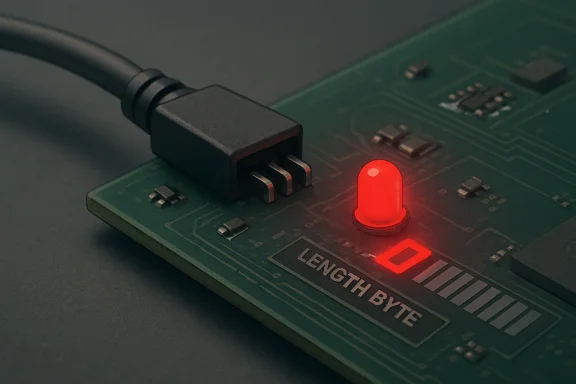
The legal SMBus block length is bounded by I2C_SMBUS_BLOCK_MAX, which is conventionally 32 bytes. The patch adds a direct guard: if the byte is zero or greater than the maximum, the driver stops the transaction and reports a protocol error. That is a classic kernel hardening pattern: validate device-supplied metadata before using it to change internal message length.
This matters because kernel drivers must treat even local hardware as an input source. A malformed response may come from a buggy peripheral, hostile hardware, compromised firmware, electrical fault, or emulation layer. The kernel does not get to assume polite behavior simply because the data arrived over a board-level bus.
Key facts for readers tracking the issue:
The s3c24xx patch mirrors logic previously added to another I2C host driver, i2c-tegra, for a similar reason. That parallel is significant because it shows this was not a one-off stylistic cleanup. It reflects a broader recognition that SMBus block-read handling needs consistent defensive checks across host controller drivers.
If a controller driver accepts an impossible length, several things can go wrong depending on surrounding code. The immediate impact may be a failed transaction or bus confusion. In worse cases, invalid length accounting can contribute to out-of-bounds reads, writes, kernel warnings, or system instability.
That assumption is increasingly weak. Modern threat models include malicious USB devices, compromised firmware, hostile expansion hardware, supply-chain implants, virtual devices, and cloud host emulation. Even when a specific bug is not remotely exploitable, normalizing strict validation reduces the chance that future bugs become exploit chains.
A good SMBus implementation should ask a simple sequence of questions:
That is exactly the sort of fix maintainers like to backport: targeted, understandable, and low-risk. It does not redesign the driver or alter unrelated behavior. It simply refuses to continue when a device supplies an invalid block length.
The CVE record identifies multiple stable references and lists fixed versions across supported kernel branches. The important operational point is that administrators should not rely on the upstream version number alone. Distribution kernels often backport patches while retaining older base versions, so the package changelog and vendor advisory matter more than a raw
For upstream stable tracking, the key fixed lines identified in the CVE data include:
This is why configuration-aware vulnerability management matters. A system is not meaningfully exposed if the affected driver is absent, disabled, not built, or unreachable in the deployed hardware profile. Conversely, a product can remain exposed even if the upstream community fixed the issue months earlier, because the vendor’s fork never absorbed the backport.
Security teams should track:
The MSRC listing is still notable because Microsoft tracks vulnerabilities that can affect its ecosystem, including Linux components used in cloud services, Azure images, embedded offerings, third-party dependencies, and customer-facing security guidance. Microsoft’s security catalog has become broader than traditional Windows patching. That broader visibility can confuse readers who equate MSRC with “Windows bug.”
The practical exposure is concentrated where Linux runs close to hardware using the affected driver. That includes embedded products, old ARM boards, industrial systems, lab devices, and custom vendor kernels. It may also include development images that build broad hardware support by default, even if the affected controller is not present.
Likely exposure categories include:
Still, hardware-adjacent bugs deserve attention in embedded environments because the attacker model is different. A malicious peripheral, compromised board component, field-service accessory, or hostile firmware layer can be realistic in some scenarios. The risk is especially relevant where devices are physically accessible, deployed in untrusted locations, or connected to replaceable modules.
For enterprises, the biggest issue is not panic but prioritization. Security dashboards may show the CVE across container hosts, appliances, virtual machines, or cloud images. Teams then need to decide whether the affected driver exists and whether the workload has any path to the relevant hardware.
Cloud risk is likely limited in typical virtual machines because guests do not usually receive direct access to Samsung S3C24xx I2C controllers. However, specialized ARM hosts, passthrough devices, lab environments, or vendor appliances hosted in cloud-like infrastructure deserve a closer look. The same caution applies to edge computing platforms that combine cloud management with physical sensor buses.
Enterprise triage should separate four questions:
That means patching an application container will not fix this issue if the host kernel is exposed. It also means a scanner that flags every container because the node kernel is old may be technically noisy but operationally useful. The remediation belongs at the node, appliance, or firmware level.
These devices often run kernels that are years behind upstream. Some are forked so heavily that applying a modern stable patch requires engineering effort. Others are “supported” only through full firmware images, which customers install rarely because updates may require downtime, physical access, or vendor approval.
In that world, a tiny missing length check can live for a very long time. The vulnerability may never be exploited in the wild, but its presence tells defenders something about the vendor’s update pipeline. If this patch is missing, other small defensive fixes may be missing too.
Embedded teams should verify:
That is why defenders should resist the reflex to dismiss hardware-facing kernel CVEs as irrelevant. Many will indeed be low priority, but the correct conclusion comes from asset context. A field-deployed ARM controller with exposed service ports and replaceable modules is different from a cloud VM with no matching hardware.
Linux kernel CVEs increasingly arrive as records tied to upstream fixes, and enrichment follows later. This produces a gap between known fixed code and fully scored vulnerability data. Mature security programs need a workflow for that gap, especially when kernel issues affect different branches, backports, and configurations.
The right response is not to treat every unscored kernel CVE as critical. It is to build a repeatable decision tree that asks whether the vulnerable code is present, reachable, and attacker-influenceable. For this CVE, that tree will downgrade many ordinary systems quickly.
A practical triage model looks like this:
The best programs enrich scanner output with runtime evidence. Loaded modules, kernel config files, device-tree data,
For Windows users, this means two things. First, do not assume every MSRC-linked CVE requires action on your Windows PC. Second, do not ignore Linux CVEs if you run WSL, Hyper-V Linux guests, Azure Linux VMs, network appliances, NAS devices, or developer boards.
In the case of CVE-2026-31627, WSL users are unlikely to be directly affected in a typical setup because WSL does not normally expose this class of legacy Samsung I2C host hardware to the Linux guest. Hyper-V guests are similarly unlikely to encounter the affected physical controller unless unusual passthrough or specialized hardware is involved. The relevant action is inventory, not alarm.
Windows-centric environments should check:
That makes asset classification more important than operating-system loyalty. The key question is not “Do we run Windows?” but “Where do we run Linux kernels, and who updates them?” For this CVE, the answer will usually point away from desktops and toward embedded or vendor-controlled systems.
Start with upstream awareness, then move quickly to vendor-specific status. If you use a distribution kernel, wait for or apply the distribution’s patched package. If you maintain your own kernel, apply the stable patch or confirm that equivalent validation already exists in your tree.
For custom kernels, review the relevant receive path and confirm that SMBus block-read length is rejected when the first byte is zero or above I2C_SMBUS_BLOCK_MAX. The code should stop the transfer rather than expanding the message length with an invalid value. That is the behavioral test that matters.
A concise verification checklist:
A sensible rollout order is:
The most meaningful future signal will come from vendors that ship embedded Linux images. If they publish patched firmware or acknowledge exposure, the issue becomes operationally relevant for their customers. If they remain silent, customers may need to inspect firmware contents or ask direct support questions.
Watch these developments closely:
CVE-2026-31627 will probably not become the most dramatic vulnerability of 2026, but it is a clean example of why kernel input validation still matters in quiet corners of the hardware stack. The fix is straightforward, the likely exposure is narrow, and the right response is disciplined triage: identify affected Linux kernels, confirm whether the s3c24xx I2C path is present and reachable, and apply vendor or stable updates where needed. In a world full of noisy CVE feeds, this is the kind of issue that rewards careful engineering judgment over reflexive alarm.
Source: NVD / Linux Kernel Security Update Guide - Microsoft Security Response Center
 Background
The Linux kernel’s I2C and SMBus subsystems are old, heavily used, and deceptively simple. I2C began as a low-pin-count serial bus for connecting chips on the same board, while SMBus built a more constrained management protocol on top of similar electrical and messaging ideas. In PCs, servers, laptops, and embedded devices, these buses are used for sensors, power controllers, EEPROMs, batteries, thermal monitoring, touch controllers, display components, and other low-bandwidth peripherals.That history is important because I2C and SMBus drivers sit close to physical devices. They often parse small byte sequences supplied by hardware, firmware, or a peripheral on the board. A single byte interpreted as a length field may look harmless, but inside the kernel it can influence buffer traversal, message sizing, and state-machine behavior.
The specific driver implicated here, i2c-s3c24xx, belongs to Samsung’s older S3C24xx-era ARM system-on-chip lineage and related controller support. This is not mainstream desktop Windows hardware, nor is it the kind of driver most WindowsForum readers will find enabled on a gaming PC or corporate laptop. It is more relevant to embedded boards, vendor-maintained Linux images, long-lived industrial devices, and downstream kernels that carry broad hardware support.
The CVE was published through the Linux kernel CVE process in late April 2026, with the NVD record initially marked as awaiting enrichment. That means defenders were given a description, affected code area, and upstream stable references before standardized severity scoring arrived. In practice, this is now common for kernel CVEs: patch availability often precedes risk clarity, forcing administrators to reason from code paths, configuration, and exposure rather than waiting for a single score.
The Vulnerability in Plain English
What went wrong
CVE-2026-31627 is about trusting a length byte too early. In an SMBus block read, the first byte returned by a device indicates how many data bytes follow. The vulnerable logic in the s3c24xx I2C driver processed that byte without first ensuring it was valid.The legal SMBus block length is bounded by I2C_SMBUS_BLOCK_MAX, which is conventionally 32 bytes. The patch adds a direct guard: if the byte is zero or greater than the maximum, the driver stops the transaction and reports a protocol error. That is a classic kernel hardening pattern: validate device-supplied metadata before using it to change internal message length.
This matters because kernel drivers must treat even local hardware as an input source. A malformed response may come from a buggy peripheral, hostile hardware, compromised firmware, electrical fault, or emulation layer. The kernel does not get to assume polite behavior simply because the data arrived over a board-level bus.
Key facts for readers tracking the issue:
- CVE ID: CVE-2026-31627
- Component: Linux kernel I2C subsystem
- Driver: s3c24xx / s3c2410 I2C host driver
- File path: drivers/i2c/busses/i2c-s3c2410.c
- Bug class: missing validation of an SMBus block length byte
- NVD status at disclosure: awaiting enrichment, with no NVD CVSS score yet
- Fix behavior: reject zero-length or oversized SMBus block-read responses with a protocol error
Why SMBus Length Validation Matters
The first byte is control data, not ordinary payload
In an SMBus block read, the first byte is not just another byte of data. It tells the host how much data the device claims it is about to return. That makes it control data, and control data must be validated before it influences memory access, buffer accounting, or transaction flow.The s3c24xx patch mirrors logic previously added to another I2C host driver, i2c-tegra, for a similar reason. That parallel is significant because it shows this was not a one-off stylistic cleanup. It reflects a broader recognition that SMBus block-read handling needs consistent defensive checks across host controller drivers.
If a controller driver accepts an impossible length, several things can go wrong depending on surrounding code. The immediate impact may be a failed transaction or bus confusion. In worse cases, invalid length accounting can contribute to out-of-bounds reads, writes, kernel warnings, or system instability.
Defensive parsing is kernel hygiene
The deeper lesson is that hardware-facing code is parser code. A kernel driver parses registers, descriptors, interrupts, status bytes, and payloads just as a network stack parses packets. The difference is that hardware protocols often receive less adversarial scrutiny because they are assumed to be local.That assumption is increasingly weak. Modern threat models include malicious USB devices, compromised firmware, hostile expansion hardware, supply-chain implants, virtual devices, and cloud host emulation. Even when a specific bug is not remotely exploitable, normalizing strict validation reduces the chance that future bugs become exploit chains.
A good SMBus implementation should ask a simple sequence of questions:
- Did the device return a length byte where the protocol expects one?
- Is the length nonzero when the operation requires data?
- Is the length less than or equal to I2C_SMBUS_BLOCK_MAX?
- Does the destination buffer have room for the advertised bytes?
- Does the transaction state remain coherent after accepting the length?
Patch Details and Fixed Kernel Lines
What changed in the driver
The patch modifies the interrupt-driven receive path in the s3c24xx I2C driver. When the driver receives the first byte of an SMBus block read, it now tests whether the value is zero or greater than I2C_SMBUS_BLOCK_MAX. If either condition is true, it stops the I2C transaction and returns -EPROTO, signaling a protocol violation.That is exactly the sort of fix maintainers like to backport: targeted, understandable, and low-risk. It does not redesign the driver or alter unrelated behavior. It simply refuses to continue when a device supplies an invalid block length.
The CVE record identifies multiple stable references and lists fixed versions across supported kernel branches. The important operational point is that administrators should not rely on the upstream version number alone. Distribution kernels often backport patches while retaining older base versions, so the package changelog and vendor advisory matter more than a raw
uname -r comparison.For upstream stable tracking, the key fixed lines identified in the CVE data include:
- 6.12.y: fixed by 6.12.83
- 6.18.y: fixed by 6.18.24
- 6.19.y: fixed by 6.19.14
- 7.0.y: fixed by 7.0.1
- Older affected range: kernels from 3.10 onward may be affected depending on branch, configuration, and backports
Why version mapping is tricky
Kernel CVEs are notoriously messy for scanners because the same fix can appear under different downstream package versions. A vendor may ship a 6.12-based kernel with the patch, another may carry a 6.6 long-term kernel with a backport, and an embedded vendor may run a heavily modified 4.x tree that still contains the vulnerable logic.This is why configuration-aware vulnerability management matters. A system is not meaningfully exposed if the affected driver is absent, disabled, not built, or unreachable in the deployed hardware profile. Conversely, a product can remain exposed even if the upstream community fixed the issue months earlier, because the vendor’s fork never absorbed the backport.
Security teams should track:
- Whether CONFIG_I2C_S3C2410 or equivalent support is enabled
- Whether the driver is built into the kernel or available as a module
- Whether the target hardware actually uses the affected controller
- Whether the vendor kernel includes the bounds-check patch
- Whether a scanner is reporting upstream version exposure without configuration context
Who Is Actually Exposed?
Desktop Windows users are unlikely targets
For most WindowsForum readers, the immediate answer is reassuring: ordinary Windows desktops and laptops are not the likely exposure zone. This is a Linux kernel driver for a Samsung-family I2C host controller, not a vulnerability in Windows Update, Win32, NTFS, Defender, Edge, or the Windows kernel. The presence of a Microsoft Security Response Center entry does not automatically mean Windows clients are vulnerable.The MSRC listing is still notable because Microsoft tracks vulnerabilities that can affect its ecosystem, including Linux components used in cloud services, Azure images, embedded offerings, third-party dependencies, and customer-facing security guidance. Microsoft’s security catalog has become broader than traditional Windows patching. That broader visibility can confuse readers who equate MSRC with “Windows bug.”
The practical exposure is concentrated where Linux runs close to hardware using the affected driver. That includes embedded products, old ARM boards, industrial systems, lab devices, and custom vendor kernels. It may also include development images that build broad hardware support by default, even if the affected controller is not present.
Likely exposure categories include:
- Embedded Linux devices using Samsung S3C24xx-era I2C hardware
- Industrial control boards with long-lived vendor kernels
- IoT appliances based on old ARM system-on-chip platforms
- Development boards where broad kernel configs enable many bus drivers
- Custom firmware images that rarely receive stable kernel backports
- Security scanners flagging generic Linux kernels without checking driver reachability
Locality lowers risk, but does not erase it
The attack surface is probably local or hardware-adjacent, not internet-facing in the normal sense. An attacker would generally need a way to influence an SMBus device response on the affected bus, trigger the relevant block-read path, or control an emulated hardware environment. That is a higher bar than sending a packet to an exposed web service.Still, hardware-adjacent bugs deserve attention in embedded environments because the attacker model is different. A malicious peripheral, compromised board component, field-service accessory, or hostile firmware layer can be realistic in some scenarios. The risk is especially relevant where devices are physically accessible, deployed in untrusted locations, or connected to replaceable modules.
Enterprise and Cloud Implications
Why Microsoft tracking matters
Microsoft’s listing of CVE-2026-31627 should be read as ecosystem awareness rather than proof of a Windows emergency. Microsoft operates enormous Linux estates through Azure, provides Linux images, supports Linux workloads, and maintains security metadata that customers consume through vulnerability management tools. A Linux kernel CVE can therefore surface in Microsoft channels even when Windows endpoints are unaffected.For enterprises, the biggest issue is not panic but prioritization. Security dashboards may show the CVE across container hosts, appliances, virtual machines, or cloud images. Teams then need to decide whether the affected driver exists and whether the workload has any path to the relevant hardware.
Cloud risk is likely limited in typical virtual machines because guests do not usually receive direct access to Samsung S3C24xx I2C controllers. However, specialized ARM hosts, passthrough devices, lab environments, or vendor appliances hosted in cloud-like infrastructure deserve a closer look. The same caution applies to edge computing platforms that combine cloud management with physical sensor buses.
Enterprise triage should separate four questions:
- Is the kernel version or package theoretically affected?
- Is the s3c24xx I2C driver built or loadable?
- Is matching hardware present or exposed to the kernel?
- Has the vendor backported the validation patch?
- Can an attacker influence the SMBus device response in practice?
Containers are usually a false positive
Containers share the host kernel, so scanners often report kernel CVEs against container images or workloads in confusing ways. For CVE-2026-31627, a container image does not carry the vulnerable kernel driver in the way a full OS image does. The host kernel is the component that matters.That means patching an application container will not fix this issue if the host kernel is exposed. It also means a scanner that flags every container because the node kernel is old may be technically noisy but operationally useful. The remediation belongs at the node, appliance, or firmware level.
Embedded Linux: The Real Long Tail
Old boards, long lifecycles, slow patches
The most interesting part of this CVE is its fit with the embedded Linux long tail. S3C24xx-era hardware is not new, but old embedded hardware does not disappear just because mainstream consumer devices move on. It remains in kiosks, controllers, laboratory gear, point-of-sale systems, access-control panels, appliances, and vendor-specific equipment.These devices often run kernels that are years behind upstream. Some are forked so heavily that applying a modern stable patch requires engineering effort. Others are “supported” only through full firmware images, which customers install rarely because updates may require downtime, physical access, or vendor approval.
In that world, a tiny missing length check can live for a very long time. The vulnerability may never be exploited in the wild, but its presence tells defenders something about the vendor’s update pipeline. If this patch is missing, other small defensive fixes may be missing too.
Embedded teams should verify:
- Whether the product kernel includes drivers/i2c/busses/i2c-s3c2410.c
- Whether SMBus block reads are used by board peripherals
- Whether untrusted or replaceable devices can sit on the affected bus
- Whether field firmware updates include upstream stable backports
- Whether watchdog resets hide bus-triggered kernel faults
- Whether vendor SBOMs include kernel configuration and patch-level detail
Physical access changes the equation
A vulnerability that looks minor in a locked server room can matter more in a hallway kiosk or factory floor device. Attackers with physical access may attach peripherals, swap modules, manipulate sensor boards, or trigger edge-case hardware behavior. The distance between “local hardware bug” and “real attack path” depends on deployment context.That is why defenders should resist the reflex to dismiss hardware-facing kernel CVEs as irrelevant. Many will indeed be low priority, but the correct conclusion comes from asset context. A field-deployed ARM controller with exposed service ports and replaceable modules is different from a cloud VM with no matching hardware.
Scanner Noise and Vulnerability Management
CVSS will not tell the whole story
At the time the CVE appeared, the NVD record had no NVD CVSS score. That can frustrate teams whose patch queues rely on numeric thresholds. In this case, the absence of a score should not freeze action; it should trigger context-based triage.Linux kernel CVEs increasingly arrive as records tied to upstream fixes, and enrichment follows later. This produces a gap between known fixed code and fully scored vulnerability data. Mature security programs need a workflow for that gap, especially when kernel issues affect different branches, backports, and configurations.
The right response is not to treat every unscored kernel CVE as critical. It is to build a repeatable decision tree that asks whether the vulnerable code is present, reachable, and attacker-influenceable. For this CVE, that tree will downgrade many ordinary systems quickly.
A practical triage model looks like this:
- Identify kernel packages across servers, endpoints, appliances, and build images.
- Check vendor advisories for backported fixes rather than relying only on upstream versions.
- Inspect kernel configuration for the affected s3c24xx I2C driver.
- Confirm hardware reachability through device tree, platform data, modules, and boot logs.
- Prioritize exposed embedded devices over generic desktops and ordinary cloud guests.
- Document false positives so the same alert does not reappear every scan cycle.
Why scanners over-report kernel CVEs
Most vulnerability scanners are good at package inventory and weaker at kernel configuration analysis. They may see “Linux kernel before fixed version” and flag exposure without knowing whether CONFIG_I2C_S3C2410 is enabled. That is understandable, but it can overwhelm defenders.The best programs enrich scanner output with runtime evidence. Loaded modules, kernel config files, device-tree data,
dmesg logs, and vendor build manifests can distinguish real exposure from theoretical exposure. This is especially important for Linux kernel drivers tied to uncommon hardware.WindowsForum Angle: What Windows Users Should Take Away
Not every MSRC CVE is a Windows desktop crisis
The presence of this CVE in Microsoft’s security ecosystem is a reminder that Microsoft is no longer only a Windows company in security terms. Azure runs Linux. Developers run Linux in virtual machines and containers. Enterprises manage mixed fleets through Microsoft tooling. Security data therefore crosses operating-system boundaries.For Windows users, this means two things. First, do not assume every MSRC-linked CVE requires action on your Windows PC. Second, do not ignore Linux CVEs if you run WSL, Hyper-V Linux guests, Azure Linux VMs, network appliances, NAS devices, or developer boards.
In the case of CVE-2026-31627, WSL users are unlikely to be directly affected in a typical setup because WSL does not normally expose this class of legacy Samsung I2C host hardware to the Linux guest. Hyper-V guests are similarly unlikely to encounter the affected physical controller unless unusual passthrough or specialized hardware is involved. The relevant action is inventory, not alarm.
Windows-centric environments should check:
- Azure Linux VMs for vendor kernel updates
- Linux appliances managed by Windows administrators
- Hyper-V hosts running Linux guests with custom kernels
- Developer ARM boards used for testing or hardware integration
- Security dashboards that may merge Windows and Linux CVE views
- WSL installations only if using custom kernels and unusual hardware access patterns
Mixed fleets need mixed thinking
The broader lesson for WindowsForum readers is that modern administration is hybrid. A Windows shop may still own Linux-based firewalls, backup appliances, Kubernetes nodes, build runners, NAS units, smart displays, and embedded controllers. Kernel CVEs can enter the risk register through those side doors.That makes asset classification more important than operating-system loyalty. The key question is not “Do we run Windows?” but “Where do we run Linux kernels, and who updates them?” For this CVE, the answer will usually point away from desktops and toward embedded or vendor-controlled systems.
Patch and Verification Workflow
How administrators should respond
The best response to CVE-2026-31627 is measured and evidence-driven. Do not rush emergency maintenance windows for unaffected systems, but do not leave embedded Linux devices unexamined simply because the bug sounds obscure. Kernel bugs in obscure drivers are often ignored until a compliance scan or incident review reveals years of missing updates.Start with upstream awareness, then move quickly to vendor-specific status. If you use a distribution kernel, wait for or apply the distribution’s patched package. If you maintain your own kernel, apply the stable patch or confirm that equivalent validation already exists in your tree.
For custom kernels, review the relevant receive path and confirm that SMBus block-read length is rejected when the first byte is zero or above I2C_SMBUS_BLOCK_MAX. The code should stop the transfer rather than expanding the message length with an invalid value. That is the behavioral test that matters.
A concise verification checklist:
- Confirm whether the kernel contains the affected s3c24xx I2C driver.
- Confirm whether the driver is enabled in the deployed build.
- Confirm whether the affected hardware exists on the device.
- Confirm whether the patch or equivalent logic is present.
- Confirm whether vendor firmware images include the updated kernel.
- Confirm whether monitoring shows I2C protocol errors after patching.
- Confirm whether scanners have been tuned to avoid repeated false positives.
Operational rollout order
For large environments, prioritize by exposure rather than by scanner count. A thousand cloud VMs with no relevant hardware may be less urgent than fifty field devices with reachable I2C peripherals and old vendor kernels. That is the difference between vulnerability management and vulnerability accounting.A sensible rollout order is:
- Patch or validate embedded products using Samsung-family I2C controllers.
- Update vendor appliances where kernel configuration is opaque.
- Patch ARM development boards and lab systems used with physical peripherals.
- Update general Linux hosts during normal kernel maintenance cycles.
- Suppress or annotate false positives only after configuration evidence is captured.
Strengths and Opportunities
What the response gets right
The handling of CVE-2026-31627 shows several strengths in the modern Linux security pipeline. A narrow hardware-driver flaw was identified, patched with a minimal validation check, routed through stable branches, and assigned a CVE so downstream users could track it. That is exactly how boring-but-important kernel hardening should work.- Small, auditable fix that limits regression risk
- Clear affected file path for maintainers and downstream vendors
- Stable branch backports across multiple maintained kernel lines
- Protocol-correct behavior by rejecting invalid SMBus block lengths
- Good precedent reuse from a similar Tegra I2C driver fix
- Better scanner visibility for a bug that might otherwise vanish in changelogs
- Opportunity for embedded vendors to audit similar length-handling paths
Risks and Concerns
Why defenders should not dismiss it too quickly
The main risk is not that every Linux system is suddenly exposed. The bigger concern is that obscure kernel CVEs often fall between teams. Server admins assume embedded teams own them, embedded teams assume vendors own them, and vendors quietly defer updates because the bug lacks a scary score.- No initial NVD CVSS score may delay prioritization in score-driven programs.
- Scanner over-reporting may bury real embedded exposure under false positives.
- Vendor kernels may remain unpatched long after upstream stable branches are fixed.
- Physical-access scenarios may be underestimated in kiosks, labs, and industrial sites.
- Custom hardware integrations may expose unusual SMBus paths not considered by IT teams.
- Compliance pressure may force rushed patching without confirming driver reachability.
- Legacy products may lack a practical update path even when the fix is known.
Looking Ahead
What to watch next
The next phase is enrichment and downstream adoption. NVD scoring, distribution advisories, vendor firmware updates, and scanner signatures will shape how noisy this CVE becomes. Administrators should expect some tools to flag broad Linux version ranges before they learn to account for backports or disabled drivers.The most meaningful future signal will come from vendors that ship embedded Linux images. If they publish patched firmware or acknowledge exposure, the issue becomes operationally relevant for their customers. If they remain silent, customers may need to inspect firmware contents or ask direct support questions.
Watch these developments closely:
- NVD enrichment with CVSS metrics and weakness classification
- Distribution advisories confirming backported kernel fixes
- Embedded vendor firmware updates for ARM products using affected controllers
- Scanner rule changes that distinguish package exposure from driver reachability
- Related audits of SMBus block-read validation in other host drivers
CVE-2026-31627 will probably not become the most dramatic vulnerability of 2026, but it is a clean example of why kernel input validation still matters in quiet corners of the hardware stack. The fix is straightforward, the likely exposure is narrow, and the right response is disciplined triage: identify affected Linux kernels, confirm whether the s3c24xx I2C path is present and reachable, and apply vendor or stable updates where needed. In a world full of noisy CVE feeds, this is the kind of issue that rewards careful engineering judgment over reflexive alarm.
Source: NVD / Linux Kernel Security Update Guide - Microsoft Security Response Center
