

CVE-2026-31682 is a newly published Linux kernel vulnerability that lands in an unusually important corner of modern infrastructure: the bridge networking path used by virtualization hosts, containers, appliances, and cloud platforms. The flaw sits in
The Linux bridge has been a workhorse for decades, quietly turning general-purpose servers into Layer 2 forwarding devices. It underpins KVM hosts, container networks, lab routers, virtual switches, embedded gateways, and countless enterprise appliances that need Ethernet-style connectivity without dedicated switching hardware. For many administrators, it is invisible until a bridge named
CVE-2026-31682 concerns the bridge’s handling of IPv6 Neighbor Discovery, the protocol family that replaces much of ARP’s role in IPv6 networks. Neighbor Solicitation and Neighbor Advertisement messages are not exotic traffic; they are fundamental to address resolution, reachability detection, duplicate address detection, and local-link operation. When Linux bridge code participates in suppressing or proxying these messages, it enters a sensitive path where malformed packets, fragmented memory layouts, and performance shortcuts can collide.
The vulnerability was received into public vulnerability tracking on April 25, 2026, with the source attributed to kernel.org. At publication time, the NVD entry had not yet assigned a CVSS score, which means defenders should avoid treating the absence of a number as a sign of low risk. In kernel networking, a missing score often reflects timing rather than harmlessness.
The upstream fix is described as “linearize skb before parsing ND options,” and that phrase captures the essential technical issue. The bridge function parsed
The bug arises from the mismatch between what the function assumes and what its callers promise. The callers ensure enough of the packet is present to identify the ICMPv6 Neighbor Solicitation and its target address, but they do not guarantee that every subsequent option byte is in the same linear buffer. The option area may remain in paged or fragmented storage associated with the
That distinction matters because kernel packet parsing is memory parsing. If code walks a structure field that points beyond the contiguous region, it can read memory that is not actually part of the valid linear packet data. In the best case, the packet is mishandled; in worse cases, the system may hit a fault or expose a path toward denial of service.
The meaningful change is the introduction of
The
Linux represents packets with the
This architecture is central to high-throughput networking. Features such as scatter-gather I/O, segmentation offload, tunneling, virtualization, and driver-level optimizations all benefit from non-linear buffers. The trade-off is that parsers must be precise about which bytes are contiguous before they cast packet data into protocol structures.
CVE-2026-31682 is therefore not just a bug in bridge code; it is a reminder of a recurring kernel design tension. The fastest packet path is often the one with the least tolerance for sloppy assumptions. As Linux networking becomes more layered, the odds increase that a packet arriving at one subsystem has already been reshaped by another.
The fix also changes where the Neighbor Solicitation structure is derived. Instead of relying on a pointer passed down from an earlier check, the patched logic obtains it from the now-linearized network header. That reduces the risk that an old pointer reflects an unsafe layout.
This is the kind of defensive programming kernel networking increasingly needs. As protocol stacks interact with virtual switches, namespaces, VLANs, tunnels, and offloads, local assumptions age badly. A function that was safe under one caller contract can become unsafe when new paths reuse it.
Bridge neighbor suppression helps by allowing a bridge port to suppress or proxy ARP and ND behavior. The Linux bridge documentation exposes controls for neighbor discovery proxy and suppression on bridge ports, including VLAN-aware variants. These options are particularly useful in dense virtual networking environments where unnecessary broadcast and multicast traffic can become a scaling problem.
The feature connected to this vulnerability traces back to bridge logic that suppresses ND packets on ports configured for neighbor suppression. That historical context matters because the bug is not in a decorative feature. It sits in a performance and scalability mechanism that administrators may enable precisely on high-density systems.
When a Layer 2 device interprets Layer 3 control traffic, it gains efficiency but also inherits protocol complexity. IPv6 Neighbor Discovery includes options, link-layer addresses, and fields that require careful length handling. If packet storage is fragmented, every parser must account for the underlying memory layout before treating bytes as structures.
This is why CVE-2026-31682 deserves attention even without an assigned severity score. The affected code path is enabled by a practical bridge feature, and the trigger is rooted in packet shape rather than an obscure administrative interface. Network-facing parsing flaws rarely need theatrical descriptions to be operationally significant.
Enterprise defenders should pay special attention to hosts where guests, containers, or downstream devices can inject crafted IPv6 Neighbor Discovery traffic. The issue is not about a remote attacker somewhere on the internet directly reaching every Linux server. It is more about adjacency, local Layer 2 reachability, and whether the vulnerable bridge path processes attacker-influenced frames.
This distinction affects prioritization. A database server with no bridge interface is not the same as a KVM host bridging customer VMs, and a home desktop using no Linux bridge is not the same as an edge appliance with VLAN-aware bridge ports. Asset context determines urgency.
However, enthusiasts often run Proxmox, OpenWrt, home labs, NAS distributions, Docker hosts, or small virtualization clusters. Those environments blur the line between consumer and enterprise. A “home server” can easily have a more complex Layer 2 topology than a small office did a decade ago.
The practical advice is straightforward: if your Linux system bridges interfaces for VMs, containers, VLANs, or network services, treat this as a kernel update item. If it does not, track it through normal distribution updates but avoid panic. Risk is configuration-dependent, not name-dependent.
This matters because the old function signature accepted an
The source change is also notable because it is a stable-kernel backport candidate across multiple supported kernel branches. The NVD record lists several kernel.org stable references, and stable mailing list traffic shows the fix moving through older long-term lines as well as newer kernels. That breadth suggests maintainers viewed the issue as applicable across more than one active generation.
By recomputing
There is also a subtle failure-handling improvement. If linearization cannot be performed, the function simply does not proceed down the reply-building path. That may drop an optimization opportunity, but it avoids parsing memory under unsafe assumptions.
Security teams should instead analyze the likely prerequisites. The vulnerability requires the relevant Linux bridge path, IPv6 Neighbor Discovery traffic, and a packet layout where the options are non-linear while earlier required fields are present. Exploitability will depend on whether an attacker can influence such packets on a Layer 2 segment processed by a vulnerable bridge.
The most plausible immediate impact category is denial of service, because reading past a linear buffer in kernel networking can trigger faults or unstable behavior. More severe outcomes would require evidence beyond the public description, and responsible analysis should avoid overstating what is known. Absence of public exploit detail is not proof of absence, but it is a reason to stay precise.
Conversely, a scary-sounding kernel CVE may be irrelevant to systems that never enable the vulnerable path. That is why inventory remains the first step. Configuration-aware risk assessment beats score-only patching.
For WindowsForum readers, the point is especially important because many environments now mix Windows clients, Linux infrastructure, and Microsoft cloud services. A Linux kernel CVE may matter to a Windows administrator if it affects the virtualization layer, container host, security appliance, or cloud image supporting Windows workloads.
This does not mean ordinary Windows installations are directly affected by the Linux bridge bug. It means Microsoft tracks the CVE because Linux kernels exist inside parts of the Microsoft ecosystem, from cloud hosts and managed services to specialized Linux distributions and developer workflows. The modern Windows estate is no longer Windows-only.
For administrators, the correct response is not confusion but mapping. Ask where Linux kernels operate in your Microsoft-connected environment: Azure workloads, Kubernetes nodes, virtual appliances, WSL development systems, security tools, or on-prem hypervisors. Hybrid infrastructure turns Linux kernel advisories into Windows operations concerns.
The key is to avoid both extremes. Do not dismiss the issue because it is “Linux,” and do not assume every Windows-adjacent device is vulnerable. The bridge configuration is the hinge.
This is also a reminder that vulnerability management databases are now cross-platform by design. A CVE listed in a Microsoft portal may still require Linux package management, vendor firmware updates, or appliance replacement planning. The security workflow must follow the affected component, not the brand of the advisory page.
Administrators should also verify kernel versions against distribution advisories rather than relying only on upstream commit IDs. Enterprise distributions often backport security fixes without changing to the newest upstream kernel version. That means a vulnerable-looking version number may already contain the fix, while a self-built kernel may not.
A reasonable response sequence is:
Network teams should avoid blanket IPv6 disablement as a reflex. IPv6 may be required for platform services, cloud metadata, clustering, or modern application behavior. A safer interim approach is to isolate untrusted guests, restrict bridge participation, and ensure monitoring captures kernel warnings or crashes.
If the vulnerable path can be reached by a tenant, guest, or compromised workload, the host becomes the security boundary. In that model, the kernel bridge is not just plumbing; it is part of the isolation architecture. A crash in the host network path can become an outage across many dependent services.
Enterprises should therefore rank assets by blast radius. A lab machine with a bridge is less urgent than a production edge host carrying customer traffic. A single-purpose bridge in a trusted VLAN is less concerning than a multi-tenant virtualization node.
For systems that cannot be patched immediately, the justification should be specific. “No score assigned” is weak evidence; “bridge neighbor suppression not enabled and no untrusted Layer 2 adjacency” is stronger. The more precise the exposure statement, the easier it is to defend a maintenance schedule.
This is also a useful case for improving asset metadata. If the CMDB cannot identify Linux bridge hosts, IPv6-enabled segments, or container nodes, the response will be slower than it needs to be. Good vulnerability management starts long before the CVE lands.
Commercial competitors often sell tighter vertical integration as a security advantage. Dedicated appliances and proprietary virtualization stacks may claim fewer moving parts or more controlled configurations. Linux counters with transparency, rapid patching, and broad peer review, but those advantages only help when users update promptly.
The stable-kernel backport process is one of Linux’s strongest responses. Once the fix is accepted, maintainers can propagate it across supported branches used by distributions, appliances, and cloud images. The ecosystem’s speed is a feature, but only if downstream vendors complete the delivery chain.
This creates an opportunity for tooling. Static analysis, fuzzing, and runtime sanitizers can focus on parser paths where header guarantees are narrower than later option parsing. The bug class is understandable: a function checks enough bytes for one structure, then later reads beyond that assumption.
Vendors that build on Linux should treat this as a test of their update pipelines. Customers do not only need a fixed upstream commit; they need packages, images, firmware, maintenance windows, and confirmation. Patch availability is not the same as operational remediation.
The second thing to watch is severity refinement. Once NVD or vendors assign scores, those ratings may influence compliance dashboards and patch deadlines. Still, the best internal rating should combine public severity with local exposure: bridge usage, IPv6 reachability, tenant trust boundaries, and host criticality.
Source: NVD / Linux Kernel Security Update Guide - Microsoft Security Response Center
br_nd_send(), where Linux bridge code parsed IPv6 Neighbor Discovery options under an assumption that packet data was already present in the linear portion of an sk_buff. The fix is small, but the lesson is large: packet layout assumptions remain one of the most fragile boundaries in kernel networking security.
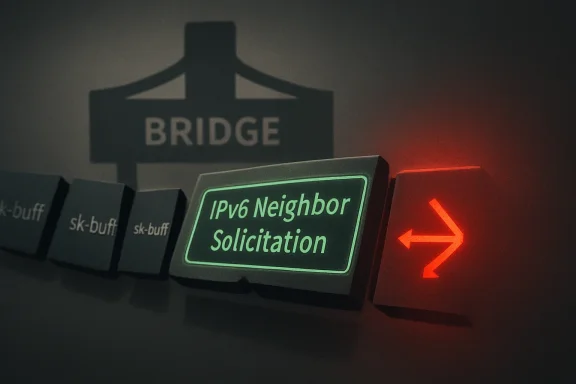 Background
The Linux bridge has been a workhorse for decades, quietly turning general-purpose servers into Layer 2 forwarding devices. It underpins KVM hosts, container networks, lab routers, virtual switches, embedded gateways, and countless enterprise appliances that need Ethernet-style connectivity without dedicated switching hardware. For many administrators, it is invisible until a bridge named br0, docker0, virbr0, or a hypervisor-managed interface becomes the center of a troubleshooting session.CVE-2026-31682 concerns the bridge’s handling of IPv6 Neighbor Discovery, the protocol family that replaces much of ARP’s role in IPv6 networks. Neighbor Solicitation and Neighbor Advertisement messages are not exotic traffic; they are fundamental to address resolution, reachability detection, duplicate address detection, and local-link operation. When Linux bridge code participates in suppressing or proxying these messages, it enters a sensitive path where malformed packets, fragmented memory layouts, and performance shortcuts can collide.
The vulnerability was received into public vulnerability tracking on April 25, 2026, with the source attributed to kernel.org. At publication time, the NVD entry had not yet assigned a CVSS score, which means defenders should avoid treating the absence of a number as a sign of low risk. In kernel networking, a missing score often reflects timing rather than harmlessness.
The upstream fix is described as “linearize skb before parsing ND options,” and that phrase captures the essential technical issue. The bridge function parsed
ns->opt[] as though the Neighbor Discovery options were contiguous in memory, while callers only guaranteed that the ICMPv6 header and target address were available. If the options area lived in a non-linear fragment, parsing could read past the linear buffer.Anatomy of the Bug
Where the Fault Occurs
The affected function,br_nd_send(), lives in the Linux bridge ARP and Neighbor Discovery proxy logic. Its purpose is not merely to pass packets along, but to help the bridge respond intelligently when neighbor suppression is enabled. That makes it part of the control-plane-adjacent behavior of a Layer 2 bridge.The bug arises from the mismatch between what the function assumes and what its callers promise. The callers ensure enough of the packet is present to identify the ICMPv6 Neighbor Solicitation and its target address, but they do not guarantee that every subsequent option byte is in the same linear buffer. The option area may remain in paged or fragmented storage associated with the
sk_buff.That distinction matters because kernel packet parsing is memory parsing. If code walks a structure field that points beyond the contiguous region, it can read memory that is not actually part of the valid linear packet data. In the best case, the packet is mishandled; in worse cases, the system may hit a fault or expose a path toward denial of service.
- Affected area: Linux bridge Neighbor Discovery send/proxy logic.
- Faulty assumption: ND options are present in the linear part of the packet.
- Actual guarantee: Only the ICMPv6 header and target address are assured.
- Resulting hazard: Parsing can access data beyond the linear buffer.
- Fix strategy: Linearize the packet before parsing the options.
Why a Small Patch Can Matter
The upstream change is compact, involving a modest edit to the bridge source file. That can make the issue look minor, but kernel security history is full of examples where small pointer-handling fixes close meaningful attack surface. The size of a patch does not measure the sensitivity of the path it protects.The meaningful change is the introduction of
skb_linearize() before Neighbor Discovery options are parsed. Once linearization succeeds, the code derives the Neighbor Solicitation pointer from the packet’s linear network header. That turns an implicit assumption into an explicit precondition.Why Non-Linear SKBs Matter
The sk_buff Reality
Linux represents packets with the sk_buff structure, usually shortened to skb. An skb can store packet bytes in a directly accessible linear region, but it can also reference additional data fragments. That design improves performance because the kernel can avoid copying large payloads unnecessarily.This architecture is central to high-throughput networking. Features such as scatter-gather I/O, segmentation offload, tunneling, virtualization, and driver-level optimizations all benefit from non-linear buffers. The trade-off is that parsers must be precise about which bytes are contiguous before they cast packet data into protocol structures.
CVE-2026-31682 is therefore not just a bug in bridge code; it is a reminder of a recurring kernel design tension. The fastest packet path is often the one with the least tolerance for sloppy assumptions. As Linux networking becomes more layered, the odds increase that a packet arriving at one subsystem has already been reshaped by another.
- Non-linear SKBs improve throughput by reducing copies.
- Protocol parsers must verify contiguous access before reading fields.
- Header-only guarantees do not automatically extend to option areas.
- Virtualization and offload paths make non-linear layouts more common.
- Security fixes often convert assumptions into explicit memory preparation.
Linearization as a Safety Boundary
Linearization forces the relevant packet data into a contiguous memory area. It is not free, because copying and memory allocation may be required, but it gives subsequent parsing code a safer model. In this case, the bridge code chooses correctness over a fragile optimization.The fix also changes where the Neighbor Solicitation structure is derived. Instead of relying on a pointer passed down from an earlier check, the patched logic obtains it from the now-linearized network header. That reduces the risk that an old pointer reflects an unsafe layout.
This is the kind of defensive programming kernel networking increasingly needs. As protocol stacks interact with virtual switches, namespaces, VLANs, tunnels, and offloads, local assumptions age badly. A function that was safe under one caller contract can become unsafe when new paths reuse it.
IPv6 Neighbor Discovery and Bridge Suppression
Why ND Suppression Exists
Neighbor Discovery can create significant multicast chatter in large Layer 2 domains. In virtualization and container environments, a host may run hundreds or thousands of endpoints that all need address resolution. If every Neighbor Solicitation is flooded broadly, the result can be noisy and inefficient.Bridge neighbor suppression helps by allowing a bridge port to suppress or proxy ARP and ND behavior. The Linux bridge documentation exposes controls for neighbor discovery proxy and suppression on bridge ports, including VLAN-aware variants. These options are particularly useful in dense virtual networking environments where unnecessary broadcast and multicast traffic can become a scaling problem.
The feature connected to this vulnerability traces back to bridge logic that suppresses ND packets on ports configured for neighbor suppression. That historical context matters because the bug is not in a decorative feature. It sits in a performance and scalability mechanism that administrators may enable precisely on high-density systems.
- IPv6 ND replaces ARP-like address resolution for IPv6.
- Neighbor suppression reduces unnecessary multicast and broadcast-like behavior.
- Bridge ports can enable suppression globally or in VLAN-aware contexts.
- Virtual hosts benefit because fewer guests see irrelevant discovery traffic.
- Large Layer 2 domains depend on this kind of optimization to remain stable.
The Control Plane Meets the Data Plane
Bridge ND suppression straddles the boundary between forwarding and protocol interpretation. A simple bridge could forward frames without caring about IPv6 internals, but suppression requires the bridge to understand enough of the packet to make smarter decisions. That makes parsing correctness essential.When a Layer 2 device interprets Layer 3 control traffic, it gains efficiency but also inherits protocol complexity. IPv6 Neighbor Discovery includes options, link-layer addresses, and fields that require careful length handling. If packet storage is fragmented, every parser must account for the underlying memory layout before treating bytes as structures.
This is why CVE-2026-31682 deserves attention even without an assigned severity score. The affected code path is enabled by a practical bridge feature, and the trigger is rooted in packet shape rather than an obscure administrative interface. Network-facing parsing flaws rarely need theatrical descriptions to be operationally significant.
Who Is Exposed
Enterprise and Cloud Environments
The most relevant exposure is likely to be on Linux systems acting as bridges for untrusted or semi-trusted traffic. That includes virtualization hosts, container platforms, network appliances, lab environments, and multi-tenant infrastructure using Linux bridges for local switching. Systems that do not use bridge neighbor suppression may have a narrower practical risk profile.Enterprise defenders should pay special attention to hosts where guests, containers, or downstream devices can inject crafted IPv6 Neighbor Discovery traffic. The issue is not about a remote attacker somewhere on the internet directly reaching every Linux server. It is more about adjacency, local Layer 2 reachability, and whether the vulnerable bridge path processes attacker-influenced frames.
This distinction affects prioritization. A database server with no bridge interface is not the same as a KVM host bridging customer VMs, and a home desktop using no Linux bridge is not the same as an edge appliance with VLAN-aware bridge ports. Asset context determines urgency.
- Prioritize hypervisors running Linux bridge networking.
- Review container hosts that expose bridge networks to untrusted workloads.
- Inspect appliances that combine routing, switching, firewalling, and virtualization.
- Evaluate lab and campus networks where untrusted devices share Layer 2 segments.
- Treat IPv6-enabled bridges as relevant even if IPv6 is not the primary workload protocol.
Consumer and Enthusiast Systems
For typical desktop users, the risk is likely narrower. A Windows laptop, a gaming PC, or a standard consumer router user is not automatically exposed merely because the CVE exists. The vulnerable code is in the Linux kernel bridge subsystem, so exposure depends on whether a Linux-based system is using that bridge functionality in a reachable configuration.However, enthusiasts often run Proxmox, OpenWrt, home labs, NAS distributions, Docker hosts, or small virtualization clusters. Those environments blur the line between consumer and enterprise. A “home server” can easily have a more complex Layer 2 topology than a small office did a decade ago.
The practical advice is straightforward: if your Linux system bridges interfaces for VMs, containers, VLANs, or network services, treat this as a kernel update item. If it does not, track it through normal distribution updates but avoid panic. Risk is configuration-dependent, not name-dependent.
Patch Mechanics
What Changed in the Kernel
The central change is thatbr_nd_send() now checks whether the request packet can be linearized before continuing. If the device pointer is absent or linearization fails, the function returns. After linearization, it derives the nd_msg pointer from the network header plus the IPv6 header length.This matters because the old function signature accepted an
ns pointer that was computed before the new safety step. The patched code removes that parameter and recalculates it after the packet layout is made safe. That is a cleaner contract: prepare memory first, parse protocol fields second.The source change is also notable because it is a stable-kernel backport candidate across multiple supported kernel branches. The NVD record lists several kernel.org stable references, and stable mailing list traffic shows the fix moving through older long-term lines as well as newer kernels. That breadth suggests maintainers viewed the issue as applicable across more than one active generation.
- Add a linearization check before parsing ND options.
- Recompute the Neighbor Solicitation pointer after linearization.
- Remove reliance on a caller-provided
nspointer. - Preserve VLAN-aware bridge handling while tightening memory safety.
- Backport the fix across supported stable kernel series.
Why Recomputing the Pointer Matters
Kernel patches often fix not just a bad read, but a bad mental model. Passing a pointer into a function can imply that the pointee remains valid and complete for the operation ahead. In this case, the pointer’s semantic validity did not guarantee safe contiguous memory for option parsing.By recomputing
ns after skb_linearize(), the code aligns the pointer with the new packet layout. That makes future maintenance safer because the function itself now owns the precondition it needs. Good kernel fixes reduce the number of invisible contracts between callers and callees.There is also a subtle failure-handling improvement. If linearization cannot be performed, the function simply does not proceed down the reply-building path. That may drop an optimization opportunity, but it avoids parsing memory under unsafe assumptions.
Severity Without a Score
Reading Risk Before CVSS Arrives
At the time of publication, the NVD entry had no CVSS 4.0, 3.x, or 2.0 base score assigned. That is normal for newly published records, especially when enrichment lags behind the initial CVE entry. It should not be read as a statement that the issue is harmless.Security teams should instead analyze the likely prerequisites. The vulnerability requires the relevant Linux bridge path, IPv6 Neighbor Discovery traffic, and a packet layout where the options are non-linear while earlier required fields are present. Exploitability will depend on whether an attacker can influence such packets on a Layer 2 segment processed by a vulnerable bridge.
The most plausible immediate impact category is denial of service, because reading past a linear buffer in kernel networking can trigger faults or unstable behavior. More severe outcomes would require evidence beyond the public description, and responsible analysis should avoid overstating what is known. Absence of public exploit detail is not proof of absence, but it is a reason to stay precise.
- Do not wait for CVSS if affected bridge hosts are high-value.
- Do not assume internet-wide exploitability without network adjacency evidence.
- Treat multi-tenant virtualization hosts as higher priority.
- Watch vendor advisories for distribution-specific severity ratings.
- Distinguish kernel availability risk from confirmed privilege escalation.
Why CVSS Can Mislead for Kernel Networking
CVSS is useful for triage, but kernel networking flaws often resist neat scoring. Attack complexity can change depending on offloads, drivers, namespaces, VLAN settings, and the exact bridge configuration. A score that looks medium in a generic model can still be urgent for a cloud host carrying untrusted tenant traffic.Conversely, a scary-sounding kernel CVE may be irrelevant to systems that never enable the vulnerable path. That is why inventory remains the first step. Configuration-aware risk assessment beats score-only patching.
For WindowsForum readers, the point is especially important because many environments now mix Windows clients, Linux infrastructure, and Microsoft cloud services. A Linux kernel CVE may matter to a Windows administrator if it affects the virtualization layer, container host, security appliance, or cloud image supporting Windows workloads.
Microsoft and the Windows Ecosystem Angle
Why This Appears in Microsoft Security Contexts
The user-facing source for many administrators may be the Microsoft Security Response Center rather than a Linux distribution advisory. That reflects how broad Microsoft’s platform responsibilities have become. Microsoft now ships, hosts, secures, or documents Linux components across Azure, container services, developer tools, and hybrid infrastructure.This does not mean ordinary Windows installations are directly affected by the Linux bridge bug. It means Microsoft tracks the CVE because Linux kernels exist inside parts of the Microsoft ecosystem, from cloud hosts and managed services to specialized Linux distributions and developer workflows. The modern Windows estate is no longer Windows-only.
For administrators, the correct response is not confusion but mapping. Ask where Linux kernels operate in your Microsoft-connected environment: Azure workloads, Kubernetes nodes, virtual appliances, WSL development systems, security tools, or on-prem hypervisors. Hybrid infrastructure turns Linux kernel advisories into Windows operations concerns.
- Azure-hosted Linux VMs may need distribution kernel updates.
- Kubernetes nodes using Linux bridge or related networking should be reviewed.
- Developer systems using WSL are less likely to expose this bridge path, but should still receive platform updates.
- Security appliances built on Linux may bridge Windows network segments.
- Hyper-V environments can still depend on Linux guests or Linux-based virtual network appliances.
Windows Administrators Should Care Selectively
Windows administrators often inherit Linux components indirectly. A Windows Server estate may rely on a Linux-based firewall, a container registry, an observability node, or a network virtual appliance. If that component bridges traffic, it may be more relevant to this CVE than any Windows endpoint.The key is to avoid both extremes. Do not dismiss the issue because it is “Linux,” and do not assume every Windows-adjacent device is vulnerable. The bridge configuration is the hinge.
This is also a reminder that vulnerability management databases are now cross-platform by design. A CVE listed in a Microsoft portal may still require Linux package management, vendor firmware updates, or appliance replacement planning. The security workflow must follow the affected component, not the brand of the advisory page.
Operational Guidance for Administrators
A Practical Triage Workflow
The first task is to identify systems using Linux bridge functionality. Look for interfaces managed by libvirt, Docker, container platforms, Proxmox, OpenStack, network namespaces, or customip link configurations. Then determine whether neighbor suppression is enabled on bridge ports, especially in VLAN-aware deployments.Administrators should also verify kernel versions against distribution advisories rather than relying only on upstream commit IDs. Enterprise distributions often backport security fixes without changing to the newest upstream kernel version. That means a vulnerable-looking version number may already contain the fix, while a self-built kernel may not.
A reasonable response sequence is:
- Inventory bridge hosts that process IPv6 traffic from untrusted or semi-trusted sources.
- Check vendor kernel advisories for CVE-2026-31682 or equivalent bridge ND patch references.
- Prioritize hypervisors and container nodes before isolated test systems.
- Schedule kernel updates and reboots according to workload criticality.
- Verify the running kernel after maintenance, not merely the installed package.
- Monitor logs and crash reports for bridge or IPv6 ND anomalies until updates are complete.
Mitigation Before Patching
The best mitigation is to install a kernel containing the fix. If immediate patching is not possible, reduce exposure by reviewing where untrusted Layer 2 traffic can reach Linux bridges. In some environments, disabling unneeded bridge neighbor suppression or limiting IPv6 on isolated bridge segments may reduce attack surface, but such changes must be tested carefully.Network teams should avoid blanket IPv6 disablement as a reflex. IPv6 may be required for platform services, cloud metadata, clustering, or modern application behavior. A safer interim approach is to isolate untrusted guests, restrict bridge participation, and ensure monitoring captures kernel warnings or crashes.
- Patch kernels through the supported distribution channel.
- Reboot into the fixed kernel after installation.
- Reduce untrusted Layer 2 adjacency where feasible.
- Review bridge port neighbor suppression settings.
- Avoid untested emergency changes to IPv6 in production.
- Preserve packet captures only under controlled conditions if investigating suspected triggers.
Enterprise Impact
Virtualization Hosts Carry the Highest Practical Weight
Enterprise risk concentrates around hosts that bridge traffic for many workloads. A single hypervisor can place dozens or hundreds of VMs behind bridge ports, and a container node can process high volumes of synthetic traffic from mutually distrustful workloads. That makes even availability-only kernel bugs worth prompt attention.If the vulnerable path can be reached by a tenant, guest, or compromised workload, the host becomes the security boundary. In that model, the kernel bridge is not just plumbing; it is part of the isolation architecture. A crash in the host network path can become an outage across many dependent services.
Enterprises should therefore rank assets by blast radius. A lab machine with a bridge is less urgent than a production edge host carrying customer traffic. A single-purpose bridge in a trusted VLAN is less concerning than a multi-tenant virtualization node.
- Highest priority: multi-tenant hypervisors and container hosts.
- High priority: Linux-based network appliances bridging production VLANs.
- Medium priority: internal lab bridges with trusted users.
- Lower priority: systems with bridge modules present but unused.
- Special review: appliances that receive updates only through vendor firmware.
Compliance and Audit Implications
Even without a CVSS score, auditors may flag the CVE once scanners ingest it. That creates a familiar gap between technical reality and compliance workflow. Teams should document exposure analysis, patch status, compensating controls, and reboot plans.For systems that cannot be patched immediately, the justification should be specific. “No score assigned” is weak evidence; “bridge neighbor suppression not enabled and no untrusted Layer 2 adjacency” is stronger. The more precise the exposure statement, the easier it is to defend a maintenance schedule.
This is also a useful case for improving asset metadata. If the CMDB cannot identify Linux bridge hosts, IPv6-enabled segments, or container nodes, the response will be slower than it needs to be. Good vulnerability management starts long before the CVE lands.
Competitive and Ecosystem Implications
Linux Networking Remains Powerful but Exposed
Linux dominates many software-defined networking roles because it is flexible, scriptable, and deeply integrated with containers and virtualization. That strength also creates a vast attack surface. Every new offload, tunnel, bridge option, or namespace interaction adds another place where packet shape and parser expectations can diverge.Commercial competitors often sell tighter vertical integration as a security advantage. Dedicated appliances and proprietary virtualization stacks may claim fewer moving parts or more controlled configurations. Linux counters with transparency, rapid patching, and broad peer review, but those advantages only help when users update promptly.
The stable-kernel backport process is one of Linux’s strongest responses. Once the fix is accepted, maintainers can propagate it across supported branches used by distributions, appliances, and cloud images. The ecosystem’s speed is a feature, but only if downstream vendors complete the delivery chain.
- Linux benefits from public review and fast stable backports.
- Appliance vendors may lag if kernel updates require full firmware releases.
- Cloud providers can often patch managed infrastructure faster than on-prem teams.
- Open-source visibility helps defenders understand the exact code path.
- Fragmented distribution packaging can complicate version-based scanning.
The Broader Market Signal
CVE-2026-31682 is part of a broader pattern: subtle memory-safety flaws in foundational infrastructure still matter in 2026. The industry’s shift toward memory-safe languages has not removed the need to harden C code in the kernel. Linux networking will remain C-heavy for the foreseeable future, and defensive idioms like explicit linearization are essential.This creates an opportunity for tooling. Static analysis, fuzzing, and runtime sanitizers can focus on parser paths where header guarantees are narrower than later option parsing. The bug class is understandable: a function checks enough bytes for one structure, then later reads beyond that assumption.
Vendors that build on Linux should treat this as a test of their update pipelines. Customers do not only need a fixed upstream commit; they need packages, images, firmware, maintenance windows, and confirmation. Patch availability is not the same as operational remediation.
Strengths and Opportunities
The strongest aspect of this disclosure is that the fix is clear, narrow, and already aligned with a well-understood kernel safety pattern. It gives administrators a concrete update target while offering developers a useful reminder about packet layout contracts in non-linear buffers.- Clear root cause: The issue is tied to parsing ND options outside guaranteed linear data.
- Focused fix: The patch linearizes before parsing and recomputes the protocol pointer.
- Stable backport path: Multiple maintained kernel branches are receiving the change.
- Actionable triage: Exposure can be narrowed by identifying bridge and neighbor suppression usage.
- Educational value: The CVE illustrates why
sk_bufflayout matters to security. - Hybrid relevance: Microsoft-connected environments can use it to improve Linux asset visibility.
- Defensive pattern: Future parser audits can look for similar option-parsing assumptions.
Risks and Concerns
The main concern is not that every Linux system is equally exposed, but that the most exposed systems may be the ones with the highest concentration of workloads. A bridge flaw on a virtualization host can have outsized operational impact even if the technical trigger requires local Layer 2 positioning.- No CVSS score yet: Some teams may delay action because automated prioritization is incomplete.
- Configuration ambiguity: Scanners may detect kernels but not bridge feature exposure.
- Appliance lag: Embedded vendors may take longer to ship fixed firmware.
- Reboot friction: Kernel fixes often require downtime or live-patching infrastructure.
- Multi-tenant risk: Guest-controlled traffic may reach bridge paths on shared hosts.
- IPv6 blind spots: Organizations that “do not use IPv6” may still have it enabled locally.
- Operational overreaction: Disabling IPv6 or bridge features without testing can cause outages.
Looking Ahead
The immediate next step is distribution response. Administrators should watch for kernel updates from their Linux vendor, cloud image provider, appliance supplier, or managed platform operator. The upstream patch exists, but practical protection arrives when the fixed kernel is installed, booted, and verified in the actual environment.The second thing to watch is severity refinement. Once NVD or vendors assign scores, those ratings may influence compliance dashboards and patch deadlines. Still, the best internal rating should combine public severity with local exposure: bridge usage, IPv6 reachability, tenant trust boundaries, and host criticality.
- Watch for distribution advisories that explicitly mention CVE-2026-31682.
- Confirm whether fixed kernels are backports rather than major version jumps.
- Track appliance vendor firmware notices for bridge-heavy products.
- Review whether bridge neighbor suppression is intentionally enabled.
- Add Linux bridge attributes to asset inventory for faster future triage.
Source: NVD / Linux Kernel Security Update Guide - Microsoft Security Response Center
