

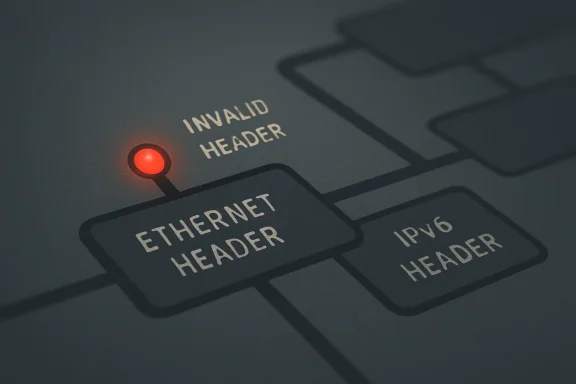
CVE-2026-31685 is a newly published Linux kernel vulnerability that turns a tiny netfilter guard condition into a useful reminder about how fragile packet parsing can be at kernel speed. The flaw sits in ip6t_eui64, an IPv6 iptables match module that compares an Ethernet-derived EUI-64 identifier with the lower 64 bits of an IPv6 source address. The fix is only a one-line logic change, but its significance is larger: malformed packets should be rejected before the kernel attempts to read a MAC header that may not be valid.
The vulnerability was added to the public CVE ecosystem on April 25, 2026, with kernel.org listed as the source and NVD enrichment still pending. As of publication, NVD has not assigned a CVSS score, CVSS vector, CWE classification, or affected software matrix. That means defenders should avoid treating the absence of a score as evidence of low risk; it simply means the record is still in early processing.
The vulnerable code path is in the Linux kernel’s netfilter subsystem, specifically the IPv6 legacy iptables extension known as ip6t_eui64. This module is not the everyday firewall rule most desktop users write, but it can appear in specialized IPv6 filtering policies, embedded Linux builds, routers, lab environments, and network appliances. The bug matters because netfilter code executes deep in the packet path, where assumptions about headers, offsets, and buffer layout must be exact.
Historically, EUI-64 addressing has been tied to IPv6 autoconfiguration practices where a 64-bit interface identifier can be derived from a device’s MAC address. The ip6t_eui64 match exists to validate that relationship by reconstructing a modified EUI-64 value from the Ethernet source address and comparing it with the lower half of the IPv6 source address. That sounds straightforward until packets arrive through paths where the expected Ethernet header is missing, invalid, or no longer positioned where the code assumes it is.
The patch removes a condition that previously rejected invalid MAC headers only when the packet had a non-zero fragment offset. For unfragmented packets, where
The impact has not been formally scored by NVD, and public evidence of exploitation is not currently established. Still, the underlying class is familiar: a kernel component can reach for header data before proving that the header is present and within bounds. In a subsystem that processes attacker-controlled network traffic, defensive ordering is not optional.
For WindowsForum readers, the Linux focus does not make the issue irrelevant. Many Windows environments rely on Linux in the background, whether through WSL2, Hyper-V guests, Azure Linux workloads, container hosts, edge devices, or security appliances. The question is less “Does this affect the Windows kernel?” and more “Where do we run Linux kernels that process IPv6 traffic?”
Key points for administrators:
The problem is not the EUI-64 math itself. The issue is the module’s guard condition around access to the Ethernet header through
The older logic checked whether the MAC header pointer was within a valid range, but it only hot-dropped the packet when that failed and
The patch changes the rule from conditional rejection to universal rejection for invalid MAC headers. In practical terms, if the MAC header is not safely between the start of the socket buffer and the network data pointer with enough room for an Ethernet header, the packet is dropped before the code reads it. This is a classic example of validate before dereference.
From a firewall perspective, this created an apparent opportunity. If a packet’s IPv6 source address claims to be tied to a particular link-layer identity, a rule could test whether the claim matches the Ethernet source address. The ip6t_eui64 match was built for that type of validation.
Modern IPv6 deployments complicate this picture. Privacy extensions, stable private addresses, DHCPv6, randomized interface identifiers, tunnels, bridges, virtual NICs, and overlay networks all weaken the assumption that an IPv6 interface identifier should map neatly to a visible Ethernet MAC address. The Internet moved on, but compatibility code remains in kernels for many years.
That is why a module like ip6t_eui64 can be simultaneously obscure and important. It may be irrelevant to many hosts, yet still present in enterprise firewalls, old rule sets, embedded systems, or specialized validation policies. Kernel vulnerabilities often hide in exactly these compatibility seams.
Possible use cases include:
The Microsoft Security Response Center listing is noteworthy because MSRC increasingly tracks third-party and open-source components that intersect with Microsoft platforms, cloud services, or customer environments. A CVE appearing in that ecosystem does not automatically mean Windows itself is vulnerable. It does mean administrators should check whether Microsoft-managed Linux components, Azure images, or bundled Linux kernels receive an update.
For consumer Windows users, the risk is likely indirect. A typical Windows 11 desktop using WSL for application development is not usually acting as an IPv6 firewall with an ip6t_eui64 rule. However, power users who run network labs, containers, packet forwarding, VPN gateways, or custom kernels inside WSL2 should pay closer attention.
Enterprise exposure should be assessed by role rather than operating-system brand. If a Linux kernel processes untrusted IPv6 traffic and uses the relevant netfilter match, it belongs in the patch queue.
Check these environments first:
One useful detail is the “Fixes” tag pointing back to Linux 2.6.12-rc2. That does not mean every deployed kernel since that era is equally exploitable in practice, because configuration, module availability, compiler behavior, traffic path, and backports all matter. It does indicate that the vulnerable logic is very old and that maintainers considered the bug rooted in longstanding code.
Some third-party trackers have already inferred fixed versions such as 6.12.83, 6.18.24, and 6.19.14. Treat those as helpful but not definitive until your Linux distribution or vendor publishes its own advisory. Stable kernel version numbers do not always map cleanly to enterprise distributions, because vendors backport security fixes without changing the apparent major kernel version.
The safest approach is to verify the specific patch state rather than rely only on a version banner. Enterprise Linux systems often report older kernel series while carrying selected fixes from much newer upstream trees. Version strings are clues, not proof.
The technical description points to a memory-safety concern around invalid MAC header access. The mailing-list discussion described a KASAN-reported memory-safety issue triggered by a non-fragment packet. KASAN reports are valuable because they identify invalid memory behavior during testing, but they do not automatically prove reliable remote code execution.
A realistic preliminary assessment is that exploitation would likely require a system where the vulnerable match is active and reachable by crafted IPv6 traffic. The attacker’s position may be local network adjacent in many practical scenarios, especially because Ethernet source addresses are link-layer properties. However, tunnels, bridges, namespaces, and virtual networking can complicate where “local” begins and ends.
Until authoritative scoring arrives, defenders should rank this as situationally important rather than universally catastrophic. Kernel memory safety bugs deserve respect, but exposure depends heavily on configuration. That nuance is critical for patch prioritization.
Over the past several years, netfilter and related packet-processing paths have produced multiple security fixes involving use-after-free bugs, out-of-bounds accesses, reference-counting errors, and validation failures. That pattern does not mean netfilter is uniquely poor code. It means the subsystem handles unusually complex state at high privilege under adversarial conditions.
The migration from legacy iptables to nftables has reduced some administrative complexity, but compatibility layers and old extensions remain widely deployed. Many distributions still ship legacy modules, and many tools still generate iptables-compatible rules. The long tail of modules like ip6t_eui64 is therefore not merely historical baggage; it is part of real operational infrastructure.
CVE-2026-31685 reinforces a broader engineering lesson. Security boundaries inside a packet path must be explicit, local, and independent. A check for MAC-header validity should not depend on whether a packet is fragmented.
Cloud environments deserve special attention because network functions are often distributed. A workload VM may not use ip6t_eui64, but a self-managed firewall VM, transit gateway appliance, or packet inspection node might. Similarly, Kubernetes hosts may have legacy iptables rules even when applications are unaware of them.
For regulated environments, the lack of an NVD score can create reporting friction. Vulnerability management platforms may show the CVE as incomplete, unscored, or informational. Security teams should annotate the finding with local exposure evidence rather than wait passively for enrichment.
Patch timing should follow role-based priority. Internet-facing or partner-facing IPv6 filtering nodes should be updated first. Internal hosts with no eui64 match and no packet-forwarding role can likely follow the normal kernel maintenance cadence.
Power users are different. Anyone using Linux as a home router, lab firewall, IPv6 tunnel endpoint, or container host should check whether ip6tables rules include the eui64 match. Home labs often accumulate copied firewall snippets over years, and legacy IPv6 examples sometimes include unusual matches.
Windows power users running WSL2 should also keep the WSL kernel current. The most common WSL workloads are not exposed in the same way as a network gateway, but WSL environments can be customized heavily. If you are experimenting with namespaces, packet forwarding, raw sockets, or bridged networking, you are closer to the affected territory.
The broader consumer lesson is simple: kernel updates are not just about visible features. They routinely carry small hardening fixes in subsystems most users never touch directly. The safest desktop is usually the one that reboots after kernel updates instead of postponing them indefinitely.
Distribution advisories will matter more than generic kernel version claims. Debian, Ubuntu, Red Hat, SUSE, Fedora, Arch, Alpine, Azure Linux, and appliance vendors may each handle the fix differently. Some will ship new kernel point releases; others will backport the patch into existing package streams.
Watch for these developments:
CVE-2026-31685 will probably not be remembered as a landmark vulnerability, but it is exactly the kind of flaw that separates mature infrastructure programs from reactive ones. The fix is small, the exposure is configuration-dependent, and the affected code is specialized, yet the lesson is broad: packet metadata is untrusted until proven otherwise. For Windows and Linux administrators alike, the right response is not panic; it is disciplined inventory, timely patching, and renewed attention to the IPv6 paths that quietly carry more of today’s network traffic.
Source: NVD / Linux Kernel Security Update Guide - Microsoft Security Response Center
 Overview
The vulnerability was added to the public CVE ecosystem on April 25, 2026, with kernel.org listed as the source and NVD enrichment still pending. As of publication, NVD has not assigned a CVSS score, CVSS vector, CWE classification, or affected software matrix. That means defenders should avoid treating the absence of a score as evidence of low risk; it simply means the record is still in early processing.The vulnerable code path is in the Linux kernel’s netfilter subsystem, specifically the IPv6 legacy iptables extension known as ip6t_eui64. This module is not the everyday firewall rule most desktop users write, but it can appear in specialized IPv6 filtering policies, embedded Linux builds, routers, lab environments, and network appliances. The bug matters because netfilter code executes deep in the packet path, where assumptions about headers, offsets, and buffer layout must be exact.
Historically, EUI-64 addressing has been tied to IPv6 autoconfiguration practices where a 64-bit interface identifier can be derived from a device’s MAC address. The ip6t_eui64 match exists to validate that relationship by reconstructing a modified EUI-64 value from the Ethernet source address and comparing it with the lower half of the IPv6 source address. That sounds straightforward until packets arrive through paths where the expected Ethernet header is missing, invalid, or no longer positioned where the code assumes it is.
The patch removes a condition that previously rejected invalid MAC headers only when the packet had a non-zero fragment offset. For unfragmented packets, where
par->fragoff == 0, the old logic could still proceed to eth_hdr(skb) even if the socket buffer’s MAC header was not valid. The corrected behavior is to reject any packet with an invalid MAC header before the module attempts to read Ethernet header data.Why This Vulnerability Matters
A small condition with kernel-level consequences
At first glance, CVE-2026-31685 looks like the kind of quiet kernel fix that disappears into a stable release changelog. The diff removes a fragment-offset condition, changes three lines in one file, and makes invalid MAC headers a hot-drop condition for all packets. Yet this is precisely the kind of fix security teams should notice, because packet parsers routinely sit at the boundary between untrusted input and privileged kernel memory.The impact has not been formally scored by NVD, and public evidence of exploitation is not currently established. Still, the underlying class is familiar: a kernel component can reach for header data before proving that the header is present and within bounds. In a subsystem that processes attacker-controlled network traffic, defensive ordering is not optional.
For WindowsForum readers, the Linux focus does not make the issue irrelevant. Many Windows environments rely on Linux in the background, whether through WSL2, Hyper-V guests, Azure Linux workloads, container hosts, edge devices, or security appliances. The question is less “Does this affect the Windows kernel?” and more “Where do we run Linux kernels that process IPv6 traffic?”
Key points for administrators:
- The bug is in Linux netfilter, not the Windows TCP/IP stack.
- The affected code path is IPv6-specific and tied to the ip6t_eui64 match.
- The fix is already represented in stable kernel patch references, but distro packaging timelines may vary.
- No NVD severity score is available yet, so local risk assessment matters.
- Systems not using the eui64 iptables match may have limited exposure, though kernel inventory remains important.
The Technical Root Cause
How ip6t_eui64 reaches the risky path
The vulnerable function,eui64_mt6(), attempts to derive a modified EUI-64 value from the Ethernet source address. It then compares that value with the low 64 bits of the IPv6 source address. This is a packet classification task: if the relationship matches, the firewall rule can act on the packet accordingly.The problem is not the EUI-64 math itself. The issue is the module’s guard condition around access to the Ethernet header through
eth_hdr(skb). In Linux networking, an sk_buff carries packet data plus metadata describing where protocol headers are located, but those offsets are meaningful only when they are valid for the path the packet took.The older logic checked whether the MAC header pointer was within a valid range, but it only hot-dropped the packet when that failed and
par->fragoff != 0. That left a hole for packets with par->fragoff == 0. In that case, invalid MAC header state could slip past the guard and reach an Ethernet-header access that should have been blocked.The patch changes the rule from conditional rejection to universal rejection for invalid MAC headers. In practical terms, if the MAC header is not safely between the start of the socket buffer and the network data pointer with enough room for an Ethernet header, the packet is dropped before the code reads it. This is a classic example of validate before dereference.
What changed in behavior
The functional change is narrow but important:- Before: Invalid MAC headers were rejected only for non-first fragments.
- After: Invalid MAC headers are rejected for all packets.
- Before: Unfragmented packets could still reach Ethernet header access with bad MAC metadata.
- After: The match fails safely and marks the packet for hot drop.
- Before: The fragment offset influenced a memory-safety decision.
- After: Header validity alone controls whether the read is allowed.
IPv6, EUI-64, and Why This Module Exists
The legacy logic behind EUI-64 matching
The EUI-64 concept comes from a period when IPv6 autoconfiguration often derived interface identifiers from link-layer addresses. A 48-bit MAC address could be transformed into a 64-bit identifier by insertingff:fe in the middle and flipping the universal/local bit. That identifier could then appear in the lower 64 bits of an IPv6 address.From a firewall perspective, this created an apparent opportunity. If a packet’s IPv6 source address claims to be tied to a particular link-layer identity, a rule could test whether the claim matches the Ethernet source address. The ip6t_eui64 match was built for that type of validation.
Modern IPv6 deployments complicate this picture. Privacy extensions, stable private addresses, DHCPv6, randomized interface identifiers, tunnels, bridges, virtual NICs, and overlay networks all weaken the assumption that an IPv6 interface identifier should map neatly to a visible Ethernet MAC address. The Internet moved on, but compatibility code remains in kernels for many years.
That is why a module like ip6t_eui64 can be simultaneously obscure and important. It may be irrelevant to many hosts, yet still present in enterprise firewalls, old rule sets, embedded systems, or specialized validation policies. Kernel vulnerabilities often hide in exactly these compatibility seams.
Where EUI-64 checks may still appear
Administrators are most likely to encounter EUI-64 logic in environments that value deterministic addressing or link-layer validation. These are often not consumer laptops, but infrastructure systems.Possible use cases include:
- Router and gateway builds that expose legacy iptables modules.
- IPv6 lab networks using predictable SLAAC-derived addresses.
- Embedded appliances with vendor-supplied firewall templates.
- ISP edge devices or CPE firmware based on older Linux networking assumptions.
- Security research environments testing IPv6 identity behavior.
- Container or VM hosts where iptables compatibility modules remain available.
-m eui64. If the module is present but unused, risk is likely reduced. If the match is active on an IPv6 packet path, patching becomes more urgent.Exposure in Windows-Centric Environments
Why Windows admins should still care
This CVE is not a Windows kernel vulnerability, but it can surface in Windows-adjacent infrastructure. WSL2 runs Linux workloads on a Microsoft-managed Linux kernel, and many developers run Docker, Kubernetes tooling, packet labs, or security tools inside that ecosystem. Enterprise Windows shops also commonly run Linux virtual machines on Hyper-V, Azure, VMware, or Proxmox infrastructure.The Microsoft Security Response Center listing is noteworthy because MSRC increasingly tracks third-party and open-source components that intersect with Microsoft platforms, cloud services, or customer environments. A CVE appearing in that ecosystem does not automatically mean Windows itself is vulnerable. It does mean administrators should check whether Microsoft-managed Linux components, Azure images, or bundled Linux kernels receive an update.
For consumer Windows users, the risk is likely indirect. A typical Windows 11 desktop using WSL for application development is not usually acting as an IPv6 firewall with an ip6t_eui64 rule. However, power users who run network labs, containers, packet forwarding, VPN gateways, or custom kernels inside WSL2 should pay closer attention.
Enterprise exposure should be assessed by role rather than operating-system brand. If a Linux kernel processes untrusted IPv6 traffic and uses the relevant netfilter match, it belongs in the patch queue.
Windows-adjacent places to check
A focused inventory is better than broad alarm. Start with systems that combine IPv6 forwarding, firewalling, and Linux kernels.Check these environments first:
- WSL2 kernels used for networking research or privileged packet handling.
- Hyper-V Linux guests acting as routers, firewalls, proxies, or VPN endpoints.
- Azure Linux virtual machines with custom iptables policies.
- Container hosts that still rely on iptables compatibility layers.
- Network appliances based on Linux firmware.
- CI/CD test runners that load unusual netfilter modules.
- Developer workstations running custom kernels or packet fuzzing tools.
Patch Status and Kernel Lineage
Stable commits and backport signals
The public record identifies multiple stable kernel commit references for the fix, with the upstream patch attributed to the netfilter change titled “ip6t_eui64: reject invalid MAC header for all packets.” The mailing-list trail shows the patch moving through netfilter and stable review channels in early to mid-April 2026, before the CVE record landed in NVD on April 25. That sequence is common for Linux kernel CVEs: the fix can exist in upstream or stable trees before the public vulnerability databases complete enrichment.One useful detail is the “Fixes” tag pointing back to Linux 2.6.12-rc2. That does not mean every deployed kernel since that era is equally exploitable in practice, because configuration, module availability, compiler behavior, traffic path, and backports all matter. It does indicate that the vulnerable logic is very old and that maintainers considered the bug rooted in longstanding code.
Some third-party trackers have already inferred fixed versions such as 6.12.83, 6.18.24, and 6.19.14. Treat those as helpful but not definitive until your Linux distribution or vendor publishes its own advisory. Stable kernel version numbers do not always map cleanly to enterprise distributions, because vendors backport security fixes without changing the apparent major kernel version.
The safest approach is to verify the specific patch state rather than rely only on a version banner. Enterprise Linux systems often report older kernel series while carrying selected fixes from much newer upstream trees. Version strings are clues, not proof.
Practical patch workflow
A sequential response plan should look like this:- Inventory kernels that process IPv6 traffic through netfilter or iptables compatibility paths.
- Search firewall rules for the eui64 match, especially
ip6tablesrules using-m eui64. - Check vendor advisories for your distribution, appliance, cloud image, or WSL kernel channel.
- Confirm patch inclusion through package changelogs, commit backports, or vendor security notes.
- Reboot or live-patch carefully where kernel updates require activation.
- Retest IPv6 firewall behavior after patching to ensure legacy rules still operate as intended.
Exploitability and Severity: What We Know Now
Why the missing CVSS score matters
As of April 26, 2026, NVD has not supplied a CVSS 4.0, CVSS 3.x, or CVSS 2.0 score for CVE-2026-31685. That makes the vulnerability harder to rank in dashboards that depend on numeric severity. It also creates room for premature overstatement by automated scanners, feeds, and low-quality vulnerability blogs.The technical description points to a memory-safety concern around invalid MAC header access. The mailing-list discussion described a KASAN-reported memory-safety issue triggered by a non-fragment packet. KASAN reports are valuable because they identify invalid memory behavior during testing, but they do not automatically prove reliable remote code execution.
A realistic preliminary assessment is that exploitation would likely require a system where the vulnerable match is active and reachable by crafted IPv6 traffic. The attacker’s position may be local network adjacent in many practical scenarios, especially because Ethernet source addresses are link-layer properties. However, tunnels, bridges, namespaces, and virtual networking can complicate where “local” begins and ends.
Until authoritative scoring arrives, defenders should rank this as situationally important rather than universally catastrophic. Kernel memory safety bugs deserve respect, but exposure depends heavily on configuration. That nuance is critical for patch prioritization.
Early risk indicators
The most important indicators are operational rather than theoretical:- Is IPv6 enabled and routed through the affected host?
- Does the system use ip6tables rather than only nftables-native rules?
- Is the eui64 match loaded or referenced in rules?
- Can untrusted traffic reach the relevant chain?
- Is the kernel supplied by a vendor that backports netfilter fixes promptly?
- Is the system an appliance where updates lag behind upstream Linux?
Netfilter’s Broader Security Context
Why packet filters remain high-value attack surface
Netfilter has a long history as one of Linux’s most important networking subsystems. It underpins iptables, nftables, NAT, packet mangling, connection tracking, and countless security products. That power also makes it a rich attack surface, because it parses complex, attacker-influenced packet state before user-space services ever see the traffic.Over the past several years, netfilter and related packet-processing paths have produced multiple security fixes involving use-after-free bugs, out-of-bounds accesses, reference-counting errors, and validation failures. That pattern does not mean netfilter is uniquely poor code. It means the subsystem handles unusually complex state at high privilege under adversarial conditions.
The migration from legacy iptables to nftables has reduced some administrative complexity, but compatibility layers and old extensions remain widely deployed. Many distributions still ship legacy modules, and many tools still generate iptables-compatible rules. The long tail of modules like ip6t_eui64 is therefore not merely historical baggage; it is part of real operational infrastructure.
CVE-2026-31685 reinforces a broader engineering lesson. Security boundaries inside a packet path must be explicit, local, and independent. A check for MAC-header validity should not depend on whether a packet is fragmented.
Lessons for firewall design
Administrators can take several design lessons from this CVE:- Prefer simpler firewall rules where specialized matches are not required.
- Retire legacy IPv6 assumptions that depend on MAC-derived interface identifiers.
- Audit rarely used modules because obscure paths receive less routine scrutiny.
- Limit packet filtering roles to systems designed and monitored for that purpose.
- Use vendor-supported kernels rather than custom builds unless you can track upstream fixes.
- Test IPv6 paths explicitly, not as an afterthought to IPv4 policy.
Enterprise Impact
Where businesses should prioritize
For enterprises, CVE-2026-31685 is mainly an inventory and exposure-management problem. The highest-priority systems are Linux-based routers, firewalls, bastion gateways, Kubernetes nodes with complex network plugins, VPN concentrators, and appliances that process untrusted IPv6 traffic. These systems are more likely to exercise netfilter paths than ordinary application servers.Cloud environments deserve special attention because network functions are often distributed. A workload VM may not use ip6t_eui64, but a self-managed firewall VM, transit gateway appliance, or packet inspection node might. Similarly, Kubernetes hosts may have legacy iptables rules even when applications are unaware of them.
For regulated environments, the lack of an NVD score can create reporting friction. Vulnerability management platforms may show the CVE as incomplete, unscored, or informational. Security teams should annotate the finding with local exposure evidence rather than wait passively for enrichment.
Patch timing should follow role-based priority. Internet-facing or partner-facing IPv6 filtering nodes should be updated first. Internal hosts with no eui64 match and no packet-forwarding role can likely follow the normal kernel maintenance cadence.
Enterprise checklist
Security teams should document:- Kernel package names and versions across Linux fleets.
- Presence of ip6t_eui64 module files or loaded modules.
- Rules using
-m eui64in persistent and runtime firewall configurations. - IPv6 forwarding status on gateways, containers, and virtual hosts.
- Vendor advisory status for distributions and appliances.
- Maintenance windows needed for kernel replacement and reboot.
- Compensating controls such as upstream filtering or rule removal.
Consumer and Power-User Impact
Why most desktops are probably not the main target
For ordinary Linux desktop users, this issue is likely to be addressed through routine distribution kernel updates. Most consumer systems do not use ip6t_eui64 rules, do not route untrusted IPv6 traffic for other hosts, and do not expose custom packet-filtering behavior to local networks. That keeps practical risk lower than the word “kernel vulnerability” might suggest.Power users are different. Anyone using Linux as a home router, lab firewall, IPv6 tunnel endpoint, or container host should check whether ip6tables rules include the eui64 match. Home labs often accumulate copied firewall snippets over years, and legacy IPv6 examples sometimes include unusual matches.
Windows power users running WSL2 should also keep the WSL kernel current. The most common WSL workloads are not exposed in the same way as a network gateway, but WSL environments can be customized heavily. If you are experimenting with namespaces, packet forwarding, raw sockets, or bridged networking, you are closer to the affected territory.
The broader consumer lesson is simple: kernel updates are not just about visible features. They routinely carry small hardening fixes in subsystems most users never touch directly. The safest desktop is usually the one that reboots after kernel updates instead of postponing them indefinitely.
What home users can do
Reasonable steps include:- Apply your distribution’s kernel updates when they arrive.
- Restart after kernel updates so the patched kernel is actually running.
- Review custom firewall scripts for unusual IPv6 matches.
- Update router firmware if your router uses Linux-based firmware.
- Avoid copying old IPv6 firewall recipes blindly from outdated tutorials.
- Keep WSL updated if you rely on Linux networking experiments inside Windows.
Strengths and Opportunities
CVE-2026-31685 is a good example of the Linux security process working in a quiet but meaningful way: researchers identified a narrow memory-safety issue, maintainers produced a minimal fix, stable backports followed, and the CVE ecosystem began tracking it publicly. The opportunity now is to use this bug as a prompt for broader IPv6 and netfilter hygiene.- The patch is small and auditable, which reduces regression risk compared with invasive rewrites.
- The vulnerable logic is clearly described, making exposure analysis easier for defenders.
- Stable kernel backports are already visible, giving vendors a concrete fix to ship.
- The issue highlights legacy iptables modules, which many organizations should audit anyway.
- The CVE encourages IPv6 rule review, an area often neglected in firewall governance.
- The fix reinforces safe parser design, especially validate-before-access ordering.
- Windows-adjacent teams get a useful reminder that Linux kernels are part of many Microsoft-centered environments.
Risks and Concerns
The main concern is not that every Linux machine is suddenly at high risk. The concern is that obscure packet-filtering code can persist unnoticed in appliances, custom kernels, and inherited firewall policies for years. An unscored CVE may be ignored by dashboards even when a particular organization has exactly the kind of IPv6 gateway that should be patched quickly.- NVD has not yet assigned severity, which may delay prioritization.
- Affected-version mapping remains vendor-dependent, especially for backported enterprise kernels.
- Legacy firewall rules can be hard to inventory, particularly on appliances.
- IPv6 exposure is often misunderstood, leading teams to check only IPv4 paths.
- Custom kernels may miss stable backports unless maintainers track upstream closely.
- Third-party scanners may overstate or understate risk before authoritative enrichment arrives.
- Embedded devices may receive patches slowly, even when the upstream fix is simple.
What to Watch Next
The next signals from vendors
The immediate item to watch is NVD enrichment. A CVSS vector, CWE assignment, and affected software configuration will help vulnerability scanners converge on a more consistent rating. However, administrators should not wait for those fields if they already know they run Linux IPv6 filtering systems using ip6t_eui64.Distribution advisories will matter more than generic kernel version claims. Debian, Ubuntu, Red Hat, SUSE, Fedora, Arch, Alpine, Azure Linux, and appliance vendors may each handle the fix differently. Some will ship new kernel point releases; others will backport the patch into existing package streams.
Watch for these developments:
- NVD severity and CWE assignment for CVE-2026-31685.
- Linux distribution advisories confirming patched kernel packages.
- Microsoft guidance for any affected Microsoft-managed Linux kernels or services.
- Appliance vendor firmware updates for routers, firewalls, and edge devices.
- Scanner plugin updates that improve detection beyond simple version matching.
CVE-2026-31685 will probably not be remembered as a landmark vulnerability, but it is exactly the kind of flaw that separates mature infrastructure programs from reactive ones. The fix is small, the exposure is configuration-dependent, and the affected code is specialized, yet the lesson is broad: packet metadata is untrusted until proven otherwise. For Windows and Linux administrators alike, the right response is not panic; it is disciplined inventory, timely patching, and renewed attention to the IPv6 paths that quietly carry more of today’s network traffic.
Source: NVD / Linux Kernel Security Update Guide - Microsoft Security Response Center
