

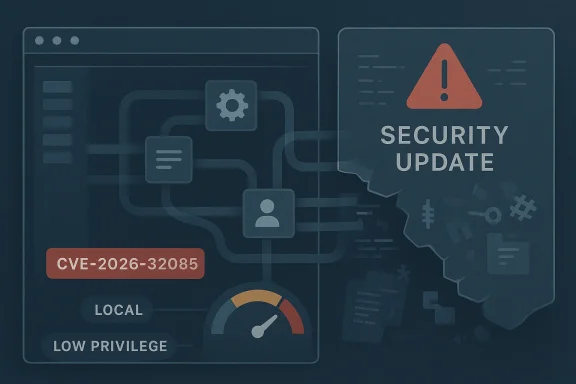
Microsoft has published a new Remote Procedure Call Information Disclosure Vulnerability under CVE-2026-32085, and the classification itself is a useful signal: this is the kind of flaw that does not need flashy remote code execution to matter. In Microsoft’s security model, an information disclosure issue can still expose sensitive data, weaken defenses, or provide the missing piece for a larger compromise. The available public description indicates the flaw is tied to Windows Remote Procedure Call (RPC) and is rated as a local, low-privilege confidentiality issue, which suggests the immediate risk is narrower than a wormable network exploit but still operationally important for enterprise hardening. Microsoft’s current Security Update Guide is the authoritative source for the entry, while third-party catalogs mirror the same title and severity framing.
Remote Procedure Call, or RPC, is one of those Windows subsystems that most users never notice and most defenders only think about when it breaks. Yet RPC sits underneath a wide range of operating-system and enterprise functions, from service management to distributed administration and application interoperability. That makes RPC vulnerabilities especially interesting: even when an issue is “only” an information disclosure flaw, the subsystem’s breadth can turn a small bug into a meaningful foothold. Microsoft has spent more than a decade publishing RPC fixes that range from code execution to privilege escalation and disclosure, which shows how central this interface remains to Windows security.
Microsoft’s own vulnerability descriptions have evolved over time toward clearer, more standardized wording. In 2020, MSRC explained that many modern CVE titles are concise forms of the first descriptive sentence in the advisory, such as “Windows kernel information disclosure vulnerability,” and that the public text is intended to convey impact, conditions, and scoring without drowning readers in implementation details. That matters here because the wording around CVE-2026-32085 is brief but informative: it points to disclosure through RPC, implies local exploitation, and suggests the root cause remains abstracted from public view. The company’s newer CSAF publishing model also reflects a push for machine-readable, structured advisories, even when the human-facing page remains lightweight.
The public record also shows that Microsoft routinely distinguishes between the existence of a vulnerability and the availability of deep technical detail. In some cases, the company confirms the condition and ships a fix long before researchers or attackers fully understand the exploit path. In other cases, Microsoft explicitly acknowledges when a vulnerability was discovered through coordinated disclosure and provides enough information for defenders to patch without publishing a step-by-step attack recipe. That is important context for CVE-2026-32085, because the current public language suggests the flaw is real, understood well enough to remediate, and not yet accompanied by public exploit code.
It is also worth noting that RPC disclosure bugs are not new. Microsoft has previously patched RPC-related issues that exposed memory contents, mishandled object initialization, or failed to enforce the right access control in the runtime. That history gives this new CVE a familiar profile: not the most dramatic kind of Windows flaw, but one that can be valuable to attackers who want credentials, tokens, object pointers, or other sensitive material that later enables escalation. That is often the quiet danger of disclosure bugs—they do not always look severe on first read, but they can lower the bar for subsequent compromise.
The significance is not just academic. Enterprises routinely treat local disclosure flaws as “secondary” because they do not resemble headline-grabbing remote worms. But on a hardened Windows estate, attackers increasingly chain small issues together, and a disclosure bug can reveal enough state to defeat defenses, discover memory layout, or extract data that was assumed to remain secret. In modern threat models, post-compromise value matters almost as much as first-touch value.
There is also a consistent theme in Microsoft’s descriptions: the company often emphasizes whether exploitation requires authentication, user interaction, or special configuration. That matters because the difference between local authenticated exploitation and remote unauthenticated exploitation can determine whether a vulnerability is mainly a hardening concern or an incident-response emergency. CVE-2026-32085 appears, at least from the public mirror descriptions, to fall into the former category.
The low-privilege requirement also suggests this issue is relevant on systems where many users share the same host. Think VDI, terminal services, lab systems, shared admin jump boxes, and some OT or kiosk deployments. Shared trust boundaries are where local disclosures become disproportionately dangerous. A vulnerability that leaks memory or subsystem state can make a secondary compromise much easier on precisely the machines defenders care most about.
Enterprise environments face a different calculus. A disclosure flaw on a workstation may expose credentials that belong to an admin who logged in earlier, or reveal information useful for lateral movement. In regulated or high-security environments, even a contained confidentiality issue can trigger a patching obligation because the downstream cost of leaked secrets far exceeds the cost of the patch itself. The severity score is only a starting point; context determines the outcome.
Microsoft’s transparency push also tells us something about its confidence threshold. The company is more willing today to publish CVEs and structured details even when the public explanation is deliberately modest. That suggests CVE-2026-32085 is not being withheld because of uncertainty; rather, it is being disclosed in the ordinary MSRC way, with enough detail for remediation and not enough detail to hand attackers a blueprint.
This is especially true when the vulnerability affects a foundational subsystem rather than a single optional app. Foundational issues tend to show up in more products, more toolchains, and more enterprise workflows than their initial title suggests. Even if only a subset of Windows builds is explicitly listed at first, downstream effects can spread into management tools, enterprise products, and partner software that rely on the same runtime.
The broader market implication is that disclosure bugs remain commercially meaningful even when they do not produce dramatic headlines. Enterprises buy layered defenses for precisely these reasons: a local information leak can be enough to defeat another product’s assumptions or provide the missing context for a later exploit. In other words, the patch is not only about Microsoft’s code; it is about the reliability of the platform as a whole.
That is why defenders should look at the CVE not in isolation but as part of the larger Windows attack surface. The more foundational the component, the more likely a “small” bug can matter in a multi-stage intrusion. Attack chains are where many medium-severity issues become high-impact incidents.
Microsoft’s latest CVE is therefore less a dramatic alarm than a practical reminder: foundational Windows components still matter, local attacks still count, and information disclosure remains one of the most underestimated paths in enterprise compromise. Organizations that treat this as a simple low-severity patch ticket may be missing the larger lesson. The real value is in reducing the attacker’s ability to learn, adapt, and chain, because that is exactly how modern intrusions progress.
Source: MSRC Security Update Guide - Microsoft Security Response Center
 Background
Remote Procedure Call, or RPC, is one of those Windows subsystems that most users never notice and most defenders only think about when it breaks. Yet RPC sits underneath a wide range of operating-system and enterprise functions, from service management to distributed administration and application interoperability. That makes RPC vulnerabilities especially interesting: even when an issue is “only” an information disclosure flaw, the subsystem’s breadth can turn a small bug into a meaningful foothold. Microsoft has spent more than a decade publishing RPC fixes that range from code execution to privilege escalation and disclosure, which shows how central this interface remains to Windows security.Microsoft’s own vulnerability descriptions have evolved over time toward clearer, more standardized wording. In 2020, MSRC explained that many modern CVE titles are concise forms of the first descriptive sentence in the advisory, such as “Windows kernel information disclosure vulnerability,” and that the public text is intended to convey impact, conditions, and scoring without drowning readers in implementation details. That matters here because the wording around CVE-2026-32085 is brief but informative: it points to disclosure through RPC, implies local exploitation, and suggests the root cause remains abstracted from public view. The company’s newer CSAF publishing model also reflects a push for machine-readable, structured advisories, even when the human-facing page remains lightweight.
The public record also shows that Microsoft routinely distinguishes between the existence of a vulnerability and the availability of deep technical detail. In some cases, the company confirms the condition and ships a fix long before researchers or attackers fully understand the exploit path. In other cases, Microsoft explicitly acknowledges when a vulnerability was discovered through coordinated disclosure and provides enough information for defenders to patch without publishing a step-by-step attack recipe. That is important context for CVE-2026-32085, because the current public language suggests the flaw is real, understood well enough to remediate, and not yet accompanied by public exploit code.
It is also worth noting that RPC disclosure bugs are not new. Microsoft has previously patched RPC-related issues that exposed memory contents, mishandled object initialization, or failed to enforce the right access control in the runtime. That history gives this new CVE a familiar profile: not the most dramatic kind of Windows flaw, but one that can be valuable to attackers who want credentials, tokens, object pointers, or other sensitive material that later enables escalation. That is often the quiet danger of disclosure bugs—they do not always look severe on first read, but they can lower the bar for subsequent compromise.
What Microsoft is actually signaling
The public title for CVE-2026-32085 is concise, but the wording carries several implications. First, “information disclosure” tells us this is a confidentiality issue rather than an integrity or availability problem. Second, the RPC reference narrows the likely attack surface to systems or components that use Windows RPC internals. Third, the current advisory language, as mirrored by aggregators, points toward a local attack path with low privileges, which is materially different from a network-only exploit that could spread unauthenticated across the internet.Why the wording matters
Microsoft’s old bulletins often contained more narrative detail, but the modern Security Update Guide emphasizes a standardized summary and structured fields. In practice, that means defenders have to read the title, the CVSS vector, and the affected-product list together rather than waiting for a long prose explanation. For CVE-2026-32085, the combination of “RPC,” “information disclosure,” and a local-privilege vector implies a bug that could matter most after initial access has already been established. That makes the issue especially relevant in post-exploitation scenarios, lateral movement workflows, and multi-user environments.The significance is not just academic. Enterprises routinely treat local disclosure flaws as “secondary” because they do not resemble headline-grabbing remote worms. But on a hardened Windows estate, attackers increasingly chain small issues together, and a disclosure bug can reveal enough state to defeat defenses, discover memory layout, or extract data that was assumed to remain secret. In modern threat models, post-compromise value matters almost as much as first-touch value.
The confidence metric explained
The text you supplied describes a metric measuring confidence in a vulnerability’s existence and the credibility of its technical details. That framing is consistent with how security communities distinguish between confirmed, corroborated, and speculative findings. Microsoft’s own disclosure workflow supports that distinction: it may publish a CVE because the issue is confirmed and patched even if the technical root cause remains intentionally sparse, or because the company wants to notify defenders before the details are broadly usable by attackers.- A confirmed vulnerability usually has vendor acknowledgement and a patch.
- A corroborated issue may have independent research but less certainty about exact internals.
- A speculative issue may be suspected from symptoms or partial analysis alone.
- Microsoft’s publication of a CVE generally means the issue has crossed the threshold from theory to action.
How RPC bugs have historically behaved
RPC is a recurring source of Windows security issues because it is both foundational and complicated. The subsystem handles marshalling, authentication, message parsing, and object representation across process boundaries, which means subtle memory-handling mistakes can create dangerous security gaps. Microsoft’s older bulletins show that RPC flaws have produced remote code execution, elevation of privilege, and disclosure issues across many generations of Windows.A pattern of mixed impact
Some RPC vulnerabilities have been outright catastrophic. Others have been limited by configuration, authentication, or platform version. The important lesson is that RPC bugs scale differently depending on where they sit in the stack. A flaw in the runtime itself can affect many products indirectly, while a flaw in a specific RPC client or server implementation may be narrower but still dangerous inside enterprise management tools, domain infrastructure, or third-party software that embeds Windows RPC.There is also a consistent theme in Microsoft’s descriptions: the company often emphasizes whether exploitation requires authentication, user interaction, or special configuration. That matters because the difference between local authenticated exploitation and remote unauthenticated exploitation can determine whether a vulnerability is mainly a hardening concern or an incident-response emergency. CVE-2026-32085 appears, at least from the public mirror descriptions, to fall into the former category.
Why disclosure bugs still matter
Information disclosure vulnerabilities can leak objects, pointers, secrets, or state that reduce the cost of later exploitation. In a memory-safe world, that might sound less alarming than code execution, but Windows security has never been a pure one-bug game. Attackers often need reconnaissance inside a target before they can reliably pivot, and disclosure bugs are excellent reconnaissance tools. They can help defeat ASLR, reveal privileged state, or expose credentials cached in memory or adjacent structures.- Disclosure bugs can support chain attacks.
- They often aid post-exploitation more than initial intrusion.
- They can expose memory layout or sensitive process state.
- They sometimes act as a stepping stone to privilege escalation.
- They are frequently underweighted by non-specialists.
Severity and exploitability
The current third-party mirror for CVE-2026-32085 reports a CVSS 5.5 score with a local attack vector, low privileges required, and no user interaction, which aligns with a moderately serious but contained issue. The confidentiality impact is listed as high, while integrity and availability are unaffected. That combination is classic for a disclosure flaw: the attacker does not crash the machine or alter code, but can still learn something they should not know.What the vector suggests
A local vector usually means the attacker already has a foothold on the endpoint or server. That can include a low-privilege account, a compromised service context, or access obtained through another exploit. In enterprise environments, that is a meaningful distinction because it changes remediation priorities: the question becomes not “Can the internet hit us?” but “What can a low-privilege insider, tenant, or post-breach actor extract once inside?”The low-privilege requirement also suggests this issue is relevant on systems where many users share the same host. Think VDI, terminal services, lab systems, shared admin jump boxes, and some OT or kiosk deployments. Shared trust boundaries are where local disclosures become disproportionately dangerous. A vulnerability that leaks memory or subsystem state can make a secondary compromise much easier on precisely the machines defenders care most about.
Why there may be no public exploit
The available information indicates no public proof of concept and no evidence of active exploitation at the time of publication. That is a reassuring sign, but it is not a reason to delay patching. Microsoft has repeatedly shown that vulnerabilities can be fully real and still remain unexploited in the wild for a period, only to become weaponized later once details circulate or attackers reverse-engineer the fix. The absence of a public exploit does not eliminate the operational benefit of patching early.- No public exploit means less immediate pressure, not zero risk.
- Local-only flaws can still be highly valuable after compromise.
- A disclosure bug may be chained with a separate privilege bug.
- Patch timing still matters because fixes can be reverse-engineered.
- Internal attackers and malware operators may exploit before public proof exists.
Enterprise impact versus consumer impact
For home users, a local RPC disclosure issue is usually less urgent than a remote browser, email, or network worm vulnerability. Most consumer systems are single-user, regularly rebooted, and less likely to host complex administrative tooling that attackers can pivot through. Still, consumer endpoints are not immune, especially if malware is already present and trying to escalate, harvest secrets, or move laterally through shared credentials.Consumer reality
On a personal PC, the practical risk is often secondary: malware or an unwanted application may be able to extract more information once it gains a foothold. That can include tokens, service state, or data that helps the attacker persist. For that reason, “low-privilege local” should never be interpreted as “only a lab problem.” It is simply a sign that the vulnerability becomes dangerous after the first compromise step.Enterprise environments face a different calculus. A disclosure flaw on a workstation may expose credentials that belong to an admin who logged in earlier, or reveal information useful for lateral movement. In regulated or high-security environments, even a contained confidentiality issue can trigger a patching obligation because the downstream cost of leaked secrets far exceeds the cost of the patch itself. The severity score is only a starting point; context determines the outcome.
Enterprise scenarios that deserve attention
Some environments should prioritize this CVE faster than others. Systems that allow multiple users, automation, or privileged maintenance sessions are more exposed to local abuse. Systems that run legacy line-of-business software on shared Windows builds may also warrant extra scrutiny, because older RPC-dependent components often have weaker assumptions about local trust.- Shared workstations
- Jump servers
- VDI and remote desktop hosts
- Admin workstations
- Multi-user lab systems
- Any host with cached credentials or elevated automation
Microsoft’s current disclosure strategy
Microsoft’s modern vulnerability publishing strategy is more transparent than it once was, but also more structured. The company now leans on the Security Update Guide, API-driven data, and CSAF files to provide machine-readable advisories at scale. That matters for defenders because it enables faster ingestion by vulnerability-management platforms and more consistent monitoring across product families.Why the format matters
The old bulletin model was easy for humans to read, but less efficient for automation. The newer model is better suited to asset inventories, patch orchestration, and security analytics pipelines. That is especially helpful when a vulnerability affects many Windows versions or when patch applicability varies by build, SKU, or servicing branch. For a large enterprise, the publication format can be as operationally important as the vulnerability title itself.Microsoft’s transparency push also tells us something about its confidence threshold. The company is more willing today to publish CVEs and structured details even when the public explanation is deliberately modest. That suggests CVE-2026-32085 is not being withheld because of uncertainty; rather, it is being disclosed in the ordinary MSRC way, with enough detail for remediation and not enough detail to hand attackers a blueprint.
What defenders should infer
A published CVE with a patch, a title, and a severity profile usually means the vendor believes the issue is actionable. It may still be under active analysis, but the window for uncertainty is closing the moment the update goes live. Defenders should therefore plan for the possibility that further technical detail will arrive later, not before remediation. That is the pattern Microsoft has used for many years across RPC and other Windows components.This is especially true when the vulnerability affects a foundational subsystem rather than a single optional app. Foundational issues tend to show up in more products, more toolchains, and more enterprise workflows than their initial title suggests. Even if only a subset of Windows builds is explicitly listed at first, downstream effects can spread into management tools, enterprise products, and partner software that rely on the same runtime.
Practical response for IT teams
The immediate response to a disclosure CVE should be disciplined rather than dramatic. Patch management, exposure review, and credential hygiene all matter, but the sequence matters too. Teams should first confirm whether the advisory applies to their exact Windows versions, then prioritize shared and privileged systems, and finally assess whether any local access paths are broader than expected.Suggested response sequence
- Confirm affected Windows builds and servicing branches.
- Prioritize internet-connected but user-restricted systems.
- Patch shared hosts, jump servers, and admin workstations first.
- Review local-privilege controls and unnecessary local accounts.
- Check whether endpoint protection and EDR can flag suspicious local RPC activity.
- Reassess cached credentials and privileged logon history on high-value machines.
Hardening priorities
Patch deployment is the main fix, but defenders should also think about surrounding controls. Restricting local admin rights, limiting interactive logons, and segmenting shared systems all reduce the blast radius if a local attacker succeeds. Those steps do not replace the patch, but they make exploitation less rewarding and post-compromise movement less efficient.- Reduce unnecessary local administrator membership
- Separate privileged and standard user workflows
- Minimize account reuse across roles
- Protect shared systems with stronger monitoring
- Revalidate trusted-admin assumptions on jump hosts
- Keep endpoint detection tuned for suspicious privilege use
Competitive and ecosystem implications
Windows RPC remains a core mechanism not just for Microsoft, but for countless enterprise products that interface with Windows services or management layers. That means an RPC disclosure flaw has ecosystem implications beyond a single advisory page. Third-party security tools, management agents, and assessment products often rely on RPC to collect data, authenticate, or coordinate actions, so any bug in the base runtime can ripple outward across vendor software.Why partner software should care
Microsoft’s own ecosystem includes products and services that communicate over RPC as part of routine administration. That is not automatically a vulnerability, but it does mean a flaw in the runtime can have a wide blast radius if a partner product assumes too much about what RPC exposes. Vendors that build on Windows internals should therefore test against the patched behavior quickly rather than assuming their own code is insulated.The broader market implication is that disclosure bugs remain commercially meaningful even when they do not produce dramatic headlines. Enterprises buy layered defenses for precisely these reasons: a local information leak can be enough to defeat another product’s assumptions or provide the missing context for a later exploit. In other words, the patch is not only about Microsoft’s code; it is about the reliability of the platform as a whole.
The attacker’s perspective
From an attacker’s standpoint, disclosure bugs are efficient. They are often quieter than ransomware, more reliable than a zero-day code execution attempt, and easier to chain with stolen access. If CVE-2026-32085 ends up being broadly exploitable in the wild, it will likely be because it helped attackers do something else better—identify objects, recover secrets, or prepare an escalation path—not because it changed files on disk.That is why defenders should look at the CVE not in isolation but as part of the larger Windows attack surface. The more foundational the component, the more likely a “small” bug can matter in a multi-stage intrusion. Attack chains are where many medium-severity issues become high-impact incidents.
Strengths and Opportunities
Microsoft’s handling of CVE-2026-32085 shows several strengths that help defenders, even if the underlying flaw is unwelcome. The advisory appears to have been published in a structured, modern format, the title is sufficiently descriptive, and the likely local-privilege nature of the issue gives organizations a chance to prioritize intelligently rather than react blindly. The opportunity for defenders is to use this event as a reminder to tighten local security posture on shared Windows hosts.- The issue is named and trackable through Microsoft’s security guidance.
- The likely local attack path allows risk-based prioritization.
- The high confidentiality impact gives teams a clear reason to act.
- Microsoft’s structured advisories support automation and ticketing.
- The absence of public exploit evidence gives some teams a brief but useful window.
- Patching this issue can also improve overall credential hygiene.
- The event highlights where shared-host controls remain too weak.
Risks and Concerns
The main concern with a disclosure flaw is that it can be underestimated. Teams may see a medium score and conclude it can wait, even though a local information leak on the right system can unlock valuable credentials or memory state. Another concern is that attackers often find disclosure issues more useful after they have already established a foothold, which means the vulnerability can sit quietly until a broader intrusion occurs.- Underestimating local does not reduce attacker interest.
- Shared systems can turn a moderate flaw into a serious one.
- Post-exploitation chaining can magnify the impact.
- Delayed patching increases exposure to later weaponization.
- Weak local-admin controls make exploitation easier.
- Legacy Windows environments may have slower remediation cycles.
- Third-party RPC-dependent products may inherit risk indirectly.
Looking Ahead
The next thing to watch is whether Microsoft expands the public description, adjusts the score, or adds more product coverage as servicing data matures. That is normal for Microsoft advisories, especially if researchers later identify a more specific root cause or if the patch proves relevant across more Windows builds than first indicated. For defenders, the safest assumption is that the issue is real, patched, and worth immediate inventory verification.Watch list
- Updated Microsoft advisory text
- Any change in CVSS scoring or vector details
- Broader affected-product listings
- Reports from vulnerability-management vendors
- Evidence of exploitation or proof-of-concept code
- Third-party writeups that clarify the local attack path
Microsoft’s latest CVE is therefore less a dramatic alarm than a practical reminder: foundational Windows components still matter, local attacks still count, and information disclosure remains one of the most underestimated paths in enterprise compromise. Organizations that treat this as a simple low-severity patch ticket may be missing the larger lesson. The real value is in reducing the attacker’s ability to learn, adapt, and chain, because that is exactly how modern intrusions progress.
Source: MSRC Security Update Guide - Microsoft Security Response Center
