

Microsoft’s CVE-2026-32150 entry for the Windows Function Discovery Service and its
Windows security advisories often arrive in two layers: the product label and the confidence signal. The product label tells defenders what subsystem is involved, while the confidence signal gives a rough measure of how much faith Microsoft has in the vulnerability record itself. That distinction matters because not every CVE ships with a full root-cause explanation or a proof-of-concept exploit, yet the operational risk can still be very real. Microsoft has increasingly used CVSS-style detail in the Security Update Guide to make those judgments easier to interpret.
Function Discovery is one of those Windows subsystems that most users never think about until something breaks. It helps Windows identify devices, services, and network-advertised capabilities, which makes it part of the plumbing behind discovery, enumeration, and presence-based features. When a flaw lands in a discovery service, it tends to matter disproportionately because the component can be reachable in many different deployment contexts, from consumer desktops to enterprise endpoints with device discovery enabled.
The significance of
Microsoft’s recent security posture has also emphasized whole classes of mitigations, not just one-off fixes. The company has spent the past year highlighting defenses against path traversal, unsafe junction handling, and other filesystem tricks that can be abused by lower-privileged code. That context is useful because many local privilege-escalation bugs are not standalone “magic” vulnerabilities; they are the product of mundane implementation errors in services that touch files, paths, objects, or brokered operations on behalf of users.
In that sense, CVE-2026-32150 fits a familiar Windows security pattern. It is a local privilege-escalation issue in a system service, and Microsoft’s confidence metric suggests the company believes the vulnerability is real enough to publish and track as a concrete remediation target. For defenders, the absence of deep technical detail should not be read as reassurance. It should be read as a reminder that the patch train is ahead of the public exploit narrative.
For CVE-2026-32150, the important point is not just that the issue exists in Function Discovery, but that Microsoft has deemed the record actionable enough to place in the public update guide. That alone usually means internal validation is substantial, even if the company does not disclose the exact flaw class. In Microsoft’s world, the presence of an assigned CVE plus a confidence indicator is generally a stronger signal than a vague security note or an unactionable product announcement.
The danger in discovery-oriented code is that it frequently handles input that is semi-trusted by design. Device names, advertised endpoints, path-like references, service metadata, and network-visible descriptors all create opportunities for validation mistakes. A flaw in a component like
There is also a strategic lesson here for enterprise admins. Discovery services are often enabled by default because they support interoperability, print/device visibility, and network presence. Those same conveniences make them harder to disable wholesale without affecting business workflows. The operational answer is usually to patch quickly, reduce local admin exposure, and keep endpoint privilege hygiene tight.
The most likely bug classes in this area are ones that let an attacker influence object handling, file handling, or impersonation behavior. Those are the traditional ingredients for local privilege escalation in Windows because they allow lower-privileged code to trick a higher-privileged service into doing the dangerous work. Even if the exact flaw differs, the defensive response is similar: patch, review exposure, and watch for post-compromise abuse.
That makes CVE-2026-32150 more than an endpoint-only problem. In managed environments, attackers rarely need to elevate on every machine. They just need one good pivot point, and Windows services that sit in common execution paths are often excellent candidates. Discovery services can be especially useful to attackers because they tend to live on broadly deployed client systems, where they can blend into normal administrative noise.
There is also a governance angle. Vulnerabilities like this are reminders that patch prioritization should weight system role, privilege context, and exploitability signal together. A bug in a lightly used utility is not the same as a bug in a service that can help a local attacker become SYSTEM. Function Discovery belongs much closer to the latter category than many organizations might assume at first glance.
This is one reason why Windows cumulative updates matter so much for everyday users. Most people will never know whether a vulnerability lived in Function Discovery, a graphics component, or a kernel driver. What they do know is whether their system is current, whether reboots have been deferred for weeks, and whether built-in protections have been allowed to work as intended.
That makes the message for consumers simple: even if the advisory feels abstract, it is worth taking seriously. A low-profile Windows service flaw can still be a practical route to account takeover, malware persistence, or data theft once an attacker gets onto the machine. The patch is the easy part; avoiding the foothold is the harder part.
CVE-2026-32150 fits that model well. The update guide entry gives the community a place to anchor its response without forcing Microsoft to expose implementation details that may still be under analysis or that could meaningfully assist attackers. For defenders, that means the advisory is trustworthy enough to patch against, but not rich enough to support precise root-cause assumptions.
The bigger lesson is that the update guide itself has become a strategic asset. Microsoft’s transparency improvements, including machine-readable advisories and more structured vulnerability descriptions, mean defenders can do more with less narrative. CVE-2026-32150 is another example of why that shift matters in practice.
That is enough to justify a practical response even without exploit code. In real-world defense operations, many of the most damaging vulnerabilities are patched before they are fully understood by outsiders. Waiting for the perfect writeup is a luxury few environments can afford.
The advisory also gives enterprises an opportunity to improve how they triage Windows privilege-escalation risk. A bug in a discovery service is a good reminder that “non-obvious” services can still matter deeply, especially when they sit near trust boundaries. In that sense, the CVE is a prompt to harden not just one machine, but the way an organization thinks about local escalation.
Another risk is that discovery services are easy to underestimate. They often look like convenience features rather than security-sensitive components, which can delay prioritization. In reality, they may handle privileged operations or broker interactions that are extremely useful to attackers once they have a foothold.
The next phase is likely to be routine but important: patch deployment, fleet validation, and retrospective analysis once more technical detail becomes available. If additional public research emerges, it will probably clarify the bug class and the exact exploit path. Until then, the right posture is to treat the advisory as real, actionable, and worth immediate operational planning.
Source: MSRC Security Update Guide - Microsoft Security Response Center
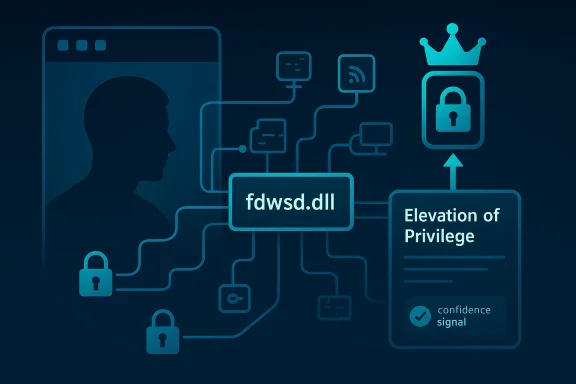
fdwsd.dll component is exactly the kind of advisory that security teams need to read carefully, even when the public description is sparse. The vulnerability is classified as an Elevation of Privilege issue, which means an attacker who already has local access may be able to cross a Windows security boundary and gain higher rights. Microsoft’s own confidence language is also important here: it is meant to signal how certain the company is that the vulnerability exists and how credible the technical details are, which in turn influences how urgently defenders should act.
 Background
Windows security advisories often arrive in two layers: the product label and the confidence signal. The product label tells defenders what subsystem is involved, while the confidence signal gives a rough measure of how much faith Microsoft has in the vulnerability record itself. That distinction matters because not every CVE ships with a full root-cause explanation or a proof-of-concept exploit, yet the operational risk can still be very real. Microsoft has increasingly used CVSS-style detail in the Security Update Guide to make those judgments easier to interpret.Function Discovery is one of those Windows subsystems that most users never think about until something breaks. It helps Windows identify devices, services, and network-advertised capabilities, which makes it part of the plumbing behind discovery, enumeration, and presence-based features. When a flaw lands in a discovery service, it tends to matter disproportionately because the component can be reachable in many different deployment contexts, from consumer desktops to enterprise endpoints with device discovery enabled.
The significance of
fdwsd.dll is less about name recognition and more about trust boundaries. Windows components that broker discovery, service enumeration, or path resolution often operate with privileges that ordinary user processes do not have. If a local attacker can influence those operations, the result is often a privilege escalation path rather than a flashy remote exploit. That is why local EoP flaws continue to be among the most operationally important Windows issues, especially in managed enterprise environments where users already have footholds on workstations.Microsoft’s recent security posture has also emphasized whole classes of mitigations, not just one-off fixes. The company has spent the past year highlighting defenses against path traversal, unsafe junction handling, and other filesystem tricks that can be abused by lower-privileged code. That context is useful because many local privilege-escalation bugs are not standalone “magic” vulnerabilities; they are the product of mundane implementation errors in services that touch files, paths, objects, or brokered operations on behalf of users.
In that sense, CVE-2026-32150 fits a familiar Windows security pattern. It is a local privilege-escalation issue in a system service, and Microsoft’s confidence metric suggests the company believes the vulnerability is real enough to publish and track as a concrete remediation target. For defenders, the absence of deep technical detail should not be read as reassurance. It should be read as a reminder that the patch train is ahead of the public exploit narrative.
What Microsoft Is Signaling
Microsoft’s Security Update Guide does more than name vulnerabilities; it communicates a risk posture. The wording around confidence is designed to tell administrators how certain Microsoft is about the existence of the flaw and the quality of the available technical evidence. In practice, that becomes a proxy for whether the advisory is speculative, corroborated, or fully acknowledged. When Microsoft publishes a CVE with a confidence metric, it is effectively saying, “this is not just theory”.For CVE-2026-32150, the important point is not just that the issue exists in Function Discovery, but that Microsoft has deemed the record actionable enough to place in the public update guide. That alone usually means internal validation is substantial, even if the company does not disclose the exact flaw class. In Microsoft’s world, the presence of an assigned CVE plus a confidence indicator is generally a stronger signal than a vague security note or an unactionable product announcement.
Why confidence matters operationally
Security teams are often forced to make patching decisions before exploit details are known. Confidence scores help narrow the gap between “known risk” and “hypothetical risk” by showing how much of the advisory is grounded in verified evidence. That is especially useful for local elevation bugs, where the main question is often not whether exploitation is possible, but how easily an attacker can chain it after obtaining a foothold.- Higher confidence usually means less room for wishful thinking.
- Sparse technical detail does not mean low risk.
- A local EoP should be treated as a post-compromise accelerant.
- Confidence metrics help separate validated issues from preliminary research.
- Microsoft’s wording should influence patch priority, not just curiosity.
A familiar Microsoft pattern
This is not the first time Microsoft has used advisory metadata to help defenders make decisions under uncertainty. The company has repeatedly explained that its vulnerability descriptions now incorporate structured scoring and richer CVE records precisely because those fields help customers prioritize patches. The message is consistent: patching is not just about the text of the description, but about the confidence behind it.Why Function Discovery Matters
Function Discovery is a Windows subsystem that sits closer to the user experience than many people realize. It helps devices and services advertise themselves, and it helps Windows discover what is present on the local machine or the network. That means it often interacts with services, brokers, and APIs that are reachable under standard user conditions, which is exactly the sort of ecosystem where privilege escalation bugs emerge.The danger in discovery-oriented code is that it frequently handles input that is semi-trusted by design. Device names, advertised endpoints, path-like references, service metadata, and network-visible descriptors all create opportunities for validation mistakes. A flaw in a component like
fdwsd.dll can therefore become a bridge from local user control to elevated execution if the service assumes too much about the integrity of the data it consumes.Discovery services and trust boundaries
Services that discover devices or resources often run with permissions and assumptions that are broader than a normal user process. They may need to enumerate system objects, interact with network state, or process content that was originally supplied by another process or device. That makes them attractive targets for local attackers who want to turn a low-privilege session into an administrative one.- Discovery services often parse untrusted or semi-trusted inputs.
- They may run under a more privileged service account.
- They are frequently exposed through normal system functionality.
- They can become a powerful pivot after initial compromise.
- Small validation errors can have large security consequences.
There is also a strategic lesson here for enterprise admins. Discovery services are often enabled by default because they support interoperability, print/device visibility, and network presence. Those same conveniences make them harder to disable wholesale without affecting business workflows. The operational answer is usually to patch quickly, reduce local admin exposure, and keep endpoint privilege hygiene tight.
What We Can Infer About the Bug Class
Microsoft has not, at least in the public metadata referenced here, spelled out whether CVE-2026-32150 is a use-after-free, improper access control, path traversal, race condition, or something else entirely. That means any deeper technical claim would be speculation. Still, the combination of a service component, a DLL name, and an elevation-of-privilege label allows a few reasonable inferences about the likely attack surface.The most likely bug classes in this area are ones that let an attacker influence object handling, file handling, or impersonation behavior. Those are the traditional ingredients for local privilege escalation in Windows because they allow lower-privileged code to trick a higher-privileged service into doing the dangerous work. Even if the exact flaw differs, the defensive response is similar: patch, review exposure, and watch for post-compromise abuse.
What we should not assume
It would be a mistake to overfit the advisory to one favorite exploit pattern. Not every Windows EoP is a kernel memory corruption bug, and not every DLL-based advisory implies code execution in the obvious sense. The public record simply does not justify that level of specificity yet. What it does justify is urgency and skepticism toward any assumption that “no exploit details” means “no operational consequence.” That would be a dangerous read.- Do not assume remote exploitability.
- Do not assume kernel involvement.
- Do not assume the issue is harmless without a PoC.
- Do not assume the absence of details means the risk is low.
- Do assume the attacker already has local access.
Enterprise Impact
For enterprises, local privilege escalation is often the step that turns a routine compromise into a major incident. A phishing click, a stolen user token, or a foothold through another vulnerability can be enough to land an attacker on an endpoint. Once there, an EoP in a core Windows service can unlock credential dumping, persistence, lateral movement, and security-tool tampering.That makes CVE-2026-32150 more than an endpoint-only problem. In managed environments, attackers rarely need to elevate on every machine. They just need one good pivot point, and Windows services that sit in common execution paths are often excellent candidates. Discovery services can be especially useful to attackers because they tend to live on broadly deployed client systems, where they can blend into normal administrative noise.
Why patch timing matters
The timing of remediation is critical because local escalation bugs are often chained into broader intrusion playbooks. A low-privilege compromise on Monday can become domain-level movement by Tuesday if the attacker finds a working EoP and the estate has not been patched. That is why even “local-only” vulnerabilities routinely receive urgent internal triage in enterprise SOCs.- Lateral movement becomes easier after privilege gain.
- Credential theft often follows local escalation.
- Security products may be disabled or bypassed.
- Incident scope expands faster on unpatched fleets.
- Legacy endpoints can become the softest target.
fdwsd.dll is present on a meaningful slice of the fleet, and if local users can interact with the affected subsystem, the patch should move quickly through the standard rings of validation and deployment.There is also a governance angle. Vulnerabilities like this are reminders that patch prioritization should weight system role, privilege context, and exploitability signal together. A bug in a lightly used utility is not the same as a bug in a service that can help a local attacker become SYSTEM. Function Discovery belongs much closer to the latter category than many organizations might assume at first glance.
Consumer Impact
Consumers may be less likely than enterprises to face targeted exploitation, but the risk model is still meaningful. A home PC with a local attacker foothold is not the same as a corporate domain, yet many consumer systems hold browser sessions, password managers, cloud sync tokens, and personal documents that are valuable to an intruder. A local privilege escalation can still expose all of that.This is one reason why Windows cumulative updates matter so much for everyday users. Most people will never know whether a vulnerability lived in Function Discovery, a graphics component, or a kernel driver. What they do know is whether their system is current, whether reboots have been deferred for weeks, and whether built-in protections have been allowed to work as intended.
Consumer behavior is part of the risk
Consumer security failures are often behavioral as much as technical. Users install software without checking provenance, click through warnings, or postpone updates because a reboot is inconvenient. That means a local EoP can become dangerous very quickly if an attacker first lands through a browser exploit, a malicious attachment, or a rogue installer.- Keep Windows Update current.
- Reboot after security updates.
- Avoid running unnecessary admin sessions.
- Be cautious with third-party installers.
- Treat browser and email hygiene as security controls.
That makes the message for consumers simple: even if the advisory feels abstract, it is worth taking seriously. A low-profile Windows service flaw can still be a practical route to account takeover, malware persistence, or data theft once an attacker gets onto the machine. The patch is the easy part; avoiding the foothold is the harder part.
Microsoft’s Disclosure Strategy
Microsoft’s modern disclosure model reflects a balancing act between transparency and exploitation risk. The company now publishes richer vulnerability metadata than it used to, including severity, CVSS-style information, and sometimes confidence signals, but it does not always publish deep exploit mechanics immediately. That is a deliberate tradeoff: enough detail for defenders to act, not so much detail that a half-understood bug becomes easier to weaponize.CVE-2026-32150 fits that model well. The update guide entry gives the community a place to anchor its response without forcing Microsoft to expose implementation details that may still be under analysis or that could meaningfully assist attackers. For defenders, that means the advisory is trustworthy enough to patch against, but not rich enough to support precise root-cause assumptions.
Why sparse detail can be a feature
The absence of a detailed exploitation narrative is not a flaw in the disclosure process. In many cases, it is a safeguard. Microsoft has repeatedly argued that timely publication of the right metadata matters more than a long technical writeup when the goal is to help customers make risk-based decisions. That philosophy is especially valuable when the issue is local, privilege-related, and potentially chainable.- Structured metadata helps prioritize patching.
- Confidence signals reduce guesswork.
- Limited detail can slow attacker weaponization.
- Public records can still be operationally useful.
- Defensive action should not wait for a postmortem.
The bigger lesson is that the update guide itself has become a strategic asset. Microsoft’s transparency improvements, including machine-readable advisories and more structured vulnerability descriptions, mean defenders can do more with less narrative. CVE-2026-32150 is another example of why that shift matters in practice.
How Defenders Should Read the Signal
The most important thing to understand about this advisory is that the security value lies in the combination of fields, not one field alone. The title tells you the component, the category tells you the impact class, and the confidence signal tells you how much trust to place in the record. Read together, they point to a validated local privilege-escalation risk in a core Windows service.That is enough to justify a practical response even without exploit code. In real-world defense operations, many of the most damaging vulnerabilities are patched before they are fully understood by outsiders. Waiting for the perfect writeup is a luxury few environments can afford.
A simple triage model
Security teams can approach CVE-2026-32150 with a basic decision tree. First, confirm whether affected Windows builds and Function Discovery components are present in the environment. Second, determine whether standard users or attacker-controlled processes can interact with the service in meaningful ways. Third, prioritize the patch according to exposure, not just severity labels.- Identify affected Windows SKUs and build numbers.
- Verify whether the Function Discovery Service is enabled or reachable.
- Assess whether local users have an easy path to execution.
- Apply the update through staged deployment.
- Monitor for unusual privilege-boundary activity after patching.
Strengths and Opportunities
Microsoft’s handling of CVE-2026-32150 shows several strengths in how modern vulnerability disclosure can support defenders. The update guide provides a concise, actionable identifier, and the confidence framework helps readers distinguish between raw publication and validated technical risk. That combination is more useful than a vague warning and is a sign that Microsoft’s disclosure process has matured.The advisory also gives enterprises an opportunity to improve how they triage Windows privilege-escalation risk. A bug in a discovery service is a good reminder that “non-obvious” services can still matter deeply, especially when they sit near trust boundaries. In that sense, the CVE is a prompt to harden not just one machine, but the way an organization thinks about local escalation.
- Better patch prioritization across Windows fleets.
- Stronger attention to service-level trust boundaries.
- Improved awareness of Microsoft’s confidence signals.
- A chance to reduce excessive local privileges.
- A reminder to treat core system services as sensitive.
- A catalyst for more disciplined endpoint update compliance.
- A useful case study in actionable but restrained disclosure.
Risks and Concerns
The main concern with CVE-2026-32150 is that the public record is limited enough to leave room for overconfidence. When an advisory is short, some teams incorrectly conclude that the bug must be narrow, theoretical, or low impact. That is exactly the wrong lesson to draw from a Microsoft-published local elevation-of-privilege issue.Another risk is that discovery services are easy to underestimate. They often look like convenience features rather than security-sensitive components, which can delay prioritization. In reality, they may handle privileged operations or broker interactions that are extremely useful to attackers once they have a foothold.
What could go wrong if teams delay
The most likely operational failure is not a dramatic remote worm outbreak. It is a slow-burn enterprise compromise where an attacker uses the bug as a post-exploitation stepping stone. That path is quieter, harder to notice, and often more damaging in the long run.- Patch deferral creates an avoidable escalation path.
- Local footholds become more valuable to attackers.
- Sensitive endpoints may be exposed to lateral movement.
- Security tooling can be undermined after privilege gain.
- Legacy devices may remain vulnerable longer than expected.
- Sparse public detail may lull teams into complacency.
- Misreading the confidence metric could slow response.
Looking Ahead
CVE-2026-32150 is unlikely to be remembered for flashy exploit details. It will matter because it underscores how much weight defenders should place on Microsoft’s validation signals, even when the public explanation is brief. That is the real story here: the combination of a Windows service component, an elevation-of-privilege label, and a confidence metric is enough to justify urgent attention.The next phase is likely to be routine but important: patch deployment, fleet validation, and retrospective analysis once more technical detail becomes available. If additional public research emerges, it will probably clarify the bug class and the exact exploit path. Until then, the right posture is to treat the advisory as real, actionable, and worth immediate operational planning.
- Confirm affected Windows versions and update status.
- Prioritize endpoints with higher privilege exposure.
- Watch for new technical writeups or exploit research.
- Reassess local admin practices while patching.
- Use the advisory as a training example for triage discipline.
Source: MSRC Security Update Guide - Microsoft Security Response Center
