

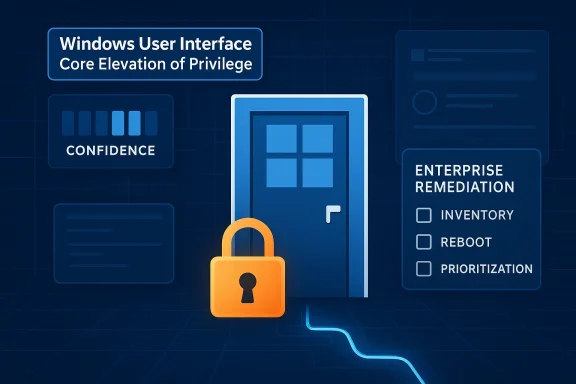
Microsoft’s CVE-2026-32165 entry is another reminder that Microsoft’s confidence metric is becoming as important as the component name itself. The advisory labels the issue a Windows User Interface Core Elevation of Privilege Vulnerability, which places it squarely in the class of bugs that can turn a local foothold into much broader control. What Microsoft is signaling here is not just that the flaw exists, but that the company believes the technical details are credible enough to track and remediate as a real, actionable risk m Windows defenders are no longer triaging just on severity labels. They are triaging on a combination of vendor acknowledgment, technical confidence, and the likelihood that a bug sits in a component with broad attack surface. In practice, that means CVE-2026-32165 should be treated as more than a theoretical advisory even if Microsoft has intentionally kept low-level details sparse .
Windows elevation-of-prgy important vulnerabilities in the platform because they often represent the final step in a compromise chain. An attacker may arrive through phishing, a browser exploit, a malicious attachment, or stolen credentials, but a privilege-escalation bug is what often turns a limited user session into SYSTEM-level control. That is why Microsoft’s update guidance and the broader Windows security ecosystem treat these issues as operationally urgent even when public technical detail is thin .
The Windows User Interface Core sits in the part of the operating system thatts, and interactive elements behave. That makes it a sensitive place for bugs to live, because UI components often sit close to user interaction, message handling, and rendering logic. Historically, Microsoft has repeatedly had to harden adjacent surfaces such as Win32k, DWM, ATBroker, and other desktop-facing components because attackers have consistently found ways to weaponize the complexity of the Windows interaction stack .
What stands out in this advisory style is the emphasis on confidence rather than full disclosure. Microsoft’s terminologydhether the vendor is reporting a confirmed issue, a highly credible research finding, or a tentative signal that still needs corroboration. In that framework, the rating attached to CVE-2026-32165 is itself a material security fact, not just metadata. It suggests Microsoft is comfortable enough with the report to tell customers to act, but not necessarily to publish every exploitation detail publicly .
That pattern fits what Microsoft has done with other recent Windows issues. We have seen the company publicly track local privilege-escalation flaws in subsystems likeP with minimal exploit description but enough signal for administrators to prioritize patching. CVE-2026-32165 appears to belong to that same operational class: a potentially high-value local bug in a core component, with Microsoft’s confidence serving as the main indicator of urgency .
In other words, the confidence metric is a triage shortcut. It does not tell you the exploit chain, but it does tell you whether the clock is probably already running. For enterprise teams balancing dozens of monthly updates, that can be the difference between immedangerous delay .
The advisory does not, at least in the information surfaced here, provide a rich root-cause narrative. That absence should not be mistaken for weakness in the warning. It is usually a sign that Microsoft is publishing the minimum needed for defenders to patch while withholding exploit-enabling specifics that could be misused by attackers before pateen the lines
There are three likely implications when Microsoft publishes a Windows UI-core EoP entry with a confidence signal. First, the bug is probably repeatable enough to be meaningful. Second, the component is likely central enough to matter across a wide range of systems. Third, Microsoft believes the issue is credible enough that defenders should not wait for proof-rction. That last point is especially important for enterprise environments where patch windows are often scheduled, not instant .
This is why sparse advisories can still be high value. Security teams do not need every exploit primitive to decide whether to prioritize a patch; they need to know whether the vendor stands behind the finding. Here, Microsoft’s own confidence language implies that the answer is yes .
A few practical takeaways follow:
Historically, Microsoft has had to patch adjacent areas like Win32k, DWM, ATBroker, and graphics components for similar reasons. These are not isolated curiosities; they are part of the long-running story of how desktop plumbing can become an escalation path. The public record around recent Windows advisories shows a recurring pattern: local attackers look for the most deeply embedded, least glamorous code because that code often has the highest leverage .
It is also worth remembering that local does not mean harmless. A local privilege-escalation flaw can be the difference between malware that merely runs under a arredential material, or establishes durable persistence. In enterprise terms, that is often the bridge from incident response to full-scale compromise .
The practical lesson is that defenders should not down-rank UI-related CVEs simply because they sound “desktop-like.” The desktop is often the path into the kernel, the token, or the service account, and attackers know it.
For defenders, the biggest aeate three different situations. One is a confirmed vendor issue with limited details. Another is a research-backed but not fully corroborated finding. The third is a more tentative lead that may still be under analysis. CVE-2026-32165 appears to fall into the first bucket, which means patch planning should proceed without waiting for more public proof .
The other reason this matters ugs often coexist with other recent issues in the same monthly cycle. That means defenders are rarely patching one issue in isolation. They are managing a portfolio of trust-boundary flaws, and Microsoft’s confidence signal helps decide which one gets the first maintenance window .
The impact is compounded when endphn high-trust roles. Administrative workstations, help desk systems, and virtual desktop infrastructure can all become more sensitive if a local escalation bug lands on them. Even where the original foothold is low-value, the payoff can be enormous if the local environment carries access to privileged network resources .
Another enterprise concern is patch coordination. Many organizations still separate security updates into endpoint, server, and application phases, but EoP bugs in core Windows components do not respect those organizational silos. If the affected UI-corss client builds, then endpoint teams and server teams may need to move in parallel rather than sequentially. That is the kind of issue that can overwhelm a slow change-management process if the advisory is not acted on quickly .
The practical consumer takeaway is that the issue is relevant even if no one is “targeting you personally.” Modern malware operators routinely exploit any local weakness they can find, especially on systems where users run as local administrators or install software without close scrutiny. A UI-core EoP flaw can be one of the final steps in that chain .
Still, the consumer angle should not be trivialized. Home systems are often the place where a breach starts, especially when they are used for work-from-home access or personal cloud credentials. A local Windows escalation flaw can create spillover risk that extends well beyond the device itself.
--crosoft’s Recent Security Pattern
CVE-2026-32165 looks consistent with a broader Microsoft pattern in 2026: publish a CVE, rate it clearly, but keep exploit-enabling details limited until patch adoption improves. We have seen similar treatment across multiple Windows components, including shell, graphics, driver, and service-level vulnerabilities. The message is repeated often enough that it is no longer subtle: Microsoft wants defenders to act on the signal first and the internals second .
That approach reflects a balance between transparency and operational security. Full public disclosure can help defenders, but it can also help attackers if patch uptake is slow. By leaning on a crosoft preserves enough information for defenders to prioritize without handing the entire exploit chain to adversaries immediately .
This also means that advisory literacy matters more than ever. Administrators who can interpret Microsoft’s labels, confidence signals, and product scope are in a far better position than those wn2of why that skill matters.
The other strength is that the confidence metric is usable. It gives security teams a way to rank advisories even when they lack a detailed root-cause description, which is especially helpful during busy Patch Tuesday cycles. It also aligns well with enterprise change management, where not every patch can be treated equally.
Another concern is that local privilege-escalation bugs are often underappreciated in executive reporting. They rarely sound as dramatic as remote code execution, but they can be just as damaging once an attacker has any foothold. In practice, EoP flaws are what let adversaries disable EDR, tamper with logs, dump secrets, or stage the next move in a breach.
Watch also for any sign that the advisory is linked to a broader desktop or UI servicing change. Microsoft often revisits adjacent code paths after an issue is disclosed, especially when a flaw lives in a core subsystem. If that happens, the initial CVE could become part of a larger cluster of fixes affecting the same family of components .
The larger lesson is that confidence is now part of the vulnerability story. CVE-2026-32165 may not yet come with a rich public exploit narrative, but Microsoft’s own framing makes it clear enough for serious defenders: thisse issue in a sensitive part of the operating system, and it deserves prompt attention.
CVE-2026-32165 is exactly the sort of Windows flaw that rewards fast, disciplined response and punishes hesitation. Even without a parade of technical details, the advisory’s signal is strong enough to justify immediate prioritization, especially in envirolme an enterprise-wide problem. In the end, that is the real story here: not the secrecy of the bug, but the clarity of the warning.
Source: MSRC Security Update Guide - Microsoft Security Response Center
 Background
Windows elevation-of-prgy important vulnerabilities in the platform because they often represent the final step in a compromise chain. An attacker may arrive through phishing, a browser exploit, a malicious attachment, or stolen credentials, but a privilege-escalation bug is what often turns a limited user session into SYSTEM-level control. That is why Microsoft’s update guidance and the broader Windows security ecosystem treat these issues as operationally urgent even when public technical detail is thin .The Windows User Interface Core sits in the part of the operating system thatts, and interactive elements behave. That makes it a sensitive place for bugs to live, because UI components often sit close to user interaction, message handling, and rendering logic. Historically, Microsoft has repeatedly had to harden adjacent surfaces such as Win32k, DWM, ATBroker, and other desktop-facing components because attackers have consistently found ways to weaponize the complexity of the Windows interaction stack .
What stands out in this advisory style is the emphasis on confidence rather than full disclosure. Microsoft’s terminologydhether the vendor is reporting a confirmed issue, a highly credible research finding, or a tentative signal that still needs corroboration. In that framework, the rating attached to CVE-2026-32165 is itself a material security fact, not just metadata. It suggests Microsoft is comfortable enough with the report to tell customers to act, but not necessarily to publish every exploitation detail publicly .
That pattern fits what Microsoft has done with other recent Windows issues. We have seen the company publicly track local privilege-escalation flaws in subsystems likeP with minimal exploit description but enough signal for administrators to prioritize patching. CVE-2026-32165 appears to belong to that same operational class: a potentially high-value local bug in a core component, with Microsoft’s confidence serving as the main indicator of urgency .
Why Microsoft’s confidence metric matters
The confidence signal is not decorative. It tells defenders whether Microsoft has a solid internal or external basis for calling something a real vulnerabilit mh-confidence, low-detail advisory is often more actionable than a speculative one with a longer writeup, because it usually means remediation is based on vendor validation rather than rumor turn1file8.In other words, the confidence metric is a triage shortcut. It does not tell you the exploit chain, but it does tell you whether the clock is probably already running. For enterprise teams balancing dozens of monthly updates, that can be the difference between immedangerous delay .
What the Advisory Is Telling Us
The most important thing Microsoft is saying with CVE-2026-32165 is simple: this is a real Windows privilege boundary problem, not a vague compatibility issue or a cosmetic UI defect. The label places the flaw in a class of vulnerabilities that can yield materiat is exactly the sort of bug attackers prize after initial compromise .The advisory does not, at least in the information surfaced here, provide a rich root-cause narrative. That absence should not be mistaken for weakness in the warning. It is usually a sign that Microsoft is publishing the minimum needed for defenders to patch while withholding exploit-enabling specifics that could be misused by attackers before pateen the lines
There are three likely implications when Microsoft publishes a Windows UI-core EoP entry with a confidence signal. First, the bug is probably repeatable enough to be meaningful. Second, the component is likely central enough to matter across a wide range of systems. Third, Microsoft believes the issue is credible enough that defenders should not wait for proof-rction. That last point is especially important for enterprise environments where patch windows are often scheduled, not instant .
This is why sparse advisories can still be high value. Security teams do not need every exploit primitive to decide whether to prioritize a patch; they need to know whether the vendor stands behind the finding. Here, Microsoft’s own confidence language implies that the answer is yes .
A few practical takeaways follow:
- Treat the advisory as confirmed rather than speculative.
- Assume the flaw is locally exploitable unleests that expose sensitive user workflows or shared desktop access.
- Watch for follow-on disclosures that may identify the precise subcomponent.
- Expect broader exploit analysis to emerge after patch deployment accelerates.
Windows User Interface Core in the Attack Surface
The ostinctively look for serious security bugs, but that is exactly why it is so dangerous. User-interface code tends to process complex inputs, support rich interactions, and bridge user space and privileged subsystems. Those characteristics make it fertile ground for memory-safety bugs, logic flaws, and privilege-boundary mistakes .Historically, Microsoft has had to patch adjacent areas like Win32k, DWM, ATBroker, and graphics components for similar reasons. These are not isolated curiosities; they are part of the long-running story of how desktop plumbing can become an escalation path. The public record around recent Windows advisories shows a recurring pattern: local attackers look for the most deeply embedded, least glamorous code because that code often has the highest leverage .
Why UI bugs are high-leverage
UI componenthtem services. When they fail, the failure can expose privileged operations, state transitions, or object references that should never have been attacker-controlled in the first place. That is one reason UI-core vulnerabilities can be so attractive: the surface looks ordinary, but the consequences are not .It is also worth remembering that local does not mean harmless. A local privilege-escalation flaw can be the difference between malware that merely runs under a arredential material, or establishes durable persistence. In enterprise terms, that is often the bridge from incident response to full-scale compromise .
The practical lesson is that defenders should not down-rank UI-related CVEs simply because they sound “desktop-like.” The desktop is often the path into the kernel, the token, or the service account, and attackers know it.
What Microsof Defenders
Microsoft’s vulnerability metadata is increasingly designed to do more than classify severity. It is meant to help security teams answer the more useful question: how much do we need to trust this alert, and how soon should we move? That is where the confidence field becomes a real operational input rather than a documentation flourish .For defenders, the biggest aeate three different situations. One is a confirmed vendor issue with limited details. Another is a research-backed but not fully corroborated finding. The third is a more tentative lead that may still be under analysis. CVE-2026-32165 appears to fall into the first bucket, which means patch planning should proceed without waiting for more public proof .
How to use the signal operationally
A good response model is straightforward:- Validate whether the vulnerable Windows build is present in your environment.
- Identify systems with elevated exposure, especially shared workstations and remote-access endpointch pipeline immediately.
- Watch for vendor follow-up if Microsoft later clarifies the root cause or affected versions.
- Confirm remediation by inventory, not by assumption.
The other reason this matters ugs often coexist with other recent issues in the same monthly cycle. That means defenders are rarely patching one issue in isolation. They are managing a portfolio of trust-boundary flaws, and Microsoft’s confidence signal helps decide which one gets the first maintenance window .
Enterprise Impact
For enterprises, CVE-2026-32165 is especially important because privilege escalation is an amplifier. On an individual home PC, an attacker might use it to gain persistence or disable protections. In a corporate environment, the same flaw can be used to move laterally, harvest tokens, tamper with software deployment, or interfere with security tooling .The impact is compounded when endphn high-trust roles. Administrative workstations, help desk systems, and virtual desktop infrastructure can all become more sensitive if a local escalation bug lands on them. Even where the original foothold is low-value, the payoff can be enormous if the local environment carries access to privileged network resources .
Enterprisegider the following as high-priority candidates for remediation:
- Privileged user workstations
- Shared terminal or kiosk systems
- Remote access hosts
- Systems running security administration tools
- Developer endpoints with broad network reach
- VDI and session-host infrastructure
Another enterprise concern is patch coordination. Many organizations still separate security updates into endpoint, server, and application phases, but EoP bugs in core Windows components do not respect those organizational silos. If the affected UI-corss client builds, then endpoint teams and server teams may need to move in parallel rather than sequentially. That is the kind of issue that can overwhelm a slow change-management process if the advisory is not acted on quickly .
Consumer Impact
For consumers, the threat model is narrower but still meaningful. Home users are less likely than enterprises to face sophisticated chained intrusions, but they are not immune to malware that needs local escalation to turn a standard compromise into a durable foothold. A privilege-escalation bug in a core Windows component gives commodity malware a better chance of disabling sitions .The practical consumer takeaway is that the issue is relevant even if no one is “targeting you personally.” Modern malware operators routinely exploit any local weakness they can find, especially on systems where users run as local administrators or install software without close scrutiny. A UI-core EoP flaw can be one of the final steps in that chain .
What consumers should care about
- Whether Windows Update is current
- Whether the device is used with administrator rights
- Whether toftware is up to date
- Whether the machine is shared with family members
- Whether it is used for banking or credential management
- Whether old software may already have created a foothold
Still, the consumer angle should not be trivialized. Home systems are often the place where a breach starts, especially when they are used for work-from-home access or personal cloud credentials. A local Windows escalation flaw can create spillover risk that extends well beyond the device itself.
--crosoft’s Recent Security Pattern
CVE-2026-32165 looks consistent with a broader Microsoft pattern in 2026: publish a CVE, rate it clearly, but keep exploit-enabling details limited until patch adoption improves. We have seen similar treatment across multiple Windows components, including shell, graphics, driver, and service-level vulnerabilities. The message is repeated often enough that it is no longer subtle: Microsoft wants defenders to act on the signal first and the internals second .
That approach reflects a balance between transparency and operational security. Full public disclosure can help defenders, but it can also help attackers if patch uptake is slow. By leaning on a crosoft preserves enough information for defenders to prioritize without handing the entire exploit chain to adversaries immediately .
The broader trend
The broader trend is that Windows security has become increasingly componentized, and Microsoft’s advisories now reflect that reality. Rather than simply saying “Windows is affected,” the company often points to a specific service, driver, or user-interface subsystem. That granularity helps defenders, but it also makes one thing plain: the attack surface is still large, and the most dangerous bugs often hide in places that ordinary users never think about .This also means that advisory literacy matters more than ever. Administrators who can interpret Microsoft’s labels, confidence signals, and product scope are in a far better position than those wn2of why that skill matters.
Strengths and Opportunities
Microsoft’s handling of CVE-2026-32165 shows several strengths in the current disclosure model, and it also highlights opportunities for defenders to improve how they react to sparse-but-credible advisories. The most obvious strength is that Microsoft is publishing enough to let customethout overexposing exploit details. That keeps the remediation path open while reducing the chance that public writeups become a live attack manual.The other strength is that the confidence metric is usable. It gives security teams a way to rank advisories even when they lack a detailed root-cause description, which is especially helpful during busy Patch Tuesday cycles. It also aligns well with enterprise change management, where not every patch can be treated equally.
- **Clear vehs from speculation.
- Confidence scoring improves triage when technical detail is sparse.
- Core component coverage signals broad potential impact.
- Patch-first guidance reduces delay in remediation.
- Layered Windows defenses can limit exploitability if fully enabled.
- Enterprise visibility is improved when advisories map to specific subsystems.
- Consumer simplicity makes immediate updating straightforward.
Risks and Concerns
The biggest risk with advisories like CVE-2026-32165 is complacency. When Microsoft does not publish rich technical detail, some teams mistakenly assume the issue is still uncertain or not immediately weaponizable. That is the wrong interpretation here. The confidence signal exists precisely to tell you that the issue is credible enough to act on now .Another concern is that local privilege-escalation bugs are often underappreciated in executive reporting. They rarely sound as dramatic as remote code execution, but they can be just as damaging once an attacker has any foothold. In practice, EoP flaws are what let adversaries disable EDR, tamper with logs, dump secrets, or stage the next move in a breach.
- Delayed patching can create a large exposure window.
- Misread confidence signals can lead to under-prioritization.
- Shared and privileged workstations increase practical risk.
- Poor privilege hygiene magnifies the impact of local bugs.
- Sparse public detail can slow independent validation.
- Attack chaining makes a local bug far more serious than it looks.
- Patch fatigue may push teams to defer a high-value fix.
What to Watch Next
The next stage will likely involve more clarity from Microsoft or third-party researchers about the exact mechanism behind CVE-2026-32165. Until then, the most important fact is still the vendor’s confidence that the issue exists and is meaningful. That means defenders should treat this as an already-actionable patch item rather than waiting for a fuller technical postmortem .Watch also for any sign that the advisory is linked to a broader desktop or UI servicing change. Microsoft often revisits adjacent code paths after an issue is disclosed, especially when a flaw lives in a core subsystem. If that happens, the initial CVE could become part of a larger cluster of fixes affecting the same family of components .
Items worth monitoring
- Microsoft’s next advisory update for affected versions or severity changes
- Independent exploit analysis from reputable researchers
- Any related fixes in nearby desktop or graphics components
- Signs of active exploitation in the wild
- Whether the issue appears in enterprise patch rollups or out-of-band updates
The larger lesson is that confidence is now part of the vulnerability story. CVE-2026-32165 may not yet come with a rich public exploit narrative, but Microsoft’s own framing makes it clear enough for serious defenders: thisse issue in a sensitive part of the operating system, and it deserves prompt attention.
CVE-2026-32165 is exactly the sort of Windows flaw that rewards fast, disciplined response and punishes hesitation. Even without a parade of technical details, the advisory’s signal is strong enough to justify immediate prioritization, especially in envirolme an enterprise-wide problem. In the end, that is the real story here: not the secrecy of the bug, but the clarity of the warning.
Source: MSRC Security Update Guide - Microsoft Security Response Center
