

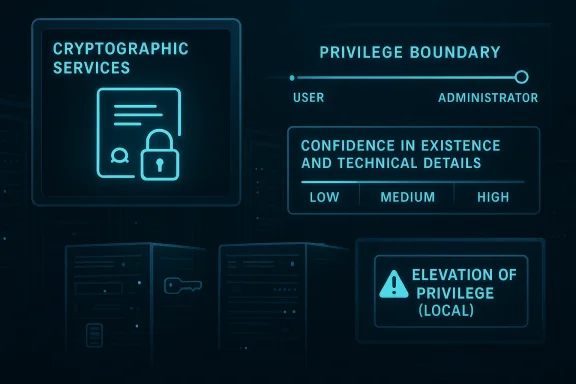
The MSRC entry for CVE-2026-26152 points to a Microsoft Cryptographic Services Elevation of Privilege Vulnerability, but the key thing defenders need to understand is that this advisory is as much about Microsoft’s confidence signal as it is about the flaw itself. That confidence metric is designed to tell customers how sure Microsoft is that the vulnerability exists in the form described, and how credible the available technical details are. In practice, that means the advisory is not just a patch notice; it is also a statement about the maturity of the evidence behind the report.
For Windows administrators, the distinction matters because an elevation-of-privilege issue in Cryptographic Services can become a high-value local foothold if a low-privileged user or attacker already has a beachhead on the system. Microsoft has used similar wording for earlier Cryptographic Services CVEs, including CVE-2023-21561, which also carried an EoP label and was treated as a serious Windows weakness. That historical pattern suggests this family of bugs should be taken seriously even when the public technical detail is thin.
Microsoft’s Security Response Center uses a layered set of labels to help customers sort real-world urgency from theoretical risk. Severity tells you how bad an exploit could be; exploitability signals whether the vulnerability is likely to be exploited; and the confidence metric tells you how much trust Microsoft places in the existence and detail level of the vulnerability itself. The glossary description is explicit that this metric measures confidence in both the vulnerability’s existence and the credibility of the technical details.
That distinction is important because not every published CVE arrives with a fully dissected root cause. Sometimes Microsoft confirms the issue and ships a fix before the wider community has a precise public write-up, and sometimes the public description is intentionally limited to reduce attacker guidance. The result is a vulnerability entry that can be operationally meaningful to defenders even while the underlying exploit chain remains partly opaque.
Cryptographic Services is one of those Windows components that rarely gets public attention until something goes wrong. It sits close to identity, certificate handling, and trust decisions, which means a bug there is not just another local issue; it is the sort of flaw that can help an attacker move from ordinary access to privileged control. In Windows security, that is a dangerous transition because local privilege escalation often becomes the launchpad for credential theft, persistence, and later movement across the environment.
Microsoft’s earlier treatment of CVE-2023-21561 shows why security teams should pay attention to the category, not just the exact CVE number. That earlier Cryptographic Services flaw was publicly described as an elevation-of-privilege vulnerability and was listed across a broad set of Windows versions, including older desktop and server releases. The breadth of that coverage reinforces the idea that cryptographic subsystem bugs can touch a wide installed base, especially in mixed enterprise estates with legacy endpoints still in circulation.
For enterprise responders, the metric is useful because it helps separate three different situations. One is a confirmed issue with a clear code path and a fix; another is a credible report with partial technical corroboration; the third is a more speculative finding that may prove less actionable than it first appeared. The confidence label is meant to navigate those distinctions, not replace severity or exploitability.
The title also tells us what is not yet being emphasized: remote execution, browser exploitation, or a pure information disclosure scenario. That matters because defenders should shape their response around local foothold scenarios, malicious insider risk, and post-compromise escalation rather than internet-facing exposure alone. In other words, the likely question is not whether an unauthenticated attacker can click a website and pop the machine; it is whether someone with some access can become more powerful than they should be.
The practical consequence is that a single user-level compromise can become much more serious. Once privilege is escalated, the attacker may disable security tools, harvest credentials, tamper with logs, or implant persistence that survives simple account resets. Those downstream effects often matter more than the initial foothold.
A high-confidence vulnerability implies Microsoft believes the flaw is real and well understood enough to merit direct operational action. A lower-confidence entry, by contrast, may reflect incomplete technical corroboration, a report that is still being validated, or a public description that has not yet been fully substantiated. For security teams, that can affect how much engineering time they allocate to validation and how aggressively they hunt for exposure.
That separation is useful in large environments where patch queues are crowded. A confirmed flaw in a widely deployed component gets a different response than a vaguely described issue in a niche service, even if both are labeled with the same severity. Microsoft’s metadata is essentially a prioritization aid for exactly that reason.
Historical context matters because recurring CVEs in the same subsystem usually point to deeper complexity. Cryptographic code tends to mix state, permissions, format parsing, and trust logic, and those are exactly the kinds of surfaces that produce hard-to-audit bugs. When a component has already produced multiple escalation issues, teams should assume the next one may be equally consequential until proven otherwise.
The more a component must support older APIs and long-tail enterprise scenarios, the more difficult it becomes to eliminate risky edge cases. That is one reason Microsoft increasingly emphasizes defense in depth and systematic hardening, rather than assuming one-off fixes are enough. The company’s broader MSRC messaging has repeatedly stressed that it wants to reduce entire classes of vulnerabilities, not just individual bugs.
The risk profile is especially high in environments with developer workstations, administrative jump hosts, and shared server access. Those machines are more likely to host privileged credentials, elevated tokens, or lateral movement tooling, so a local privilege escalation can have outsized consequences. In practical terms, one patch missed on a privileged endpoint can become an incident.
Monitoring also matters. Enterprises should watch for abnormal privilege changes, unexpected service behavior, and suspicious post-compromise activity on systems that lag patch deployment. A local escalation bug is often detected only after the attacker has already used it to get what they wanted. That is why detection cannot be an afterthought.
The average consumer is less likely to exploit the nuance of a Cryptographic Services bug directly, but they are also less likely to notice early signs of compromise. That means the practical defense is straightforward: keep Windows updated, avoid untrusted downloads, and treat “low privilege” malware as a serious threat rather than a minor infection. Local does not mean harmless.
There is also a family safety angle. Shared household PCs, gaming rigs, and creator workstations can accumulate software from multiple sources, increasing exposure to low-privilege footholds. Consumers often think in terms of “don’t get malware,” but the better mental model is “don’t let malware stay low privilege.”
The right question is not simply “did Microsoft publish a fix?” It is “which systems are most likely to be used as privilege escalation launch points?” That includes endpoints with sensitive operators, machines that run admin tools, and servers where local compromise would immediately become a broader environment compromise.
The market implication is subtle but important. Security teams, third-party vulnerability platforms, and EDR vendors all use Microsoft’s advisory metadata to make prioritization decisions, and confidence can shape everything from ticket severity to executive escalation. In other words, a small line in an MSRC entry can have a large operational effect across thousands of organizations.
That does not mean the signal is perfect. Vendors can still be cautious in public disclosures, and researchers may hold back proof-of-concept details to avoid enabling abuse. But compared with a naked CVE listing, the confidence signal is a meaningful step toward better operational triage.
The opportunity for defenders is to use the advisory as a trigger for broader hygiene work rather than a one-off patch task. If a cryptographic subsystem flaw is serious enough to get a CVE, it is serious enough to revisit local admin sprawl, credential exposure, and the amount of trust granted to standard-user code on Windows endpoints. That is the real upside of a good vulnerability disclosure process.
Another concern is patch lag in large organizations. Even when Microsoft publishes a fix, the practical window of vulnerability remains open until endpoints are updated, and older systems or disconnected assets often fall behind. That creates a mismatch between vendor remediation and real-world closure.
It will also be worth watching whether researchers independently map the bug class to a specific attack pattern. If that happens, organizations should reassess whether similar privilege boundary weaknesses exist elsewhere in their environment, especially in services that mediate trust, files, certificates, or authentication logic. The broader lesson is that one CVE can reveal a whole category of design pressure.
CVE-2026-26152 should be read as a reminder that the most dangerous Windows bugs are not always the loudest ones. A cryptographic services elevation-of-privilege issue may look like a routine local flaw on paper, but in practice it can become a powerful pivot into full host compromise and, eventually, broader enterprise impact. Microsoft’s confidence signal suggests the company believes the issue is real enough to act on now, and that alone is a strong reason for defenders to move quickly rather than wait for the rest of the technical story to unfold.
Source: MSRC Security Update Guide - Microsoft Security Response Center
For Windows administrators, the distinction matters because an elevation-of-privilege issue in Cryptographic Services can become a high-value local foothold if a low-privileged user or attacker already has a beachhead on the system. Microsoft has used similar wording for earlier Cryptographic Services CVEs, including CVE-2023-21561, which also carried an EoP label and was treated as a serious Windows weakness. That historical pattern suggests this family of bugs should be taken seriously even when the public technical detail is thin.
 Background
Microsoft’s Security Response Center uses a layered set of labels to help customers sort real-world urgency from theoretical risk. Severity tells you how bad an exploit could be; exploitability signals whether the vulnerability is likely to be exploited; and the confidence metric tells you how much trust Microsoft places in the existence and detail level of the vulnerability itself. The glossary description is explicit that this metric measures confidence in both the vulnerability’s existence and the credibility of the technical details.That distinction is important because not every published CVE arrives with a fully dissected root cause. Sometimes Microsoft confirms the issue and ships a fix before the wider community has a precise public write-up, and sometimes the public description is intentionally limited to reduce attacker guidance. The result is a vulnerability entry that can be operationally meaningful to defenders even while the underlying exploit chain remains partly opaque.
Cryptographic Services is one of those Windows components that rarely gets public attention until something goes wrong. It sits close to identity, certificate handling, and trust decisions, which means a bug there is not just another local issue; it is the sort of flaw that can help an attacker move from ordinary access to privileged control. In Windows security, that is a dangerous transition because local privilege escalation often becomes the launchpad for credential theft, persistence, and later movement across the environment.
Microsoft’s earlier treatment of CVE-2023-21561 shows why security teams should pay attention to the category, not just the exact CVE number. That earlier Cryptographic Services flaw was publicly described as an elevation-of-privilege vulnerability and was listed across a broad set of Windows versions, including older desktop and server releases. The breadth of that coverage reinforces the idea that cryptographic subsystem bugs can touch a wide installed base, especially in mixed enterprise estates with legacy endpoints still in circulation.
Why confidence matters more than many teams realize
A lot of patch workflows treat every CVE as a binary event: either patch it or ignore it. Microsoft’s confidence metric complicates that picture by saying, in effect, how certain are we that this issue exists as described? That can influence whether defenders prioritize emergency validation, hunt for exploit evidence, or simply fold the patch into the normal maintenance cycle.For enterprise responders, the metric is useful because it helps separate three different situations. One is a confirmed issue with a clear code path and a fix; another is a credible report with partial technical corroboration; the third is a more speculative finding that may prove less actionable than it first appeared. The confidence label is meant to navigate those distinctions, not replace severity or exploitability.
What the CVE Title Suggests
The wording “Microsoft Cryptographic Services Elevation of Privilege Vulnerability” tells us a fair amount even before any exploit details are public. It indicates the bug is local in nature, it affects a privileged Windows service or component, and successful exploitation could let an attacker cross a privilege boundary. That is a classic EoP pattern, and in Windows environments it is often the difference between a compromised user session and a compromised host.The title also tells us what is not yet being emphasized: remote execution, browser exploitation, or a pure information disclosure scenario. That matters because defenders should shape their response around local foothold scenarios, malicious insider risk, and post-compromise escalation rather than internet-facing exposure alone. In other words, the likely question is not whether an unauthenticated attacker can click a website and pop the machine; it is whether someone with some access can become more powerful than they should be.
Local privilege escalation is a force multiplier
An EoP vulnerability in a cryptographic subsystem can be disproportionately valuable to attackers because it may interact with secrets, keys, trust validation, or protected Windows objects. If an attacker already has code execution as a standard user, EoP turns that foothold into a system-level problem. That is why many incident responders treat local escalation bugs as “endgame” issues in a compromise chain.The practical consequence is that a single user-level compromise can become much more serious. Once privilege is escalated, the attacker may disable security tools, harvest credentials, tamper with logs, or implant persistence that survives simple account resets. Those downstream effects often matter more than the initial foothold.
- EoP flaws often convert limited access into administrative control.
- Cryptographic components can expose especially sensitive trust boundaries.
- Local issues are still enterprise-wide threats when attackers already have a foothold.
- The value of the flaw depends on whether the attacker can chain it with another weakness.
- Defense-in-depth controls can reduce, but rarely eliminate, the damage.
How Microsoft’s Confidence Metric Works
Microsoft’s own glossary defines the confidence metric as a measure of how confident the company is in the existence of the vulnerability and the credibility of the technical details. That is subtly different from exploitability, which focuses on whether exploitation is likely in the current threat landscape. The two together give defenders a better sense of urgency than severity alone.A high-confidence vulnerability implies Microsoft believes the flaw is real and well understood enough to merit direct operational action. A lower-confidence entry, by contrast, may reflect incomplete technical corroboration, a report that is still being validated, or a public description that has not yet been fully substantiated. For security teams, that can affect how much engineering time they allocate to validation and how aggressively they hunt for exposure.
Confidence versus exploitability
It is easy to conflate these terms, but they answer different questions. Confidence asks, does the flaw exist as described? Exploitability asks, how likely is exploitation given what attackers can do today? A vulnerability can be highly credible yet not immediately exploitable at scale, or technically uncertain yet still worth tracking if the potential impact is severe.That separation is useful in large environments where patch queues are crowded. A confirmed flaw in a widely deployed component gets a different response than a vaguely described issue in a niche service, even if both are labeled with the same severity. Microsoft’s metadata is essentially a prioritization aid for exactly that reason.
- Confidence addresses credibility.
- Exploitability addresses attacker practicality.
- Severity addresses impact if exploited.
- Exposure addresses whether your systems actually include the affected component.
- Time-to-patch should be driven by all four, not just one.
Historical Context: Previous Cryptographic Services Issues
Microsoft has a track record of publishing Cryptographic Services EoP issues, and that history makes CVE-2026-26152 easier to interpret. CVE-2023-21561, for example, was also identified as a Microsoft Cryptographic Services elevation-of-privilege vulnerability and was publicly documented across a broad range of Windows versions. Even without identical technical details, the repeated pattern is enough to tell defenders this component has been a recurring security concern.Historical context matters because recurring CVEs in the same subsystem usually point to deeper complexity. Cryptographic code tends to mix state, permissions, format parsing, and trust logic, and those are exactly the kinds of surfaces that produce hard-to-audit bugs. When a component has already produced multiple escalation issues, teams should assume the next one may be equally consequential until proven otherwise.
Why these bugs keep coming back
Cryptographic Services is not just “crypto.” It often mediates how Windows decides what is trusted, what is signed, and what can be used by whom. That makes it a natural place for boundary mistakes, especially when legacy behavior has to coexist with modern hardening. Legacy compatibility is often the hidden tax on security in Windows.The more a component must support older APIs and long-tail enterprise scenarios, the more difficult it becomes to eliminate risky edge cases. That is one reason Microsoft increasingly emphasizes defense in depth and systematic hardening, rather than assuming one-off fixes are enough. The company’s broader MSRC messaging has repeatedly stressed that it wants to reduce entire classes of vulnerabilities, not just individual bugs.
- Repeated EoP bugs often indicate architectural complexity.
- Legacy compatibility can preserve risky code paths.
- Crypto-adjacent code is especially sensitive because trust decisions are involved.
- Historical patterns help defenders infer risk before details are public.
- Previous patches do not eliminate future exposure in the same subsystem.
Enterprise Impact
For enterprises, the central issue is not whether every endpoint can be remotely reached. It is whether a compromised workstation, service account, or low-privilege interactive user can be turned into something much more dangerous. That is a familiar attacker pattern, and an EoP flaw in a core Windows service can make that escalation much faster and more reliable.The risk profile is especially high in environments with developer workstations, administrative jump hosts, and shared server access. Those machines are more likely to host privileged credentials, elevated tokens, or lateral movement tooling, so a local privilege escalation can have outsized consequences. In practical terms, one patch missed on a privileged endpoint can become an incident.
Operationally, what matters most
Patch managers should prioritize systems that can serve as stepping stones: servers with management agents, admin desktops, build systems, and any host with access to sensitive certificates or domain operations. Even if the vulnerability appears local, the blast radius can extend well beyond that one machine if it is used as an administrative pivot point. That is the quiet danger of EoP flaws.Monitoring also matters. Enterprises should watch for abnormal privilege changes, unexpected service behavior, and suspicious post-compromise activity on systems that lag patch deployment. A local escalation bug is often detected only after the attacker has already used it to get what they wanted. That is why detection cannot be an afterthought.
- Patch privileged workstations first.
- Include jump hosts and admin consoles in high-priority rings.
- Inventory systems that use Windows cryptographic and certificate services heavily.
- Look for anomalous privilege boundary transitions.
- Treat stale endpoints as high-risk even if they are not internet-facing.
Consumer Impact
Consumers often assume local privilege escalation is mainly an enterprise problem, but that is only partly true. Home users who run untrusted software, sideload tools, or install questionable utilities can still create the kind of foothold attackers need. Once code runs under a normal account, a privilege escalation bug can turn a nuisance into a full device compromise.The average consumer is less likely to exploit the nuance of a Cryptographic Services bug directly, but they are also less likely to notice early signs of compromise. That means the practical defense is straightforward: keep Windows updated, avoid untrusted downloads, and treat “low privilege” malware as a serious threat rather than a minor infection. Local does not mean harmless.
Why consumer patching still matters
Windows consumers benefit from cumulative updates that silently remove classes of escalation opportunities. Even if the bug has not been broadly weaponized, closing the escalation path narrows the attacker’s options and reduces the chance of a simple infection turning into deep persistence. That is a strong argument for automatic updating on personal devices.There is also a family safety angle. Shared household PCs, gaming rigs, and creator workstations can accumulate software from multiple sources, increasing exposure to low-privilege footholds. Consumers often think in terms of “don’t get malware,” but the better mental model is “don’t let malware stay low privilege.”
- Keep Windows and Microsoft security updates current.
- Avoid unsigned or unfamiliar utilities.
- Use standard accounts for daily work where possible.
- Be cautious with browser downloads and cracked software.
- Treat privilege escalation as a major risk, not a niche technical detail.
Patch Prioritization Strategy
A vulnerability like CVE-2026-26152 should be handled through a risk-based patching lens, not a generic monthly roll-up mindset. If Microsoft’s confidence signal is elevated, that suggests the company believes the flaw is real enough to justify action even if technical details are limited. In a large estate, that argues for fast validation and a short deployment window.The right question is not simply “did Microsoft publish a fix?” It is “which systems are most likely to be used as privilege escalation launch points?” That includes endpoints with sensitive operators, machines that run admin tools, and servers where local compromise would immediately become a broader environment compromise.
A practical prioritization sequence
- Identify systems that run with privileged administrative access or sensitive service accounts.
- Fast-track patching for jump boxes, servers, and high-value workstations.
- Verify whether any security controls, such as application allowlisting, are already limiting attacker footholds.
- Watch for exploit chatter or post-patch abnormality that may indicate active targeting.
- Roll the update through the rest of the fleet after the highest-value assets are covered.
- Prioritize high-privilege endpoints.
- Validate the patch in controlled rings.
- Use telemetry to search for suspicious escalation behavior.
- Treat any cryptographic-service bug as potentially high-impact.
- Close the path before attackers learn how to chain it.
Broader Security Implications
CVE-2026-26152 is also a reminder that Windows security is increasingly about boundary management rather than isolated product bugs. If Microsoft is highlighting confidence as a formal signal, it is acknowledging that vulnerability response is now as much about information quality as it is about remediation. That makes the advisory valuable even when the public technical dossier remains sparse.The market implication is subtle but important. Security teams, third-party vulnerability platforms, and EDR vendors all use Microsoft’s advisory metadata to make prioritization decisions, and confidence can shape everything from ticket severity to executive escalation. In other words, a small line in an MSRC entry can have a large operational effect across thousands of organizations.
Defender tooling and signal quality
Security platforms increasingly ingest vendor metadata to score risk automatically. If that metadata is clear, teams can separate urgent patching from routine maintenance; if it is vague, they may either overreact or miss the real issue. Microsoft’s confidence indicator helps reduce that uncertainty by framing how much of the vulnerability story is actually validated.That does not mean the signal is perfect. Vendors can still be cautious in public disclosures, and researchers may hold back proof-of-concept details to avoid enabling abuse. But compared with a naked CVE listing, the confidence signal is a meaningful step toward better operational triage.
- Better metadata improves prioritization.
- Confidence scores help separate confirmed bugs from weaker reports.
- Security automation can use the signal to rank remediation.
- Less ambiguity lowers the chance of patch fatigue.
- Good vulnerability reporting supports faster incident response.
Strengths and Opportunities
The strongest aspect of Microsoft’s approach here is the way it turns a simple CVE entry into a richer risk signal. That is useful for administrators who need to make decisions before every technical detail is public. It also helps align patching with the realities of modern enterprise operations, where context matters as much as raw severity.The opportunity for defenders is to use the advisory as a trigger for broader hygiene work rather than a one-off patch task. If a cryptographic subsystem flaw is serious enough to get a CVE, it is serious enough to revisit local admin sprawl, credential exposure, and the amount of trust granted to standard-user code on Windows endpoints. That is the real upside of a good vulnerability disclosure process.
- Improved prioritization through confidence metadata.
- Better alignment between severity and real-world urgency.
- A chance to harden local privilege boundaries.
- Useful precedent from earlier Cryptographic Services fixes.
- Stronger enterprise patch governance around Windows core services.
- Opportunity to refine detection for privilege escalation attempts.
- Better user education around the danger of low-privilege compromise.
Risks and Concerns
The biggest concern is that limited public detail can make it harder for defenders to judge exposure precisely. If the advisory lacks a clear root cause or exploit chain, some teams may delay action while waiting for more information, which is the wrong instinct for a privilege escalation bug in a core Windows service. Silence should not be mistaken for low risk.Another concern is patch lag in large organizations. Even when Microsoft publishes a fix, the practical window of vulnerability remains open until endpoints are updated, and older systems or disconnected assets often fall behind. That creates a mismatch between vendor remediation and real-world closure.
- Limited detail can slow triage.
- Patch lag extends exposure.
- Legacy Windows estates are harder to secure.
- Privileged endpoints raise the stakes dramatically.
- Attackers can chain EoP with earlier footholds.
- Overconfidence in “local only” flaws can lead to underresponse.
- Mixed OS versions complicate fleet-wide remediation.
Looking Ahead
The next thing to watch is whether Microsoft updates the advisory with more detail, revised confidence language, or additional affected-product information. Any such change would help defenders better understand whether the issue is narrow and well characterized or broader than the first public entry suggested. That kind of clarification often matters more than the original headline.It will also be worth watching whether researchers independently map the bug class to a specific attack pattern. If that happens, organizations should reassess whether similar privilege boundary weaknesses exist elsewhere in their environment, especially in services that mediate trust, files, certificates, or authentication logic. The broader lesson is that one CVE can reveal a whole category of design pressure.
Indicators worth tracking
- Microsoft advisory updates or revised metadata.
- Public research that clarifies the root cause.
- Evidence of exploit chaining in the wild.
- Patch deployment speed across high-value Windows systems.
- Any appearance of related Cryptographic Services flaws in future monthly releases.
CVE-2026-26152 should be read as a reminder that the most dangerous Windows bugs are not always the loudest ones. A cryptographic services elevation-of-privilege issue may look like a routine local flaw on paper, but in practice it can become a powerful pivot into full host compromise and, eventually, broader enterprise impact. Microsoft’s confidence signal suggests the company believes the issue is real enough to act on now, and that alone is a strong reason for defenders to move quickly rather than wait for the rest of the technical story to unfold.
Source: MSRC Security Update Guide - Microsoft Security Response Center
Last edited:
