

CVE-2026-32224 is the kind of Windows Server vulnerability that administrators cannot afford to treat as a theoretical footnote. Microsoft’s Security Update Guide entry identifies it as a Windows Server Update Service (WSUS) Elevation of Privilege Vulnerability, and third-party tracking currently describes the flaw as a use-after-free in WSUS that can let an authorized local attacker elevate privileges. The public record is still sparse, but the metadata is enough to make one thing clear: this is a real, vendor-tracked issue with immediate operational relevance for anyone running WSUS in production. //cvefeed.io/vuln/detail/CVE-2026-32224))
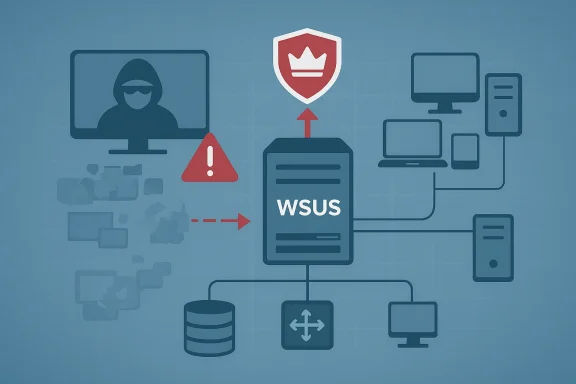
WSUS has always sat in a sensitive spot in the Windows ecosystem. It is not just another service; it is part of the machinery that controls how updates move through enterprise networks, which means a bug in WSUS can have consequences well beyond a single host. In practical terms, WSUS is a management-plane asset, and management-plane flaws are especially dangerous because they can become launch points for broader compromise. The appearance of a privilege-escalation issue in that layer deserves attention even when the advisory is brief. (cvefeed.io)
The CVE entry available right now suggests that Microsoft is dealing with a local elevation-of-privilege problem rather than a remote exploit path. That matters because local privilege escalation usually assumes the attacker already has some foothold, whether through a compromised account, a malicious insider, or another vulnerability used as the initial access vector. Once a foothold exists, moving from low privilege to higher privilege inside the same management environment can be enough to pivot into more sensitive systems. (cvefeed.io)
This latest WSUS bug also fits a pattern that Windows administrators know too well. WSUS vulnerabilities have historically been high-value because they touch patch distribution, trust, and administrative orchestration all at once. When Microsoft publishes a WSUS security entry, defenders should think not only about the vulnerable server itself, but also about the possibility that the server becomes a stepping-stone into the broader patch infrastructure. That indirect risk often matters more than the immediate one. (cvefeed.io)
There is also a reason confidence metadata matters here. Microsoft’s MSRC guidance has increasingly emphasized the distinction between a vulnerability that is merely rumored and one that is vendor-confirmed with enough technical credibility to drive patching decisions. In a world of rapid advisories and noisy threat chatter, the confidence signal tells administrators whether the issue is speculative or actionable. For CVE-2026-32224, the existence of an MSRC entry and the presence of a concrete weakness classification make it actionable. (msrc.microsoft.com)
That combination tells defenders quite a bit. A local attacker, high privileges impact, and no remote vector usually points to a post-compromise escalation bug rather than a web-facing wormable issue. This does not make the flaw less important; in many enterprise incidents, the ability to escalate locally is what turns an initial breach into a domain-wide disaster. The practical response is therefore still urgent. (cvefeed.io)
Microsoft’s vulnerability history metadata also shows that the entry was newly added on April 14, 2026, which suggests this is fresh disclosure rather than a long-standing advisory that has been quietly updated over time. Freshly published issues often create a race between defenders trying to patch and attackers trying to understand whether the flaw can be chained with other weaknesses. That race is especially tense when the component in question is part of a widely deployed management service. (cvefeed.io)
The broader lesson is that WSUS problems tend to expose a structural tension: the more essential the patching system becomes, the more catastrophic its failure modes can be. Organizations rely on WSUS to keep fleets current, but the same service can also become a high-value target if attackers can abuse it for privilege escalation or tampering. That makes WSUS one of those technologies that is quietly critical until it suddenly becomes front-page security news. (cvefeed.io)
There is also an enterprise governance angle. WSUS servers are often placed in trusted network segments, sometimes with elevated rights or management connectivity that ordinary servers never get. That architecture is convenient for operations, but it can magnify the damage if an attacker gains a foothold inside the same environment. A local escalation bug in WSUS is therefore not merely about one service binary; it is about the trust policy surrounding the whole patching tier. (cvefeed.io)
Security teams should also remember that local privilege escalation often appears late in the attack chain. Attackers do not always need a flashy remote exploit if they can first obtain a standard account, token, scheduled task, or another minimal foothold. Once inside, the escalation step is what often unlocks credential theft, service tampering, or administrative persistence. That makes a WSUS EoP bug strategically attractive even without network exposure. (cvefeed.io)
The proper response is therefore not to ask whether the flaw is “as bad” as a remote code execution issue, but whether the affected server is sufficiently important that any privilege boundary failure would matter. In most enterprises, the answer is yes. Especially in a WSUS role, local escalation should be treated as a high-priority security event rather than a routine maintenance fix. (cvefeed.io)
For enterprises, the picture is very different. WSUS frequently sits at the center of a patch distribution workflow that affects large fleets, branch offices, and disconnected environments. A compromise or escalation on that server can affect update confidence, administrative integrity, and potentially the organization’s ability to maintain compliance. That is why a WSUS vulnerability has a disproportionate operational impact even when it is not remotely exploitable. (cvefeed.io)
There is also a compliance dimension. Enterprises often have to prove timely patching, change control, and resilience in core management systems. A WSUS flaw can complicate all three at once, especially if administrators delay remediation because the issue appears local or because the advisory is technically sparse. In security operations, sparse does not mean benign; it often means the attack surface is still being mapped. (cvefeed.io)
In this case, the existence of an MSRC advisory and the publication of a clear weakness description make the issue credible enough to act on without waiting for a public proof of concept. Administrators do not need every exploit detail before patching a server that handles critical update infrastructure. The confidence signal is, in effect, Microsoft telling customers that the weakness is not just rumor. (cvefeed.io)
That kind of signal becomes especially important when attacker tooling can lag disclosure by only a short time. Security teams often have to choose between waiting for richer research and moving immediately on vendor-confirmed metadata. For a WSUS EoP issue, delay is usually the more dangerous option. Prudence in this context means patch first, analyze second. (cvefeed.io)
That history affects how defenders interpret new WSUS CVEs. Once a service has been publicly shown to matter in real-world attack chains, future advisories inherit some of that urgency. Security teams no longer have the luxury of assuming that WSUS bugs are niche or low-impact, because attackers have already demonstrated interest in the platform.
The broader implication is that WSUS should be managed like any other tier-zero or near-tier-zero infrastructure system. It may not be an identity controller or a domain controller, but it has enough operational authority that its compromise can create outsized consequences. That makes it a natural target for adversaries looking for leverage rather than noise. (cvefeed.io)
Next, organizations should patch promptly using Microsoft’s advisory guidance and confirm the fix through normal change-management and validation processes. Because the current public information is sparse, defenders should avoid assuming there are known mitigations beyond standard hardening and timely update deployment. If Microsoft later publishes additional technical details, those can be used to refine detection and hunting. (cvefeed.io)
Finally, teams should review privileged access around the WSUS server itself. If a low-privilege account can execute code on the server, local escalation paths become highly relevant. Restrict interactive access, minimize service account privileges, and treat WSUS as a sensitive asset rather than a routine administrative utility. That mindset is often the difference between a contained issue and a costly incident. (cvefeed.io)
Administrators should also expect more scrutiny of Windows management infrastructure as a category. WSUS, update orchestration, and other trust-plane components are increasingly attractive to attackers because they sit between endpoint hygiene and network control. That makes future patches in this space worth reviewing quickly, even when the CVE headline sounds narrower than the operational risk truly is. (cvefeed.io)
Source: MSRC Security Update Guide - Microsoft Security Response Center
 Overview
WSUS has always sat in a sensitive spot in the Windows ecosystem. It is not just another service; it is part of the machinery that controls how updates move through enterprise networks, which means a bug in WSUS can have consequences well beyond a single host. In practical terms, WSUS is a management-plane asset, and management-plane flaws are especially dangerous because they can become launch points for broader compromise. The appearance of a privilege-escalation issue in that layer deserves attention even when the advisory is brief. (cvefeed.io)The CVE entry available right now suggests that Microsoft is dealing with a local elevation-of-privilege problem rather than a remote exploit path. That matters because local privilege escalation usually assumes the attacker already has some foothold, whether through a compromised account, a malicious insider, or another vulnerability used as the initial access vector. Once a foothold exists, moving from low privilege to higher privilege inside the same management environment can be enough to pivot into more sensitive systems. (cvefeed.io)
This latest WSUS bug also fits a pattern that Windows administrators know too well. WSUS vulnerabilities have historically been high-value because they touch patch distribution, trust, and administrative orchestration all at once. When Microsoft publishes a WSUS security entry, defenders should think not only about the vulnerable server itself, but also about the possibility that the server becomes a stepping-stone into the broader patch infrastructure. That indirect risk often matters more than the immediate one. (cvefeed.io)
There is also a reason confidence metadata matters here. Microsoft’s MSRC guidance has increasingly emphasized the distinction between a vulnerability that is merely rumored and one that is vendor-confirmed with enough technical credibility to drive patching decisions. In a world of rapid advisories and noisy threat chatter, the confidence signal tells administrators whether the issue is speculative or actionable. For CVE-2026-32224, the existence of an MSRC entry and the presence of a concrete weakness classification make it actionable. (msrc.microsoft.com)
Why WSUS bugs get treated differently
A normal endpoint bug affects one machine at a time. A WSUS bug affects the infrastructure that helps govern many machines at once. That means a vulnerability can carry an outsized blast radius even if it requires local access and even if exploitation is not remote. In the enterprise, control of update flow is nearly as sensitive as control of identity systems or virtualization layers. (cvefeed.io)- WSUS is part of the administrative trust chain.
- Local privilege escalation in WSUS can amplify an existing foothold.
- Patch-management servers often have broader network reach than ordinary hosts.
- A management-plane flaw can become a pivot point into other systems.
What Microsoft has confirmed
The current public data is compact but meaningful. CVE-2026-32224 is identified as a HIGH severity issue with a CVSS 3.1 score of 7.0, and the stated description is that a use after free in Windows Server Update Service allows an authorized attacker to elevate privileges locally. The advisory also indicates that the vulnerability is not remotely exploitable, which reinforces the local privilege-escalation framing. (cvefeed.io)That combination tells defenders quite a bit. A local attacker, high privileges impact, and no remote vector usually points to a post-compromise escalation bug rather than a web-facing wormable issue. This does not make the flaw less important; in many enterprise incidents, the ability to escalate locally is what turns an initial breach into a domain-wide disaster. The practical response is therefore still urgent. (cvefeed.io)
Microsoft’s vulnerability history metadata also shows that the entry was newly added on April 14, 2026, which suggests this is fresh disclosure rather than a long-standing advisory that has been quietly updated over time. Freshly published issues often create a race between defenders trying to patch and attackers trying to understand whether the flaw can be chained with other weaknesses. That race is especially tense when the component in question is part of a widely deployed management service. (cvefeed.io)
Reading the severity correctly
A 7.0 on CVSS is not the highest possible score, but that number can be misleading if read in isolation. The real story is the combination of privilege escalation, local access requirements, and the nature of the affected component. In other words, the score says “important,” but the operational context says “potentially much more consequential in enterprise environments.” (cvefeed.io)What the description implies
Because Microsoft’s public description is brief, defenders should avoid over-interpreting the exact code path. A use-after-free generally implies memory lifetime management gone wrong, which can often be exploitable in multiple ways, but the public advisory does not disclose exploit primitives or proof-of-concept details. That means the safest assumption is that the bug is real, the exposure is meaningful, and the exact attacker workflow remains partially opaque. (cvefeed.io)- The issue is confirmed in Microsoft’s update guidance.
- The weakness classification is CWE-416: Use After Free.
- The attack surface is local, not remote.
- The impact is privilege escalation, not just instability.
Why WSUS security matters now
WSUS has been under unusual scrutiny for months because the service sits in the center of Windows patch administration and has already been the subject of urgent security work. Microsoft and third-party reporting in late 2025 showed how quickly WSUS flaws can turn into emergency patching events, especially when remote code execution enters the picture. That history matters because it gives CVE-2026-32224 a more serious backdrop than a generic local bug would otherwise have.The broader lesson is that WSUS problems tend to expose a structural tension: the more essential the patching system becomes, the more catastrophic its failure modes can be. Organizations rely on WSUS to keep fleets current, but the same service can also become a high-value target if attackers can abuse it for privilege escalation or tampering. That makes WSUS one of those technologies that is quietly critical until it suddenly becomes front-page security news. (cvefeed.io)
There is also an enterprise governance angle. WSUS servers are often placed in trusted network segments, sometimes with elevated rights or management connectivity that ordinary servers never get. That architecture is convenient for operations, but it can magnify the damage if an attacker gains a foothold inside the same environment. A local escalation bug in WSUS is therefore not merely about one service binary; it is about the trust policy surrounding the whole patching tier. (cvefeed.io)
The management-plane problem
Security teams often focus on internet-facing applications, but management infrastructure deserves equal scrutiny. If attackers can compromise a system responsible for distributing updates, they may be able to use that position for lateral movement, persistence, or sabotage. This is why defenders should treat WSUS as a high-trust asset even when the vulnerability itself is only local. (cvefeed.io)- WSUS often has privileged network reach.
- It can influence update trust across many endpoints.
- Compromise of the server can have strategic impact.
- Attackers prize management systems for escalation and persistence.
Patch priority and risk triage
From a patching perspective, CVE-2026-32224 should be handled quickly, even if the public advisory is not yet rich in exploit detail. Microsoft’s own publication establishes the vulnerability as real, and the local escalation profile means it is likely relevant anywhere WSUS is reachable by a user who could already execute code on the server or co-located management host. In other words, the prerequisite for exploitation may be narrower than a remote exploit, but the consequences can still be severe. (cvefeed.io)Security teams should also remember that local privilege escalation often appears late in the attack chain. Attackers do not always need a flashy remote exploit if they can first obtain a standard account, token, scheduled task, or another minimal foothold. Once inside, the escalation step is what often unlocks credential theft, service tampering, or administrative persistence. That makes a WSUS EoP bug strategically attractive even without network exposure. (cvefeed.io)
The proper response is therefore not to ask whether the flaw is “as bad” as a remote code execution issue, but whether the affected server is sufficiently important that any privilege boundary failure would matter. In most enterprises, the answer is yes. Especially in a WSUS role, local escalation should be treated as a high-priority security event rather than a routine maintenance fix. (cvefeed.io)
How defenders should rank it
If your organization uses WSUS in production, the safest assumption is that the server belongs in an accelerated patch queue. If your deployment model places WSUS in a highly trusted enclave or uses it as part of a broader management plane, urgency should rise further. The more privileged the server, the more valuable the bug becomes. (cvefeed.io)- Identify every WSUS server and management host.
- Confirm which systems have the WSUS role enabled.
- Check patch level against Microsoft’s advisory.
- Treat exposed servers as high-priority remediation targets.
- Review adjacent admin access and service account privileges.
Enterprise vs consumer impact
For consumers, this vulnerability is mostly invisible because WSUS is an enterprise service, not a typical home-user feature. Most individual Windows users will never interact with WSUS directly, and that means their personal attack surface is not the main concern here. However, many consumer devices are indirectly protected by enterprise update infrastructure when they are managed by a workplace. (cvefeed.io)For enterprises, the picture is very different. WSUS frequently sits at the center of a patch distribution workflow that affects large fleets, branch offices, and disconnected environments. A compromise or escalation on that server can affect update confidence, administrative integrity, and potentially the organization’s ability to maintain compliance. That is why a WSUS vulnerability has a disproportionate operational impact even when it is not remotely exploitable. (cvefeed.io)
There is also a compliance dimension. Enterprises often have to prove timely patching, change control, and resilience in core management systems. A WSUS flaw can complicate all three at once, especially if administrators delay remediation because the issue appears local or because the advisory is technically sparse. In security operations, sparse does not mean benign; it often means the attack surface is still being mapped. (cvefeed.io)
Different stakes, same conclusion
Home users can mostly ignore the WSUS-specific mechanics, but enterprises should not. The correct interpretation is simple: this is a server-side trust issue with management-plane implications, and those always deserve a sharper response than ordinary desktop bugs. The more organizations depend on centralized patching, the more they need to harden the patching system itself. (cvefeed.io)- Consumer exposure is indirect.
- Enterprise exposure is direct and strategic.
- WSUS compromise can affect update governance.
- Patch delay increases organizational risk.
Why confidence matters in this advisory
Microsoft’s security taxonomy includes a confidence concept precisely because not every vulnerability record carries the same evidentiary weight. Some advisories are backed by mature technical analysis and vendor validation, while others are more tentative or incomplete. That distinction matters to defenders because it changes how much faith they should place in the existence and exploitability of the weakness. (msrc.microsoft.com)In this case, the existence of an MSRC advisory and the publication of a clear weakness description make the issue credible enough to act on without waiting for a public proof of concept. Administrators do not need every exploit detail before patching a server that handles critical update infrastructure. The confidence signal is, in effect, Microsoft telling customers that the weakness is not just rumor. (cvefeed.io)
That kind of signal becomes especially important when attacker tooling can lag disclosure by only a short time. Security teams often have to choose between waiting for richer research and moving immediately on vendor-confirmed metadata. For a WSUS EoP issue, delay is usually the more dangerous option. Prudence in this context means patch first, analyze second. (cvefeed.io)
Confidence versus completeness
A full technical write-up is useful, but it is not required to justify remediation. Microsoft’s confidence model helps separate actionable advisories from merely interesting ones. For defenders, that means the absence of exploit code should not be mistaken for absence of risk. (msrc.microsoft.com)- Confidence supports triage.
- Completeness supports research.
- Neither replaces remediation.
- Vendor confirmation is a strong signal.
Context from prior WSUS incidents
Recent WSUS security history explains why this advisory should be taken seriously. In late 2025, Microsoft issued emergency attention around a WSUS vulnerability that drew broad industry concern, with reports of active abuse and out-of-band remediation activity. Even though that earlier issue was different in nature, it reinforced the same lesson: WSUS is a high-value target and a weak point in many Windows environments.That history affects how defenders interpret new WSUS CVEs. Once a service has been publicly shown to matter in real-world attack chains, future advisories inherit some of that urgency. Security teams no longer have the luxury of assuming that WSUS bugs are niche or low-impact, because attackers have already demonstrated interest in the platform.
The broader implication is that WSUS should be managed like any other tier-zero or near-tier-zero infrastructure system. It may not be an identity controller or a domain controller, but it has enough operational authority that its compromise can create outsized consequences. That makes it a natural target for adversaries looking for leverage rather than noise. (cvefeed.io)
A pattern defenders should notice
The pattern is not one dramatic bug but repeated emphasis on the same service class. That repetition tells us that update infrastructure is a durable target, not a one-off curiosity. For organizations that still rely on WSUS, the security standard should be correspondingly high. (cvefeed.io)- WSUS is repeatedly drawn into urgent security news.
- Management services attract attacker attention.
- Infrastructure trust bugs can outlive single CVEs.
- Past incidents raise the baseline expectation of risk.
Operational guidance for administrators
Administrators should begin by inventorying all WSUS deployments, including servers that may be used for branch distribution, disconnected networks, or legacy servicing workflows. Then they should verify which hosts have the WSUS role enabled and whether any elevated service accounts or administrative users can reach those systems unnecessarily. The goal is to reduce the chance that a local escalation bug can be chained with broader trust or access issues. (cvefeed.io)Next, organizations should patch promptly using Microsoft’s advisory guidance and confirm the fix through normal change-management and validation processes. Because the current public information is sparse, defenders should avoid assuming there are known mitigations beyond standard hardening and timely update deployment. If Microsoft later publishes additional technical details, those can be used to refine detection and hunting. (cvefeed.io)
Finally, teams should review privileged access around the WSUS server itself. If a low-privilege account can execute code on the server, local escalation paths become highly relevant. Restrict interactive access, minimize service account privileges, and treat WSUS as a sensitive asset rather than a routine administrative utility. That mindset is often the difference between a contained issue and a costly incident. (cvefeed.io)
Practical response checklist
A simple response plan is better than a delayed perfect plan. In this case, the immediate priorities are operational hygiene, patch verification, and administrative access review. Those steps reduce the chance that CVE-2026-32224 becomes part of a larger compromise. (cvefeed.io)- Patch WSUS servers quickly.
- Confirm the WSUS role inventory.
- Review who can log on locally.
- Tighten service account permissions.
- Watch for suspicious privilege changes.
Strengths and Opportunities
The strongest part of Microsoft’s handling here is that the company has already published the advisory and clearly labeled the weakness type, which gives defenders enough signal to act. The presence of a concrete classification, a severity score, and a local privilege-escalation description makes this easier to triage than a vague or anonymous report. That transparency is useful even when the technical details remain limited. (cvefeed.io)- Microsoft has confirmed the issue.
- The weakness classification is specific.
- The severity is clear enough for triage.
- Local impact narrows the scope of exposure.
- Enterprises can prioritize the right servers faster.
- The advisory aligns with MSRC’s confidence-driven model.
Risks and Concerns
The biggest concern is that WSUS sits too close to the organization’s patch-trust chain to be treated casually. Even a local escalation bug can have outsized consequences if it is chained with ordinary administrative access or another foothold on the same host. The other concern is the current lack of rich public detail, which makes it harder for defenders to build detections before attackers start experimenting. (cvefeed.io)- The attack surface is a trusted management service.
- Local escalation can be chained with other compromises.
- Technical detail is still limited.
- Delayed patching increases enterprise exposure.
- Legacy WSUS deployments may be harder to audit.
- Overconfidence in “local only” issues can be dangerous.
Looking Ahead
The next thing to watch is whether Microsoft expands the advisory with additional mitigation guidance, exploitability context, or exploit activity notes. If the company later connects this issue to observed exploitation, the urgency profile could rise further. Even without that, the safest posture today is to assume the bug is real, actionable, and relevant to any organization that still depends on WSUS. (cvefeed.io)Administrators should also expect more scrutiny of Windows management infrastructure as a category. WSUS, update orchestration, and other trust-plane components are increasingly attractive to attackers because they sit between endpoint hygiene and network control. That makes future patches in this space worth reviewing quickly, even when the CVE headline sounds narrower than the operational risk truly is. (cvefeed.io)
- Monitor MSRC for advisory updates.
- Watch for exploit write-ups and proof-of-concepts.
- Reassess WSUS placement and privilege boundaries.
- Audit admin access to patch infrastructure.
- Prepare for related management-plane disclosures.
Source: MSRC Security Update Guide - Microsoft Security Response Center
