

CVE-2026-32169 has landed in Microsoft’s Security Update Guide as an Azure Cloud Shell elevation-of-privilege vulnerability, but the public record at this stage appears sparse on the exact technical mechanics. That combination matters because Cloud Shell sits at the intersection of identity, browser-delivered admin workflows, and Azure control-plane access, so even a localized privilege issue can have outsized implications for tenants that lean on it for day-to-day operations. Microsoft’s own guidance framework makes clear that confidence in a vulnerability rises when the issue is confirmed by the vendor and technical details are well understood, which is precisely why this CVE deserves close attention even before the full exploit narrative is visible. The broader pattern is familiar: cloud-service flaws tend to be fixed centrally, but their operational impact can be immediate for customers who rely on the service as an administrative foothold.
Azure Cloud Shell is not just another convenience feature; it is a browser-based management environment built to let administrators work quickly without standing up a local toolkit. That convenience is also the reason Cloud Shell occupies a sensitive trust boundary. It bridges an authenticated user session, Microsoft-managed infrastructure, and customer Azure resources, which means a flaw in the service can potentially widen access in ways that are harder to reason about than a traditional desktop application bug.
Microsoft has a long history of publishing cloud-service vulnerabilities after internal mitigation, and that publication model is important context here. In prior Azure cases, the company has described privilege-escalation issues in services such as Azure Synapse Spark, Azure Database for PostgreSQL Flexible Server, Azure Bastion, Azure Machine Learning, and Azure Service Fabric, often emphasizing coordinated disclosure and service-side remediation rather than customer-side patching. Those disclosures show that Microsoft treats cloud privilege issues as real product vulnerabilities, not merely configuration mishaps. They also show that the company increasingly uses CVEs to document service-side trust failures even when the fix is largely invisible to customers.
The “elevation of privilege” label is especially meaningful in cloud environments. In a browser-managed admin service, privilege escalation may not mean a classic local root break; it can mean a lower-privileged user, sandbox, or context reaches a higher-privilege Azure identity or action boundary. In practice, that can translate into broader resource access, unauthorized command execution, or the ability to act as a more trusted operator. That distinction is subtle, but operationally it is everything.
Microsoft’s Security Response Center has also made clear that it uses service vulnerability disclosures to communicate both the existence of a flaw and the posture of its mitigation. In some cases, the customer action is minimal or nonexistent because the service is updated centrally; in others, the advisory exists to warn defenders, log reviewers, and tenant administrators that exposure may have occurred before the fix. That means the mere appearance of a cloud-service CVE can be as important as the eventual technical write-up.
The confidence level also influences how defenders prioritize the issue. A confirmed vulnerability with limited technical detail still deserves faster triage than an uncorroborated report because it implies Microsoft has already validated the flaw internally or through a coordinated report. That doesn’t tell us whether the attack is easy or hard, but it does tell us the risk is not merely theoretical.
What we should avoid doing is overreading the label into a specific attack chain. No public technical write-up in the material reviewed here confirms whether the issue was remote, authenticated, cross-tenant, or limited to a certain shell mode. That restraint is important because precision is more useful than speculation when a CVE is still light on detail.
A vulnerability in such a service can also have a multiplier effect. Even if the flaw affects only authenticated users, those users are often the very accounts with the highest privileges in the tenant. That means a seemingly modest privilege escalation can become a full administrative compromise if the victim account already has broad Azure rights.
This is why Microsoft’s cloud advisories often emphasize defense in depth. Prior Azure service disclosures have shown that even when the company rapidly patches a defect, it still uses the public CVE to document the trust break and to encourage customers to review logs, scopes, and access patterns. The lesson is that service-side hardening is necessary, but visibility is just as important.
That sequencing has practical benefits. It shortens the window of exposure, reduces copycat risk, and keeps the focus on mitigation. But it also means defenders may need to act before a full public breakdown of the bug exists. This is one of the paradoxes of cloud security: the best fixes can arrive before the best explanations.
That difference is especially important for Azure Cloud Shell. Because it is a service rather than a distributable binary, customers may not be able to “install the patch” in the conventional sense. Instead, they need to understand whether they were exposed, whether any misuse occurred before remediation, and whether their own privilege design made the problem worse.
A flaw in token handling is particularly dangerous because it can survive beyond a single shell session. If an attacker can trigger a privilege transition or extend the validity of a higher-trust token, the issue stops being a one-off application bug and becomes a control-plane problem. That is the kind of defect that tends to draw urgent attention from cloud defenders.
Even when the service is not directly comparable to a server container, the logic is similar: the attacker wants to cross a trust boundary that should have remained sealed. That could mean gaining access to a broader command surface, escalating to a more privileged workspace, or manipulating internal service workflows. The key question is always the same: what boundary was supposed to exist, and how was it crossed?
If the issue turns out to involve command mediation, the security implications could be substantial even if the public description stays vague. A broker flaw can affect not just one shell command, but a whole set of administrative workflows. That is why a short advisory can still signal a broader security review inside Microsoft.
The enterprise concern is also one of visibility. Large environments often have fragmented logging, multiple identity providers, and parallel administrative tools. If a Cloud Shell weakness is exploited, the defender’s challenge is not only remediation but also reconstructing what was accessible during the window of exposure. That makes identity auditing and control-plane logs indispensable.
Smaller environments also tend to assume that “cloud means Microsoft handles it,” which is only partly true. Microsoft can fix the service, but customers still need strong least-privilege design, multi-factor authentication, role separation, and alerting on unusual management actions. Security features do not compensate for excessive standing privilege.
Next, examine whether your identity and role model assumes the shell is trustworthy by default. If operators have broad standing permissions, the vulnerability’s impact rises dramatically. If access is constrained through just-in-time privilege or scoped roles, the downside is reduced even if exposure existed.
At the same time, transparency can cut both ways. The more visible the CVE catalog becomes, the easier it is for competitors or attackers to point to Microsoft’s scale and complexity as evidence of risk. That is why disclosure quality matters: clear advisories can build trust, while vague ones can create uncertainty. The company has to prove that openness is a strength, not a liability.
The broader market implication is that cloud providers are now judged on more than uptime and feature breadth. Their security posture around identity, session handling, and service isolation is part of the product. The companies that can explain and correct those failures fastest are likely to gain credibility with risk-conscious buyers.
The other thing to watch is whether this CVE becomes part of a broader pattern in Azure service security disclosures. If Microsoft continues to surface more browser-facing or identity-adjacent cloud privilege issues, enterprises will likely respond by tightening admin access, reducing standing privileges, and demanding more granular logs. That would be a healthy outcome, but only if customers actually act on the warning.
Source: MSRC Security Update Guide - Microsoft Security Response Center
 Background
Azure Cloud Shell is not just another convenience feature; it is a browser-based management environment built to let administrators work quickly without standing up a local toolkit. That convenience is also the reason Cloud Shell occupies a sensitive trust boundary. It bridges an authenticated user session, Microsoft-managed infrastructure, and customer Azure resources, which means a flaw in the service can potentially widen access in ways that are harder to reason about than a traditional desktop application bug.Microsoft has a long history of publishing cloud-service vulnerabilities after internal mitigation, and that publication model is important context here. In prior Azure cases, the company has described privilege-escalation issues in services such as Azure Synapse Spark, Azure Database for PostgreSQL Flexible Server, Azure Bastion, Azure Machine Learning, and Azure Service Fabric, often emphasizing coordinated disclosure and service-side remediation rather than customer-side patching. Those disclosures show that Microsoft treats cloud privilege issues as real product vulnerabilities, not merely configuration mishaps. They also show that the company increasingly uses CVEs to document service-side trust failures even when the fix is largely invisible to customers.
The “elevation of privilege” label is especially meaningful in cloud environments. In a browser-managed admin service, privilege escalation may not mean a classic local root break; it can mean a lower-privileged user, sandbox, or context reaches a higher-privilege Azure identity or action boundary. In practice, that can translate into broader resource access, unauthorized command execution, or the ability to act as a more trusted operator. That distinction is subtle, but operationally it is everything.
Microsoft’s Security Response Center has also made clear that it uses service vulnerability disclosures to communicate both the existence of a flaw and the posture of its mitigation. In some cases, the customer action is minimal or nonexistent because the service is updated centrally; in others, the advisory exists to warn defenders, log reviewers, and tenant administrators that exposure may have occurred before the fix. That means the mere appearance of a cloud-service CVE can be as important as the eventual technical write-up.
What the CVE label tells us
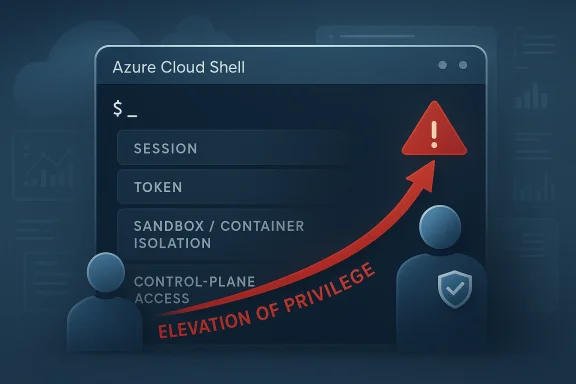
The public description of CVE-2026-32169 is brief, but the framing is still informative. An Azure Cloud Shell elevation-of-privilege issue strongly suggests the weakness lies in a path that allows a user or process to gain more authority than intended inside the Cloud Shell trust model. That might involve session handling, token handling, container isolation, command mediation, or some other service boundary, but Microsoft has not publicly tied the issue to a specific root cause in the source material available here.Why the confidence metric matters
The user-provided description of the metric is essentially a vulnerability-confidence gauge. It separates mere suspicion from a vendor-confirmed issue with credible technical grounding. In this case, the existence of a Microsoft-assigned CVE is itself a strong signal that the vulnerability is real and actionable, even if the detailed attack path is not yet public. In other words, the market should treat this as confirmed, not hypothetical.The confidence level also influences how defenders prioritize the issue. A confirmed vulnerability with limited technical detail still deserves faster triage than an uncorroborated report because it implies Microsoft has already validated the flaw internally or through a coordinated report. That doesn’t tell us whether the attack is easy or hard, but it does tell us the risk is not merely theoretical.
What we can infer safely
We cannot infer exploitability from the CVE label alone, but we can infer the class of problem. A Cloud Shell EoP issue likely involves one of the service’s privileged workflows or sandbox boundaries rather than a generic Azure tenant misconfiguration. It may also affect a narrower subset of users or a particular interaction pattern, which is common in cloud service bugs where the trigger depends on session state or administrative context.What we should avoid doing is overreading the label into a specific attack chain. No public technical write-up in the material reviewed here confirms whether the issue was remote, authenticated, cross-tenant, or limited to a certain shell mode. That restraint is important because precision is more useful than speculation when a CVE is still light on detail.
- The CVE is vendor-confirmed through Microsoft’s advisory system.
- The flaw is categorized as elevation of privilege, not data exposure or denial of service.
- The affected surface is Azure Cloud Shell, a high-trust administrative service.
- The technical root cause is not yet publicly detailed in the material reviewed here.
- Treat the issue as real and actionable, even if the exploit chain remains unpublished.
Why Azure Cloud Shell is a sensitive target
Cloud Shell is attractive to attackers because it can compress a lot of administrative power into a small user-facing surface. It is a productivity tool, but it also becomes a natural pivot point if an adversary can subvert session boundaries, token handling, or container permissions. That makes Cloud Shell qualitatively different from a normal web app: it is a management interface with direct reach into cloud control operations.Administrative convenience becomes attack surface
The more seamless a cloud management plane becomes, the more valuable it is as a target. Cloud Shell reduces friction by presenting a ready-to-use environment in the browser, which is excellent for legitimate operators but can be risky if the service’s authority boundaries are not airtight. Attackers prize exactly these kinds of shortcuts because they often sit closer to high-value tokens and operational commands than ordinary user-facing portals do.A vulnerability in such a service can also have a multiplier effect. Even if the flaw affects only authenticated users, those users are often the very accounts with the highest privileges in the tenant. That means a seemingly modest privilege escalation can become a full administrative compromise if the victim account already has broad Azure rights.
Service isolation is only as strong as its weakest boundary
Cloud-hosted shells typically rely on layered isolation: container boundaries, brokered authentication, short-lived tokens, and policy enforcement by the control plane. This architecture is robust when every component behaves correctly, but it creates multiple places where a flaw can erode the expected security model. If one layer mismanages identity or execution context, the gap can become the attacker’s entry point.This is why Microsoft’s cloud advisories often emphasize defense in depth. Prior Azure service disclosures have shown that even when the company rapidly patches a defect, it still uses the public CVE to document the trust break and to encourage customers to review logs, scopes, and access patterns. The lesson is that service-side hardening is necessary, but visibility is just as important.
- Cloud Shell is high leverage because it sits close to admin workflows.
- Session and token trust are likely central to the security model.
- Container or sandbox boundaries may be relevant in any EoP issue.
- High-privilege users make a small vulnerability far more damaging.
- Defensive logging matters because detection may be the only clue after exposure.
Microsoft’s cloud vulnerability disclosure pattern
Microsoft has steadily normalized the publication of CVEs for cloud services, and that matters because it creates a public record of service-side security work. In Azure, the company often explains that it identified or mitigated the flaw centrally and then used the CVE to document the issue for customers. This pattern improves transparency, but it also means that the existence of a CVE may precede a rich technical analysis.Coordinated disclosure remains the default
Across recent Azure cases, Microsoft has highlighted coordinated vulnerability disclosure with researchers and security vendors. That model is visible in the company’s handling of Azure Synapse Spark, Azure Database for PostgreSQL Flexible Server, Azure Machine Learning, and Azure Bastion issues. The common thread is that Microsoft prefers to fix first, disclose after, and frame the issue in terms of service resiliency rather than publish exploit details prematurely.That sequencing has practical benefits. It shortens the window of exposure, reduces copycat risk, and keeps the focus on mitigation. But it also means defenders may need to act before a full public breakdown of the bug exists. This is one of the paradoxes of cloud security: the best fixes can arrive before the best explanations.
Why cloud CVEs feel different from Windows CVEs
Traditional Windows vulnerabilities often ship with patch notes, exploitation guidance, and clearly defined affected versions. Cloud-service vulnerabilities are less tidy because Microsoft may patch the back end without exposing version numbers in the same way. The result is a disclosure that confirms the issue but leaves defenders with fewer on-prem-style indicators.That difference is especially important for Azure Cloud Shell. Because it is a service rather than a distributable binary, customers may not be able to “install the patch” in the conventional sense. Instead, they need to understand whether they were exposed, whether any misuse occurred before remediation, and whether their own privilege design made the problem worse.
- Microsoft frequently uses centralized service fixes for Azure vulnerabilities.
- CVD is the dominant disclosure model in these cases.
- Customers may need to focus on log review and access audit rather than patch deployment.
- Cloud CVEs often provide less version-level detail than device or OS CVEs.
- For defenders, the practical response is often verification, monitoring, and governance.
Possible technical themes behind the issue
Microsoft has not published the specific mechanics of CVE-2026-32169 in the material reviewed here, so any technical discussion must stay within the bounds of inference. Still, the Azure Cloud Shell context makes several themes plausible. Those themes are not proof, but they are the kinds of failure modes defenders should keep in mind when assessing exposure.Identity and token handling
Cloud shells rely heavily on identity assertions. If a service mishandles token scope, token reuse, or session binding, a user may gain a stronger or longer-lived capability than intended. In cloud environments, the line between authentication and authorization can be thin, and a small mistake can become a major escalation path.A flaw in token handling is particularly dangerous because it can survive beyond a single shell session. If an attacker can trigger a privilege transition or extend the validity of a higher-trust token, the issue stops being a one-off application bug and becomes a control-plane problem. That is the kind of defect that tends to draw urgent attention from cloud defenders.
Container and sandbox boundaries
Cloud Shell services often run inside managed isolation layers, and those layers are exactly where many privilege bugs emerge. If a shell environment can access host-level resources, brokered APIs, or adjacent administrative functions that it should not reach, the attacker may be able to escape the intended sandbox. The history of Azure service advisories suggests Microsoft is deeply aware of this class of failure.Even when the service is not directly comparable to a server container, the logic is similar: the attacker wants to cross a trust boundary that should have remained sealed. That could mean gaining access to a broader command surface, escalating to a more privileged workspace, or manipulating internal service workflows. The key question is always the same: what boundary was supposed to exist, and how was it crossed?
Brokered command execution
Cloud shells often mediate command execution through service brokers, web sockets, backend orchestration, or managed terminals. A bug in that mediation layer can let an attacker smuggle higher-privilege commands or manipulate execution context. This is especially concerning if the service translates browser-originated actions into backend operations on the user’s behalf.If the issue turns out to involve command mediation, the security implications could be substantial even if the public description stays vague. A broker flaw can affect not just one shell command, but a whole set of administrative workflows. That is why a short advisory can still signal a broader security review inside Microsoft.
- Token scope mistakes can silently widen authority.
- Sandbox escape paths are a classic cloud privilege problem.
- Brokered execution layers can become the real attack surface.
- Session binding weaknesses can extend attacker control.
- Trust boundary confusion is often the root cause in EoP bugs.
Enterprise impact versus individual admin impact
For enterprises, an Azure Cloud Shell EoP issue is less about a single compromised browser tab and more about governance over privileged cloud operations. If Cloud Shell is used by central platform teams, DevOps staff, or incident responders, then a flaw there can intersect with broad production access. That raises the stakes because a compromised admin context can cascade quickly into resource tampering, credential harvesting, or policy changes.Enterprise blast radius
In larger organizations, Cloud Shell often sits within workflows that already touch critical infrastructure. That means the attack surface is not just the shell itself, but the Azure resources reachable from that shell. If an attacker can escalate within the service, they may be able to move from a constrained operator role into broader subscription-level activity.The enterprise concern is also one of visibility. Large environments often have fragmented logging, multiple identity providers, and parallel administrative tools. If a Cloud Shell weakness is exploited, the defender’s challenge is not only remediation but also reconstructing what was accessible during the window of exposure. That makes identity auditing and control-plane logs indispensable.
Individual and small-team impact
For smaller teams, the impact can be simpler but still severe. A handful of administrators may depend on Cloud Shell as their main rapid-response interface, and those same users may have broad rights by necessity. If the service is trusted as a shortcut, a privilege bug can translate directly into production impact with little delay.Smaller environments also tend to assume that “cloud means Microsoft handles it,” which is only partly true. Microsoft can fix the service, but customers still need strong least-privilege design, multi-factor authentication, role separation, and alerting on unusual management actions. Security features do not compensate for excessive standing privilege.
- Enterprises face a larger blast radius because Cloud Shell may reach many subscriptions.
- Small teams face higher dependency because one service may be the primary admin path.
- Auditability becomes critical after any service-side EoP issue.
- Least privilege reduces the value of a successful escalation.
- MFA and conditional access remain essential, even for service-managed tools.
Defensive response priorities
Because the advisory details are limited, the best response is a disciplined one. Defenders should not wait for a full exploit narrative before checking how Cloud Shell is used in their environment. The goal is to reduce exposure, verify whether privileged actions occurred unexpectedly, and make sure governance controls are actually doing their job.What administrators should review
Start by identifying who uses Cloud Shell and why. In many organizations, the service is enabled broadly even though only a subset of users truly need it. That is a classic case for tightening scope, especially if privileged operators can reach production through the shell. Any service that blends convenience and control deserves a careful access review.Next, examine whether your identity and role model assumes the shell is trustworthy by default. If operators have broad standing permissions, the vulnerability’s impact rises dramatically. If access is constrained through just-in-time privilege or scoped roles, the downside is reduced even if exposure existed.
Practical response steps
- Identify all users who can access Azure Cloud Shell.
- Review privileged role assignments tied to those users.
- Check sign-in and management-plane logs for unusual activity during the advisory window.
- Validate whether any automation depended on Cloud Shell credentials or sessions.
- Tighten conditional access and MFA enforcement for privileged accounts.
- Reassess whether Cloud Shell should be enabled for all users or only a narrow group.
- Review user access to Cloud Shell.
- Audit role assignments and standing permissions.
- Search management-plane logs for anomalies.
- Verify automation dependencies on shell-based workflows.
- Enforce MFA and conditional access for admin paths.
- Restrict Cloud Shell to those who actually need it.
Competitive and market implications
Cloud-service vulnerability disclosures are not just security events; they are also market signals. Microsoft’s willingness to publish a CVE for Azure Cloud Shell shows the company continues to lean into transparency, even though public cloud providers sometimes prefer to minimize the optics of service flaws. That is a strategic choice, and it influences how customers compare cloud platforms on trust and disclosure maturity.Transparency as a differentiator
When Microsoft documents a cloud-service EoP issue, it sends a message that service vulnerabilities are part of the security conversation, not hidden from it. For enterprise buyers, that can be reassuring because it suggests a process exists to identify, remediate, and communicate these defects. It also places pressure on rivals to be equally transparent when their own managed services break security boundaries.At the same time, transparency can cut both ways. The more visible the CVE catalog becomes, the easier it is for competitors or attackers to point to Microsoft’s scale and complexity as evidence of risk. That is why disclosure quality matters: clear advisories can build trust, while vague ones can create uncertainty. The company has to prove that openness is a strength, not a liability.
Cloud control-plane security is now a sales issue
As more workloads shift to managed services, the security of administrative surfaces becomes a purchasing criterion. Customers increasingly ask not only whether a service can be deployed, but whether its privileged workflows are resilient and auditable. A Cloud Shell CVE fits directly into that conversation because it touches the very tools administrators use to manage the cloud.The broader market implication is that cloud providers are now judged on more than uptime and feature breadth. Their security posture around identity, session handling, and service isolation is part of the product. The companies that can explain and correct those failures fastest are likely to gain credibility with risk-conscious buyers.
- Transparency strengthens trust when handled well.
- Control-plane security is now a buying criterion.
- Competitors may use such CVEs as comparison points.
- Clear remediation matters as much as disclosure.
- Auditability is becoming a differentiator in cloud sales.
Strengths and Opportunities
The strongest signal in this advisory is not the flaw itself, but the fact that Microsoft has treated it as a real, named vulnerability in a managed cloud service. That reinforces the maturity of the disclosure process and gives defenders something concrete to track. It also highlights how cloud security can improve when vendors surface service-side issues instead of burying them behind generic platform language.- Vendor confirmation reduces ambiguity about whether the issue exists.
- The CVE framework gives defenders a trackable reference point.
- Microsoft’s disclosure model supports faster enterprise triage.
- Cloud-service CVEs encourage better identity and access reviews.
- The event may prompt hardening of adjacent admin workflows.
- It reinforces the value of centralized patching for managed services.
- Customers can use the disclosure to justify least-privilege cleanup.
Risks and Concerns
The biggest concern is that the public description may be enough to signal danger without enough detail to support precise remediation. That is a familiar problem with cloud-service vulnerabilities: the service is fixed centrally, but customers still need to determine whether they were affected operationally. In a privileged service like Cloud Shell, even brief exposure can matter.- Attackers may focus on high-value admin accounts that use Cloud Shell.
- Limited technical detail can make incident scoping harder.
- Privilege escalation in a management service can enable rapid lateral movement.
- Organizations with broad standing access may have larger blast radius.
- Teams may wrongly assume Microsoft’s fix eliminates the need for internal review.
- Cloud Shell convenience can encourage overuse by privileged staff.
- Logging gaps can make it difficult to prove whether abuse occurred.
Looking Ahead
The next question is whether Microsoft will publish a fuller advisory narrative, a mitigation note, or a retrospective explanation of the flaw class. That sort of follow-up would help customers understand whether they need to adjust Cloud Shell usage, rotate credentials, or simply rely on Microsoft’s central fix. In cloud security, clarity often arrives later than the patch.The other thing to watch is whether this CVE becomes part of a broader pattern in Azure service security disclosures. If Microsoft continues to surface more browser-facing or identity-adjacent cloud privilege issues, enterprises will likely respond by tightening admin access, reducing standing privileges, and demanding more granular logs. That would be a healthy outcome, but only if customers actually act on the warning.
- Watch for a deeper Microsoft explanation of the issue.
- Monitor whether Microsoft adds mitigation or detection guidance.
- Check whether organizations restrict Cloud Shell usage further.
- Observe whether adjacent Azure services receive additional hardening.
- Track whether incident responders report abuse patterns tied to the CVE.
Source: MSRC Security Update Guide - Microsoft Security Response Center
