

Microsoft’s CVE-2026-32210 advisory for Dynamics 365 (online) is a reminder that even mature cloud business platforms can still be exposed to spoofing risks that are more about trust than raw technical exploitation. The Security Update Guide’s description centers on confidence in the vulnerability’s existence and the credibility of the technical details, which matters because attackers can only weaponize what they understand well enough to reproduce. In practical terms, the issue sits at the intersection of identity, user trust, and cloud service assurance, all of which are foundational to Dynamics 365 deployments.
Microsoft’s security taxonomy has become more transparent over time, and that shift is important here. The company has moved toward richer vulnerability descriptions, including CVSS-based scoring and, more recently, standardized CWE publishing for root cause data in many CVEs. That means a cloud-service entry like CVE-2026-32210 is not just a label; it is part of a broader effort to help customers understand how certain Microsoft is about the issue and what kind of attack behavior it may enable.
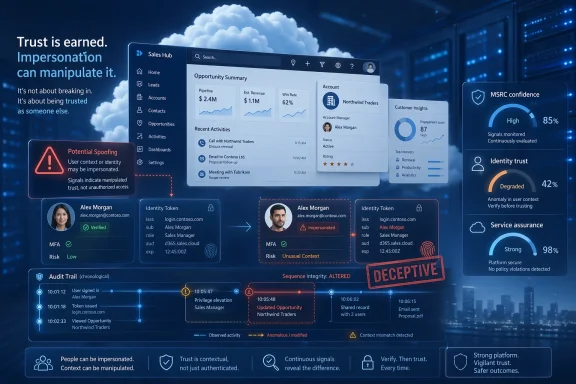
Dynamics 365 itself is a large and strategically important target surface. It supports customer relationship management, sales workflows, service management, and broader business operations, which makes any spoofing flaw especially sensitive. In a SaaS context, spoofing does not necessarily mean a dramatic code execution exploit; it can mean an attacker manipulates identity or presentation in a way that causes a user or process to trust the wrong source.
That distinction matters because cloud applications increasingly depend on layered trust signals. Authentication, tenant boundaries, session state, branding, and permission context all work together to tell users what is legitimate. When one of those trust signals can be forged or misrepresented, the resulting damage may be less visible than a classic ransomware event, but it can still be highly consequential.
Microsoft’s own history with cloud and service CVEs suggests that these issues are often addressed in a way that is invisible to most customers. Unlike server-side patches that require manual deployment, Dynamics 365 online fixes are typically rolled out by Microsoft behind the scenes. That lowers operational friction, but it also means customers can underestimate the seriousness of a cloud advisory if they do not see an immediate action item.
The key takeaway from the advisory framing is that certainty and exploitability are related but not identical. Microsoft’s confidence metric exists because some vulnerability reports are based on strong evidence, while others begin as partial technical observations that need corroboration. For defenders, the difference is critical: a higher-confidence vulnerability warrants faster attention, closer monitoring, and broader internal awareness.
This is not the same as simple phishing, although the two can overlap. Spoofing vulnerabilities are generally rooted in product behavior, not merely human deception. If a platform allows an attacker to present false information with a trusted appearance, the product itself has contributed to the deception.
Common spoofing outcomes include:
The cloud setting raises the stakes further. Users often assume that anything inside a Microsoft-hosted service is already validated and trustworthy. That assumption is convenient, but it also creates a powerful opportunity for attackers if the service can be manipulated into showing the wrong provenance or attribution.
That does not make the issue less relevant. It simply means organizations should interpret the advisory as a signal to watch for follow-on details, update guidance, and administrative actions. In cloud services, even partial information can be enough to justify an internal review.
The attack value lies in the data and the decisions. A spoofing flaw can be used to make a malicious interaction appear routine, or to make a fraudulent artifact appear to come from a trusted source. In enterprise software, perception is often almost as valuable as privilege.
That is why cloud-service spoofing deserves careful attention:
Microsoft’s ongoing investment in bounty programs for Dynamics 365 and Power Platform reflects the scale of that risk. By encouraging external research, Microsoft is acknowledging that large SaaS surfaces need continuous scrutiny. That is especially true when the product evolves quickly and new features can introduce new identity assumptions.
For consumers, the issue would mainly matter if a Dynamics-integrated service or customer-facing portal were involved. For enterprises, the concern is broader: staff workflows, partner interactions, and customer communications all become part of the threat model. The same spoofing condition can therefore have very different business meaning depending on deployment and usage.
This is especially helpful for cloud CVEs, where the underlying technical facts may be less visible than for on-premises products. Microsoft can patch or mitigate service-side issues without publishing a full exploit narrative. Customers still need a way to judge urgency, and the confidence framing is designed to fill that gap.
This has practical consequences for security teams:
The confidence metric also helps explain why some advisories look sparse at first. Microsoft may intentionally limit technical detail until the service-side fix is fully deployed or until the company is confident that public disclosure will not materially increase risk. That restraint is frustrating for researchers, but it is common in modern cloud response.
For administrators, the lesson is to avoid waiting for a perfect write-up before acting. If Microsoft has assigned a CVE and described the issue as spoofing in a business-critical cloud app, that is enough to warrant attention. The absence of a detailed exploit path may simply mean the disclosure process is still in motion.
The company’s recent moves toward machine-readable formats and standardized metadata are intended to help defenders automate tracking and response. For cloud-service issues, where remediation may happen server-side and the customer action may be limited, that transparency is especially valuable.
That matters for a few reasons:
Microsoft’s documentation strategy suggests it wants to keep moving toward standardization while preserving enough discretion to protect live services. That is the right direction, especially for online platforms where a fix can be deployed invisibly and the public only sees the advisory after the fact.
For users of Dynamics 365, this means the advisory should not be read in isolation. It is part of a larger pattern in which Microsoft is making service-side security more visible while still relying on its own internal response machinery to do much of the actual mitigation work. The visibility is improving, but the operational burden on customers remains real.
In many cases, the goal is not immediate system compromise. It is business compromise. That can mean fraudulent approvals, deceptive communications, or altered user expectations that enable later fraud or credential theft.
That is why spoofing often sits upstream of bigger incidents. A deceptive record can lead to incorrect action, which can then lead to privilege abuse, money movement, data leakage, or account takeover. The initial flaw may look local; the consequences are often systemic.
An on-premises exploit might leave obvious logs or crashes. A SaaS spoofing issue can be subtler. The interface may look normal, the audit trail may appear consistent, and the victim may only realize something was wrong after an unexpected downstream outcome. That delay is part of the attacker’s advantage.
The right response depends on how the organization uses Dynamics 365, how tightly it integrates with identity and workflow systems, and whether internal controls can detect suspicious trust anomalies. Security teams should coordinate with application owners rather than waiting for a formal incident.
Communication should be concise and specific. Teams do not need alarmist messaging; they need a clear understanding that spoofing within a trusted cloud application can alter behavior without breaking obvious controls. That nuance is what makes these advisories worth escalating internally.
Organizations using Dynamics 365 should treat this as part of a broader shift toward cloud trust management. The question is no longer just whether a service is up to date. It is whether the service’s identity and presentation layers are reliable enough to support business decisions without ambiguity.
Microsoft Dynamics 365 is too central to enterprise operations to treat spoofing as a minor category. Even without a public exploit chain, the combination of cloud delivery, business-process reliance, and identity sensitivity makes this a story worth watching closely. The real lesson is simple: in modern SaaS, trust is infrastructure, and every trust failure deserves serious attention.
Source: MSRC Security Update Guide - Microsoft Security Response Center
 Overview
Microsoft’s security taxonomy has become more transparent over time, and that shift is important here. The company has moved toward richer vulnerability descriptions, including CVSS-based scoring and, more recently, standardized CWE publishing for root cause data in many CVEs. That means a cloud-service entry like CVE-2026-32210 is not just a label; it is part of a broader effort to help customers understand how certain Microsoft is about the issue and what kind of attack behavior it may enable.Dynamics 365 itself is a large and strategically important target surface. It supports customer relationship management, sales workflows, service management, and broader business operations, which makes any spoofing flaw especially sensitive. In a SaaS context, spoofing does not necessarily mean a dramatic code execution exploit; it can mean an attacker manipulates identity or presentation in a way that causes a user or process to trust the wrong source.
That distinction matters because cloud applications increasingly depend on layered trust signals. Authentication, tenant boundaries, session state, branding, and permission context all work together to tell users what is legitimate. When one of those trust signals can be forged or misrepresented, the resulting damage may be less visible than a classic ransomware event, but it can still be highly consequential.
Microsoft’s own history with cloud and service CVEs suggests that these issues are often addressed in a way that is invisible to most customers. Unlike server-side patches that require manual deployment, Dynamics 365 online fixes are typically rolled out by Microsoft behind the scenes. That lowers operational friction, but it also means customers can underestimate the seriousness of a cloud advisory if they do not see an immediate action item.
The key takeaway from the advisory framing is that certainty and exploitability are related but not identical. Microsoft’s confidence metric exists because some vulnerability reports are based on strong evidence, while others begin as partial technical observations that need corroboration. For defenders, the difference is critical: a higher-confidence vulnerability warrants faster attention, closer monitoring, and broader internal awareness.
What “Spoofing” Means in a Cloud App
In Microsoft’s taxonomy, spoofing usually means an attacker can impersonate another entity or trick a user into believing something is authentic when it is not. In a cloud application, that can involve identity confusion, misleading interface elements, or forged communication paths that appear to originate from a trusted service.This is not the same as simple phishing, although the two can overlap. Spoofing vulnerabilities are generally rooted in product behavior, not merely human deception. If a platform allows an attacker to present false information with a trusted appearance, the product itself has contributed to the deception.
Why spoofing is dangerous in Dynamics 365
Dynamics 365 is often used by staff who handle customers, contracts, cases, and internal records. If a spoofing issue can make a workflow, contact, or notification appear legitimate when it is not, the impact can cascade quickly. People make operational decisions based on what they see in the application, and trust is the actual attack surface.Common spoofing outcomes include:
- Fake sender or origin indicators
- Misleading records or object ownership
- Impersonated internal workflows
- False trust in approval or notification content
- Incorrect tenant or organizational context
The cloud setting raises the stakes further. Users often assume that anything inside a Microsoft-hosted service is already validated and trustworthy. That assumption is convenient, but it also creates a powerful opportunity for attackers if the service can be manipulated into showing the wrong provenance or attribution.
The confidence metric matters
The language in the advisory points to a broader MSRC principle: the degree of confidence in the vulnerability’s existence affects urgency. If Microsoft has high confidence, customers can assume the issue is real even if public technical details are sparse. If confidence is lower, defenders may see more uncertainty around reproducing or validating the scenario.That does not make the issue less relevant. It simply means organizations should interpret the advisory as a signal to watch for follow-on details, update guidance, and administrative actions. In cloud services, even partial information can be enough to justify an internal review.
Why Dynamics 365 Online Is a High-Value Target
Dynamics 365 online is not a niche product. It is a business operations platform that touches sales pipelines, service tickets, customer data, and workflow approvals. That makes it a natural target for attackers seeking influence rather than raw technical compromise.The attack value lies in the data and the decisions. A spoofing flaw can be used to make a malicious interaction appear routine, or to make a fraudulent artifact appear to come from a trusted source. In enterprise software, perception is often almost as valuable as privilege.
Business-process trust is the real asset
The platform’s importance comes from the way organizations use it. Employees may rely on Dynamics 365 for lead records, customer correspondence, support histories, and escalation workflows. If an attacker can distort any of those trust anchors, they may not need to break encryption or exploit a kernel bug.That is why cloud-service spoofing deserves careful attention:
- It can affect operational decisions
- It may bypass user suspicion
- It can support social engineering inside the app
- It can damage auditability
- It can erode trust in business records
Microsoft’s ongoing investment in bounty programs for Dynamics 365 and Power Platform reflects the scale of that risk. By encouraging external research, Microsoft is acknowledging that large SaaS surfaces need continuous scrutiny. That is especially true when the product evolves quickly and new features can introduce new identity assumptions.
Enterprise vs consumer impact
Dynamics 365 online is overwhelmingly an enterprise issue, and that shapes the severity profile. Consumer malware often aims for broad compromise; enterprise spoofing targets coordination, approvals, and trust. That means the impact can be narrower in user count but deeper in organizational consequence.For consumers, the issue would mainly matter if a Dynamics-integrated service or customer-facing portal were involved. For enterprises, the concern is broader: staff workflows, partner interactions, and customer communications all become part of the threat model. The same spoofing condition can therefore have very different business meaning depending on deployment and usage.
How Microsoft Frames Vulnerability Confidence
Microsoft’s wording around this kind of metric reflects an important shift in security reporting. The company increasingly tries to indicate not just what a vulnerability is, but how sure it is that the vulnerability exists and how much technical detail is available to attackers. That helps customers prioritize response.This is especially helpful for cloud CVEs, where the underlying technical facts may be less visible than for on-premises products. Microsoft can patch or mitigate service-side issues without publishing a full exploit narrative. Customers still need a way to judge urgency, and the confidence framing is designed to fill that gap.
Why certainty changes response
A high-confidence vulnerability means defenders should treat the issue as real even if public exploitation is not documented. A lower-confidence report might justify monitoring and contingency planning while waiting for additional evidence. In both cases, the advisory is useful, but the operational response differs.This has practical consequences for security teams:
- Confirm whether the advisory affects the organization’s Dynamics 365 environment.
- Review any Microsoft follow-up guidance or service updates.
- Correlate the issue with internal threat models and incident history.
- Brief application owners and identity teams.
- Watch for changes in the advisory page or related MSRC updates.
The confidence metric also helps explain why some advisories look sparse at first. Microsoft may intentionally limit technical detail until the service-side fix is fully deployed or until the company is confident that public disclosure will not materially increase risk. That restraint is frustrating for researchers, but it is common in modern cloud response.
The role of limited technical detail
Limited detail does not mean limited seriousness. In fact, some of the most important cloud advisories are initially described in broad terms precisely because the product owner wants to protect customers before publicizing root cause mechanics. That is a defensive disclosure pattern rather than a sign of uncertainty.For administrators, the lesson is to avoid waiting for a perfect write-up before acting. If Microsoft has assigned a CVE and described the issue as spoofing in a business-critical cloud app, that is enough to warrant attention. The absence of a detailed exploit path may simply mean the disclosure process is still in motion.
Microsoft’s Cloud-Security Transparency Push
CVE-2026-32210 also fits into Microsoft’s broader push for more transparent security communication. Over the last several years, MSRC has expanded how it reports vulnerabilities, added advisory information for non-CVE security events, and published more structured data for automated consumption. That evolution matters because cloud security is now too complex to manage from terse bulletins alone.The company’s recent moves toward machine-readable formats and standardized metadata are intended to help defenders automate tracking and response. For cloud-service issues, where remediation may happen server-side and the customer action may be limited, that transparency is especially valuable.
Why this helps defenders
Security teams do not just need patches. They need context, metadata, and confidence signals. A cloud CVE with richer description fields can feed ticketing systems, compliance dashboards, and risk registers more accurately than a bare severity label.That matters for a few reasons:
- It improves prioritization
- It supports automated vulnerability tracking
- It helps separate confirmed issues from speculative reports
- It clarifies product scope and service boundaries
- It reduces the risk of missed advisories
Microsoft’s documentation strategy suggests it wants to keep moving toward standardization while preserving enough discretion to protect live services. That is the right direction, especially for online platforms where a fix can be deployed invisibly and the public only sees the advisory after the fact.
Historical context from Microsoft security reporting
Microsoft has been steadily improving how it communicates vulnerability data. It has moved from older, more opaque security bulletins toward richer Security Update Guide entries and, more recently, more structured root-cause information. That progression makes cloud advisories easier to ingest, but it also raises expectations for consistency and timeliness.For users of Dynamics 365, this means the advisory should not be read in isolation. It is part of a larger pattern in which Microsoft is making service-side security more visible while still relying on its own internal response machinery to do much of the actual mitigation work. The visibility is improving, but the operational burden on customers remains real.
Threat Scenarios and Abuse Paths
A spoofing vulnerability in a cloud business app can be abused in several ways, even if the precise technical vector is not yet public. Attackers may try to create false legitimacy, misroute trust, or impersonate objects and messages inside the application. The technical method matters, but the strategic objective is usually the same: get the victim to believe the wrong thing.In many cases, the goal is not immediate system compromise. It is business compromise. That can mean fraudulent approvals, deceptive communications, or altered user expectations that enable later fraud or credential theft.
Possible attack outcomes
Potential abuse scenarios include:- False customer or case identities
- Misleading service notifications
- Impersonated workflow approvals
- Forged tenant or organization context
- Deceptive UI elements that appear native to the platform
That is why spoofing often sits upstream of bigger incidents. A deceptive record can lead to incorrect action, which can then lead to privilege abuse, money movement, data leakage, or account takeover. The initial flaw may look local; the consequences are often systemic.
Why cloud spoofing can be hard to spot
Cloud applications are rich, interactive, and constantly changing. Users see branded navigation, embedded records, shared dashboards, and contextual notifications. That complexity creates opportunities for ambiguity, and ambiguity is precisely what spoofing exploits.An on-premises exploit might leave obvious logs or crashes. A SaaS spoofing issue can be subtler. The interface may look normal, the audit trail may appear consistent, and the victim may only realize something was wrong after an unexpected downstream outcome. That delay is part of the attacker’s advantage.
What Customers Should Do Now
Because Dynamics 365 online is a Microsoft-managed service, customers usually do not patch the product directly in the traditional sense. Instead, they should treat the advisory as a trigger to verify coverage, review tenant posture, and monitor Microsoft’s updates. Even when no direct remediation is available, there is still meaningful work to do.The right response depends on how the organization uses Dynamics 365, how tightly it integrates with identity and workflow systems, and whether internal controls can detect suspicious trust anomalies. Security teams should coordinate with application owners rather than waiting for a formal incident.
Practical response steps
- Confirm whether the organization uses Dynamics 365 online and which modules or portals are affected.
- Review Microsoft’s advisory page for any updated impact, mitigation, or service-side notes.
- Check identity and access controls for unusual trust dependencies or delegated workflows.
- Audit recent activity for suspicious approvals, origin mismatches, or anomalous records.
- Brief support, CRM, and security operations teams on the potential spoofing risk.
The importance of internal awareness
Many organizations underestimate service-side advisories because they do not require a manual patch. That is a mistake. If the flaw involves identity confusion or apparent trust signals, business users need to know that unusual-looking requests or records may require extra verification.Communication should be concise and specific. Teams do not need alarmist messaging; they need a clear understanding that spoofing within a trusted cloud application can alter behavior without breaking obvious controls. That nuance is what makes these advisories worth escalating internally.
Strengths and Opportunities
The positive side of this advisory is that it reflects a more mature approach to cloud vulnerability disclosure. Microsoft is signaling that it understands trust issues in online business platforms, and that is a good sign for customers who rely on Dynamics 365 for sensitive workflows. The more transparent the reporting, the better defenders can align their monitoring and governance.- Better visibility into cloud-service risk categories
- Earlier warning for enterprise security teams
- Improved prioritization when confidence is high
- Service-side remediation that may reduce customer workload
- Stronger ecosystem awareness around SaaS spoofing
- More mature disclosure from Microsoft’s security program
- Opportunity to harden identity and workflow controls
Risks and Concerns
The most obvious concern is that spoofing vulnerabilities are often underestimated because they do not always look catastrophic at first glance. In a platform that underpins customer records and operational workflows, however, trust failures can be just as damaging as direct exploitation. The bigger risk is not only the flaw itself, but the organizational habit of treating cloud advisories as low-priority because they do not require immediate patching.- Underestimation of business impact
- Delayed response due to lack of manual remediation
- Weak internal communication about trust-related flaws
- Potential for social engineering inside trusted workflows
- Audit and compliance issues if records are manipulated
- Confusion from limited technical detail
- Overreliance on Microsoft without local validation
Looking Ahead
The next phase of this story will likely depend on how much Microsoft chooses to publish in follow-up guidance and whether additional technical context is added to the advisory page. In cloud CVEs, the initial label often tells only part of the story, and later updates can sharpen the operational meaning considerably. Security teams should expect the advisory to evolve.Organizations using Dynamics 365 should treat this as part of a broader shift toward cloud trust management. The question is no longer just whether a service is up to date. It is whether the service’s identity and presentation layers are reliable enough to support business decisions without ambiguity.
- Watch for MSRC updates to the advisory
- Monitor for service-side changes in Dynamics 365 behavior
- Review identity and workflow assumptions inside the tenant
- Validate alerting and audit controls for spoofing indicators
- Brief stakeholders if Microsoft changes the severity or scope
Microsoft Dynamics 365 is too central to enterprise operations to treat spoofing as a minor category. Even without a public exploit chain, the combination of cloud delivery, business-process reliance, and identity sensitivity makes this a story worth watching closely. The real lesson is simple: in modern SaaS, trust is infrastructure, and every trust failure deserves serious attention.
Source: MSRC Security Update Guide - Microsoft Security Response Center
