

Microsoft’s CVE-2026-32214 entry is a useful reminder that not every Windows security advisory arrives with a full technical postmortem, but that does not make it any less real. The MSRC description frames the issue as a Universal Plug and Play (upnp.dll) Information Disclosure Vulnerability, and the surrounding confidence language is designed to tell defenders how certain Microsoft is that the flaw exists and how credible the technical details are. That matters because patching decisions are always a blend of severity, exposure, and certainty, and Microsoft’s update guide is explicitly trying to signal all three. In other words, this is not just a label; it is a confidence-weighted warning that should influence triage, not merely satisfy curiosity. ersal Plug and Play has been part of the Windows security conversation for more than two decades, and the reason is simple: it sits at the intersection of convenience and trust. Microsoft’s older security bulletins on UPnP show that the service has repeatedly been relevant to remote attacks, denial-of-service behavior, and code execution scenarios, which means the component’s security history is neither trivial nor theoretical. Microsoft’s own 2001 and 2007 bulletin language makes clear that UPnP was treated as a real attack surface long before modern CVE tracking and today’s more granular advisory metadata.
The broader lesson from those historical bulletins is that network-discovery services are inherently sensitive because they are designed to listen, respond, and expose information about devices and capabilities. That design is useful for consumer convenience and enterprise automation, but it also creates opportunities for attackers who can trigger unexpected behavior or coerce the service into revealing data it should have kept private. Microsoft’s own historical descriptions of UPnP emphasize broadcast discovery and device response behavior, which is exactly the sort of mechanism that can become security-relevant when validation, parsing, or access control is imperfect.
What makes CVE-2026-32214 interesting is not merely that it involves UPnP again, but that it is specifically framed as an information disclosure issue rather than a crash or a full compromise story. Information disclosure flaws often look less dramatic on paper, but they can be strategically valuable because they leak memory, internal state, pointers, or configuration details that help attackers stage a sern Windows defense, a leak is rarely “just a leak”; it is often the missing piece that turns a hard exploit into a practical one.
Microsoft’s current Security Update Guide framework also matters here. The company has been increasingly explicit that its advisory pages are meant to do more than publish a CVE title; they are supposed to communicate the certainty of the issue, the credibility of the technical details, and the urgency implied by that combination. Microsoft has described this model publicly as part of its effort to make vulnerability descriptions more useful for customers, and that approach is especially valuable for sparse advisories where the public details are still thin.
The confidence metric is not an academic flourish. It is Microsoft’s way of telling defenders whether the issue is well-established, partially corroborated, or still emergince. That can be the difference between “watch this” and “patch this now,” especially when the vulnerability lives in a shared system component like upnp.dll and the public technical narrative has not yet caught up.
For defenders, the practical implication is straightforward: the less public detail there is, the more valuable Microsoft’s own confidence signal becomes. In a world where security teams already face patch backlogs, asset sprawl, and limited staff time, any vendor-provided clue about certainty helps prioritize the queue. That is particularly true for Windows components that may be disabled on some systems but quietly active on others through vendor customization or legacy configuration.
The most important contextual clue is the component itself. UPnP is a discovery and control framework that was designed for convenience, not for minimal exposure, and Microsoft’s historical bulletins show that security issues in the service can have meaningful impact even when they do not immediately lead to code execution. That history raises the baseline seriousness of any new UPnP-related advisory, particularly when the affected file is a core Windows DLL rather than a peripheral add-on.
There is also a subtle but important enterprise angle. Many organizations think of UPnP as a home-network concern, but Windows components often travel from consumer contexts into managed fleets through OEM builds, legacy images, and convenience fea fully retired. A vulnerability in upnp.dll therefore has a wider potential footprint than some administrators may initially assume, especially in mixed estates where configuration drift is common. That is one of the reasons Microsoft’s confidence-bearing guidance deserves attention even before the full technical write-up lands.
From a security operations perspective, advisories like this also expose a recurring problem: the public record often lags the vendor’s internal certainty. Microsoft may already have enough evidence to publish a CVE and update guidance, while third-party databases and community analysis are still waiting for full enrichment. That timing mismatch is normal, but it means defenders should not treat sparse public detail as a sign of low risk.
That is especially true for information disclosure bugs, which can be easy to underestimate because they do not always break service immediately. Yet memory leaks, object leaks, or state leaks are often the enablers for later exploitation, and they can also reveal details that help attackers bypass modern defenses. For patch teams, that means the right question is not “Does this crash the machine?” but “What does this leak make easier afterward?” ([msrc.microsoft.com](Microsoft Security Response Center Blog--
That distinction matters because defenders must constantly decide what deserves immediate action, what can wait for maintenance windows, and what should be monitored for exploit development. Microsoft’s newer advisory model helps by adding metadata that goes beyond a raw CVE title. The confidence metric is meant to reduce ambiguity, and in a disclosure issue that ambiguity would otherwise be scrosoft.com]
It also helps explain why these advisories matter to enterprise teams that do not have in-house reverse engineers. Most t going to reconstruct the bug from first principles; they need enough metadata to decide whether to prioritize an update across thousands of endpoints. Microsoft’s confidence language is effectively a shorthand for “we have enough evidence that you should treat this as real.”
The practical takeaway is that vulnerability management is not only about severity labels like important or critical. It is also about how much trust you can place in the existence of the flaw itself. CVE-2026-32214 seems designed to push that judgment toward action rather than hesitation.
The interesting part is that the attack class changes over time while the component remains relevant. In earlier years, Microsoft documented code execution and memory corruption problems in UPnP. Now the public framing for CVE-2026-32214 is information disclosure. That evolution suggests that the security issues are not just repetitive; they are adaptive, shifting with the state of the platform and the threat landscape.
UPnP-related flaws are also important because they sit in a part of the Windows stack that tends to be underappreciated during inventory work. Administrators often track browsers, Office, and obvious server workloads, but they may not keep detailed visibility into services that are present by default, installed by OEMs, or enabled through legacy configurations. That creal exposure remains hidden until an advisory like CVE-2026-32214 forces a review.
The broader implication is that “legacy” does not mean “irrelevant.” Some of the longest-lived Windows security exposures are in utility services that keep getting reused, repackaged, or quietly maintained because they still serve a purpose. UPnP is one of those components, and that is why it deserves ongoing scrutiny.
That makes this advisory a classic example of why vulnerability management is partly an asset-inventory problem. The patch itself may be simple, but the challenge is finding every system that needs it, proving that the update landed, and verifying that the build is actually remediated. Windows environments that mix modern management with older machines, specialized hardware, or fragmented software controls often struggle with exactly that kind of visibility.
The second concern is chained exploitation. Information disclosure issues often become force multipliers for other weaknesses, which means they can raise the success rate of adjacent attacks even if they are not independently catastrophic. In practical terms, a leak can make a later intrusion more reliable, more persistent, and harder to detect.
The third concern is patch velocity. Microsoft can publish guidance quickly, but large organizations still need change windows, regression testing, and compliance checks. That lag is one reason confidence-bearing advisories matter: they help teams justify moving the fix up the queue before evidence of exploitation becomes public.
For home users, UPnP is also one of those technologies that tends to be invisible until something breaks or a device stops discovering another device correctly. That invisibility can create complacency. A security issue in a background service rarely feels urgent to a user, but the service’s quiet presence is exactly what makes it dangerous when it leaks information in the wrong context.
The best consumer defense is still the least glamorous: stay current, allow updates to install, and do not postpone security maintenance indefinitely. Microsoft’s advisory structure is telling you that the bug is credible enough to patch, and that is the signal most households need.
That matters because not all CVEs arrive with the same level of supporting detail. Sometimes a vendor knows enough to issue a patch and assign a CVE before the public has a full exploit narrative. Sometimes the reverse is true: researchers may have partial evidence, but the vendor has not yet published a deeply technical explanation. Confidence metadata helps bridge that gap and gives defenders a better basis for prioritization.
That is especially valuable for disclosure bugs, where the exploit path may be indirect but the intelligence value of the leak is high. A leak that is not immediately weaponized can still be a stepping stone to a later attack chain, and confidence metadata gives defenders a reason to treat the issue as strategically important even if it is not flashy.
The comparison also highlights an important trend: the security industry has learned to treat disclosure issues as meaningful because they often appear in the same families as more severe flaws. The fact that UPnP has previously been associated with both instability and code execution makes a disclosure advisory in the same space more interesting, not less. It implies an ecosystem where adjacent weaknesses may coexist.
It also suggests that disclosure and exploitation often travel together in practice. Attackers value leaks because they reduce uncertainty, and security researchers value them because they expose where the parser or state machine is weakest. That makes CVE-2026-32214 relevant not just as a standalone patch item, but as a clue about where future security work may be needed.
It will also be worth watching how quickly enterprise patch teams absorb the update and whether any follow-on research reveals a stronger chaining story. Historically, disclosure bugs in Windows subsystems do not remain isolated for long; researchers often find that a leak in one component makes another weakness easier to weaponize. That is why the advisory should be viewed as part of a larger Windows hardening pattern, not a one-off fix.
Source: MSRC Security Update Guide - Microsoft Security Response Center
The broader lesson from those historical bulletins is that network-discovery services are inherently sensitive because they are designed to listen, respond, and expose information about devices and capabilities. That design is useful for consumer convenience and enterprise automation, but it also creates opportunities for attackers who can trigger unexpected behavior or coerce the service into revealing data it should have kept private. Microsoft’s own historical descriptions of UPnP emphasize broadcast discovery and device response behavior, which is exactly the sort of mechanism that can become security-relevant when validation, parsing, or access control is imperfect.
What makes CVE-2026-32214 interesting is not merely that it involves UPnP again, but that it is specifically framed as an information disclosure issue rather than a crash or a full compromise story. Information disclosure flaws often look less dramatic on paper, but they can be strategically valuable because they leak memory, internal state, pointers, or configuration details that help attackers stage a sern Windows defense, a leak is rarely “just a leak”; it is often the missing piece that turns a hard exploit into a practical one.
Microsoft’s current Security Update Guide framework also matters here. The company has been increasingly explicit that its advisory pages are meant to do more than publish a CVE title; they are supposed to communicate the certainty of the issue, the credibility of the technical details, and the urgency implied by that combination. Microsoft has described this model publicly as part of its effort to make vulnerability descriptions more useful for customers, and that approach is especially valuable for sparse advisories where the public details are still thin.
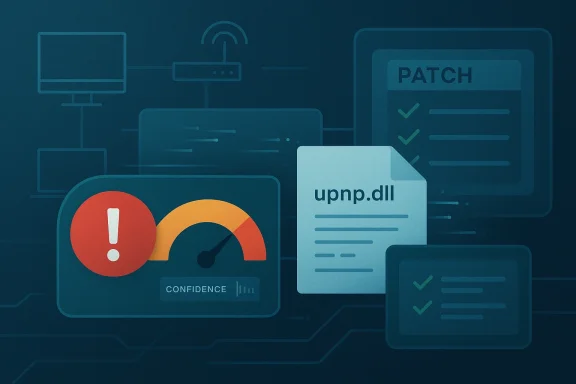 Why confidence is part of the story
The confidence metric is not an academic flourish. It is Microsoft’s way of telling defenders whether the issue is well-established, partially corroborated, or still emergince. That can be the difference between “watch this” and “patch this now,” especially when the vulnerability lives in a shared system component like upnp.dll and the public technical narrative has not yet caught up.For defenders, the practical implication is straightforward: the less public detail there is, the more valuable Microsoft’s own confidence signal becomes. In a world where security teams already face patch backlogs, asset sprawl, and limited staff time, any vendor-provided clue about certainty helps prioritize the queue. That is particularly true for Windows components that may be disabled on some systems but quietly active on others through vendor customization or legacy configuration.
Overview
CVE-2026-32214 fits into a broader pattern of Windows advisories where the headline severity does not fully capture the operational meaning of the fix. An information disclosure issue in a network-exposed subsystem may not sound as urgent as remote t can still be a high-value problem if it helps an attacker infer memory layout, session data, or system internals. In practice, these bugs are often chained with other vulnerabilities, and that is one reason they deserve more attention than their “info leak” label suggests.The most important contextual clue is the component itself. UPnP is a discovery and control framework that was designed for convenience, not for minimal exposure, and Microsoft’s historical bulletins show that security issues in the service can have meaningful impact even when they do not immediately lead to code execution. That history raises the baseline seriousness of any new UPnP-related advisory, particularly when the affected file is a core Windows DLL rather than a peripheral add-on.
There is also a subtle but important enterprise angle. Many organizations think of UPnP as a home-network concern, but Windows components often travel from consumer contexts into managed fleets through OEM builds, legacy images, and convenience fea fully retired. A vulnerability in upnp.dll therefore has a wider potential footprint than some administrators may initially assume, especially in mixed estates where configuration drift is common. That is one of the reasons Microsoft’s confidence-bearing guidance deserves attention even before the full technical write-up lands.
From a security operations perspective, advisories like this also expose a recurring problem: the public record often lags the vendor’s internal certainty. Microsoft may already have enough evidence to publish a CVE and update guidance, while third-party databases and community analysis are still waiting for full enrichment. That timing mismatch is normal, but it means defenders should not treat sparse public detail as a sign of low risk.
Why sparse technical detail i risk
A bare advisory can be misleading if readers equate “not much published yet” with “not much going on.” In reality, many Windows CVEs are initially described in restrained language because Microsoft is balancing disclosure, patch readiness, and ongoing coordination. The result is that the most important operational clue may be the fact that the CVE exists at all, combined with the confidence signal attached to it.That is especially true for information disclosure bugs, which can be easy to underestimate because they do not always break service immediately. Yet memory leaks, object leaks, or state leaks are often the enablers for later exploitation, and they can also reveal details that help attackers bypass modern defenses. For patch teams, that means the right question is not “Does this crash the machine?” but “What does this leak make easier afterward?” ([msrc.microsoft.com](Microsoft Security Response Center Blog--
What the advisory is really telling defenders
At first glance, CVE-2026-32214 looks like a straightforward Windows security bulletin: a named component, a disclosure class, and a patched product family. But the real signal lies in how Microsoft frames the issue. The company is telling customers that the vulnerability is not speculative, that the known technical details have enough credibility to publish, and that the issue belongs in the patch queue as a confirmed security problem rather than an abstract concern.That distinction matters because defenders must constantly decide what deserves immediate action, what can wait for maintenance windows, and what should be monitored for exploit development. Microsoft’s newer advisory model helps by adding metadata that goes beyond a raw CVE title. The confidence metric is meant to reduce ambiguity, and in a disclosure issue that ambiguity would otherwise be scrosoft.com]
Confidence as a triage tool
A confidence score or confidence description does not replace technical analysis, but it changes the default operational posture. If Microsoft says the vulnerability is real and the technical understanding is credible, then the burden shifts to defenders to assume the issue is actionable even when the public write-up is incomplete. That is a rational response in a patch ecosystem where waiting for perfect details often means waiting too long.It also helps explain why these advisories matter to enterprise teams that do not have in-house reverse engineers. Most t going to reconstruct the bug from first principles; they need enough metadata to decide whether to prioritize an update across thousands of endpoints. Microsoft’s confidence language is effectively a shorthand for “we have enough evidence that you should treat this as real.”
The practical takeaway is that vulnerability management is not only about severity labels like important or critical. It is also about how much trust you can place in the existence of the flaw itself. CVE-2026-32214 seems designed to push that judgment toward action rather than hesitation.
Why UPnP keeps coming back
UPnP is one of those Windows technologies that never entirely disappears from security discussions because it solves a real problem while creating an enduring attack surface. Devices and services that discover each other automatically must parse input, manage state, and expose capabilities, and every one of those functions can fail in ways that matter to an attacker. Microsoft’s historical bulletins show the same theme over and over: the service is useful, but it is also a recurring source of risk.The interesting part is that the attack class changes over time while the component remains relevant. In earlier years, Microsoft documented code execution and memory corruption problems in UPnP. Now the public framing for CVE-2026-32214 is information disclosure. That evolution suggests that the security issues are not just repetitive; they are adaptive, shifting with the state of the platform and the threat landscape.
From code execution to information disclosure
The security impact of a disclosure bug depends heavily on context. If the leak reveals predictablinternal structures, it may help an attacker defeat exploit mitigations such as ASLR or strengthen a chained attack. If it exposes session data or system metadata, it can also help with lateral movement or privilege escalation planning. That is why a disclosure advisory in a sensitive service should not be dismissed as minor.UPnP-related flaws are also important because they sit in a part of the Windows stack that tends to be underappreciated during inventory work. Administrators often track browsers, Office, and obvious server workloads, but they may not keep detailed visibility into services that are present by default, installed by OEMs, or enabled through legacy configurations. That creal exposure remains hidden until an advisory like CVE-2026-32214 forces a review.
The broader implication is that “legacy” does not mean “irrelevant.” Some of the longest-lived Windows security exposures are in utility services that keep getting reused, repackaged, or quietly maintained because they still serve a purpose. UPnP is one of those components, and that is why it deserves ongoing scrutiny.
The enterprise impact
For enterprise defenders, the main issue with CVE-2026-32214 is not whether every workstation has visible UPnP activity. It is whether the organization has enough control over Windows baselines to know where the component is present and how it behaves. On a managed fleet, a vulnerability in upnp.dll can become a fleet-wide hygi if images, OEM defaults, or inherited settings have left the service active in places that were never documented.That makes this advisory a classic example of why vulnerability management is partly an asset-inventory problem. The patch itself may be simple, but the challenge is finding every system that needs it, proving that the update landed, and verifying that the build is actually remediated. Windows environments that mix modern management with older machines, specialized hardware, or fragmented software controls often struggle with exactly that kind of visibility.
What enterprises sho
The first concern is exposure mapping. If the organization cannot tell where UPnP is running or how the relevant Windows component is configured, then it cannot accurately scope the risk. That is especially dangerous when the advisory is a disclosure issue, because teams may incorrectly assume that lack of obvious symptoms equals lack of exposure.The second concern is chained exploitation. Information disclosure issues often become force multipliers for other weaknesses, which means they can raise the success rate of adjacent attacks even if they are not independently catastrophic. In practical terms, a leak can make a later intrusion more reliable, more persistent, and harder to detect.
The third concern is patch velocity. Microsoft can publish guidance quickly, but large organizations still need change windows, regression testing, and compliance checks. That lag is one reason confidence-bearing advisories matter: they help teams justify moving the fix up the queue before evidence of exploitation becomes public.
- Inventory all Windows systems where UPnP or related discovery services are present.
- Confirm whether upnp.dll is affected on your exact build set.
- Prioritize internet-adjacent or high-value endpoints first.
- Validate patch deployment, not just patch approval.
- Review adjacent detection rules for disclosure-to-exploit chaining.
- Document whether OEM images or legacy templates re-enable the service later.
- Treat the advisory as actionable even if public exploit detail remains sparse.
The consumer impact
Consumer systems are less likely to be run with formal change management, which means the pron automatic updating and baseline Windows hygiene. That is good news and bad news at the same time. Good, because modern Windows is much better at delivering security fixes; bad, because consumers often underestimate the value of disclosure vulnerabilities and delay reboots or updates until they become inconvenient.For home users, UPnP is also one of those technologies that tends to be invisible until something breaks or a device stops discovering another device correctly. That invisibility can create complacency. A security issue in a background service rarely feels urgent to a user, but the service’s quiet presence is exactly what makes it dangerous when it leaks information in the wrong context.
Consumer risk in plain language
A disclosure vulnerability is not always dramatic, but it can still help an attacker learn things about your system that should stay private. That may include internal memory contents, service state, or clues that make a later exploit easier. For the average user, the safest assumption is that thehan the headline phrasing suggests.The best consumer defense is still the least glamorous: stay current, allow updates to install, and do not postpone security maintenance indefinitely. Microsoft’s advisory structure is telling you that the bug is credible enough to patch, and that is the signal most households need.
How Microsoft’s confidence model changes the conversation
Microsoft’s confidence-oriented advisory model is one of the more useful evolutions in modern Windows security communication. Instead of forcing customers to infer certainty from severity labels alone, the company provides an additional cue about how solidcture is. Microsoft has described this system publicly as part of a broader effort to make vulnerability descriptions more informative and actionable.That matters because not all CVEs arrive with the same level of supporting detail. Sometimes a vendor knows enough to issue a patch and assign a CVE before the public has a full exploit narrative. Sometimes the reverse is true: researchers may have partial evidence, but the vendor has not yet published a deeply technical explanation. Confidence metadata helps bridge that gap and gives defenders a better basis for prioritization.
Why this is useful in a patch cycle
In the real world, patch teams make decisions under time pressure. They are balancing outage risk, business uptime, user impact, and the possibility that delaying a fix creates a more expensive problem later. Confidence metadata helps them judge which advisories can be safely deferred and which are likely to become urgent.That is especially valuable for disclosure bugs, where the exploit path may be indirect but the intelligence value of the leak is high. A leak that is not immediately weaponized can still be a stepping stone to a later attack chain, and confidence metadata gives defenders a reason to treat the issue as strategically important even if it is not flashy.
Comparing this with prior UPnP issues
UPnP has a long, uneven security record, and the historical record is the best lens through which to interpret CVE-2026-32214. Microsoft’s eathat the same service has been associated with invalid request handling, memory leaks, and remote code execution. That consistency suggests the component sits on a fragile boundary between convenience and secure parsing.The comparison also highlights an important trend: the security industry has learned to treat disclosure issues as meaningful because they often appear in the same families as more severe flaws. The fact that UPnP has previously been associated with both instability and code execution makes a disclosure advisory in the same space more interesting, not less. It implies an ecosystem where adjacent weaknesses may coexist.
What the history suggests
The history suggests that administrators should not assume a single patched bug resolves the whole class of risk. Legacy network-discovery code tends to accumulate edge cases, especially in components that have survived multiple platform generations. Even when Microsoft’s current advisory is narrowly scoped, the underlying lesson is that the component family deserves careful attention.It also suggests that disclosure and exploitation often travel together in practice. Attackers value leaks because they reduce uncertainty, and security researchers value them because they expose where the parser or state machine is weakest. That makes CVE-2026-32214 relevant not just as a standalone patch item, but as a clue about where future security work may be needed.
Strengths and Opportunities
The strongest aspect of Microsoft’s handling of CVE-2026-32214 is that it gives defenders a real signal even when the public technical detail is limited. That lets organizations prioritize based on vendor certainty instead of waiting for a postmortem that may arrive later, and in security operations, that is often the difference between timely remediation and avoidable exposure.- Confidence metadata helps teams judge certainty, not just severity.
- The advisory is tied to a well-known Windows component with a real security history.
- Information disclosure issues are often useful as exploit enablers, so fixing them can reduce downstream risk.
- Microsoft’s guidance framework is more actionable than a bare CVE title.
- Enterprises can fold the issue into existing Windows patch cycles without special tooling.
- Consumer systems benefit from standard Windows Update hygiene.
- The advisory may prompt broader review of legacy network-discovery services.
Risks and Concerns
The main danger with CVE-2026-32214 is underestimation. Information disclosure can sound softer than code execution, and that framing can lull administrators into treating the issue as optional or low priority when the real impact may emerge in a later attack chain. The second danger is blind trust in sparse public data; when details are thin, some teams delay action instead of reading Microsoft’s confidence signal correctly.- Teams may treat a leak as less urgent than it really is.
- Hidden or OEM-enabled UPnP configurations may go unnoticed.
- Patch validation may be incomplete in fragmented Windows estates.
- Disclosure could aid chaining with unrelated local or remote flaws.
- Security tools may not clearly surface where upnp.dll is active.
- Legacy images and templates can reintroduce the issue later.
- Delays in third-party enrichment may create false reassurance.
Looking Ahead
The next thing to watch is whether Microsoft expands the advisory with more technical detail, including scope, affected versions, or exploitability context. That would help clarify whether the issue is primarily a local disclosure concern, a network-reachable leak, or something that becomes more dangerous when paired with other bugs. Until then, the safest reading is that Microsoft believes the vulnerability is credible and worth immediate defensive attention.It will also be worth watching how quickly enterprise patch teams absorb the update and whether any follow-on research reveals a stronger chaining story. Historically, disclosure bugs in Windows subsystems do not remain isolated for long; researchers often find that a leak in one component makes another weakness easier to weaponize. That is why the advisory should be viewed as part of a larger Windows hardening pattern, not a one-off fix.
- Confirm patch deployment across all Windows builds in your environment.
- Validate whether UPnP is present or active where you did not expect it.
- Watch for any Microsoft update to the confidence or exploitability language.
- Monitor security research for chaining scenarios involving upnp.dll.
- Reassess legacy templates and OEM images that may preserve the exposure.
Source: MSRC Security Update Guide - Microsoft Security Response Center
