

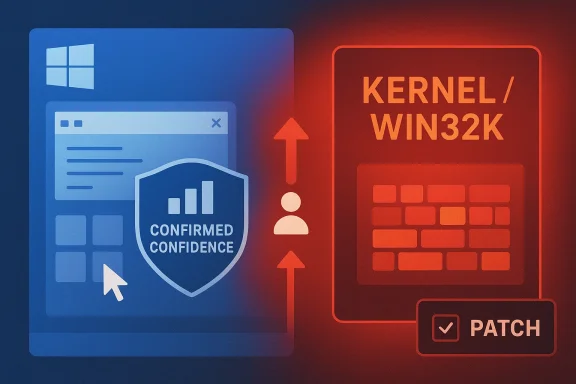
Microsoft has assigned CVE-2026-33104 to a Win32k Elevation of Privilege Vulnerability, a class of Windows kernel issue that security teams treat with particular seriousness because it can potentially turn a low-privileged local foothold into full system control. The public-facing description on Microsoft’s Security Update Guide emphasizes the confidence metric behind the vulnerability entry rather than detailed exploit mechanics, which usually means the vendor is signaling that the flaw is real and technically credible even if the full root cause is not yet public. That matters because certainty changes how defenders should prioritize patching, hunting, and exposure reduction. It also tells attackers that Microsoft has already moved far enough to publish a formal CVE, which is often the first step in the disclosure-to-remediation cycle.
Win32k has been one of the most heavily scrutinized parts of Windows for years because it sits at the junction of graphics, user interaction, and kernel privilege. In practical terms, it mediates a huge amount of desktop behavior, which makes it both essential and risky: any mistake in how it validates memory, objects, or callbacks can become a privilege escalation path. Microsoft has historically dealt with many Win32k bugs that stem from unsafe object handling, weak validation, or use-after-free conditions, and the company has repeatedly noted that such flaws can permit a standard user to run code in Supervisor mode or otherwise seize elevated rights.
That history is important because Win32k vulnerabilities are not a theoretical class; they are a recurring security pattern. Microsoft’s own guidance over the years has described cases where Win32k incorrectly handled objects in memory, failed to validate data after user-mode callbacks, or otherwise exposed kernel memory corruption conditions that could be converted into elevation of privilege. The recurring theme is simple: if an attacker can interact with a locally reachable kernel surface, they may not need remote access at all to become admin or SYSTEM.
Microsoft’s modern disclosure framework also matters here. The company has been expanding the amount of vulnerability information it shares through the Security Update Guide, and it has publicly discussed a broader move toward transparency through CSAF machine-readable advisories and the continued publication of CVEs even when customer action may be limited or the technical story is still evolving. In other words, the presence of a CVE is not just a label; it is part of Microsoft’s operational signal to defenders that a validated security issue exists and should be tracked.
CVE-2026-33104 should therefore be read against that backdrop. A Win32k elevation-of-privilege entry on Microsoft’s advisory portal usually means the issue is expected to affect Windows systems in a way that is relevant to patch management, endpoint hardening, and local attack-path reduction. Even when Microsoft withholds the exact exploit primitive, the category itself is enough to justify attention, because Win32k bugs are frequently chained after an initial compromise to move from user context to kernel-level control. That is where the danger often lies: not in initial infection, but in the rapid consolidation of power after entry.
For administrators, the practical consequence is that a confirmed Win32k EoP vulnerability belongs in the same operational bucket as other kernel-level local privilege escalation issues: patch it quickly, reduce local access, and assume the bug may be useful in a chain. Historically, Win32k weaknesses have often been attractive to attackers because once code is already running on a target, a local escalation can bypass a large amount of EDR friction, credential restrictions, and user-level containment. This is one reason such bugs remain relevant even when they are not remotely exploitable.
That pattern is why defenders should not dismiss a Win32k CVE as “just another Windows bug.” A local privilege escalation in this subsystem can be the final step in a multi-stage intrusion where the attacker first lands through phishing, macro abuse, browser exploitation, or a supply-chain compromise. Once the attacker has a user shell, a kernel bug can turn a limited incident into a full machine takeover. That escalation is often the difference between containment and catastrophe.
Patch orchestration will matter more than raw urgency headlines. If the vulnerable code is present across multiple Windows editions, enterprises need to map affected assets, check servicing baselines, and verify which machines actually receive the update through normal channels. Microsoft’s update ecosystem has improved over the years, but Windows environments still differ widely in lifecycle status, feature set, and patch cadence. That means the real work is not downloading the patch; it is making sure it reaches the right estate.
Consumers also tend to underestimate how privilege escalation fits into malware behavior. A lot of modern threats do not need to be clever at the first step if they can be persistent and patient later. A user opens a malicious document, runs a fake installer, or clicks through a misleading prompt, and the malware then looks for a kernel weakness to finish the job. The exploit chain is often less dramatic than the outcome.
For security professionals, this matters because it changes the speed and shape of response. Better metadata means vulnerability management tools can ingest and correlate data faster, while analysts can spend less time scraping manual pages and more time making judgment calls. In an environment where attackers move fast, even small gains in advisory clarity can reduce exposure windows.
What has changed over time is the attacker ecosystem. Years ago, many Win32k bugs were largely interesting to researchers and niche exploit writers. Today, local privilege escalations are more likely to be folded into commodity malware, ransomware tradecraft, and post-exploitation frameworks. The business value of a reliable EoP exploit is high because it improves stealth, persistence, and impact.
There is also an indirect competitive signal. Vendors that offer endpoint protection or vulnerability management can differentiate themselves by how quickly they ingest Microsoft advisories, prioritize risk, and help customers move from awareness to action. A bug like this rewards organizations with strong automation and penalizes those still relying on manual review. That is a quiet but real market pressure.
Security teams should also watch for ecosystem follow-through. When a Win32k bug becomes public, EDR vendors, vulnerability scanners, and managed service providers usually update their guidance quickly. The speed and quality of that follow-up will tell us how seriously the market is treating the issue, and whether Microsoft’s confidence signal is being translated into real-world action.
CVE-2026-33104 is therefore less a one-off event than another reminder that the last mile of Windows compromise often begins with a local kernel flaw. The safest assumption is that this issue is real, operationally relevant, and worth immediate attention even before every technical detail is public. In security, certainty is valuable, but so is the discipline to act before certainty becomes a postmortem.
Source: MSRC Security Update Guide - Microsoft Security Response Center
 Background
Win32k has been one of the most heavily scrutinized parts of Windows for years because it sits at the junction of graphics, user interaction, and kernel privilege. In practical terms, it mediates a huge amount of desktop behavior, which makes it both essential and risky: any mistake in how it validates memory, objects, or callbacks can become a privilege escalation path. Microsoft has historically dealt with many Win32k bugs that stem from unsafe object handling, weak validation, or use-after-free conditions, and the company has repeatedly noted that such flaws can permit a standard user to run code in Supervisor mode or otherwise seize elevated rights.That history is important because Win32k vulnerabilities are not a theoretical class; they are a recurring security pattern. Microsoft’s own guidance over the years has described cases where Win32k incorrectly handled objects in memory, failed to validate data after user-mode callbacks, or otherwise exposed kernel memory corruption conditions that could be converted into elevation of privilege. The recurring theme is simple: if an attacker can interact with a locally reachable kernel surface, they may not need remote access at all to become admin or SYSTEM.
Microsoft’s modern disclosure framework also matters here. The company has been expanding the amount of vulnerability information it shares through the Security Update Guide, and it has publicly discussed a broader move toward transparency through CSAF machine-readable advisories and the continued publication of CVEs even when customer action may be limited or the technical story is still evolving. In other words, the presence of a CVE is not just a label; it is part of Microsoft’s operational signal to defenders that a validated security issue exists and should be tracked.
CVE-2026-33104 should therefore be read against that backdrop. A Win32k elevation-of-privilege entry on Microsoft’s advisory portal usually means the issue is expected to affect Windows systems in a way that is relevant to patch management, endpoint hardening, and local attack-path reduction. Even when Microsoft withholds the exact exploit primitive, the category itself is enough to justify attention, because Win32k bugs are frequently chained after an initial compromise to move from user context to kernel-level control. That is where the danger often lies: not in initial infection, but in the rapid consolidation of power after entry.
Overview
The key phrase in the CVE description is Microsoft’s confidence metric language. That metric is not a CVSS score, and it is not a statement about severity in the narrow scoring sense; instead, it reflects how certain Microsoft is that a vulnerability exists and how much technical detail is currently known or corroborated. A higher-confidence designation implies that the vendor has enough evidence to treat the flaw as real, even if the details are not fully public. That distinction matters because defenders often need to decide whether to treat something as speculative research, a confirmed bug, or an actively exploitable path.For administrators, the practical consequence is that a confirmed Win32k EoP vulnerability belongs in the same operational bucket as other kernel-level local privilege escalation issues: patch it quickly, reduce local access, and assume the bug may be useful in a chain. Historically, Win32k weaknesses have often been attractive to attackers because once code is already running on a target, a local escalation can bypass a large amount of EDR friction, credential restrictions, and user-level containment. This is one reason such bugs remain relevant even when they are not remotely exploitable.
Why the confidence metric matters
A confidence metric is useful because it distinguishes between “we suspect a problem” and “we know enough to warn you.” In the vulnerability-management world, that difference influences everything from emergency change windows to compensating controls. When Microsoft publicly tags a bug with a formal CVE and a meaningful confidence indication, defenders should assume the risk is concrete enough to merit action, even if exploit proof is not yet public. In practice, this can shave days or weeks off the response timeline.Win32k is a high-value target
Win32k sits close to the Windows kernel and supports a wide range of desktop operations, so it has a broad attack surface. That breadth gives it utility for normal system behavior, but it also creates more opportunities for security bugs, especially around object lifetimes, callback transitions, and state validation. Microsoft has repeatedly described old Win32k issues as arising from exactly those design pressures, and that pattern helps explain why new EoP bugs in the subsystem are never treated casually.What Microsoft usually does next
When a Win32k issue is disclosed, Microsoft typically follows the standard patch-and-document model: fix the flaw, update the Security Update Guide, and ship revision notes through the broader update ecosystem. Microsoft’s newer advisory workflow also means the ecosystem around the CVE can include more structured machine-readable data, which is helpful for enterprise automation and compliance tooling. That trend is part of a larger effort to make vulnerability response less manual and more scalable.The Win32k EoP Pattern
Win32k elevation-of-privilege bugs tend to share a family resemblance even when the exact root cause differs. Microsoft has publicly discussed classes involving insufficient locking, dangling pointers after callbacks, and invalidated objects that kernel code later trusts. Those are classic ingredients for memory corruption, token theft, or arbitrary kernel write scenarios, any of which can lead to higher privileges.That pattern is why defenders should not dismiss a Win32k CVE as “just another Windows bug.” A local privilege escalation in this subsystem can be the final step in a multi-stage intrusion where the attacker first lands through phishing, macro abuse, browser exploitation, or a supply-chain compromise. Once the attacker has a user shell, a kernel bug can turn a limited incident into a full machine takeover. That escalation is often the difference between containment and catastrophe.
Common root-cause themes
Historically, Microsoft has pointed to a few repeated themes in Win32k vulnerabilities:- Insufficient validation of kernel objects after user-mode callbacks.
- Use-after-free conditions where an object is destroyed but later reused by kernel code.
- Memory corruption pathways that can become arbitrary code execution in ring 0.
- Token or object manipulation that ultimately grants SYSTEM-level control.
Why local does not mean low risk
A local bug is still a serious bug when it sits at the end of an intrusion chain. In enterprise environments, the attacker does not need to start with admin access if they can first obtain a standard user session. Once inside, local EoP vulnerabilities can bypass many hardening assumptions, especially on endpoints where users have too many rights or where lateral movement tools are already present. That is why local bugs often show up in breach writeups even when initial compromise came from somewhere else.How defenders should interpret “elevation of privilege”
“Elevation of privilege” sounds abstract, but it usually means one thing operationally: the attacker can do more than their assigned account should allow. In Windows, that may mean escaping AppContainer, moving from a standard user to admin, or reaching SYSTEM. Once an attacker hits that level, they can tamper with security tools, dump credentials, alter persistence, and interfere with forensic visibility. The jump in capability is disproportionate to the amount of code required.What This Means for Enterprises
For enterprise teams, CVE-2026-33104 should be treated as a patch-priority signal even before every technical detail is public. The reason is not only the subsystem involved, but the fact that privilege-escalation issues in Win32k are often used after an initial foothold, which means they can accelerate the speed and severity of incident response. Security operations teams should think of this as a chance to close a likely attack path rather than a theoretical one.Patch orchestration will matter more than raw urgency headlines. If the vulnerable code is present across multiple Windows editions, enterprises need to map affected assets, check servicing baselines, and verify which machines actually receive the update through normal channels. Microsoft’s update ecosystem has improved over the years, but Windows environments still differ widely in lifecycle status, feature set, and patch cadence. That means the real work is not downloading the patch; it is making sure it reaches the right estate.
Endpoint hardening still pays off
Defensive controls remain valuable because kernel bugs are most dangerous when paired with broad local access. Least privilege, application control, attack surface reduction, and strict administrative separation all reduce the blast radius if an attacker lands on the box. These controls do not replace patching, but they can make exploitation materially harder and post-exploitation less rewarding.Inventory and exposure management
Enterprise exposure to a Win32k flaw is not uniform. Systems that are internet-facing, used for privileged administration, or heavily exposed to untrusted file and script workflows tend to deserve faster attention. The same is true for kiosks, shared workstations, and high-value endpoints where a local breakout would be especially damaging. Security teams should prioritize based on business criticality and likely attacker pathways, not just on the presence of Windows itself.Practical response steps
- Identify affected Windows builds in the estate and map them against Microsoft’s security guidance.
- Patch in priority order, starting with high-risk endpoints and administrative workstations.
- Review local admin rights and remove unnecessary privileges where possible.
- Monitor for privilege-escalation telemetry and suspicious kernel-adjacent exploitation behavior.
- Verify patch deployment through compliance tooling rather than assuming success.
Consumer Impact
For home users, a Win32k EoP vulnerability is less about enterprise intrusion chains and more about post-compromise damage. If malware already lands on a PC, a local privilege escalation can help it disable security software, steal browser sessions, install persistence, and hide more effectively. That makes a seemingly “local only” bug very relevant to ordinary Windows users, especially those who reuse passwords or run with elevated rights more often than they realize.Consumers also tend to underestimate how privilege escalation fits into malware behavior. A lot of modern threats do not need to be clever at the first step if they can be persistent and patient later. A user opens a malicious document, runs a fake installer, or clicks through a misleading prompt, and the malware then looks for a kernel weakness to finish the job. The exploit chain is often less dramatic than the outcome.
Why ordinary users should care
Even though the bug is not described as remote code execution, the ability to escalate locally can make ransomware, info-stealers, and botnet components much harder to remove. It can also make the machine a more durable launch point for lateral movement if the system is on a home office network with shared resources. That is why local Windows EoP vulnerabilities continue to matter outside the enterprise.Simple consumer guidance
- Install Windows updates promptly.
- Keep a standard account for daily use where possible.
- Avoid running untrusted software or cracked installers.
- Treat prompts for admin elevation as security events, not just annoyances.
- Keep third-party security tools and browser protections current.
Microsoft’s Disclosure Strategy
Microsoft’s broader CVE policy has changed noticeably over the last few years, with a strong push toward transparency, machine-readable advisories, and clearer publication of vulnerabilities that may not require customer-side action in the traditional sense. The company has explained that CSAF files complement, rather than replace, the Security Update Guide and CVRF-based data channels. That is a sign of a maturing disclosure model, not a cosmetic change.For security professionals, this matters because it changes the speed and shape of response. Better metadata means vulnerability management tools can ingest and correlate data faster, while analysts can spend less time scraping manual pages and more time making judgment calls. In an environment where attackers move fast, even small gains in advisory clarity can reduce exposure windows.
Why transparency helps defenders
More transparent advisory data improves triage. It also makes it easier to connect individual CVEs to broader trends, such as recurring bug classes in Win32k or clusters of local escalation issues in a monthly patch cycle. That kind of context helps CISOs and admins decide whether to treat a patch as routine maintenance or as an urgent operational event. Good metadata is a force multiplier.Why vendors still withhold details
At the same time, withholding technical detail early in the disclosure cycle is standard and sensible. Too much information too soon can speed weaponization, especially for kernel bugs where exploitability may hinge on relatively subtle memory-management behavior. Microsoft’s approach is a familiar balancing act: alert defenders without handing attackers a ready-made blueprint.What this says about Microsoft’s priorities
Microsoft has clearly decided that publishing CVEs promptly and with richer machine-readable context is worth the operational cost. That is consistent with the company’s recent security messaging around cloud-service CVEs and CSAF publications. The result is a disclosure model that aims to support both human decision-making and automated remediation at scale.Historical Significance of Win32k Bugs
Win32k vulnerabilities have long represented a core Windows security challenge, and Microsoft’s old bulletin history shows that the subsystem has been a frequent source of elevation-of-privilege fixes. The repetition is not surprising: any kernel component that handles complex user interaction and graphics state has a large, difficult-to-audit attack surface. That makes the subsystem a natural place for both researchers and criminals to look for leverage.What has changed over time is the attacker ecosystem. Years ago, many Win32k bugs were largely interesting to researchers and niche exploit writers. Today, local privilege escalations are more likely to be folded into commodity malware, ransomware tradecraft, and post-exploitation frameworks. The business value of a reliable EoP exploit is high because it improves stealth, persistence, and impact.
From research novelty to operational commodity
A Win32k bug used to be the kind of issue you read about in conference talks. Now it is more often a practical tradecraft component, especially in campaigns that seek to dominate a machine after the first compromise. That shift has made kernel vulnerabilities more relevant to blue teams that might otherwise have focused mainly on browser, email, or identity weaknesses.Why the subsystem keeps coming back
The answer is complexity. Win32k must handle legacy behavior, rich UI functionality, and many compatibility edge cases, all of which increase the chance of subtle logic errors. Legacy compatibility is a blessing for customers, but it also preserves old attack surface in ways that are difficult to eliminate entirely.What this means for long-term security
The long-term lesson is that Windows kernel hardening is an ongoing process, not a one-time cleanup. Microsoft can reduce bug classes, improve validation, and harden interfaces, but as long as the subsystem exists in its current role, security teams should expect periodic Win32k EoP disclosures. The right response is to build operational muscle around them, not to assume they will stop.Competitive and Broader Market Implications
Security incidents like CVE-2026-33104 also have a market effect, even if they are not directly tied to a new product feature. Windows remains the dominant endpoint platform in many organizations, so a kernel privilege-escalation issue has a broad downstream impact on patch management vendors, EDR providers, MDR services, and compliance platforms. When Microsoft publishes a high-confidence Win32k CVE, the ecosystem around it starts updating dashboards, detections, and guidance almost immediately.There is also an indirect competitive signal. Vendors that offer endpoint protection or vulnerability management can differentiate themselves by how quickly they ingest Microsoft advisories, prioritize risk, and help customers move from awareness to action. A bug like this rewards organizations with strong automation and penalizes those still relying on manual review. That is a quiet but real market pressure.
The role of response automation
The move toward CSAF and richer CVE data is not just about transparency; it is about enabling machine-assisted response. As enterprises accumulate thousands of endpoints and dozens of software streams, human-only patch triage becomes too slow to keep up. Microsoft’s advisory ecosystem is slowly reflecting that reality by offering data in forms that are easier to consume programmatically.Why this matters to security vendors
Security vendors can build more accurate detection and prioritization logic when they understand the vulnerability class, product scope, and likely exposure pattern. A Win32k EoP issue is not the same as a remote browser flaw, and a good platform should reflect that in its scoring and remediation workflow. In that sense, Microsoft’s disclosure quality influences the entire security market around Windows.Broader lessons for platform security
The broader lesson is that platform security is now as much about response architecture as about code quality. A vendor can reduce vulnerability volume, but it also needs to make sure customers can consume advisories quickly and act on them with confidence. Microsoft’s recent advisory improvements suggest it understands that the delivery layer matters almost as much as the bug fix itself.Strengths and Opportunities
Microsoft’s handling of CVE-2026-33104 appears to fit a more mature disclosure and remediation model, and that creates several strengths for defenders and the wider ecosystem. The main opportunity is to use the advisory not just as a patch notice, but as a trigger for deeper local-privilege hardening and endpoint hygiene.- Clear categorization as a Win32k elevation-of-privilege issue helps defenders understand the likely attack path.
- High-confidence disclosure gives security teams a stronger basis for urgent triage.
- Machine-readable advisory trends can improve automated vulnerability management.
- Win32k history provides useful context for threat hunting and control tuning.
- Patch prioritization can be aligned to high-risk endpoints first.
- Least-privilege enforcement becomes more compelling when the bug class is local escalation.
- EDR rules can be tuned to watch for suspicious kernel-adjacent post-compromise behavior.
Risks and Concerns
The main concern is that Win32k vulnerabilities often become most dangerous after an attacker already has a foothold. That means organizations can mistakenly underestimate the issue if they focus only on whether the flaw is remote or publicly weaponized. Another concern is that kernel privilege escalation can undermine the value of many endpoint controls if patching is delayed.- Local foothold chaining makes the vulnerability highly relevant after initial compromise.
- Delayed patching can leave a large enterprise exposed longer than expected.
- Legacy systems may be harder to update or validate quickly.
- Overly broad admin rights increase the payoff of exploitation.
- Detection gaps may miss post-exploitation privilege escalation.
- Operational fatigue can cause security teams to down-rank “local only” bugs too aggressively.
- Inconsistent baselines across Windows versions can complicate validation.
Looking Ahead
The next thing to watch is Microsoft’s own update guidance. If the company adds more detail to CVE-2026-33104, the security community will be able to better assess whether the flaw resembles a use-after-free, validation failure, or another classic Win32k primitive. If a patch lands across multiple supported Windows branches, organizations should assume the issue is broadly relevant and not a niche edge case.Security teams should also watch for ecosystem follow-through. When a Win32k bug becomes public, EDR vendors, vulnerability scanners, and managed service providers usually update their guidance quickly. The speed and quality of that follow-up will tell us how seriously the market is treating the issue, and whether Microsoft’s confidence signal is being translated into real-world action.
What to monitor next
- Updated Microsoft advisory details for CVE-2026-33104.
- Any revised servicing or patch guidance from Microsoft.
- Detection content from EDR and MDR vendors.
- Patch validation across Windows editions and build numbers.
- Signs of exploit chaining in threat intelligence reporting.
CVE-2026-33104 is therefore less a one-off event than another reminder that the last mile of Windows compromise often begins with a local kernel flaw. The safest assumption is that this issue is real, operationally relevant, and worth immediate attention even before every technical detail is public. In security, certainty is valuable, but so is the discipline to act before certainty becomes a postmortem.
Source: MSRC Security Update Guide - Microsoft Security Response Center
Last edited:
