

CVE-2026-33672 is a medium-severity vulnerability in the JavaScript glob-matching library Picomatch, disclosed in late March 2026 and tracked by Microsoft’s Security Update Guide, that can let crafted POSIX character-class patterns produce incorrect filename matches in affected application logic. The bug is not a remote-code-execution headline grabber, and that is precisely why it deserves attention. It sits in the quiet layer where build systems, developer tools, file upload filters, test runners, bundlers, and policy engines decide what a pattern is allowed to touch. When that layer lies, the blast radius depends less on the library than on the assumptions wrapped around it.
The first thing to understand about CVE-2026-33672 is that this is not a Windows kernel flaw, not an Exchange emergency, and not a browser sandbox escape. Picomatch is an npm package: a compact, widely reused JavaScript library for matching file paths against glob patterns. If you have lived in the Node.js ecosystem for more than a week, you have almost certainly depended on this kind of code indirectly.
That makes Microsoft’s appearance in the story easy to misread. The MSRC listing does not turn Picomatch into a Microsoft product, nor does it mean every Windows installation is exposed in the way a monthly cumulative update might imply. It means Microsoft’s vulnerability ecosystem now routinely surfaces flaws in the open-source components that underpin modern software development and enterprise tooling.
That shift matters for WindowsForum readers because the Windows estate is no longer just Windows. A typical corporate desktop fleet now includes Node-based development tools, Electron apps, CI/CD agents, code scanners, package managers, IDE extensions, local build caches, and cloud-connected management utilities. Many of those components do not ship through Windows Update, yet they run on Windows machines and influence what code is built, tested, published, excluded, uploaded, or denied.
CVE-2026-33672 is therefore a supply-chain vulnerability in the practical sense, even if it is not a catastrophic one. It asks administrators and developers to look past the CVSS score and examine where glob matching has been promoted from convenience feature to security boundary.
CVE-2026-33672 lives in that last corner. A specially crafted POSIX bracket expression, such as one that references inherited JavaScript object properties, can interfere with how Picomatch builds the regular expression it ultimately uses for matching. The issue affects the internal
That sounds like a language-lawyer detail, and in one sense it is. JavaScript’s prototype chain has long been a fertile source of security bugs because objects are not always just dictionaries; they may also inherit names and behavior from their prototypes. If code treats such an object as a closed table of safe values, it can be surprised by properties it did not explicitly define.
The practical result here is not code execution. The advisory record is clear that the bug can cause incorrect glob matching, with an integrity impact rather than confidentiality or availability compromise. But integrity bugs in selection logic are underrated because they can be the first domino in systems that use pattern matches to decide what is safe, forbidden, included, or ignored.
Security teams, however, do not patch scorecards. They patch systems. A medium-severity library bug that affects a dead-end internal script is background noise; the same bug inside a file-filtering service that accepts user-provided patterns becomes a control failure.
The distinction is whether untrusted users can supply glob patterns. If the only people writing patterns are developers editing checked-in configuration files, the risk is mostly limited to local mistakes or malicious commits that would already imply a deeper trust failure. If customers, tenants, plugin authors, build jobs, web users, or API clients can submit patterns, the calculation changes.
Glob patterns often feel harmless because they are not SQL, shell commands, or JavaScript source code. But a pattern language is still a language. When an application grants it authority over file inclusion, exclusion, validation, or access control, it becomes part of the application’s security model whether anyone wrote that down or not.
A modern npm application may contain more than one version of the same package because different transitive dependencies pin different ranges. Updating the top-level dependency is not always enough. You may need to refresh lockfiles, audit nested dependency paths, and inspect whether older Picomatch versions remain buried under tooling that has not yet been bumped.
This is why the remediation advice is simple but the operational work is not. “Upgrade Picomatch” is the right answer, but it hides the plumbing: package manager behavior, semver ranges, lockfile churn, vendor lag, bundled distributions, and the awkward reality that some enterprise tools ship their own frozen Node modules.
For Windows administrators, that last point is important. The vulnerable code may not appear in a place that looks like a developer workstation. It may be inside a packaged desktop application, a scanner appliance, a self-hosted automation runner, or a build tool installed under Program Files. npm vulnerabilities do not always stay inside the folder named
Consider an application that lets users define file allowlists. If a malformed POSIX class causes a pattern to match unintended filenames, a user may be able to include files that should have remained excluded. In a backup or sync product, that might mean accidental data movement. In a publishing pipeline, it might mean sensitive files enter an artifact. In an access-control wrapper, it could mean a boundary is softer than intended.
The inverse is also possible. If a pattern intended to catch risky filenames fails to match them, the system may skip validation or scanning. Security tools often rely on include and exclude patterns to control scope; incorrect matching can create blind spots that look like configuration choices rather than software defects.
That is why the “no RCE” caveat should comfort but not sedate anyone. Many serious incidents begin with a non-executable logic error that alters the set of things a later stage processes. Security is often a pipeline, and a file-selection bug can be the gate that lets the wrong object into the next room.
That helps contain the practical exploitability. A product that never enables POSIX-style glob behavior, or never accepts such patterns from users, is less exposed. The vulnerability is narrower than a general “all glob matching is broken” story.
But edge cases become security cases when developers expose advanced syntax without constraining it. A tool that proudly supports “full glob syntax” may inherit a larger attack surface than its UI suggests. A server-side API that accepts pattern filters may allow syntax its designers never expected customers to know.
There is also a cultural problem: developers often validate paths and commands more carefully than patterns. A path looks concrete and dangerous; a pattern looks abstract and user friendly. CVE-2026-33672 is a reminder that abstraction does not remove risk. It relocates it into the parser.
Windows systems now routinely run workloads whose assumptions were born elsewhere. PowerShell scripts call Node tools. Visual Studio Code extensions bring npm dependencies. Azure pipelines build Linux containers from Windows-hosted agents. Developers on Windows use cross-platform package managers whose dependency graphs are indifferent to the operating system printed on the laptop.
This means Windows administrators can no longer divide their world into “Microsoft patches” and “everything else.” The second category is often where application logic lives. Windows Update may keep the OS current while the project lockfile preserves a vulnerable parser indefinitely.
The practical ownership model is messy. Desktop engineering teams manage endpoints. Security teams run scanners. Developers own package manifests. Platform teams maintain CI images. Procurement owns vendor software. A vulnerability like CVE-2026-33672 slips across those lines because it is small enough that everyone can assume someone else will handle it.
That simplicity is good news. There is no elaborate migration required for most consumers, no architectural rewrite, and no emergency key rotation. The task is dependency hygiene: update, test, rebuild, redeploy.
But dependency hygiene is where many organizations are weakest. They know how to respond to a vendor patch with an MSI. They are less consistent when the fix is a transitive npm package three layers below a tool nobody thinks of as production software. The result is a patch gap that exists not because the fix is hard, but because ownership is unclear.
For developers, the right test is not merely whether the application still builds. Any code path that relies on glob patterns for security-relevant behavior should have tests for adversarial patterns. That includes odd bracket expressions, unsupported classes, nested glob features, and input that should be rejected outright rather than interpreted generously.
This is a place where security and product design align. Many applications expose glob syntax because developers find it convenient, not because users require every corner of the grammar. A small allowlisted subset — literal prefixes,
The temptation is to “sanitize” strings with a quick regular expression. That may be acceptable as a temporary control, but it is fragile if the application’s parser and the sanitizer do not understand the same language. The safer long-term approach is to define the allowed grammar explicitly and reject everything else.
For sysadmins evaluating vendor products, the question is not “do you use Picomatch?” Vendors may not know offhand, especially if it is transitive. The better question is whether the product accepts user-defined glob patterns and, if so, whether those patterns cross a trust boundary. That framing turns a package advisory into an operational risk discussion.
The hard half is prioritization. A scanner can tell you that Picomatch 2.3.1 exists somewhere in a repository. It cannot reliably tell you whether untrusted patterns reach it, whether POSIX classes are enabled, whether the output controls access to sensitive files, or whether a compensating validation layer exists upstream.
This is where security teams often get trapped between false urgency and false dismissal. Treating every medium npm advisory as a fire drill will burn out developers and bury the genuinely dangerous cases. Treating all medium advisories as routine backlog will miss the cases where a modest parser bug undermines a critical workflow.
The correct response is targeted triage. Find affected versions, then ask what the dependency does in context. Is it part of a build-only tool? A web-facing service? A plugin ecosystem? A customer-configurable automation platform? A file upload pipeline? The same CVE can be nearly irrelevant in one repository and highly relevant in another.
Microsoft’s security documentation has become a broader index of vulnerabilities that may affect Microsoft products, developer ecosystems, cloud workloads, or customer environments. That broader coverage is useful, but it also demands more interpretation from administrators. A CVE appearing under Microsoft’s umbrella is not always a Microsoft-authored code flaw, and remediation may live entirely outside Microsoft’s patch channels.
For WindowsForum’s audience, the lesson is that the Microsoft security feed has become a starting point, not the whole workflow. The next steps may involve npm, GitHub advisories, package-lock files, vendor support tickets, container rebuilds, and CI image refreshes. The Windows admin still has a role, but it is increasingly a coordinating role across software supply chains.
This also explains the dry legal disclaimer attached to the Knowledge Base material. The “as is” language is boilerplate, but it reflects a practical truth: vulnerability metadata is not a substitute for environment-specific validation. Microsoft can identify and describe the issue; it cannot know where every organization has embedded Picomatch or whether a given pattern parser is exposed to untrusted users.
This has been known for years, yet it continues to appear because JavaScript makes the unsafe path convenient. A plain object is easy to write, easy to read, and perfectly fine until untrusted strings become keys. At that point, the object’s prototype can become part of the input surface.
The fix pattern is equally old: use
What makes Picomatch interesting is not that the mistake is unprecedented. It is that a small lookup-table assumption in a low-level utility can propagate into thousands of applications that never consciously chose that risk. Open source gives developers enormous leverage. It also gives small implementation details enormous reach.
A malicious or simply malformed pattern that changes a file set can alter what is shipped. It might include generated files that should not be published, skip tests that should have run, or package files outside an intended boundary. In many organizations, those outcomes would not trigger a security alarm because they look like build variance rather than intrusion.
This is why “developer tooling” is no longer a safe synonym for “low risk.” CI/CD systems hold credentials, sign artifacts, publish packages, and deploy infrastructure. A glob parser in that environment may sit closer to production authority than a web server endpoint with a neatly documented threat model.
Enterprises should therefore treat pattern-matching libraries as part of the trusted computing base for their build pipelines. Not every such bug deserves a sev-one response, but every such bug deserves to be mapped against the pipeline stages where correctness is security.
The useful response begins with inventory. Find Picomatch in direct and transitive dependencies, including development tools and packaged applications where possible. Pay particular attention to services that accept pattern input from users, tenants, plugins, repositories, or automation jobs.
Next comes dependency updating. For actively maintained projects, refreshing to the patched release line should be routine. For pinned or abandoned dependencies, teams may need overrides, resolutions, vendor updates, or a temporary fork. Where the affected code lives in third-party software, the answer may be a support case rather than a pull request.
Finally, review the design. If user-supplied glob patterns are accepted, decide whether they should be. If they must be accepted, constrain the grammar and test rejection paths. A narrow pattern language that fails closed is better than a generous parser surrounded by hopeful comments.
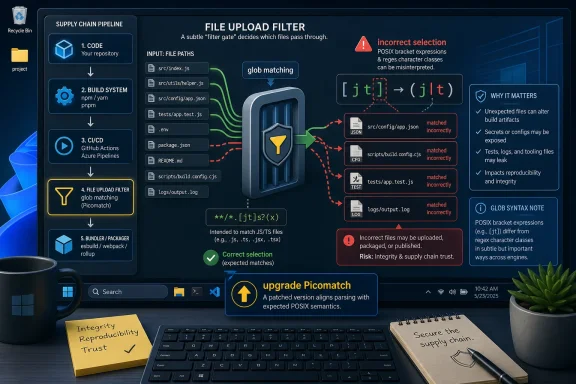 A Small Parser Bug Lands in Microsoft’s Bigger Supply-Chain Ledger
The first thing to understand about CVE-2026-33672 is that this is not a Windows kernel flaw, not an Exchange emergency, and not a browser sandbox escape. Picomatch is an npm package: a compact, widely reused JavaScript library for matching file paths against glob patterns. If you have lived in the Node.js ecosystem for more than a week, you have almost certainly depended on this kind of code indirectly.That makes Microsoft’s appearance in the story easy to misread. The MSRC listing does not turn Picomatch into a Microsoft product, nor does it mean every Windows installation is exposed in the way a monthly cumulative update might imply. It means Microsoft’s vulnerability ecosystem now routinely surfaces flaws in the open-source components that underpin modern software development and enterprise tooling.
That shift matters for WindowsForum readers because the Windows estate is no longer just Windows. A typical corporate desktop fleet now includes Node-based development tools, Electron apps, CI/CD agents, code scanners, package managers, IDE extensions, local build caches, and cloud-connected management utilities. Many of those components do not ship through Windows Update, yet they run on Windows machines and influence what code is built, tested, published, excluded, uploaded, or denied.
CVE-2026-33672 is therefore a supply-chain vulnerability in the practical sense, even if it is not a catastrophic one. It asks administrators and developers to look past the CVSS score and examine where glob matching has been promoted from convenience feature to security boundary.
The Vulnerability Is About Trusting a Pattern Too Much
Picomatch exists to answer a deceptively simple question: does this file path match this pattern? A pattern like*.js should match JavaScript files. A pattern like src/**/*.test.js should match test files beneath a source tree. A pattern using POSIX-style character classes can express more specialized matching behavior inside bracket expressions.CVE-2026-33672 lives in that last corner. A specially crafted POSIX bracket expression, such as one that references inherited JavaScript object properties, can interfere with how Picomatch builds the regular expression it ultimately uses for matching. The issue affects the internal
POSIX_REGEX_SOURCE object, which inherited from Object.prototype, allowing names such as constructor to be reached in a context where only known POSIX classes should have been considered.That sounds like a language-lawyer detail, and in one sense it is. JavaScript’s prototype chain has long been a fertile source of security bugs because objects are not always just dictionaries; they may also inherit names and behavior from their prototypes. If code treats such an object as a closed table of safe values, it can be surprised by properties it did not explicitly define.
The practical result here is not code execution. The advisory record is clear that the bug can cause incorrect glob matching, with an integrity impact rather than confidentiality or availability compromise. But integrity bugs in selection logic are underrated because they can be the first domino in systems that use pattern matches to decide what is safe, forbidden, included, or ignored.
“Medium” Does Not Mean “Irrelevant”
The vulnerability carries a CVSS 3.1 score of 5.3, which places it in the medium range. That score makes sense in isolation: network attack vector, low attack complexity, no privileges required, no user interaction, unchanged scope, no confidentiality impact, low integrity impact, and no availability impact. It is the profile of a bug that can be triggered easily but whose immediate consequence is narrow.Security teams, however, do not patch scorecards. They patch systems. A medium-severity library bug that affects a dead-end internal script is background noise; the same bug inside a file-filtering service that accepts user-provided patterns becomes a control failure.
The distinction is whether untrusted users can supply glob patterns. If the only people writing patterns are developers editing checked-in configuration files, the risk is mostly limited to local mistakes or malicious commits that would already imply a deeper trust failure. If customers, tenants, plugin authors, build jobs, web users, or API clients can submit patterns, the calculation changes.
Glob patterns often feel harmless because they are not SQL, shell commands, or JavaScript source code. But a pattern language is still a language. When an application grants it authority over file inclusion, exclusion, validation, or access control, it becomes part of the application’s security model whether anyone wrote that down or not.
The Affected Versions Tell a Familiar npm Story
The fixed Picomatch releases are 2.3.2, 3.0.2, and 4.0.4. Versions before 2.3.2 are affected, as are 3.0.0 through versions before 3.0.2 and 4.0.0 through versions before 4.0.4. The multiple patched lines reflect a reality that enterprise JavaScript teams know well: dependency trees rarely move in a single clean line.A modern npm application may contain more than one version of the same package because different transitive dependencies pin different ranges. Updating the top-level dependency is not always enough. You may need to refresh lockfiles, audit nested dependency paths, and inspect whether older Picomatch versions remain buried under tooling that has not yet been bumped.
This is why the remediation advice is simple but the operational work is not. “Upgrade Picomatch” is the right answer, but it hides the plumbing: package manager behavior, semver ranges, lockfile churn, vendor lag, bundled distributions, and the awkward reality that some enterprise tools ship their own frozen Node modules.
For Windows administrators, that last point is important. The vulnerable code may not appear in a place that looks like a developer workstation. It may be inside a packaged desktop application, a scanner appliance, a self-hosted automation runner, or a build tool installed under Program Files. npm vulnerabilities do not always stay inside the folder named
node_modules.The Real Risk Is Not Matching Too Much — It Is Trusting the Match
The advisory’s phrase “incorrect glob matching” sounds almost quaint, as if the worst outcome is a messy file list. In security terms, the more interesting question is what the application does after the match. Does it delete the file, publish it, expose it, scan it, ignore it, upload it, compile it, lint it, or allow access to it?Consider an application that lets users define file allowlists. If a malformed POSIX class causes a pattern to match unintended filenames, a user may be able to include files that should have remained excluded. In a backup or sync product, that might mean accidental data movement. In a publishing pipeline, it might mean sensitive files enter an artifact. In an access-control wrapper, it could mean a boundary is softer than intended.
The inverse is also possible. If a pattern intended to catch risky filenames fails to match them, the system may skip validation or scanning. Security tools often rely on include and exclude patterns to control scope; incorrect matching can create blind spots that look like configuration choices rather than software defects.
That is why the “no RCE” caveat should comfort but not sedate anyone. Many serious incidents begin with a non-executable logic error that alters the set of things a later stage processes. Security is often a pipeline, and a file-selection bug can be the gate that lets the wrong object into the next room.
POSIX Classes Are an Edge Case Until They Are User Input
POSIX bracket expressions are not the most common thing casual users type into a web form. Most people know*, maybe **, and perhaps ?. Character classes like [[:alpha:]] belong to the older grammar of Unix tooling and regular-expression culture.That helps contain the practical exploitability. A product that never enables POSIX-style glob behavior, or never accepts such patterns from users, is less exposed. The vulnerability is narrower than a general “all glob matching is broken” story.
But edge cases become security cases when developers expose advanced syntax without constraining it. A tool that proudly supports “full glob syntax” may inherit a larger attack surface than its UI suggests. A server-side API that accepts pattern filters may allow syntax its designers never expected customers to know.
There is also a cultural problem: developers often validate paths and commands more carefully than patterns. A path looks concrete and dangerous; a pattern looks abstract and user friendly. CVE-2026-33672 is a reminder that abstraction does not remove risk. It relocates it into the parser.
Windows Shops Meet a Unix-Flavored Bug Through JavaScript
There is a mild irony here. POSIX character classes come from a Unix tradition, Picomatch is a JavaScript library, and the alert may surface for many readers through Microsoft’s vulnerability channels. That is the modern Windows environment in miniature.Windows systems now routinely run workloads whose assumptions were born elsewhere. PowerShell scripts call Node tools. Visual Studio Code extensions bring npm dependencies. Azure pipelines build Linux containers from Windows-hosted agents. Developers on Windows use cross-platform package managers whose dependency graphs are indifferent to the operating system printed on the laptop.
This means Windows administrators can no longer divide their world into “Microsoft patches” and “everything else.” The second category is often where application logic lives. Windows Update may keep the OS current while the project lockfile preserves a vulnerable parser indefinitely.
The practical ownership model is messy. Desktop engineering teams manage endpoints. Security teams run scanners. Developers own package manifests. Platform teams maintain CI images. Procurement owns vendor software. A vulnerability like CVE-2026-33672 slips across those lines because it is small enough that everyone can assume someone else will handle it.
The Fix Is Boring, Which Is Exactly How It Should Be
The recommended fix is to move to a patched Picomatch release: 2.3.2, 3.0.2, 4.0.4, or later within the appropriate major line. The underlying code-level repair is conceptually straightforward: do not let the POSIX character-class lookup inherit arbitrary properties fromObject.prototype. In JavaScript terms, this is the difference between a plain object used casually and a deliberately constrained lookup table.That simplicity is good news. There is no elaborate migration required for most consumers, no architectural rewrite, and no emergency key rotation. The task is dependency hygiene: update, test, rebuild, redeploy.
But dependency hygiene is where many organizations are weakest. They know how to respond to a vendor patch with an MSI. They are less consistent when the fix is a transitive npm package three layers below a tool nobody thinks of as production software. The result is a patch gap that exists not because the fix is hard, but because ownership is unclear.
For developers, the right test is not merely whether the application still builds. Any code path that relies on glob patterns for security-relevant behavior should have tests for adversarial patterns. That includes odd bracket expressions, unsupported classes, nested glob features, and input that should be rejected outright rather than interpreted generously.
Mitigation Means Reducing the Grammar, Not Just Filtering Strings
If upgrading immediately is not possible, the published mitigation advice points in a sensible direction: avoid passing untrusted glob patterns to Picomatch, reject or sanitize patterns containing POSIX character classes, avoid POSIX bracket expressions where user input is involved, or manually patch the lookup object to use a null prototype. The deeper principle is even simpler: do not offer users a richer pattern language than the application actually needs.This is a place where security and product design align. Many applications expose glob syntax because developers find it convenient, not because users require every corner of the grammar. A small allowlisted subset — literal prefixes,
* within a filename, maybe ** under controlled conditions — is often enough.The temptation is to “sanitize” strings with a quick regular expression. That may be acceptable as a temporary control, but it is fragile if the application’s parser and the sanitizer do not understand the same language. The safer long-term approach is to define the allowed grammar explicitly and reject everything else.
For sysadmins evaluating vendor products, the question is not “do you use Picomatch?” Vendors may not know offhand, especially if it is transitive. The better question is whether the product accepts user-defined glob patterns and, if so, whether those patterns cross a trust boundary. That framing turns a package advisory into an operational risk discussion.
Dependency Scanners Will Find the Package; They Will Not Find the Business Logic
Software composition analysis tools should flag vulnerable Picomatch versions quickly. GitHub Dependabot, npm audit-style workflows, SBOM scanners, and enterprise vulnerability platforms are all designed to catch this class of package issue. That is the easy half.The hard half is prioritization. A scanner can tell you that Picomatch 2.3.1 exists somewhere in a repository. It cannot reliably tell you whether untrusted patterns reach it, whether POSIX classes are enabled, whether the output controls access to sensitive files, or whether a compensating validation layer exists upstream.
This is where security teams often get trapped between false urgency and false dismissal. Treating every medium npm advisory as a fire drill will burn out developers and bury the genuinely dangerous cases. Treating all medium advisories as routine backlog will miss the cases where a modest parser bug undermines a critical workflow.
The correct response is targeted triage. Find affected versions, then ask what the dependency does in context. Is it part of a build-only tool? A web-facing service? A plugin ecosystem? A customer-configurable automation platform? A file upload pipeline? The same CVE can be nearly irrelevant in one repository and highly relevant in another.
Microsoft’s Listing Is a Signal About the Ecosystem, Not a Patch Tuesday Event
Because the user-facing source here is Microsoft’s Security Update Guide, some readers will instinctively map the story onto Patch Tuesday. That would be a mistake. There is no reason to treat CVE-2026-33672 like a Windows cumulative update that will arrive through WSUS and settle the matter.Microsoft’s security documentation has become a broader index of vulnerabilities that may affect Microsoft products, developer ecosystems, cloud workloads, or customer environments. That broader coverage is useful, but it also demands more interpretation from administrators. A CVE appearing under Microsoft’s umbrella is not always a Microsoft-authored code flaw, and remediation may live entirely outside Microsoft’s patch channels.
For WindowsForum’s audience, the lesson is that the Microsoft security feed has become a starting point, not the whole workflow. The next steps may involve npm, GitHub advisories, package-lock files, vendor support tickets, container rebuilds, and CI image refreshes. The Windows admin still has a role, but it is increasingly a coordinating role across software supply chains.
This also explains the dry legal disclaimer attached to the Knowledge Base material. The “as is” language is boilerplate, but it reflects a practical truth: vulnerability metadata is not a substitute for environment-specific validation. Microsoft can identify and describe the issue; it cannot know where every organization has embedded Picomatch or whether a given pattern parser is exposed to untrusted users.
The Prototype Chain Keeps Taxing JavaScript Security
CVE-2026-33672 belongs to a long family of JavaScript bugs rooted in the prototype model. The specific label attached here is CWE-1321, associated with improperly controlled modification of object prototype attributes, though this case is about inherited object behavior polluting a lookup path rather than an attacker necessarily rewriting global prototypes. The common pattern is the same: treating JavaScript objects as simple maps without fully accounting for inherited names.This has been known for years, yet it continues to appear because JavaScript makes the unsafe path convenient. A plain object is easy to write, easy to read, and perfectly fine until untrusted strings become keys. At that point, the object’s prototype can become part of the input surface.
The fix pattern is equally old: use
Object.create(null) for dictionary-like structures, use Map where appropriate, check own properties deliberately, and avoid implicit coercion in security-sensitive paths. None of these techniques are exotic. They are the defensive seatbelts of JavaScript parser code.What makes Picomatch interesting is not that the mistake is unprecedented. It is that a small lookup-table assumption in a low-level utility can propagate into thousands of applications that never consciously chose that risk. Open source gives developers enormous leverage. It also gives small implementation details enormous reach.
Build Systems Are Security Systems Now
The most important audience for this advisory may be build and platform teams. Glob matching is everywhere in build systems: deciding which files to compile, which tests to run, which artifacts to publish, which source files to exclude, and which directories to scan. Those choices shape the integrity of software long before it reaches production.A malicious or simply malformed pattern that changes a file set can alter what is shipped. It might include generated files that should not be published, skip tests that should have run, or package files outside an intended boundary. In many organizations, those outcomes would not trigger a security alarm because they look like build variance rather than intrusion.
This is why “developer tooling” is no longer a safe synonym for “low risk.” CI/CD systems hold credentials, sign artifacts, publish packages, and deploy infrastructure. A glob parser in that environment may sit closer to production authority than a web server endpoint with a neatly documented threat model.
Enterprises should therefore treat pattern-matching libraries as part of the trusted computing base for their build pipelines. Not every such bug deserves a sev-one response, but every such bug deserves to be mapped against the pipeline stages where correctness is security.
The Practical Response Is Smaller Than the Anxiety
There is no need to panic over CVE-2026-33672. There is no public basis to describe it as an active mass-exploitation event, and the vulnerability does not grant remote code execution by itself. The fix exists, the affected version ranges are clear, and the riskiest condition — untrusted glob patterns — is something teams can reason about.The useful response begins with inventory. Find Picomatch in direct and transitive dependencies, including development tools and packaged applications where possible. Pay particular attention to services that accept pattern input from users, tenants, plugins, repositories, or automation jobs.
Next comes dependency updating. For actively maintained projects, refreshing to the patched release line should be routine. For pinned or abandoned dependencies, teams may need overrides, resolutions, vendor updates, or a temporary fork. Where the affected code lives in third-party software, the answer may be a support case rather than a pull request.
Finally, review the design. If user-supplied glob patterns are accepted, decide whether they should be. If they must be accepted, constrain the grammar and test rejection paths. A narrow pattern language that fails closed is better than a generous parser surrounded by hopeful comments.
The Picomatch Fix Should Push Teams to Audit Pattern Power
The concrete response to CVE-2026-33672 is not complicated, but the lasting lesson is broader than one npm package.- Applications using Picomatch should move to version 2.3.2, 3.0.2, 4.0.4, or a later patched release on the appropriate major line.
- Teams should check transitive dependencies and lockfiles, because vulnerable Picomatch versions may remain after a superficial top-level package update.
- The highest-risk deployments are those where untrusted users can submit glob patterns that influence filtering, validation, access control, publishing, scanning, or artifact creation.
- Temporary mitigations should reject untrusted POSIX character-class syntax rather than trying to interpret every possible glob feature safely.
- Build, CI/CD, and developer-tooling environments deserve attention because glob matching often decides which files are tested, packaged, signed, or deployed.
- A medium CVSS score should not automatically determine priority; exposure and business logic decide whether this is routine maintenance or a meaningful control gap.
References
- Primary source: MSRC
Published: 2026-05-31T01:03:16-07:00
Security Update Guide - Microsoft Security Response Center
 msrc.microsoft.com
- Related coverage: advisories.gitlab.com
Picomatch: Method Injection in POSIX Character Classes causes incorrect Glob Matching | GitLab Advisory Database (GLAD)
CVE-2026-33672 Picomatch: Method Injection in POSIX Character Classes causes incorrect Glob Matching: picomatch is vulnerable to a method injection vulnerability (CWE-1321) affecting the POSIX_REGEX_SOURCE object. Because the object …advisories.gitlab.com - Related coverage: service.securitm.ru
CVE-2026-33672 - CVE уязвимости - SECURITM
Picomatch: Method Injection in POSIX Character Classes causes incorrect Glob Matchingservice.securitm.ru
- Related coverage: vulnerability.circl.lu
Vulnerability-Lookup
Vulnerability-Lookup - Fast vulnerability lookup correlation from different sources.vulnerability.circl.lu - Related coverage: thehackerwire.com
CVE-2026-33672 - Medium Vulnerability
CVE-2026-33672 is a Medium severity vulnerability (CVSS 5.3). Picomatch is a glob matcher written JavaScript. Versions prior to 4.0.4, 3.0.2, and 2.3.2 are vulnerable to a method injection...www.thehackerwire.com
- Related coverage: sentinelone.com
CVE-2026-33672: Picomatch Method Injection Vulnerability
CVE-2026-33672 is a method injection vulnerability in Picomatch. Learn about its impact, affected versions, and mitigation methods.www.sentinelone.com
- Related coverage: sra.io
- Related coverage: test.osv.dev

OSV - Open Source Vulnerabilities
Comprehensive vulnerability database for your open source projects and dependencies.
test.osv.dev
- Related coverage: osv.dev

OSV - Open Source Vulnerabilities
Comprehensive vulnerability database for your open source projects and dependencies.
osv.dev
- Related coverage: resolvedsecurity.com
- Related coverage: cms.gov
