

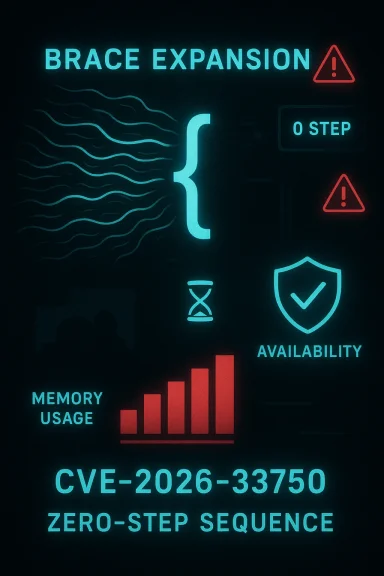
CVE-2026-33750 is a classic availability bug hiding inside a seemingly ordinary text-processing feature: brace expansion. Microsoft’s description points to a zero-step sequence path that can send the parser into a process hang and eventual memory exhaustion, which means the issue is not just a crash risk but a sustained denial of service scenario. In practical terms, the attacker does not need code execution to win; they only need to force the impacted component to consume time and memory until it becomes unusable. Microsoft’s own wording emphasizes that the result can be total loss of availability, which is why this CVE deserves to be treated as operationally serious rather than merely annoying.
Brace expansion is one of those features people rarely think about until it misbehaves. It is intended to make patterned string generation convenient, but convenience features are often where parser bugs thrive because they have to interpret compact syntax, generate sequences, and handle edge cases without ambiguity. In this case, the dangerous edge is the zero-step sequence condition, which is exactly the kind of invalid input that can turn a normal expansion routine into an unbounded resource consumer. The result is a bug class security teams know well: the system is not “compromised” in the traditional sense, but it is effectively taken offline.
Microsoft’s availability language matters because it clarifies how this vulnerability should be read in the real world. The advisory does not frame the flaw as a narrow performance hiccup or a transient failure that self-corrects immediately. Instead, it describes either a persistent condition or one that continues as long as the attacker keeps delivering the malicious input, which is a much more serious operational outcome. That distinction is important for administrators because it changes the response from “monitor it” to “patch it, validate exposure, and assume repeated abuse is possible.”
There is also a broader lesson here about parser security. Features that generate sequences, normalize inputs, or recursively expand patterns are disproportionately likely to contain corner cases that can spiral into excessive CPU use, runaway allocation, or hangs. When those routines live in shared libraries or widely reused components, a single flaw can ripple across multiple products and workflows. The blast radius is often much larger than the code size suggests.
This is especially relevant for enterprise environments where files, templates, scripts, or build artifacts may be processed automatically. A human user may only trigger brace expansion occasionally, but automated systems can hit the vulnerable path repeatedly and at scale. That turns a parser bug into a platform stability issue, and stability is security when the service is part of the trust chain.
The mention of a zero-step sequence is the technical clue that reveals the likely failure mode. A step value of zero is mathematically invalid for sequence generation, so any code path that fails to reject it early may end up looping, retrying, or allocating output structures without a terminating condition. In parser land, that kind of logic error is often enough to wedge a worker thread or inflate memory use until the process is no longer healthy.
The specific problem with a zero-step sequence is that it violates the assumptions the parser uses to make progress. A healthy sequence generator expects a nonzero increment so it can advance toward completion. If that assumption fails, the code can get trapped in a loop, repeatedly evaluating the same state or building output that never converges. That is where hangs and memory exhaustion become plausible outcomes.
Microsoft’s language suggests the attacker can either sustain the loss of availability by continuing the input stream or leave behind a persistent condition. That means defenders should think about both live abuse and post-attack cleanup. A process that has already exhausted memory may need a restart, and if the vulnerable path is reachable again immediately after restart, the system can get trapped in a repeat failure cycle.
The danger is greatest where automation is involved. Automated systems tend to process inputs without the kind of human skepticism that catches obvious abuse. That makes build farms, import pipelines, file scanners, and orchestration tools especially sensitive to parser defects that can be triggered by malformed expressions.
Developers are the most likely consumers to feel the pain because they tend to exercise edge cases more often. They unpack archives, inspect source drops, run scripts, and test malformed inputs in ways ordinary end users do not. In other words, they live closer to the boundary where parser bugs become visible.
The zero-step sequence condition is a good example of an error that seems obvious after the fact. Nobody intends to count by zero, but code can still accept it if validation is incomplete or if the parser assumes higher-level logic will sanitize the value. That is where the bug class lives: not in dramatic logic errors, but in tiny missing checks.
The larger organizational upside is that handling this CVE well can improve broader resilience. If teams use the disclosure as a reason to review parser boundaries, set better input limits, and monitor for resource spikes, they may catch similar issues before they become incidents. That is a worthwhile payoff from a bug that initially looks narrow.
A second risk is operational ambiguity. A process hang and memory exhaustion scenario can look like generic load problems, which may lead teams to chase false leads instead of recognizing malicious input as the trigger. The more distributed the environment, the harder that diagnosis becomes.
The second question is where brace expansion is exposed to untrusted input. If the vulnerable code sits behind a command-line utility, the risk profile is different than if it is used inside an automated service or shared platform component. That distinction will determine whether the issue is a local workflow nuisance or an enterprise-wide availability problem.
CVE-2026-33750 is a reminder that the most disruptive bugs are not always the ones that look dramatic on paper. A parser that cannot safely handle a nonsensical sequence step can still become a serious security problem if it hangs long enough, allocates enough memory, or is reachable from automated workflows. The lesson for defenders is straightforward: availability bugs are security bugs, and small input-validation mistakes can have large operational consequences.
Source: MSRC Security Update Guide - Microsoft Security Response Center
 Overview
Brace expansion is one of those features people rarely think about until it misbehaves. It is intended to make patterned string generation convenient, but convenience features are often where parser bugs thrive because they have to interpret compact syntax, generate sequences, and handle edge cases without ambiguity. In this case, the dangerous edge is the zero-step sequence condition, which is exactly the kind of invalid input that can turn a normal expansion routine into an unbounded resource consumer. The result is a bug class security teams know well: the system is not “compromised” in the traditional sense, but it is effectively taken offline.Microsoft’s availability language matters because it clarifies how this vulnerability should be read in the real world. The advisory does not frame the flaw as a narrow performance hiccup or a transient failure that self-corrects immediately. Instead, it describes either a persistent condition or one that continues as long as the attacker keeps delivering the malicious input, which is a much more serious operational outcome. That distinction is important for administrators because it changes the response from “monitor it” to “patch it, validate exposure, and assume repeated abuse is possible.”
There is also a broader lesson here about parser security. Features that generate sequences, normalize inputs, or recursively expand patterns are disproportionately likely to contain corner cases that can spiral into excessive CPU use, runaway allocation, or hangs. When those routines live in shared libraries or widely reused components, a single flaw can ripple across multiple products and workflows. The blast radius is often much larger than the code size suggests.
This is especially relevant for enterprise environments where files, templates, scripts, or build artifacts may be processed automatically. A human user may only trigger brace expansion occasionally, but automated systems can hit the vulnerable path repeatedly and at scale. That turns a parser bug into a platform stability issue, and stability is security when the service is part of the trust chain.
What Microsoft’s Description Tells Us
Microsoft’s wording is unusually useful here because it goes beyond a generic “denial of service” label and spells out the severity model. The advisory says the vulnerability can produce a total loss of availability or a serious partial loss of availability that still has a direct operational consequence. That phrasing tells defenders to think in terms of business interruption, not just process exits.The mention of a zero-step sequence is the technical clue that reveals the likely failure mode. A step value of zero is mathematically invalid for sequence generation, so any code path that fails to reject it early may end up looping, retrying, or allocating output structures without a terminating condition. In parser land, that kind of logic error is often enough to wedge a worker thread or inflate memory use until the process is no longer healthy.
Why the wording matters
Microsoft’s description also makes a subtle but important distinction: the attack need not permanently destroy the system to be serious. If the attacker can repeatedly force the component into a resource-starved state, the result is still a meaningful denial of service. That is why the advisory language focuses on sustained or persistent unavailability rather than only on a hard crash.- The issue is centered on availability, not confidentiality or integrity.
- The attacker’s goal is to deny access to resources, not to execute code.
- The impact can persist while the attack continues, which raises the stakes for exposed services.
- Even partial availability loss can be operationally severe if the component sits in a critical workflow.
Why Brace Expansion Is a High-Risk Parser Feature
Brace expansion looks harmless because it feels like a convenience syntax, not a security surface. But convenience syntax frequently hides nested logic: parsing delimiters, validating ranges, constructing output sets, and handling malformed input without generating absurd amounts of work. Every one of those steps creates an opportunity for a boundary bug.The specific problem with a zero-step sequence is that it violates the assumptions the parser uses to make progress. A healthy sequence generator expects a nonzero increment so it can advance toward completion. If that assumption fails, the code can get trapped in a loop, repeatedly evaluating the same state or building output that never converges. That is where hangs and memory exhaustion become plausible outcomes.
The parser problem in plain English
Think of brace expansion as a machine that turns a compact pattern into multiple strings. If the machine is told to count by zero, it cannot move forward in a meaningful way. A robust implementation should reject that input immediately, but a flawed one may try to “make sense” of it, and that is often how a harmless-looking edge case turns into a denial-of-service bug.- Sequence generation depends on valid arithmetic assumptions.
- Invalid increments can trap code in non-terminating logic.
- Recursive or iterative expansion can amplify small errors into large resource spikes.
- Parser bugs often surface only under crafted inputs, which is why they evade casual testing.
Availability Impact: Why This Is More Than a Crash
A crash is visible, but a hang is often worse because it can be harder to diagnose and recover from cleanly. If the component is blocked in a loop or chewing through memory, it may not fail fast; instead, it may degrade gradually until the service becomes unusable. That makes outage duration and troubleshooting time part of the threat model.Microsoft’s language suggests the attacker can either sustain the loss of availability by continuing the input stream or leave behind a persistent condition. That means defenders should think about both live abuse and post-attack cleanup. A process that has already exhausted memory may need a restart, and if the vulnerable path is reachable again immediately after restart, the system can get trapped in a repeat failure cycle.
Operational consequences
For an enterprise, the most important question is not whether the bug is “interesting,” but where it sits in the stack. If brace expansion is used in a developer tool, a build pipeline, a file-processing service, or a platform component, the failure can cascade beyond one process. Even a single stuck worker can delay jobs, back up queues, and cause retries that increase load elsewhere.- A hang can be harder to spot than a crash.
- Memory exhaustion can trigger broader system instability.
- Persistent unavailability can survive beyond the initial malicious request.
- Retries and failovers may amplify the original problem.
Enterprise Exposure: Where the Risk Is Highest
Enterprise exposure depends less on the feature name and more on how it is used. If brace expansion is embedded in a service that ingests untrusted or semi-trusted input, the vulnerability becomes a direct operational hazard. If the component is only used interactively by a developer, the reach is narrower, but the issue can still interrupt builds, inspections, or scripted workflows.The danger is greatest where automation is involved. Automated systems tend to process inputs without the kind of human skepticism that catches obvious abuse. That makes build farms, import pipelines, file scanners, and orchestration tools especially sensitive to parser defects that can be triggered by malformed expressions.
What to look for
Administrators should map where brace expansion or its equivalent is used, then ask a simple question: can an external party influence the input? If the answer is yes, the component deserves immediate attention. Even if the attacker cannot gain control of the system, the ability to exhaust resources can still be enough to cause a serious outage.- Build and CI/CD systems can magnify parser failures across many jobs.
- File-analysis tools may open untrusted content at scale.
- Automation services often retry failed tasks, compounding load.
- Shared libraries can spread the same flaw across multiple products.
Consumer and Developer Impact
For individual users, the immediate effect is likely to be annoyance and workflow disruption rather than major compromise. A tool that hangs or consumes too much memory can freeze a session, waste time, and reduce confidence in the software. That still matters, especially when the tool is used for work that has deadlines.Developers are the most likely consumers to feel the pain because they tend to exercise edge cases more often. They unpack archives, inspect source drops, run scripts, and test malformed inputs in ways ordinary end users do not. In other words, they live closer to the boundary where parser bugs become visible.
Developer workflow risks
A brace-expansion failure is particularly irritating because it can derail a seemingly unrelated task. A shell command, a test harness, or a script can appear to “just hang,” and the root cause may not be obvious until someone inspects memory use or traces the parser path. That uncertainty creates support overhead and slows diagnosis.- Malformed input can come from third-party packages or test corpora.
- A hang may appear as an ordinary tool slowdown at first.
- Memory pressure can affect adjacent applications on the same machine.
- Repeated failures can undermine trust in the toolchain.
Why This Kind of Bug Keeps Reappearing
Parser bugs are stubborn because they sit at the intersection of human-friendly syntax and machine-precise execution. Features like brace expansion are designed to be expressive, but every extra bit of expressiveness adds edge cases. Security testing can catch many of them, but it is hard to exhaust the space of malformed inputs that can arise in real-world usage.The zero-step sequence condition is a good example of an error that seems obvious after the fact. Nobody intends to count by zero, but code can still accept it if validation is incomplete or if the parser assumes higher-level logic will sanitize the value. That is where the bug class lives: not in dramatic logic errors, but in tiny missing checks.
The design lesson
The safest place to reject invalid input is at the boundary where it first enters the system. If the parser allows nonsensical parameters to progress into recursive expansion or allocation logic, the failure becomes harder to contain. Early rejection is not just cleaner code; it is a security control.- Validate numeric and sequence parameters as early as possible.
- Treat “impossible” values as hostile, not as harmless oddities.
- Keep expansion routines bounded in time and memory.
- Test pathological cases, not just ordinary syntax.
Strengths and Opportunities
The good news is that this appears to be a bug class with a straightforward remediation path. The problem is conceptually simple — a zero-step sequence should not be allowed — which usually means the fix can focus on validation and bounds enforcement rather than a sweeping redesign. For defenders, that makes prioritization easier because the issue is serious but likely contained.- The flaw is well-scoped to a specific parser behavior.
- The impact is easy to explain to stakeholders in business terms.
- A fix likely centers on rejecting invalid input early.
- The issue is a strong candidate for targeted inventory-based patching.
- Teams can use the incident to review related expansion and parsing paths.
The larger organizational upside is that handling this CVE well can improve broader resilience. If teams use the disclosure as a reason to review parser boundaries, set better input limits, and monitor for resource spikes, they may catch similar issues before they become incidents. That is a worthwhile payoff from a bug that initially looks narrow.
Risks and Concerns
The biggest concern is underestimation. Because the bug is framed as an availability issue rather than a code execution flaw, some teams may put it behind higher-profile items and leave exposed systems running vulnerable code longer than they should. That would be a mistake if the component sits in a critical workflow or automated service.A second risk is operational ambiguity. A process hang and memory exhaustion scenario can look like generic load problems, which may lead teams to chase false leads instead of recognizing malicious input as the trigger. The more distributed the environment, the harder that diagnosis becomes.
Why defenders should be cautious
If the vulnerable component is embedded in a service that accepts repeated requests, the attacker may not need a sophisticated strategy to keep the service degraded. That means rate limits, input filtering, and queue management matter, but they do not replace patching. The problem is fundamentally in the parser’s handling of invalid input.- The issue may be dismissed because it is “only” a denial of service.
- Repeated abuse can make the impact effectively persistent.
- Memory exhaustion can affect adjacent components and not just the target process.
- Debugging hangs is often slower than diagnosing clean crashes.
- Shared libraries can widen exposure beyond what the visible application inventory suggests.
What to Watch Next
The immediate question is whether downstream vendors and distributors have already backported fixes into their affected packages. In the real world, many teams never run the exact upstream version named in a disclosure, so the practical answer is often found in vendor advisories rather than in the original CVE record alone. If you are responsible for affected systems, the focus should be on whether the patch has landed in your own software stack, not merely on whether the CVE exists.The second question is where brace expansion is exposed to untrusted input. If the vulnerable code sits behind a command-line utility, the risk profile is different than if it is used inside an automated service or shared platform component. That distinction will determine whether the issue is a local workflow nuisance or an enterprise-wide availability problem.
Practical watch list
- Confirm whether your distribution or product vendor has issued a backported fix.
- Identify which workflows actually invoke brace expansion or equivalent parsing logic.
- Check whether untrusted input can reach the vulnerable path automatically.
- Review monitoring for hangs, memory growth, and retry storms.
- Revisit parser hardening and regression coverage around zero-value edge cases.
CVE-2026-33750 is a reminder that the most disruptive bugs are not always the ones that look dramatic on paper. A parser that cannot safely handle a nonsensical sequence step can still become a serious security problem if it hangs long enough, allocates enough memory, or is reachable from automated workflows. The lesson for defenders is straightforward: availability bugs are security bugs, and small input-validation mistakes can have large operational consequences.
Source: MSRC Security Update Guide - Microsoft Security Response Center
