

Microsoft disclosed CVE-2026-33828 on June 9, 2026, as a critical Windows Device Health Attestation elevation-of-privilege vulnerability that can let a locally authorized attacker cross a trust boundary and gain SYSTEM privileges on affected Windows clients and servers. The oddity is not the score, which lands at a familiar CVSS 7.8, but the component: Device Health Attestation sits in the machinery enterprises use to decide whether a device deserves trust. That makes this more than another local privilege escalation in the Patch Tuesday pile. It is a reminder that the systems built to measure endpoint health are themselves part of the attack surface.
Device Health Attestation, or DHA, is not a marquee Windows feature for most home users. It lives in the world of measured boot, device compliance, TPM-backed claims, and the administrative expectation that a Windows machine can prove something about its security posture before it receives access to corporate resources.
That is precisely why CVE-2026-33828 is uncomfortable. Microsoft’s description is terse: a trust boundary violation in Windows Attestation allows an authorized attacker to elevate privileges locally. In plain English, the flaw is not about breaking in from the internet; it is about a user or process already on the machine finding a way to become far more powerful than it should be.
The affected list is broad enough to matter across the installed base. Microsoft published updates for Windows 10, Windows 11, and supported Windows Server releases, including Server Core installations. The fixed builds span old enterprise workhorses such as Windows Server 2016 and Windows 10 version 1607 through newer Windows 11 and Windows Server 2025 branches.
That breadth changes the operational read. A niche component vulnerability can be ignored when it touches a narrow deployment pattern. A niche component vulnerability cannot be ignored when the patch matrix says it rides along with the supported Windows estate.
The most important part of that vector is not “local.” It is “low privileges” followed by “no user interaction.” Local privilege escalation bugs are often dismissed by executives because they do not start the intrusion. Administrators know better: modern compromises are chains, and the second or third link is frequently the one that turns a foothold into full control.
Here the prize is SYSTEM. Microsoft’s own FAQ states that successful exploitation could grant SYSTEM privileges, the Windows context that turns ordinary compromise into machine-level compromise. Once an attacker has that level of control, the distinction between “the user was compromised” and “the device was compromised” mostly evaporates.
The temporal metrics add nuance. Microsoft marked exploit code maturity as unproven, the remediation level as official fix, and report confidence as confirmed. That means Microsoft is not telling customers that exploitation is underway, but it is also not presenting this as a vague theoretical concern.
The reason is simple: local privilege escalation vulnerabilities are often most valuable after the first break-in. Phishing, stolen credentials, exposed remote access, malicious documents, and abused legitimate tools can all deliver an attacker into a low-privilege context. From there, a bug like this can supply the missing rung on the ladder.
There is also a difference between “no exploit observed” and “no one can write one.” The CVSS vector says low attack complexity and no user interaction. Microsoft’s report confidence is confirmed, and the weakness is categorized as CWE-501, a trust boundary violation. That does not hand attackers a working exploit, but it tells defenders that the bug has enough shape to be taken seriously.
Security teams sometimes overcorrect around exploitability labels. When everything is urgent, nothing is urgent; when a vendor says exploitation is unlikely, the temptation is to route the fix into the next convenient maintenance window. For internet-facing remote code execution bugs, that would be reckless. For a local privilege escalation in an attestation component, the right answer is more subtle: patch promptly, test carefully, and do not confuse calm with inaction.
That model is central to modern endpoint management. Conditional access and device compliance are not magic shields; they are decision engines consuming claims from hardware, firmware, operating system components, management agents, and cloud services. If those claims are wrong, stale, or manipulated, the access decision can be wrong too.
CVE-2026-33828 does not, based on Microsoft’s public language, say that attackers can forge health reports or bypass conditional access directly. The advisory instead describes elevation of privilege through a trust boundary violation in Windows Attestation. That distinction matters. We should not inflate the bug into a total collapse of device compliance.
But the component still matters. A flaw in an attestation-adjacent path carries symbolic and practical weight because attestation is supposed to reduce ambiguity. It exists to help administrators answer a hard question: is this device healthy enough to trust? A vulnerability in that machinery reminds us that trust signals are generated by code, and code has bugs.
For Windows 10 version 22H2, Microsoft lists build 10.0.19045.7417. For Windows 11 version 23H2, the listed fixed build is 10.0.22631.7219. Windows 11 version 24H2 is listed at 10.0.26100.8655, while Windows 11 version 25H2 is listed at 10.0.26200.8655 and Windows 11 version 26H1 at 10.0.28000.2269. On the server side, Windows Server 2022 is listed at 10.0.20348.5256 and Windows Server 2025 at 10.0.26100.32995.
Those numbers are not trivia for enterprises. They are the difference between “we deployed the June update” and “this specific vulnerability is remediated on this specific ring.” In a world of phased rollouts, safeguard holds, offline servers, golden images, and VDI pools, build numbers are the audit trail.
The table also underscores the lingering complexity of Windows fleet management. Windows 10 remains in the picture. Long-term and server editions remain in the picture. Newer Windows 11 branches are already in the picture. One vulnerability now becomes a coordination problem across hardware generations, servicing channels, business units, and maintenance windows.
SYSTEM privileges allow attackers to tamper with services, dump sensitive material, disable defenses, implant persistence, and move laterally with far fewer obstacles. Even when endpoint detection and response tooling remains active, SYSTEM-level execution complicates containment because the attacker can operate at the same layer as many defensive components.
That is why local privilege escalation bugs are perennial favorites in real intrusions. They do not need to be flashy. They need to be reliable enough to convert a compromised user session into administrative control. The lower the complexity and the less interaction required, the more attractive the bug becomes after a proof of concept appears or after skilled operators reproduce the path privately.
CVE-2026-33828 is not reported as exploited. Microsoft says exploitation is unlikely. But the advisory’s own mechanics still describe a dangerous shape: low-privilege attacker, local execution, no additional user interaction, high impact, official fix available. Defenders should read that as a patching task, not a curiosity.
That does not mean every technical detail is public. It means the vulnerability is not merely rumor, speculation, or a loosely described behavior waiting for validation. Microsoft, as the assigning CNA and vendor of the affected technology, has acknowledged the issue and shipped fixes.
That confirmation should change how administrators talk about risk. The responsible sentence is not “there is no public exploit, so this may not matter.” It is “there is no public exploit known at release, but the vendor has confirmed the bug and the fix is available.” That framing preserves the useful calm of the exploitability assessment without draining the advisory of its significance.
It also helps security teams defend patching decisions internally. When a maintenance window competes with uptime pressure, confirmed vendor vulnerabilities with SYSTEM impact deserve a stronger argument than speculative alerts from scanners. CVE-2026-33828 has that argument.
That is not an argument against DHA or device compliance. Quite the opposite: measured, policy-driven access is better than unmanaged trust. But the security community has learned the hard way that every enforcement plane becomes a target. Identity systems, update systems, endpoint agents, certificate infrastructure, and management channels all attract attention because they sit near power.
Windows Attestation belongs in that category. It is not glamorous, but it participates in decisions that shape access and trust. When Microsoft patches a trust boundary violation there, it is a reminder to include those less visible components in threat modeling.
For administrators, this means checking not only whether endpoints are compliant after patching, but whether the systems that report and consume compliance data are healthy. A fleet can look green in a dashboard while still containing machines that missed a cumulative update, failed a reboot, or remain pinned to an older build for compatibility reasons.
Still, home users should not ignore it. Consumer Windows machines are often attacked through bundles, cracked software, malicious installers, browser-delivered payloads, and stolen credentials. Once malware lands under a normal user account, elevation bugs are a route to deeper persistence.
The good news is that the remedy is ordinary: install the cumulative update through Windows Update and reboot. There is no special mitigation dance in Microsoft’s public advisory, no registry switch, and no workaround that should tempt users into improvising. The official fix is the path.
The bigger issue for home users is delayed rebooting. Windows can download an update and still leave the machine exposed until installation completes. For a vulnerability that can lead to SYSTEM privileges, “pending restart” is not an administrative detail; it is the gap between patched in theory and patched in reality.
The danger is when staged deployment becomes indefinite deployment. CVE-2026-33828 is the kind of vulnerability that can get trapped in the middle: not scary enough to trigger emergency patching, broad enough to affect nearly everything, and buried in a component that many stakeholders do not recognize by name. That is how local privilege escalation bugs persist long after the vendor has shipped the cure.
Security teams should therefore translate the advisory into operational language. Which Windows builds are below the fixed numbers? Which machines failed the June 2026 cumulative update? Which servers are excluded from automatic patching? Which images will continue producing vulnerable systems after today’s live fleet is remediated?
That last question is often missed. If the vulnerability is fixed on running machines but not in deployment media, VDI templates, lab images, recovery images, or server build pipelines, it can reappear quietly. Patch Tuesday is an event; vulnerability management is a lifecycle.
A local elevation vulnerability on a server has a different risk profile from the same bug on a laptop. Servers tend to host services, scheduled tasks, management agents, backup tools, and privileged operational workflows. A low-privilege foothold on a server can be more valuable than a similar foothold on an endpoint because the server may sit closer to credentials, data, or infrastructure dependencies.
That does not mean every Windows Server Core machine is at immediate risk from CVE-2026-33828. It means administrators should avoid assuming that reduced interface equals reduced urgency. The patch table says the affected component exists in those supported server builds, and the privilege outcome is severe.
For domain controllers, management servers, jump boxes, and systems that participate in device compliance infrastructure, the urgency rises further. Those machines sit near trust decisions. Anything that can move an attacker from low privilege to SYSTEM on them deserves prompt attention.
Then time passes. Researchers diff patches. Attackers study changed binaries. Proofs of concept appear. A bug that looked theoretical on release day becomes a reliable post-exploitation tool months later. This does not happen to every CVE, but it happens often enough that mature programs plan for it.
CVE-2026-33828 has several traits that make delayed complacency unwise. It is confirmed. It has an official fix. It affects many supported Windows versions. It can grant SYSTEM privileges. It requires low privileges and no user interaction. None of that proves it will be weaponized, but it gives defenders little reason to leave it outstanding.
This is where patch prioritization should be honest rather than theatrical. If an organization can deploy the June updates through normal accelerated rings, it should. If it cannot, it should know exactly why, document compensating controls, and track exceptions to closure. “Exploitation unlikely” should buy orderly execution, not amnesia.
The challenge is to make sure the dashboard reflects reality. Compliance policies should check OS build numbers, update installation status, and reboot completion. Endpoint detection should confirm that vulnerable builds are aging out. Vulnerability scanners should not merely report the CVE; they should map it to the exact Windows builds Microsoft lists as fixed.
Administrators should also be careful with exceptions. A machine exempted from patch policy because it runs a legacy application may also be a machine granted network access because it appears business critical. That is a dangerous combination. The more privileged or exempt a system is, the more aggressively its unpatched state should be reviewed.
This is also a good moment to test incident response assumptions. If an attacker gains SYSTEM through a local privilege escalation, what telemetry fires? Can the team distinguish normal service activity from post-exploitation behavior? Are credential stores protected well enough that SYSTEM on one endpoint does not become domain compromise?
For small businesses and home labs, the answer is straightforward: apply the June 2026 cumulative update and verify the reboot. For enterprises, the work is more procedural: validate patch rings, confirm build numbers, close exceptions, and update images. For security teams, the focus should be on the machines where local privilege escalation would create the most damage: servers, admin workstations, management hosts, and systems tied to identity or compliance infrastructure.
The most useful way to think about this CVE is as a trust-boundary bug in a trust-reporting world. Windows is no longer just an operating system on a desk; it is an endpoint in a policy fabric. Bugs in the fabric do not always announce themselves with remote shells and emergency banners. Sometimes they arrive as a quiet elevation-of-privilege entry with a long affected-products table and an official fix.
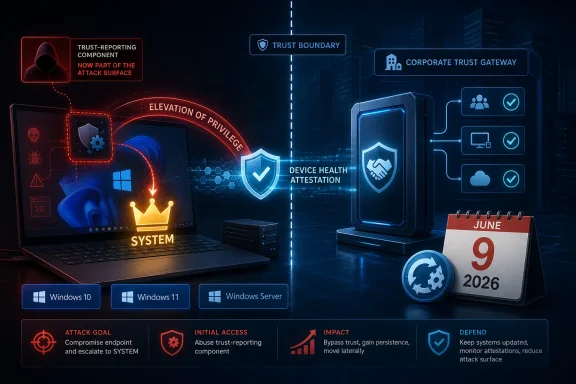 The Trust Signal Becomes the Attack Surface
Device Health Attestation, or DHA, is not a marquee Windows feature for most home users. It lives in the world of measured boot, device compliance, TPM-backed claims, and the administrative expectation that a Windows machine can prove something about its security posture before it receives access to corporate resources.That is precisely why CVE-2026-33828 is uncomfortable. Microsoft’s description is terse: a trust boundary violation in Windows Attestation allows an authorized attacker to elevate privileges locally. In plain English, the flaw is not about breaking in from the internet; it is about a user or process already on the machine finding a way to become far more powerful than it should be.
The affected list is broad enough to matter across the installed base. Microsoft published updates for Windows 10, Windows 11, and supported Windows Server releases, including Server Core installations. The fixed builds span old enterprise workhorses such as Windows Server 2016 and Windows 10 version 1607 through newer Windows 11 and Windows Server 2025 branches.
That breadth changes the operational read. A niche component vulnerability can be ignored when it touches a narrow deployment pattern. A niche component vulnerability cannot be ignored when the patch matrix says it rides along with the supported Windows estate.
Critical Severity, Familiar Math, Unusual Context
Microsoft labels the vulnerability critical, while the CVSS base score is 7.8. That combination may look contradictory to anyone who reads security bulletins by score alone, but Windows patching has never been a pure arithmetic exercise. The scoring vector tells us this is a local attack requiring low privileges, low complexity, and no user interaction, with high confidentiality, integrity, and availability impact.The most important part of that vector is not “local.” It is “low privileges” followed by “no user interaction.” Local privilege escalation bugs are often dismissed by executives because they do not start the intrusion. Administrators know better: modern compromises are chains, and the second or third link is frequently the one that turns a foothold into full control.
Here the prize is SYSTEM. Microsoft’s own FAQ states that successful exploitation could grant SYSTEM privileges, the Windows context that turns ordinary compromise into machine-level compromise. Once an attacker has that level of control, the distinction between “the user was compromised” and “the device was compromised” mostly evaporates.
The temporal metrics add nuance. Microsoft marked exploit code maturity as unproven, the remediation level as official fix, and report confidence as confirmed. That means Microsoft is not telling customers that exploitation is underway, but it is also not presenting this as a vague theoretical concern.
“Exploitation Unlikely” Is Not the Same as “Ignore”
Microsoft says CVE-2026-33828 was not publicly disclosed before release and had not been exploited at the time of publication. Its exploitability assessment is “Exploitation Unlikely.” Those words are useful; they should reduce panic. They should not reduce patching priority to background noise.The reason is simple: local privilege escalation vulnerabilities are often most valuable after the first break-in. Phishing, stolen credentials, exposed remote access, malicious documents, and abused legitimate tools can all deliver an attacker into a low-privilege context. From there, a bug like this can supply the missing rung on the ladder.
There is also a difference between “no exploit observed” and “no one can write one.” The CVSS vector says low attack complexity and no user interaction. Microsoft’s report confidence is confirmed, and the weakness is categorized as CWE-501, a trust boundary violation. That does not hand attackers a working exploit, but it tells defenders that the bug has enough shape to be taken seriously.
Security teams sometimes overcorrect around exploitability labels. When everything is urgent, nothing is urgent; when a vendor says exploitation is unlikely, the temptation is to route the fix into the next convenient maintenance window. For internet-facing remote code execution bugs, that would be reckless. For a local privilege escalation in an attestation component, the right answer is more subtle: patch promptly, test carefully, and do not confuse calm with inaction.
DHA Matters Because Enterprises Outsource Trust to Signals
Windows Device Health Attestation is part of a broader enterprise bargain. Instead of trusting a device because it belongs to the company, administrators increasingly trust a device because it can present evidence: secure boot status, measured boot state, policy compliance, encryption posture, and other signals that feed access decisions.That model is central to modern endpoint management. Conditional access and device compliance are not magic shields; they are decision engines consuming claims from hardware, firmware, operating system components, management agents, and cloud services. If those claims are wrong, stale, or manipulated, the access decision can be wrong too.
CVE-2026-33828 does not, based on Microsoft’s public language, say that attackers can forge health reports or bypass conditional access directly. The advisory instead describes elevation of privilege through a trust boundary violation in Windows Attestation. That distinction matters. We should not inflate the bug into a total collapse of device compliance.
But the component still matters. A flaw in an attestation-adjacent path carries symbolic and practical weight because attestation is supposed to reduce ambiguity. It exists to help administrators answer a hard question: is this device healthy enough to trust? A vulnerability in that machinery reminds us that trust signals are generated by code, and code has bugs.
The Patch Matrix Tells the Real Story
Microsoft’s update table is one of the most revealing parts of the advisory. The fixed build numbers include Windows 10 version 21H2 and 22H2, Windows 11 versions 23H2, 24H2, 25H2, and 26H1, plus multiple Windows Server versions from 2016 through 2025. Server Core is represented repeatedly, which matters for administrators who maintain minimized server footprints precisely to reduce attack surface.For Windows 10 version 22H2, Microsoft lists build 10.0.19045.7417. For Windows 11 version 23H2, the listed fixed build is 10.0.22631.7219. Windows 11 version 24H2 is listed at 10.0.26100.8655, while Windows 11 version 25H2 is listed at 10.0.26200.8655 and Windows 11 version 26H1 at 10.0.28000.2269. On the server side, Windows Server 2022 is listed at 10.0.20348.5256 and Windows Server 2025 at 10.0.26100.32995.
Those numbers are not trivia for enterprises. They are the difference between “we deployed the June update” and “this specific vulnerability is remediated on this specific ring.” In a world of phased rollouts, safeguard holds, offline servers, golden images, and VDI pools, build numbers are the audit trail.
The table also underscores the lingering complexity of Windows fleet management. Windows 10 remains in the picture. Long-term and server editions remain in the picture. Newer Windows 11 branches are already in the picture. One vulnerability now becomes a coordination problem across hardware generations, servicing channels, business units, and maintenance windows.
SYSTEM Is the Boundary Attackers Actually Want
The phrase “elevation of privilege” is too bland for what it often means in Windows. Many users hear it as a permissions bug. Attackers hear it as the bridge from access to ownership.SYSTEM privileges allow attackers to tamper with services, dump sensitive material, disable defenses, implant persistence, and move laterally with far fewer obstacles. Even when endpoint detection and response tooling remains active, SYSTEM-level execution complicates containment because the attacker can operate at the same layer as many defensive components.
That is why local privilege escalation bugs are perennial favorites in real intrusions. They do not need to be flashy. They need to be reliable enough to convert a compromised user session into administrative control. The lower the complexity and the less interaction required, the more attractive the bug becomes after a proof of concept appears or after skilled operators reproduce the path privately.
CVE-2026-33828 is not reported as exploited. Microsoft says exploitation is unlikely. But the advisory’s own mechanics still describe a dangerous shape: low-privilege attacker, local execution, no additional user interaction, high impact, official fix available. Defenders should read that as a patching task, not a curiosity.
“Confirmed” Narrows the Room for Wishful Thinking
The user-provided MSRC text about report confidence is worth lingering on because it explains one of the most misunderstood parts of vulnerability triage. Report confidence measures how certain the industry is that the vulnerability exists and how credible the known details are. Microsoft marks CVE-2026-33828 as confirmed.That does not mean every technical detail is public. It means the vulnerability is not merely rumor, speculation, or a loosely described behavior waiting for validation. Microsoft, as the assigning CNA and vendor of the affected technology, has acknowledged the issue and shipped fixes.
That confirmation should change how administrators talk about risk. The responsible sentence is not “there is no public exploit, so this may not matter.” It is “there is no public exploit known at release, but the vendor has confirmed the bug and the fix is available.” That framing preserves the useful calm of the exploitability assessment without draining the advisory of its significance.
It also helps security teams defend patching decisions internally. When a maintenance window competes with uptime pressure, confirmed vendor vulnerabilities with SYSTEM impact deserve a stronger argument than speculative alerts from scanners. CVE-2026-33828 has that argument.
The Attestation Lesson Is Bigger Than One CVE
The deeper lesson is that attestation is not immunity. It is evidence. Evidence can be incomplete, compromised, delayed, or misunderstood. Enterprises that build access policies around device health should treat attestation as one layer in a broader control stack, not as a single oracle.That is not an argument against DHA or device compliance. Quite the opposite: measured, policy-driven access is better than unmanaged trust. But the security community has learned the hard way that every enforcement plane becomes a target. Identity systems, update systems, endpoint agents, certificate infrastructure, and management channels all attract attention because they sit near power.
Windows Attestation belongs in that category. It is not glamorous, but it participates in decisions that shape access and trust. When Microsoft patches a trust boundary violation there, it is a reminder to include those less visible components in threat modeling.
For administrators, this means checking not only whether endpoints are compliant after patching, but whether the systems that report and consume compliance data are healthy. A fleet can look green in a dashboard while still containing machines that missed a cumulative update, failed a reboot, or remain pinned to an older build for compatibility reasons.
Home Users Are Not the Center of Gravity, But They Are Not Exempt
For individual Windows users, CVE-2026-33828 is less likely to be the headline threat of the month. A local privilege escalation generally requires the attacker to have already gained some foothold. If a home PC is well patched, uses standard user accounts where possible, and avoids untrusted software, the practical risk is lower than the word “critical” suggests.Still, home users should not ignore it. Consumer Windows machines are often attacked through bundles, cracked software, malicious installers, browser-delivered payloads, and stolen credentials. Once malware lands under a normal user account, elevation bugs are a route to deeper persistence.
The good news is that the remedy is ordinary: install the cumulative update through Windows Update and reboot. There is no special mitigation dance in Microsoft’s public advisory, no registry switch, and no workaround that should tempt users into improvising. The official fix is the path.
The bigger issue for home users is delayed rebooting. Windows can download an update and still leave the machine exposed until installation completes. For a vulnerability that can lead to SYSTEM privileges, “pending restart” is not an administrative detail; it is the gap between patched in theory and patched in reality.
Enterprise Risk Lives in the Gaps Between Rings
Most professional Windows environments do not patch everything on day one. They use deployment rings, pilot groups, maintenance windows, and staged approvals because outages are also security incidents when they take down hospitals, factories, schools, or customer-facing systems. That discipline is rational.The danger is when staged deployment becomes indefinite deployment. CVE-2026-33828 is the kind of vulnerability that can get trapped in the middle: not scary enough to trigger emergency patching, broad enough to affect nearly everything, and buried in a component that many stakeholders do not recognize by name. That is how local privilege escalation bugs persist long after the vendor has shipped the cure.
Security teams should therefore translate the advisory into operational language. Which Windows builds are below the fixed numbers? Which machines failed the June 2026 cumulative update? Which servers are excluded from automatic patching? Which images will continue producing vulnerable systems after today’s live fleet is remediated?
That last question is often missed. If the vulnerability is fixed on running machines but not in deployment media, VDI templates, lab images, recovery images, or server build pipelines, it can reappear quietly. Patch Tuesday is an event; vulnerability management is a lifecycle.
Server Core’s Presence Should Make Admins Look Twice
The inclusion of Server Core variants is notable because Server Core is often chosen as a security-conscious deployment option. It reduces the graphical surface, shrinks some servicing complexity, and removes components that do not need to exist on a server. But it does not remove the need to patch the underlying OS.A local elevation vulnerability on a server has a different risk profile from the same bug on a laptop. Servers tend to host services, scheduled tasks, management agents, backup tools, and privileged operational workflows. A low-privilege foothold on a server can be more valuable than a similar foothold on an endpoint because the server may sit closer to credentials, data, or infrastructure dependencies.
That does not mean every Windows Server Core machine is at immediate risk from CVE-2026-33828. It means administrators should avoid assuming that reduced interface equals reduced urgency. The patch table says the affected component exists in those supported server builds, and the privilege outcome is severe.
For domain controllers, management servers, jump boxes, and systems that participate in device compliance infrastructure, the urgency rises further. Those machines sit near trust decisions. Anything that can move an attacker from low privilege to SYSTEM on them deserves prompt attention.
Patch Tuesday’s Quiet Bugs Often Age Badly
The vulnerability landscape has a rhythm. Remote code execution bugs dominate headlines. Actively exploited zero-days produce emergency calls. Local privilege escalation bugs often receive a shrug, especially when the vendor says exploitation is unlikely.Then time passes. Researchers diff patches. Attackers study changed binaries. Proofs of concept appear. A bug that looked theoretical on release day becomes a reliable post-exploitation tool months later. This does not happen to every CVE, but it happens often enough that mature programs plan for it.
CVE-2026-33828 has several traits that make delayed complacency unwise. It is confirmed. It has an official fix. It affects many supported Windows versions. It can grant SYSTEM privileges. It requires low privileges and no user interaction. None of that proves it will be weaponized, but it gives defenders little reason to leave it outstanding.
This is where patch prioritization should be honest rather than theatrical. If an organization can deploy the June updates through normal accelerated rings, it should. If it cannot, it should know exactly why, document compensating controls, and track exceptions to closure. “Exploitation unlikely” should buy orderly execution, not amnesia.
The Real Test Is Whether Compliance Tools See Themselves
There is a pleasing irony in a Device Health Attestation vulnerability: many organizations will rely on device health and compliance tooling to prove they patched the system that helps produce device health signals. That recursion is not a joke. It is how modern endpoint management works.The challenge is to make sure the dashboard reflects reality. Compliance policies should check OS build numbers, update installation status, and reboot completion. Endpoint detection should confirm that vulnerable builds are aging out. Vulnerability scanners should not merely report the CVE; they should map it to the exact Windows builds Microsoft lists as fixed.
Administrators should also be careful with exceptions. A machine exempted from patch policy because it runs a legacy application may also be a machine granted network access because it appears business critical. That is a dangerous combination. The more privileged or exempt a system is, the more aggressively its unpatched state should be reviewed.
This is also a good moment to test incident response assumptions. If an attacker gains SYSTEM through a local privilege escalation, what telemetry fires? Can the team distinguish normal service activity from post-exploitation behavior? Are credential stores protected well enough that SYSTEM on one endpoint does not become domain compromise?
The June Fix Deserves a Faster Lane Than Its Label Suggests
The practical message for WindowsForum readers is not panic; it is prioritization. CVE-2026-33828 is not a wormable network bug, not a known exploited zero-day, and not a reason to rip apart working maintenance processes. But its component, impact, and breadth make it more important than a casual reading of “local” might imply.For small businesses and home labs, the answer is straightforward: apply the June 2026 cumulative update and verify the reboot. For enterprises, the work is more procedural: validate patch rings, confirm build numbers, close exceptions, and update images. For security teams, the focus should be on the machines where local privilege escalation would create the most damage: servers, admin workstations, management hosts, and systems tied to identity or compliance infrastructure.
The most useful way to think about this CVE is as a trust-boundary bug in a trust-reporting world. Windows is no longer just an operating system on a desk; it is an endpoint in a policy fabric. Bugs in the fabric do not always announce themselves with remote shells and emergency banners. Sometimes they arrive as a quiet elevation-of-privilege entry with a long affected-products table and an official fix.
The Patch Notes Say “Unlikely”; the Fleet Says “Verify”
This is the narrow operational read of CVE-2026-33828: not catastrophic, not ignorable, and not something to leave to vague assurances that Windows Update is probably doing its job.- Microsoft released CVE-2026-33828 on June 9, 2026, as a Windows Device Health Attestation elevation-of-privilege vulnerability involving a trust boundary violation.
- Successful exploitation can grant SYSTEM privileges, which makes the bug valuable as a post-compromise escalation path.
- Microsoft says the vulnerability was not publicly disclosed or exploited at release and assesses exploitation as unlikely.
- The vulnerability affects a wide range of Windows 10, Windows 11, and Windows Server builds, including multiple Server Core variants.
- The right remediation is to install the official June 2026 security updates, reboot, and verify that systems reached the fixed build numbers.
- Enterprise teams should check deployment images, exceptions, and high-value administrative systems rather than relying solely on aggregate compliance percentages.
References
- Primary source: MSRC
Published: 2026-06-09T07:00:00-07:00
Security Update Guide - Microsoft Security Response Center
 msrc.microsoft.com
