

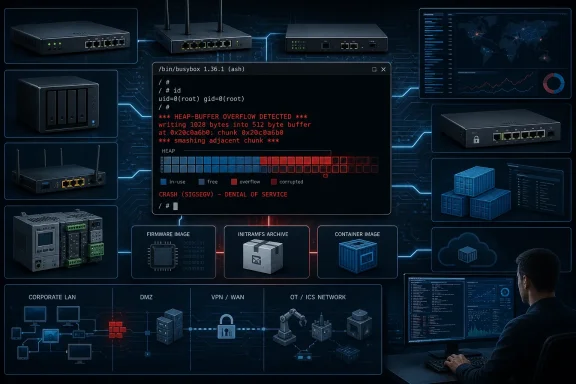
ash shell in BusyBox 1.38.0 and can trigger a heap-buffer overflow in the ifsbreakup() function when the shell processes crafted input. Current public assessments describe the practical impact as denial of service, but the issue deserves immediate attention because BusyBox frequently sits beneath the visible layer of embedded products, Linux recovery environments, lightweight containers, appliances, and developer-built firmware. For Windows administrators and security teams, the key question is not whether a Windows desktop directly runs BusyBox ash; it is whether BusyBox 1.38.0 has entered the Linux, network, edge, build, or device-management systems that Windows-centric organizations depend on.
Overview
CVE-2026-38754 was published in mid-July 2026 and identifies a heap overflow in ifsbreakup() within shell/ash.c, the source file that implements BusyBox’s compact Almquist shell derivative. The affected release is BusyBox 1.38.0, which BusyBox announced on May 13, 2026 as an unstable release.
The vulnerability is classified as CWE-122, a heap-based buffer overflow. Public CVSS scoring currently places it at 7.5 High, using the vector AV:N/AC:L/PR:N/UI:N/S:U/C:N/I:N/A:H: network reachable, low complexity, no privileges, no user interaction, unchanged scope, and high impact on availability. That vector should be read carefully. It does not mean every BusyBox deployment is remotely exploitable; it means that in a configuration where an attacker can cause crafted shell input to reach the vulnerable code, the vulnerability can be triggered without a complicated precondition.
The immediate takeaway
This is best treated as a supply-chain and exposure-management problem, not merely as a Linux package-update task. A BusyBox binary is often statically linked, embedded in firmware, copied into an initramfs image, inherited through an SDK, or shipped within an appliance image that does not advertise its component inventory clearly.
Organizations should therefore identify BusyBox 1.38.0 deployments first, establish whether the ash applet is enabled and reachable, and then obtain a vendor-supported fixed build or validated source-level remediation. Simply looking at a general-purpose Linux distribution’s package list will not expose every meaningful instance.
Why WindowsForum readers should care
Windows endpoints are unlikely to be the principal target surface for this issue. However, modern Windows environments are tied to a broad operational ecosystem that includes routers, storage devices, VPN gateways, industrial controllers, developer workstations with WSL, CI/CD runners, Linux jump hosts, embedded security tools, and appliance-style virtual machines.
A denial-of-service flaw in a compact shell can become a Windows operations problem when it interrupts boot recovery, device provisioning, administrative automation, network connectivity, or services managed through a Windows-based control plane. The affected code may be several layers removed from the console that administrators use every day.
Background
BusyBox is often described as the “Swiss Army knife” of embedded Linux because it combines a large collection of Unix-style utilities into one small executable. Depending on how it is compiled, it can provide commands for file operations, networking, process control, text processing, boot tasks, service management, and shells.
That compactness is its principal advantage. A single BusyBox executable can provide the essential userspace for a device with limited flash storage and memory, or support a recovery environment where the full userland is unavailable. The same design also creates a practical inventory challenge: an administrator may see one file named busybox, while that one file exposes dozens or hundreds of separate applets and capabilities.
BusyBox and the ash shell
BusyBox includes ash, a lightweight shell designed for environments where the size and startup cost of Bash would be unnecessary. It is common in embedded systems and startup environments because it can execute shell scripts, perform parameter expansion, handle redirects, invoke utilities, and support the scripting patterns used by many minimal Linux deployments.
ash is not merely an interactive prompt. It may process scripts during boot, respond to maintenance operations, execute hooks triggered by network events, support web administration back ends, or serve as the shell called by internal automation. This distinction matters because a vulnerability in shell parsing and expansion can affect operations even where end users never receive a shell prompt.
Unstable releases are not isolated releases
BusyBox 1.38.0 was labeled unstable, but “unstable” should not be mistaken for “unused.” Upstream labels describe a project’s release track; they do not prevent a new version from reaching development images, vendor firmware, rolling distributions, embedded build systems, test environments, or products that ship quickly after upstream packaging.
The time between upstream release and disclosure also matters. BusyBox 1.38.0 was available from May 13, 2026, while the CVE was published on July 15, 2026. That roughly two-month window is long enough for an affected version to enter evaluation and production pipelines, particularly where product teams favor current upstream components.
What the Vulnerability Actually Does
The vulnerable function, ifsbreakup(), is related to shell field splitting. In Unix shells, word expansion can transform variables, substitutions, and expansions into one or more command arguments. The shell uses the Internal Field Separator, commonly represented by the IFS environment variable, to determine how certain expanded values are separated into fields.
This is a deceptively intricate process. Shell expansion combines parsing rules, quoting behavior, variable state, temporary memory, redirection, error handling, and execution flow. A defect in the state management around one of those stages can cause later code to operate on stale assumptions.
Stale state after an error path
The upstream discussion around the fix indicates that the underlying problem is linked to IFS-region state that can remain behind when argument expansion hits an error. In the affected flow, an expansion-related error can transfer control out of a routine before the normal cleanup occurs.
That leaves offsets or region information associated with a previous expansion in a state that is no longer valid for the next operation. A later expansion can use a shorter stack-backed string, while ifsbreakup() still relies on stale offsets from the earlier state. The result is an out-of-bounds memory access as the function walks past the valid allocation.
Why a heap overflow can be “only” a DoS today
Heap overflows are often associated with code execution, but impact must be assessed from demonstrated behavior rather than assumptions. The current CVE description and public severity analysis focus on denial of service: a crafted input can crash or otherwise render the affected BusyBox shell unavailable.
That is still significant. On a constrained appliance, process crash behavior can vary. The vulnerable shell may be a child process that restarts cleanly, a service-management component that leaves a feature unavailable, a boot-time interpreter that blocks startup, or a process whose failure produces a reboot loop. Availability impact depends heavily on how the shell is invoked and supervised.
A warning against overclaiming
No public evidence currently establishes reliable arbitrary code execution from CVE-2026-38754. Security teams should avoid inflating the claim beyond the reported denial-of-service condition, because inaccurate severity narratives undermine incident response and patch prioritization.
At the same time, a heap-boundary flaw should not be dismissed as harmless merely because confidentiality and integrity impacts are currently rated “None.” Memory-safety bugs can produce environment-specific behavior, and the correct response is prompt remediation plus sensible containment rather than speculative conclusions in either direction.
Exposure Is More Important Than Version Alone
The vulnerable code is in BusyBox ash, so a binary that contains BusyBox 1.38.0 is not automatically exploitable in the same way as an internet-facing service. The practical attack path depends on whether ash is built into the binary, whether it processes attacker-controlled content, and whether the process survives long enough for a crash to create a material availability loss.
A robust assessment separates presence, reachability, and consequence.
Presence: Is BusyBox 1.38.0 actually installed?
The first task is to identify whether the affected version is present. A shell-level version check may be as simple as invoking BusyBox with its version option, but that approach is incomplete in appliance and firmware environments. The binary may be stored in a recovery partition, embedded in an initramfs archive, included in a container image, or compiled into an image that is not easily queried at runtime.
Software bills of materials are useful here, but only if they preserve component versions accurately. Hash-based identification and firmware extraction may be necessary where vendors use static linking, strip symbols, rename files, or omit package-manager metadata.
Reachability: Can untrusted input reach shell expansion?
A remotely exposed BusyBox shell is an obvious concern, but it is not the only possibility. An application can pass user-controlled values into scripts, helper commands, CGI handlers, maintenance workflows, provisioning routines, or management interfaces that rely on ash.
The distinction between input and shell code is important. A system can expose this flaw without giving an attacker an interactive terminal if application data reaches a vulnerable expansion path. Conversely, a system with BusyBox installed may present minimal risk if ash is not enabled, not invoked, or never processes data from a less-trusted source.
Consequence: What fails when ash fails?
A crash in a disposable worker process may be disruptive but recoverable. A crash during an authenticated administrative job may deny the affected request while preserving service. A crash in a device’s control script, startup logic, or network-event handler can produce much more serious consequences, including repeated service failure or device instability.
Security teams should map each use of BusyBox ash to a business or operational dependency. A low-cost endpoint may have a high-cost failure mode if its outage affects remote access, manufacturing, physical security, telemetry collection, or network routing.
The Significance of the Network Attack Vector
The published CVSS vector lists the attack vector as network and the privileges requirement as none. This is appropriately attention-grabbing, but it needs operational interpretation. CVSS describes the conditions under which a vulnerable component can be reached; it does not mean BusyBox itself exposes a network daemon by default.
BusyBox includes applets that can participate in network services, but ash is fundamentally a shell interpreter. The network condition becomes relevant when another service, application, protocol handler, or management interface gives remote input a path to the shell.
Typical exposure patterns
Several patterns deserve focused review:
- Web administration interfaces may invoke shell scripts behind CGI handlers or custom back-end logic.
- Provisioning systems may provide device-specific variables that are consumed by shell-based configuration scripts.
- Network event hooks may call scripts when DHCP leases, interfaces, tunnels, or wireless state changes.
- Remote management agents may execute diagnostics, backup routines, update checks, or log-collection commands through BusyBox utilities.
- Build and test systems may feed generated values into shell scripts that execute in minimal containers or firmware-emulation environments.
- Recovery workflows may accept operator-provided parameters that are processed by
ashduring a failure scenario.
Each case requires analysis of input controls and invocation context. The issue is not that all shell scripting is unsafe; it is that stale cleanup state in the vulnerable expansion path creates a condition that maliciously crafted data can exploit when it is allowed to reach that path.
Authentication is not a complete defense
Because the public vector identifies no privileges as required, unauthenticated paths are the highest priority. But authenticated interfaces should not be overlooked. Appliances frequently rely on default, shared, weak, or phished credentials, while internal management networks are often flatter than security diagrams suggest.
Moreover, denial of service can be damaging even when an attacker already has valid low-privilege access. The right triage question is not only “Can the public internet reach this?” but also “Can any constrained account, compromised internal host, or integrated service send the relevant data?”
Patch Status and the Upstream Fix
The source-level discussion indicates that the remediation is not simply a narrow bounds check in ifsbreakup(). The more complete approach restores cleanup of IFS-related state when expansion error handling catches an error and continues execution. The relevant cleanup uses ifsfree(), which both releases IFS-region allocations and clears the state used by subsequent field splitting.
That is technically meaningful. Bounds checks can prevent one observed out-of-range access, but they may leave state-management errors intact. Cleaning stale state at the right exception-handling boundaries addresses the causal chain: after an error interrupts expansion, later expansions should not inherit invalid offsets.
A patch process with nuance
The public mailing-list discussion also shows that the patch evolution involved more than one revision and follow-up analysis of error-handling order. That is not a red flag by itself; complex shell semantics and non-local control transfers are precisely the situations where a seemingly direct fix may expose an edge case.
It does mean organizations should be cautious about declaring themselves protected based on an arbitrary downstream patch. The correct standard is a vendor-supported build that incorporates the finalized remediation, or an internally maintained patch that has been reviewed, tested, and tracked against the final upstream resolution.
Do not assume a release number yet
As of July 21, 2026, public information clearly identifies BusyBox 1.38.0 as affected, but the operational patch picture is still developing across vendors and distributions. Some distribution trackers list the issue as needing evaluation rather than providing an immediate fixed package version.
Administrators should not invent a “fixed in” release number. Confirm the exact package, firmware, image, or source commit supplied by the vendor. This is especially important because embedded products may backport a patch without changing their visible BusyBox version string, while other products may retain an apparently newer version that lacks a specific downstream correction.
Practical Mitigation for Device and Infrastructure Teams
Patching is the preferred outcome, but temporary mitigation begins with removing risky invocation paths. Teams should identify processes that call BusyBox ash, determine whether those processes accept data across trust boundaries, and reduce the ability of untrusted input to reach shell expansion.
The following sequence provides a defensible response plan without relying on unverified exploit details.
A seven-step response plan
- Inventory all BusyBox artifacts, including runtime binaries, containers, initramfs images, recovery partitions, firmware bundles, build roots, and golden images.
- Confirm the version and build configuration for each identified artifact, including whether the
ashapplet is compiled and exposed. - Rank assets by exposure, prioritizing internet-facing devices, remote-management appliances, infrastructure edge systems, and products whose shell scripts process network-derived data.
- Obtain a vendor advisory or fixed image rather than replacing a firmware component independently unless the organization owns the full build and validation process.
- Apply the corrected package, image, or patch through a tested change window, with rollback capability for critical devices.
- Restrict untrusted inputs to shell-backed workflows until remediation is complete, using strict allowlists, structured APIs, and isolation where possible.
- Monitor for unexpected shell crashes, watchdog resets, service restarts, and boot loops, particularly in appliances that lack detailed endpoint telemetry.
Compensating controls
Where a patch is not yet available, place affected management interfaces behind VPN access, restrict them to an administrative subnet, disable unused web features, and limit exposed diagnostic functions. These controls do not correct the memory-safety flaw, but they reduce the number of entities capable of delivering malicious content.
For internally developed systems, replace ad hoc shell command construction with direct process invocation and structured argument handling. That will not necessarily eliminate this specific bug if ash still processes untrusted scripts, but it reduces broad shell-exposure risk and improves future resilience.
Windows, WSL, and Hybrid Enterprise Impact
For conventional Windows client fleets, CVE-2026-38754 is not a Windows Update event. It does not indicate a flaw in Windows Command Prompt, PowerShell, Windows Terminal, or the Windows kernel. Treating it as such would create confusion and distract from the systems that actually need review.
The relevance appears in hybrid environments, where Windows devices manage or interoperate with Linux and embedded infrastructure.
Windows-based management does not change the target
An administrator using a Windows laptop to manage a firewall, NAS, wireless controller, or industrial gateway may be administering a BusyBox-based appliance. The administration endpoint may be perfectly patched while the managed device remains exposed.
This separation is crucial during vulnerability communications. Asset owners should name the actual affected products, firmware versions, and network roles rather than issuing vague notices that “Windows systems may be impacted.”
WSL and developer workstations
WSL environments generally run complete Linux distributions rather than appliance-style BusyBox userspaces, so they should not be presumed affected. Still, developers may build BusyBox 1.38.0 from source, use it in test roots, package it into embedded SDKs, or execute it within container and emulation workflows hosted on Windows.
Developer teams should review repositories, build caches, artifact registries, and release pipelines. The highest-value question is whether Windows-hosted tooling has helped distribute vulnerable BusyBox images into devices or production infrastructure.
Enterprise procurement implications
Many enterprise products contain embedded Linux even when their branding, management software, and procurement documentation are Windows-oriented. Network equipment, surveillance systems, telephony platforms, storage appliances, secure-access products, lab instruments, and edge compute platforms may use BusyBox internally.
Procurement teams should ask vendors for a precise statement covering BusyBox 1.38.0, the presence of ash, exposure conditions, remediation status, and supported update path. A generic assertion that a product “uses Linux” or “is not affected by a desktop operating system vulnerability” is not an answer.
Detection and Validation
Detection should focus on reliable identification rather than on attempting to reproduce the crash in production. Public proof-of-concept material exists in upstream technical discussion, but reproducing memory errors on live infrastructure can destabilize services and is rarely necessary for prioritization.
The safer approach combines version detection, component inventory, configuration review, and behavioral monitoring.
What to look for in telemetry
Security operations teams should search for unexplained process termination, restart loops, watchdog events, and system log entries that coincide with configuration submissions, management requests, network lease events, or automated maintenance jobs. Appliance telemetry is often sparse, so logs from adjacent systems can be just as valuable.
For example, repeated loss of a web-management process after a particular request pattern may be more observable from a reverse proxy, load balancer, or management platform than from the appliance itself. Correlating those events can establish that an availability issue is active without running hostile test input.
Test in a representative lab
Organizations that build BusyBox internally should validate remediation in an isolated environment. Compile the same configuration, use the same C library and compiler options where feasible, exercise error-handling paths in shell expansion, and verify that ordinary scripts still function correctly.
Memory-safety instrumentation is valuable during this process. AddressSanitizer-assisted testing was used in public discussion to reveal the out-of-bounds behavior, and comparable instrumentation can help validate that a backported patch actually removes the observed fault rather than merely changing its symptoms.
Beware version-string shortcuts
A version string alone can be misleading. Vendors may backport the correction to a custom package while leaving the upstream version display unchanged. Conversely, an image may include BusyBox 1.38.0 in a build tree but deploy an older binary in the active root filesystem.
Verification should therefore combine release documentation, package metadata, binary provenance, and—when the organization controls the source—patch presence. This is standard supply-chain hygiene, but BusyBox’s role in firmware makes it particularly important.
Strengths and Opportunities
CVE-2026-38754 is disruptive, but the disclosure also presents a useful opportunity to improve practices that matter far beyond one BusyBox release.
- The flaw has a defined code location and a technically specific root cause, allowing maintainers to validate patch incorporation rather than relying only on generalized severity labels.
- The currently documented impact is denial of service, which provides a clear immediate priority: protect service continuity and reduce shell exposure while updates are prepared.
- The issue exposes gaps in embedded software inventory, giving organizations a practical reason to improve SBOM quality, firmware tracking, and product-owner accountability.
- The patch discussion emphasizes root-cause cleanup, reinforcing the value of correcting state-management faults rather than treating memory-boundary checks as universal fixes.
- Hybrid organizations can use the incident to clarify ownership, distinguishing Windows endpoint teams, network teams, product engineering, OT staff, and third-party appliance vendors.
A chance to reduce shell dependence
Many embedded workflows continue to rely on shell scripts because they are portable and compact. That is often reasonable, but sensitive input-processing paths benefit from structured configuration formats, explicit validation, and direct execution APIs.
Reducing the amount of attacker-influenced data that enters a shell interpreter is a durable security improvement. It also makes systems easier to test, audit, and migrate as firmware platforms evolve.
Risks and Concerns
The principal risk is not that every BusyBox deployment suddenly becomes remotely exploitable. The larger concern is that the affected release can be difficult to locate and that an availability-only label may lead teams to under-prioritize it.
- Firmware opacity can conceal exposure. A vulnerable BusyBox binary may be embedded in devices that do not expose package versions or offer a straightforward update mechanism.
- Denial of service can have disproportionate operational effects. A shell crash may affect a minor utility, but it can also interrupt connectivity, provisioning, boot logic, or remote administration.
- Upstream and downstream patch timing can diverge. Vendors may evaluate, backport, or bundle fixes on different schedules, leaving customers unable to rely on a single universal fixed-version claim.
- Network reachability depends on integration details. Remote management interfaces, event hooks, and shell-backed automation can create exposure that is absent from simple port scans.
- Uncontrolled testing can cause outages. Attempting to validate the flaw directly on production routers, gateways, or recovery environments can generate the very availability problem the organization is trying to prevent.
The risk of false reassurance
Older BusyBox versions should not be declared safe or unsafe solely from the current CVE description. The reported affected version is 1.38.0, but downstream source histories and patch backports require careful review.
Likewise, the absence of an interactive ash prompt does not prove the vulnerable function cannot be reached. Shell interpreters are commonly called non-interactively by services and scripts, so reachability analysis must include the full execution chain.
What to Watch Next
The next important development will be a clear upstream and downstream remediation map: an officially confirmed corrected BusyBox release or source revision, followed by vendor advisories that identify fixed firmware and package builds. Until then, organizations should track the issue as an active, high-severity availability risk rather than waiting for a broad operating-system update channel to resolve it.
Vendor advisories and fixed firmware
Appliance vendors should be expected to state whether they ship BusyBox 1.38.0, whether ash is included, whether attacker-controlled input can reach shell expansion, and which firmware releases correct the issue. Customers should prioritize suppliers that provide these details rather than broad assurances.
For unsupported devices, the decision becomes operational: isolate the device, disable exposed management features, replace it, or accept a documented risk. The right answer depends on criticality, exposure, and whether a practical update path exists.
CISA and ecosystem prioritization
The public vulnerability record includes a CISA-coordinated assessment indicating no known exploitation at the time of publication, an automatable condition, and partial technical impact. That should not be read as a prediction of safety; it is a snapshot of current knowledge.
Teams should monitor changes in exploitation status, exploit availability, vendor remediation, and any reassessment of impact. A CVE record is not static, especially in the first days after public disclosure.
Longer-term lessons for embedded security
BusyBox will remain central to many embedded Linux systems because its size and utility are exceptionally valuable. The lesson from CVE-2026-38754 is not to abandon BusyBox, but to treat it as a critical software platform with the same rigor applied to web servers, operating systems, and identity infrastructure.
That means maintaining accurate inventories, tracking upstream changes even for small utilities, testing error paths, minimizing untrusted data in shell execution, and demanding transparent remediation from device vendors.
CVE-2026-38754 is a reminder that the most consequential vulnerabilities are not always found in the most visible software. BusyBox 1.38.0’s ash flaw may present first as a narrow denial-of-service bug in a lightweight shell, yet its real-world significance is determined by where that shell lives: inside the devices, images, scripts, and recovery systems that keep modern networks and hybrid Windows environments operating. The organizations that respond best will be those that look beyond the desktop, identify their hidden embedded dependencies, and use this disclosure to strengthen both immediate resilience and long-term software supply-chain discipline.