

Microsoft’s Security Update Guide lists CVE-2026-39827 as a denial-of-service flaw in
The uncomfortable lesson is that availability bugs in library code do not stay politely confined to the language ecosystem that produced them. They travel inside binaries, containers, agents, gateways, backup tools, remote access brokers, and internal admin services. CVE-2026-39827 is a small leak with a large blast radius because SSH is the plumbing nobody wants to think about until it stops carrying water.
The first instinct with a CVE like this is to file it under “developer dependency hygiene” and move on. That would be a mistake.
The Go vulnerability database describes the defect plainly: an authenticated SSH client could repeatedly open channels that the server rejected, causing unbounded memory growth and eventually crashing the server process. The Go security team’s announcement says rejected channels are now properly removed from internal connection state and released for garbage collection. That phrasing matters because it tells us the bug lives in lifecycle management, not cryptographic failure.
This is the kind of flaw that looks boring right up until it becomes an outage. No private key theft, no remote code execution, no spectacular wormable exploit chain. Just a server that keeps remembering things it should have forgotten, until the heap grows, the process falls over, and every connected user pays the price.
Microsoft’s listing gives the issue a familiar enterprise frame: total or serious loss of availability in the impacted component. That language will land with security teams because it maps neatly to business impact. A service that cannot accept sessions, maintain tunnels, or keep management traffic flowing is not “medium” in the middle of an incident response window.
That distinction is especially important for multi-user systems. The Go advisory says a successful attack can affect all connected users, which is the difference between a nuisance and a shared-service failure. If one authenticated client can force a server process to grow memory without bound, the privilege boundary has already failed in a practical sense: the user cannot necessarily read other sessions, but can deny them service.
Availability vulnerabilities are often discounted because they do not immediately become data breaches. Administrators know better. A dead remote access service during a maintenance window, a crashed bastion during an outage, or a stalled deployment tunnel during a rollback can be just as operationally damaging as a confidentiality bug, even if the postmortem contains fewer scary screenshots.
The attack shape also fits modern abuse patterns. Repetition is cheap, automation is easy, and memory exhaustion rarely requires sophisticated timing once the path is understood. The attacker does not need to win a race; they need to keep asking the server to do something that leaves behind state.
That routine behavior is exactly why this bug is so awkward. Rejection is supposed to be cleanup-friendly. A failed channel request should leave the connection in a known state, return an error to the client, and disappear from the server’s working memory. According to the Go advisory, the vulnerable code path failed that last part.
Memory leaks in garbage-collected languages can sound counterintuitive to outsiders, but Go’s garbage collector can only reclaim objects that are no longer reachable. If a rejected channel remains referenced from a connection’s internal state, the runtime quite reasonably treats it as still alive. The problem is not that Go forgot how to collect memory; it is that the program kept holding the door open.
That is why the fix description is so revealing. The repair was not “increase a limit” or “reject more aggressively.” It was to remove rejected channels from internal state so garbage collection could do its job. In availability terms, the difference between dead state and live state is the difference between a handled error and a slow-motion crash.
If the vulnerable SSH server is a sidecar used by a development tool in a lab, the practical risk may be modest. If it is part of a production access broker, an SFTP gateway, a fleet management appliance, a privileged automation service, or a customer-facing administrative endpoint, “medium” starts to look like an accounting artifact. The exploit precondition is authentication, but the consequence is service-wide failure.
Windows shops are particularly exposed to this category of ambiguity because Go software is often distributed as self-contained binaries. There may be no system package to patch, no obvious DLL to inspect, and no Windows Update entry that tells the whole story. The affected dependency can be statically compiled into an executable whose version banner says nothing about its Go module graph.
That is the silent contract of modern infrastructure software: vendors ship convenience, and customers inherit the dependency tree. When the vulnerable component is buried inside a tool that merely “uses SSH,” administrators may not even know they are running
That distinction matters for patch triage. Admins should not rip apart Windows’ built-in OpenSSH server merely because the CVE contains “ssh” in its title. The more useful question is which Go-based services in the environment implement SSH server behavior using
For WindowsForum readers, the likely exposure is not the classic
This is why CVEs increasingly resist operating-system boundaries. A Windows admin may own the availability of a pipeline whose SSH endpoint lives in a container. A security team may track the vulnerability through Microsoft Defender or an asset platform while the fix requires a third-party vendor update. The label on the kernel is less important than the dependency inside the process.
The harder part is proving that everything has actually moved. Go modules are usually pulled into builds through
For in-house Go services, the minimum response is to inspect dependency manifests, run Go’s vulnerability tooling where available, update the module, rebuild, redeploy, and verify the running artifact. For third-party products, the response is more contractual: ask vendors whether they use
The stale-binary problem is particularly sharp on Windows. A Go executable may sit under
That makes this bug relevant to zero-trust thinking. If access is scoped correctly, one user’s actions should not be able to starve the entire service. The vulnerability violates that expectation at the implementation layer. The authentication check succeeds, but resource isolation fails.
Rate limiting can help, but it is not a substitute for the patch. Limiting channel open attempts, monitoring rejected channel rates, enforcing per-user connection caps, and applying memory limits to services can reduce the likelihood of a crash. None of those controls fixes the leak if the vulnerable code remains reachable.
There is also a logging trap here. Rejected channels may appear as normal authorization denials rather than as security anomalies. By the time memory pressure becomes visible, the useful signal may be buried among routine SSH noise. Operators should treat a surge in rejected channel requests from a single authenticated principal as suspicious until proven otherwise.
When a library receives a broad security sweep, enterprise teams should resist the temptation to patch only the one CVE that appeared in a Microsoft dashboard. The surrounding fixes may address different threat models, but they share the same operational reality: the SSH implementation is security-sensitive code sitting inside higher-level products. Updating to the fixed release buys down more than one risk.
This is also a reminder that “not OpenSSH” does not mean “not important.” Many admins have decades of muscle memory around OpenSSH configuration, hardening, and patching. Go’s SSH package occupies a different niche: it gives application developers a toolkit for embedding SSH behavior without deploying a separate server. That flexibility is useful, but it puts protocol correctness into places traditional server-hardening guides may never inspect.
The Go team’s announcement credits multiple reporters for the broader batch and credits Ziyan Zhou for CVE-2026-39827 specifically. That matters because ecosystem security often advances through precisely this kind of quiet maintenance work. There is no glamorous exploit demo required for a bug to deserve urgent operational attention.
That layering is useful but imperfect. A vulnerability scanner may flag a module version in a build artifact even if the SSH server path is not used. Conversely, a vendor may be affected but slow to publish an advisory because the vulnerable dependency is buried in a component maintained by another team. Both false positives and delayed positives are plausible.
The KrakenD advisory, for example, reportedly classified the issue as a false positive for its own product context while still summarizing the underlying Go SSH bug. That is a good example of how the same CVE can be real in the ecosystem but not exploitable in every product that happens to carry a dependency. Security teams should read product advisories as exposure statements, not as replacements for the upstream technical facts.
For Windows administrators, the practical workflow is to join three sources of truth: upstream Go vulnerability data, vendor-specific advisories, and local asset evidence. Any one of those alone can mislead. Together, they tell you whether vulnerable code exists, whether it is reachable, and whether a fixed build is actually deployed.
The key is to correlate, not merely alert. A Go service that gradually grows memory during normal workload is a performance issue; a service that grows sharply while one authenticated user generates repeated rejected SSH channel requests is a security incident candidate. The closer your telemetry gets to application-level SSH events, the better.
Windows environments may need extra care because many Go services write logs in vendor-specific formats or run under service wrappers. Event Viewer may show only the crash or restart, not the SSH-level cause. Containerized deployments can make the symptom look like a Kubernetes restart loop rather than an authentication-abuse pattern.
Memory limits are useful as damage control. They can turn unbounded growth into a controlled restart, which may be preferable to host-wide pressure. But controlled failure is still failure, and if an attacker can repeatedly trigger it, a restart policy becomes part of the denial-of-service cycle.
The complication is that SBOM presence does not equal exploitability. A binary may include
Go’s static linking model raises the bar for asset intelligence. Traditional patch-management thinking assumes that vulnerable libraries exist as files with versions. Go often turns them into compiled code inside application binaries. That does not make Go less secure; it makes build provenance and release discipline more important.
For internal development teams, the fix should become part of the standard release process rather than an emergency one-off. Update the module, run tests, rebuild, regenerate SBOMs, publish new artifacts, and retire the old ones. The last step is the one that tends to fail.
That does not make the CVE a Windows patch Tuesday story in the usual sense. There may be Microsoft products or services that depend on the affected code, and there may be Microsoft tooling that reports it, but administrators should avoid assuming that Windows Update alone resolves every instance. The dependency may live in a third-party executable, an internal Go service, or a container image deployed far from a Windows host.
This is the modern patch-management split brain. Operating-system patching remains necessary, but it no longer defines the perimeter of vulnerability management. Application dependencies, container layers, language modules, and vendor appliances all carry security state of their own.
For WindowsForum’s audience, that means CVE triage has to cross the old borders between desktop admin, server admin, DevOps, and application security. The person who sees the MSRC entry may not be the person who owns the Go build. The person who owns the Go build may not know the service is business-critical. The outage will not care.
Least privilege matters because the bug requires authentication. If every automation key can reach every SSH-speaking internal service, the blast radius is unnecessarily large. If service accounts are scoped to the smallest set of endpoints and features, compromise of one credential is less likely to become a broad denial-of-service lever.
Connection and channel limits matter because the attack relies on repetition. A limit will not correct the leak, but it can slow exploitation and create earlier telemetry. The goal is not to make vulnerable code safe forever; it is to buy time until a fixed build replaces it.
Resource isolation matters because Go services often run alongside other critical workloads. If a vulnerable SSH component can consume enough memory to destabilize its host, the outage expands beyond the affected process. Service-level memory caps and host-level monitoring keep a component failure from becoming a platform failure.
golang.org/x/crypto/ssh, where an authenticated SSH client can repeatedly open channels that a server rejects, leaking memory until the server process crashes. The Go security team disclosed the underlying issue in late May 2026 as part of a broader x/crypto security update, and the fix landed in version 0.52.0 of the module. The bug is not a Windows vulnerability in the traditional sense, but it is very much a Windows estate problem when Go-built SSH services, developer tools, appliances, CI agents, or management planes run on or support Windows infrastructure.The uncomfortable lesson is that availability bugs in library code do not stay politely confined to the language ecosystem that produced them. They travel inside binaries, containers, agents, gateways, backup tools, remote access brokers, and internal admin services. CVE-2026-39827 is a small leak with a large blast radius because SSH is the plumbing nobody wants to think about until it stops carrying water.
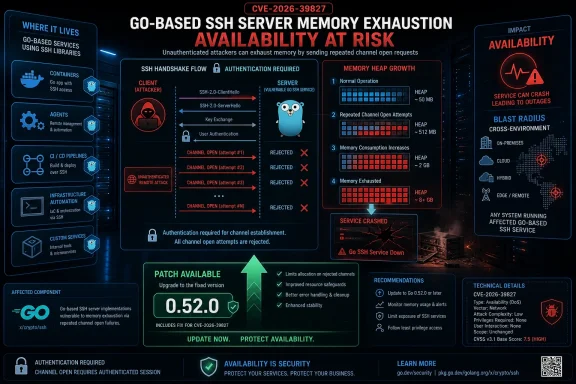 A Go Library Bug Becomes an Infrastructure Story
The first instinct with a CVE like this is to file it under “developer dependency hygiene” and move on. That would be a mistake. golang.org/x/crypto/ssh is not OpenSSH, and it is not the SSH server built into Windows, but it is a widely used Go implementation of SSH primitives that developers reach for when building remote shells, tunnels, SFTP-like workflows, Git transports, bastion-style services, and embedded management features.The Go vulnerability database describes the defect plainly: an authenticated SSH client could repeatedly open channels that the server rejected, causing unbounded memory growth and eventually crashing the server process. The Go security team’s announcement says rejected channels are now properly removed from internal connection state and released for garbage collection. That phrasing matters because it tells us the bug lives in lifecycle management, not cryptographic failure.
This is the kind of flaw that looks boring right up until it becomes an outage. No private key theft, no remote code execution, no spectacular wormable exploit chain. Just a server that keeps remembering things it should have forgotten, until the heap grows, the process falls over, and every connected user pays the price.
Microsoft’s listing gives the issue a familiar enterprise frame: total or serious loss of availability in the impacted component. That language will land with security teams because it maps neatly to business impact. A service that cannot accept sessions, maintain tunnels, or keep management traffic flowing is not “medium” in the middle of an incident response window.
The Authentication Requirement Narrows the Door, Not the Damage
The most important limiting factor is also the most easily misunderstood one: the attacker must be authenticated. This is not the same as saying the attack is harmless. In SSH-heavy environments, “authenticated” can mean a legitimate contractor key, a low-privilege automation account, a compromised CI credential, a stale service account, or a user who has access to one tenant but can still stress shared infrastructure.That distinction is especially important for multi-user systems. The Go advisory says a successful attack can affect all connected users, which is the difference between a nuisance and a shared-service failure. If one authenticated client can force a server process to grow memory without bound, the privilege boundary has already failed in a practical sense: the user cannot necessarily read other sessions, but can deny them service.
Availability vulnerabilities are often discounted because they do not immediately become data breaches. Administrators know better. A dead remote access service during a maintenance window, a crashed bastion during an outage, or a stalled deployment tunnel during a rollback can be just as operationally damaging as a confidentiality bug, even if the postmortem contains fewer scary screenshots.
The attack shape also fits modern abuse patterns. Repetition is cheap, automation is easy, and memory exhaustion rarely requires sophisticated timing once the path is understood. The attacker does not need to win a race; they need to keep asking the server to do something that leaves behind state.
Channel Rejection Is Supposed to Be Routine
SSH channels are not exotic. A single SSH connection can carry multiple logical channels for shell sessions, exec requests, port forwarding, subsystems, and other uses. Servers routinely reject channel open requests because a feature is disabled, a policy blocks it, a subsystem is unavailable, or the user is not permitted to use it.That routine behavior is exactly why this bug is so awkward. Rejection is supposed to be cleanup-friendly. A failed channel request should leave the connection in a known state, return an error to the client, and disappear from the server’s working memory. According to the Go advisory, the vulnerable code path failed that last part.
Memory leaks in garbage-collected languages can sound counterintuitive to outsiders, but Go’s garbage collector can only reclaim objects that are no longer reachable. If a rejected channel remains referenced from a connection’s internal state, the runtime quite reasonably treats it as still alive. The problem is not that Go forgot how to collect memory; it is that the program kept holding the door open.
That is why the fix description is so revealing. The repair was not “increase a limit” or “reject more aggressively.” It was to remove rejected channels from internal state so garbage collection could do its job. In availability terms, the difference between dead state and live state is the difference between a handled error and a slow-motion crash.
The Severity Score Understates the Admin Headache
Public vulnerability databases have characterized CVE-2026-39827 as a medium-severity issue with network attack vector, low attack complexity, low privileges required, no user interaction, no confidentiality impact, no integrity impact, and high availability impact. That is a rational scorecard. It is also a poor substitute for understanding where the vulnerable code sits.If the vulnerable SSH server is a sidecar used by a development tool in a lab, the practical risk may be modest. If it is part of a production access broker, an SFTP gateway, a fleet management appliance, a privileged automation service, or a customer-facing administrative endpoint, “medium” starts to look like an accounting artifact. The exploit precondition is authentication, but the consequence is service-wide failure.
Windows shops are particularly exposed to this category of ambiguity because Go software is often distributed as self-contained binaries. There may be no system package to patch, no obvious DLL to inspect, and no Windows Update entry that tells the whole story. The affected dependency can be statically compiled into an executable whose version banner says nothing about its Go module graph.
That is the silent contract of modern infrastructure software: vendors ship convenience, and customers inherit the dependency tree. When the vulnerable component is buried inside a tool that merely “uses SSH,” administrators may not even know they are running
golang.org/x/crypto/ssh until an SBOM, vendor advisory, or binary analysis says so.Windows Is in the Blast Radius Even When the Bug Is Not in Windows
Microsoft’s presence in this story is easy to misread. The MSRC entry does not mean Windows’ OpenSSH implementation is necessarily affected by this Go package flaw. Rather, Microsoft’s Security Update Guide is surfacing a vulnerability in a component that may appear in Microsoft products, customer environments, or software supply chains tracked by Microsoft security tooling.That distinction matters for patch triage. Admins should not rip apart Windows’ built-in OpenSSH server merely because the CVE contains “ssh” in its title. The more useful question is which Go-based services in the environment implement SSH server behavior using
golang.org/x/crypto/ssh before version 0.52.0.For WindowsForum readers, the likely exposure is not the classic
sshd.exe service on a Windows Server host. It is a Go binary running as a Windows service, an agent installed by a vendor, a developer tool bundled with its own SSH stack, a container running on Windows infrastructure, or a management plane that accepts SSH-like connections for automation. In hybrid estates, the affected component may run on Linux while the outage breaks Windows operations downstream.This is why CVEs increasingly resist operating-system boundaries. A Windows admin may own the availability of a pipeline whose SSH endpoint lives in a container. A security team may track the vulnerability through Microsoft Defender or an asset platform while the fix requires a third-party vendor update. The label on the kernel is less important than the dependency inside the process.
The Patch Is Simple; Finding Every Copy Is Not
The direct remediation is straightforward: updategolang.org/x/crypto to version 0.52.0 or later and rebuild affected software. The Go vulnerability database lists versions before 0.52.0 as affected for golang.org/x/crypto/ssh, with the relevant internal symbol associated with channel rejection. For developers maintaining their own services, this is the easy part.The harder part is proving that everything has actually moved. Go modules are usually pulled into builds through
go.mod, but production exposure depends on what was compiled, packaged, and deployed. A repository may show the fixed version while an old binary remains installed on a server nobody has redeployed since spring.For in-house Go services, the minimum response is to inspect dependency manifests, run Go’s vulnerability tooling where available, update the module, rebuild, redeploy, and verify the running artifact. For third-party products, the response is more contractual: ask vendors whether they use
golang.org/x/crypto/ssh, whether they were affected by CVE-2026-39827, and which product version contains the rebuild against 0.52.0 or later.The stale-binary problem is particularly sharp on Windows. A Go executable may sit under
Program Files, run as a service, and leave few clues beyond a vendor name and a version number. Unlike a shared library model, updating a Go module in one place does not magically update every binary that once embedded it.Denial of Service Is a Security Boundary in Disguise
Security culture still tends to rank availability below confidentiality and integrity, at least until the pager goes off. CVE-2026-39827 is a useful corrective because it shows how an ordinary low-privilege authenticated user can become a service-wide availability risk. The attacker may not need administrative rights if the vulnerable service converts allowed login into unbounded memory pressure.That makes this bug relevant to zero-trust thinking. If access is scoped correctly, one user’s actions should not be able to starve the entire service. The vulnerability violates that expectation at the implementation layer. The authentication check succeeds, but resource isolation fails.
Rate limiting can help, but it is not a substitute for the patch. Limiting channel open attempts, monitoring rejected channel rates, enforcing per-user connection caps, and applying memory limits to services can reduce the likelihood of a crash. None of those controls fixes the leak if the vulnerable code remains reachable.
There is also a logging trap here. Rejected channels may appear as normal authorization denials rather than as security anomalies. By the time memory pressure becomes visible, the useful signal may be buried among routine SSH noise. Operators should treat a surge in rejected channel requests from a single authenticated principal as suspicious until proven otherwise.
The Broader Go SSH Update Deserves a Closer Look
CVE-2026-39827 did not arrive alone. The Go security team’s May 2026 announcement forgolang.org/x/crypto included a cluster of SSH and SSH-agent issues, including panics, certificate restriction problems, agent constraint handling defects, deadlocks, oversized key parameter denial-of-service cases, FIDO/U2F verification behavior, large channel write loops, and known-hosts revocation enforcement. That cluster is more than trivia.When a library receives a broad security sweep, enterprise teams should resist the temptation to patch only the one CVE that appeared in a Microsoft dashboard. The surrounding fixes may address different threat models, but they share the same operational reality: the SSH implementation is security-sensitive code sitting inside higher-level products. Updating to the fixed release buys down more than one risk.
This is also a reminder that “not OpenSSH” does not mean “not important.” Many admins have decades of muscle memory around OpenSSH configuration, hardening, and patching. Go’s SSH package occupies a different niche: it gives application developers a toolkit for embedding SSH behavior without deploying a separate server. That flexibility is useful, but it puts protocol correctness into places traditional server-hardening guides may never inspect.
The Go team’s announcement credits multiple reporters for the broader batch and credits Ziyan Zhou for CVE-2026-39827 specifically. That matters because ecosystem security often advances through precisely this kind of quiet maintenance work. There is no glamorous exploit demo required for a bug to deserve urgent operational attention.
Vendor Advisories Will Lag the Real Exposure
One reason CVE-2026-39827 is likely to create confusion is that many affected users will not consume it from the Go advisory directly. They will see it in a vendor portal, an EDR dashboard, a container scan, a dependency alert, a Microsoft security feed, or a distribution tracker. Each layer may attach its own severity, affected-product interpretation, and remediation language.That layering is useful but imperfect. A vulnerability scanner may flag a module version in a build artifact even if the SSH server path is not used. Conversely, a vendor may be affected but slow to publish an advisory because the vulnerable dependency is buried in a component maintained by another team. Both false positives and delayed positives are plausible.
The KrakenD advisory, for example, reportedly classified the issue as a false positive for its own product context while still summarizing the underlying Go SSH bug. That is a good example of how the same CVE can be real in the ecosystem but not exploitable in every product that happens to carry a dependency. Security teams should read product advisories as exposure statements, not as replacements for the upstream technical facts.
For Windows administrators, the practical workflow is to join three sources of truth: upstream Go vulnerability data, vendor-specific advisories, and local asset evidence. Any one of those alone can mislead. Together, they tell you whether vulnerable code exists, whether it is reachable, and whether a fixed build is actually deployed.
Memory Pressure Is the Canary Worth Watching
If patching cannot happen immediately, monitoring becomes the bridge. The observable failure mode is memory growth in an SSH-serving process after repeated rejected channel opens. That gives defenders a few hooks: process memory, connection churn, authentication logs, channel rejection patterns, service restarts, and out-of-memory events.The key is to correlate, not merely alert. A Go service that gradually grows memory during normal workload is a performance issue; a service that grows sharply while one authenticated user generates repeated rejected SSH channel requests is a security incident candidate. The closer your telemetry gets to application-level SSH events, the better.
Windows environments may need extra care because many Go services write logs in vendor-specific formats or run under service wrappers. Event Viewer may show only the crash or restart, not the SSH-level cause. Containerized deployments can make the symptom look like a Kubernetes restart loop rather than an authentication-abuse pattern.
Memory limits are useful as damage control. They can turn unbounded growth into a controlled restart, which may be preferable to host-wide pressure. But controlled failure is still failure, and if an attacker can repeatedly trigger it, a restart policy becomes part of the denial-of-service cycle.
The SBOM Moment Arrives Again
CVE-2026-39827 is almost tailor-made for the software bill of materials argument. If an organization has good SBOM coverage, it can ask a crisp question: where do we run software that includesgolang.org/x/crypto before 0.52.0 and exposes SSH server behavior? Without that inventory, teams are left with grepping repositories, interrogating vendors, and waiting for scanners to catch up.The complication is that SBOM presence does not equal exploitability. A binary may include
x/crypto/ssh only for client functionality, test code, or a dormant feature. But SBOM absence is worse. If you cannot see the component, you cannot even begin the exposure conversation.Go’s static linking model raises the bar for asset intelligence. Traditional patch-management thinking assumes that vulnerable libraries exist as files with versions. Go often turns them into compiled code inside application binaries. That does not make Go less secure; it makes build provenance and release discipline more important.
For internal development teams, the fix should become part of the standard release process rather than an emergency one-off. Update the module, run tests, rebuild, regenerate SBOMs, publish new artifacts, and retire the old ones. The last step is the one that tends to fail.
Microsoft’s Role Is Signal, Not Ownership
Because the source supplied here is Microsoft’s Security Update Guide, it is worth being precise about what Microsoft is doing. MSRC is surfacing CVE-2026-39827 as a tracked vulnerability, but the authoritative technical description comes from the Go project’s vulnerability database and the Go security team’s announcement. Microsoft’s value for many enterprises is aggregation, prioritization, and integration into the security workflows they already use.That does not make the CVE a Windows patch Tuesday story in the usual sense. There may be Microsoft products or services that depend on the affected code, and there may be Microsoft tooling that reports it, but administrators should avoid assuming that Windows Update alone resolves every instance. The dependency may live in a third-party executable, an internal Go service, or a container image deployed far from a Windows host.
This is the modern patch-management split brain. Operating-system patching remains necessary, but it no longer defines the perimeter of vulnerability management. Application dependencies, container layers, language modules, and vendor appliances all carry security state of their own.
For WindowsForum’s audience, that means CVE triage has to cross the old borders between desktop admin, server admin, DevOps, and application security. The person who sees the MSRC entry may not be the person who owns the Go build. The person who owns the Go build may not know the service is business-critical. The outage will not care.
The Exploit Path Rewards Boring Controls
There is no need to invent exotic mitigations for this bug. The best controls are the ordinary ones that mature SSH services should already have: least-privilege accounts, connection limits, session accounting, useful logs, resource ceilings, and rapid dependency updates. CVE-2026-39827 simply makes the case for applying them to embedded SSH implementations, not only to OpenSSH daemons.Least privilege matters because the bug requires authentication. If every automation key can reach every SSH-speaking internal service, the blast radius is unnecessarily large. If service accounts are scoped to the smallest set of endpoints and features, compromise of one credential is less likely to become a broad denial-of-service lever.
Connection and channel limits matter because the attack relies on repetition. A limit will not correct the leak, but it can slow exploitation and create earlier telemetry. The goal is not to make vulnerable code safe forever; it is to buy time until a fixed build replaces it.
Resource isolation matters because Go services often run alongside other critical workloads. If a vulnerable SSH component can consume enough memory to destabilize its host, the outage expands beyond the affected process. Service-level memory caps and host-level monitoring keep a component failure from becoming a platform failure.
The Practical Reading of CVE-2026-39827
The operational response to this CVE should be concrete rather than theatrical. One vulnerable library path, one fixed version, one clear attack precondition, and one ugly failure mode are enough to drive action.- Organizations should identify Go-built software that uses
golang.org/x/crypto/sshin server mode and determine whether it was built with a version earlier than 0.52.0. - Developers maintaining affected services should update
golang.org/x/cryptoto 0.52.0 or later, rebuild the application, and verify that the deployed binary is the rebuilt one. - Administrators should not assume Windows’ built-in OpenSSH service is affected merely because the CVE concerns SSH; the likely exposure is embedded Go SSH code in applications, agents, appliances, or containers.
- Security teams should treat repeated rejected SSH channel requests from an authenticated user as a suspicious availability signal, especially when paired with process memory growth.
- Vendor management teams should ask suppliers for explicit exposure statements because statically compiled Go dependencies may not be visible through ordinary Windows patch inventory.
- Temporary controls such as connection limits, per-user restrictions, memory caps, and service monitoring can reduce impact, but they do not replace the fixed module.
References
- Primary source: MSRC
Published: 2026-07-07T01:40:36-07:00
Security Update Guide - Microsoft Security Response Center
 msrc.microsoft.com
- Related coverage: sentinelone.com
CVE-2026-39827: Golang Crypto SSH DOS Vulnerability
CVE-2026-39827 is a denial of service vulnerability in Golang Crypto SSH. Learn about its impact, affected versions, and mitigation methods.www.sentinelone.com
- Related coverage: radar.offseq.com
CVE-2026-39827: CWE-401: Missing Release of Memory after Effective Lifetime in golang.org/x/crypto golang.org/x/crypto/ssh - Live Threat Intelligence - Threat Radar | OffSeq.com
Detailed information about CVE-2026-39827: CWE-401: Missing Release of Memory after Effective Lifetime in golang.org/x/crypto golang.org/x/crypto/ssh affectingradar.offseq.com - Related coverage: mondoo.com
CVE-2026-39827 | Mondoo Vulnerability Intelligence
CVE-2026-39827 - MEDIUM severity: Invoking memory leak when rejecting channels can lead to DoS in golang.org/x/crypto/sshmondoo.com - Related coverage: osv.dev

OSV - Open Source Vulnerabilities
Comprehensive vulnerability database for your open source projects and dependencies.
osv.dev
- Related coverage: test.osv.dev

OSV - Open Source Vulnerabilities
Comprehensive vulnerability database for your open source projects and dependencies.
test.osv.dev