

CVE-2026-40225 is a medium-severity systemd udev vulnerability disclosed in April 2026 that affects systemd versions before 260, allowing local root execution when a malicious hardware device abuses unsanitized kernel output during device handling on Linux systems. The exploit path is not the stuff of drive-by internet worms, but that should not make it background noise. It sits at the uncomfortable intersection of physical access, trusted hardware events, and root-owned automation. For WindowsForum readers, the lesson is not “Linux is vulnerable”; it is that modern endpoint security still has a hardware-shaped blind spot.
udev is one of those Linux components that most users never think about until something breaks. It notices devices, interprets what the kernel reports, applies rules, creates device nodes, and helps the rest of the system react as if plugging in hardware were a tidy, predictable event. That quiet choreography is why a USB keyboard appears as a keyboard, a storage device appears in the right place, and network adapters get names and properties the rest of the OS can consume.
CVE-2026-40225 turns that trust boundary into the story. The published description says local root execution can occur through malicious hardware devices and unsanitized kernel output in udev before systemd 260. In plain English, the vulnerable path is not a remote packet hitting a listening daemon; it is a device convincing the system’s privileged hardware-management machinery to process hostile data badly.
That distinction matters because udev runs in a privileged neighborhood. If unsafe data from the kernel-to-userspace device pipeline reaches a place where commands, rules, names, properties, or environment-like values are interpreted without sufficient cleanup, the result can be much worse than a crash. In this case, the public record points to local root execution, which means the attacker’s goal is not merely disruption but control.
The rating is reportedly medium, with a CVSS 3.1 score around 6.4, because the attack vector is physical and the complexity is high. That scoring is defensible in the abstract. It is also a reminder that CVSS is a sorting tool, not a threat model.
The modern malicious device is not necessarily theatrical. It can be a doctored USB peripheral, a rogue adapter, an implant in a cable, a modified development board, or a device that presents itself as something mundane while speaking just enough protocol to trigger kernel and userspace behavior. The endpoint sees a hardware event; the attacker sees a privileged parser.
That is why CVE-2026-40225 deserves more attention than its medium label might suggest. A vulnerability requiring local hardware interaction may be irrelevant to a locked-down cloud VM, but it is highly relevant to exposed kiosks, shared Linux workstations, engineering labs, build machines, point-of-sale terminals, field laptops, embedded Linux appliances, and any machine that accepts untrusted peripherals.
The security industry has trained itself to triage remote code execution first, and usually for good reason. But endpoint compromise often begins with the messy realities of access: someone plugs in a device, boots from something they should not, connects a debugging tool, or leaves a machine unattended for five minutes. This bug belongs to that older, more tactile world of attacks — the one that never disappeared.
The technical issue is in udev, but the operational issue is dependency gravity. When a component this central needs a security fix, administrators rarely get to treat it as a simple leaf package. Updating systemd can be straightforward on rolling distributions and more cautious on enterprise systems, but it still sits close enough to boot and service management that change windows, regression testing, and vendor backports matter.
That is especially true because “before 260” does not mean every affected distribution will ask users to jump directly to systemd 260. Enterprise Linux vendors routinely backport targeted fixes into older version branches while preserving the visible package version for stability. A scanner that merely compares upstream version strings may therefore mislead both ways: it may flag a patched enterprise build as vulnerable, or it may miss a downstream packaging nuance if it does not understand the vendor advisory.
The right response is boring but important: check the distribution’s security tracker, not just the upstream version number. For administrators, the fixed state is whatever the vendor says it is for that supported release channel. Upstream version thresholds are a map, not the territory.
For WSL users, the risk deserves careful framing. Traditional WSL distributions do not handle arbitrary physical device enumeration in the same way a bare-metal Linux installation does. WSL is not simply “Linux on the laptop” with direct ownership of every USB event. That means CVE-2026-40225 is not automatically a WSL emergency just because a WSL distro includes systemd components.
But WSL is not the only Linux presence on a Windows estate. Developer laptops may dual-boot. Security researchers may run bare-metal Linux. Build labs may use Linux workstations attached to debuggers, phones, removable media, and custom USB gear. IT departments may maintain fleets of Linux appliances while thinking of themselves as Windows-first organizations because the endpoints and identity stack are Microsoft-centered.
Azure also complicates the picture. A cloud VM with no physical peripheral exposure has a very different risk profile from a kiosk or lab machine. Yet Azure Linux images, custom Linux VMs, IoT gateways, and edge deployments still rely on distribution patching pipelines. The question is not whether Microsoft published the CVE entry; it is where vulnerable systemd builds exist in your estate and whether the attack path is plausible there.
Availability damage is not trivial. A device-handling bug can stall boot, wedge services, disrupt hardware initialization, or keep a system from accepting new devices. In environments such as hospitals, factories, retail counters, and labs, a machine that cannot reliably enumerate hardware may be effectively down even if the kernel is still alive.
But root execution changes the story. If an attacker can execute code as root, denial of service becomes only one option. They may be able to implant persistence, tamper with logs, alter system binaries, create accounts, disable security controls, read secrets, pivot to connected networks, or modify the very update process meant to fix the problem.
That is why defenders should not let the availability framing lower the priority too far. The operational risk may begin with hardware-triggered disruption, but the security risk is privilege. A vulnerability that requires a malicious peripheral is still a privilege-escalation vulnerability if the device event crosses into root-controlled execution.
A headless Linux VM in a locked-down cloud environment may technically carry an affected package but lack the physical attack surface that makes the CVE practical. A reception-desk kiosk, by contrast, may have exposed USB ports and a user population that cannot distinguish a harmless charger from a malicious device. A developer workstation used for embedded testing may be even more exposed because plugging in strange hardware is part of the job.
This is where asset classification earns its keep. Security teams should not spend equal energy on every affected system. They should prioritize machines that combine vulnerable software, physical accessibility, privileged business role, and a realistic chance of unknown devices being attached.
The high-risk category is not hard to imagine. It includes public-facing systems, shared labs, classrooms, manufacturing stations, retail terminals, conference-room machines, support benches, loaner laptops, and field devices. It also includes any Linux host that acts as a bridge between untrusted hardware and trusted networks.
Yet the more durable lesson is physical port discipline. Operating systems have become better at sandboxing applications, isolating browser tabs, and hardening network services, but a plugged-in device still travels through privileged paths that were designed for convenience and compatibility. Attackers like those paths because users and administrators often treat them as mundane.
Disabling unused external ports in firmware, applying USB device control policies, restricting new device classes, using endpoint management to block unapproved peripherals, and physically covering or locking ports on exposed machines are not glamorous controls. They are also exactly the kind of controls that reduce the value of an exploit like this one.
For Windows-heavy organizations, this should sound familiar. Microsoft Defender for Endpoint device control, Intune policy, Group Policy restrictions, BIOS or UEFI settings, and third-party data-loss-prevention tools already exist because removable hardware has long been a Windows risk. The Linux side needs equivalent attention, not a shrug that “it’s only physical.”
A Debian, Ubuntu, Red Hat, SUSE, Arch, Fedora, or Azure Linux system may all present systemd differently. Stable distributions often prefer backports over major component jumps, because replacing core plumbing can create more operational risk than the vulnerability itself. Rolling distributions may consume upstream changes quickly but expose administrators to a different testing cadence.
Security teams should therefore demand evidence, not just alerts. A useful finding should identify the affected package, installed version, distribution release, vendor advisory status, and whether the fix has been backported. It should also allow risk owners to annotate physical exposure, because a scanner cannot infer whether a USB port is reachable by the public.
This is where many organizations still stumble. They treat vulnerability management as a race to close tickets rather than a process for understanding exploitability. CVE-2026-40225 is a good test case because the difference between theoretical and practical exposure is unusually visible.
That distinction is crucial. Boot integrity controls try to ensure the system starts from trusted code. CVE-2026-40225 concerns what happens when trusted code processes untrusted hardware-originated input at runtime. The machine may boot cleanly and still be vulnerable once a crafted peripheral is introduced.
Full-disk encryption also has limits here. It protects data at rest, especially when a device is powered off or stolen. If the system is running and the attacker reaches root through udev, mounted filesystems and in-memory secrets may be accessible. Encryption is not a substitute for preventing runtime compromise.
None of this makes platform security useless. It means layered security remains layered for a reason. Firmware controls, boot integrity, OS patching, least privilege, peripheral restrictions, and monitoring each cover different failure modes.
The third task is sequencing. Patch exposed endpoints first, especially machines in public or semi-public spaces. Patch developer and lab workstations next, because they often interact with unusual hardware and may hold credentials or source code. Then work through servers and appliances according to vendor guidance, maintenance windows, and compensating controls.
The fourth task is communication. Help desks and field technicians should know that unknown USB devices are not harmless troubleshooting aids. Facilities teams should understand why port blockers might appear on kiosks. Developers should know that embedded boards and test harnesses are part of the security boundary.
The fifth task is validation. After patching, confirm that the vendor-fixed package is installed, that devices still enumerate correctly, and that any custom udev rules behave as expected. udev is exactly the kind of component where brittle local rules can turn an otherwise routine update into a surprising operational incident.
If you run Linux on bare metal and plug in random devices, update systemd through your distribution. If your NAS or appliance vendor ships systemd-based firmware, watch for updates. If you maintain a lab machine specifically for testing unknown peripherals, assume that machine is a boundary device and keep it isolated from credentials and trusted networks.
Home users also tend to underestimate persistence. A successful root compromise does not need to announce itself. It can add a service, alter shell startup files, modify package hooks, or wait. If you believe a vulnerable machine may have been exposed to a malicious device, patching after the fact may not be enough; you may need to inspect, rebuild, or restore from known-good media.
That sounds severe, but it is simply the logic of root. Once an attacker owns the operating system, the defender’s confidence in that installation drops sharply. The best time to prevent that outcome is before the device is ever trusted.
Operating systems must constantly translate messy external reality into structured internal state. A device claims to be a keyboard. A disk claims a serial number. A network interface exposes properties. The kernel reports events. udev turns those events into names, permissions, symlinks, and actions. Every translation step is a security boundary if the input can be attacker-controlled.
That is the uncomfortable lesson. Hardware is not inherently honest just because it is hardware. Kernel output is not inherently safe just because it came through the kernel. Automation is not inherently safe just because it was written to make administration easier.
In a world of supply-chain attacks and hostile peripherals, those assumptions deserve to be retired. The perimeter did not vanish; it migrated into parsers, descriptors, event handlers, and policy engines.
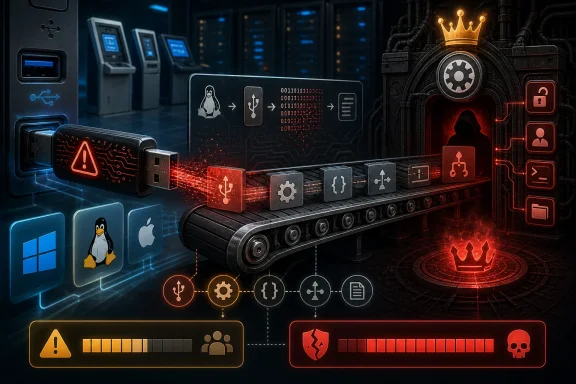 The Bug Lives Where Operating Systems Pretend Hardware Is Honest
udev is one of those Linux components that most users never think about until something breaks. It notices devices, interprets what the kernel reports, applies rules, creates device nodes, and helps the rest of the system react as if plugging in hardware were a tidy, predictable event. That quiet choreography is why a USB keyboard appears as a keyboard, a storage device appears in the right place, and network adapters get names and properties the rest of the OS can consume.CVE-2026-40225 turns that trust boundary into the story. The published description says local root execution can occur through malicious hardware devices and unsanitized kernel output in udev before systemd 260. In plain English, the vulnerable path is not a remote packet hitting a listening daemon; it is a device convincing the system’s privileged hardware-management machinery to process hostile data badly.
That distinction matters because udev runs in a privileged neighborhood. If unsafe data from the kernel-to-userspace device pipeline reaches a place where commands, rules, names, properties, or environment-like values are interpreted without sufficient cleanup, the result can be much worse than a crash. In this case, the public record points to local root execution, which means the attacker’s goal is not merely disruption but control.
The rating is reportedly medium, with a CVSS 3.1 score around 6.4, because the attack vector is physical and the complexity is high. That scoring is defensible in the abstract. It is also a reminder that CVSS is a sorting tool, not a threat model.
Physical Access Is Not the Comfort Blanket It Used to Be
Security teams have spent decades telling users that physical access changes everything. That remains true, but it has become a less satisfying dismissal. Laptops pass through conference rooms, repair desks, customs checks, hotel rooms, classrooms, labs, retail counters, hospital carts, shared workbenches, and shipping chains. “Physical” no longer means an attacker with a crowbar in the server room.The modern malicious device is not necessarily theatrical. It can be a doctored USB peripheral, a rogue adapter, an implant in a cable, a modified development board, or a device that presents itself as something mundane while speaking just enough protocol to trigger kernel and userspace behavior. The endpoint sees a hardware event; the attacker sees a privileged parser.
That is why CVE-2026-40225 deserves more attention than its medium label might suggest. A vulnerability requiring local hardware interaction may be irrelevant to a locked-down cloud VM, but it is highly relevant to exposed kiosks, shared Linux workstations, engineering labs, build machines, point-of-sale terminals, field laptops, embedded Linux appliances, and any machine that accepts untrusted peripherals.
The security industry has trained itself to triage remote code execution first, and usually for good reason. But endpoint compromise often begins with the messy realities of access: someone plugs in a device, boots from something they should not, connects a debugging tool, or leaves a machine unattended for five minutes. This bug belongs to that older, more tactile world of attacks — the one that never disappeared.
systemd’s Centrality Makes Small Cracks Feel Larger
systemd is not just an init system anymore, at least not in the way older Unix arguments used that phrase. On mainstream Linux distributions, it is a constellation of services that touches boot, logging, device management, networking hooks, service supervision, user sessions, timers, DNS resolution in some configurations, and more. udev’s presence inside that ecosystem gives the vulnerability a broader symbolic charge.The technical issue is in udev, but the operational issue is dependency gravity. When a component this central needs a security fix, administrators rarely get to treat it as a simple leaf package. Updating systemd can be straightforward on rolling distributions and more cautious on enterprise systems, but it still sits close enough to boot and service management that change windows, regression testing, and vendor backports matter.
That is especially true because “before 260” does not mean every affected distribution will ask users to jump directly to systemd 260. Enterprise Linux vendors routinely backport targeted fixes into older version branches while preserving the visible package version for stability. A scanner that merely compares upstream version strings may therefore mislead both ways: it may flag a patched enterprise build as vulnerable, or it may miss a downstream packaging nuance if it does not understand the vendor advisory.
The right response is boring but important: check the distribution’s security tracker, not just the upstream version number. For administrators, the fixed state is whatever the vendor says it is for that supported release channel. Upstream version thresholds are a map, not the territory.
The Windows Angle Is WSL, Dual-Boot, Azure, and Everything Linux Quietly Runs
A Linux udev vulnerability may seem off-topic on a Windows-focused site until you look at how Windows environments actually operate in 2026. Windows shops routinely manage Linux servers, Linux containers, Linux-based appliances, WSL developer environments, Azure-hosted Linux workloads, security tools, NAS boxes, and embedded devices. The operating-system boundary in most organizations is administrative fiction.For WSL users, the risk deserves careful framing. Traditional WSL distributions do not handle arbitrary physical device enumeration in the same way a bare-metal Linux installation does. WSL is not simply “Linux on the laptop” with direct ownership of every USB event. That means CVE-2026-40225 is not automatically a WSL emergency just because a WSL distro includes systemd components.
But WSL is not the only Linux presence on a Windows estate. Developer laptops may dual-boot. Security researchers may run bare-metal Linux. Build labs may use Linux workstations attached to debuggers, phones, removable media, and custom USB gear. IT departments may maintain fleets of Linux appliances while thinking of themselves as Windows-first organizations because the endpoints and identity stack are Microsoft-centered.
Azure also complicates the picture. A cloud VM with no physical peripheral exposure has a very different risk profile from a kiosk or lab machine. Yet Azure Linux images, custom Linux VMs, IoT gateways, and edge deployments still rely on distribution patching pipelines. The question is not whether Microsoft published the CVE entry; it is where vulnerable systemd builds exist in your estate and whether the attack path is plausible there.
Availability Language Obscures the More Serious Prize
The user-supplied impact language emphasizes availability loss: total denial of access, sustained or persistent resource unavailability, and serious disruption to the impacted component. That language is familiar from vulnerability databases, but it can obscure the more alarming phrase in the CVE description: local root execution.Availability damage is not trivial. A device-handling bug can stall boot, wedge services, disrupt hardware initialization, or keep a system from accepting new devices. In environments such as hospitals, factories, retail counters, and labs, a machine that cannot reliably enumerate hardware may be effectively down even if the kernel is still alive.
But root execution changes the story. If an attacker can execute code as root, denial of service becomes only one option. They may be able to implant persistence, tamper with logs, alter system binaries, create accounts, disable security controls, read secrets, pivot to connected networks, or modify the very update process meant to fix the problem.
That is why defenders should not let the availability framing lower the priority too far. The operational risk may begin with hardware-triggered disruption, but the security risk is privilege. A vulnerability that requires a malicious peripheral is still a privilege-escalation vulnerability if the device event crosses into root-controlled execution.
The Real Blast Radius Is Defined by Port Exposure, Not Package Presence
The lazy way to respond to CVE-2026-40225 is to ask, “Do we run systemd before 260?” The better question is, “Where can untrusted hardware reach vulnerable udev paths?” The difference separates a compliance inventory from a useful threat model.A headless Linux VM in a locked-down cloud environment may technically carry an affected package but lack the physical attack surface that makes the CVE practical. A reception-desk kiosk, by contrast, may have exposed USB ports and a user population that cannot distinguish a harmless charger from a malicious device. A developer workstation used for embedded testing may be even more exposed because plugging in strange hardware is part of the job.
This is where asset classification earns its keep. Security teams should not spend equal energy on every affected system. They should prioritize machines that combine vulnerable software, physical accessibility, privileged business role, and a realistic chance of unknown devices being attached.
The high-risk category is not hard to imagine. It includes public-facing systems, shared labs, classrooms, manufacturing stations, retail terminals, conference-room machines, support benches, loaner laptops, and field devices. It also includes any Linux host that acts as a bridge between untrusted hardware and trusted networks.
Patching Is Necessary, but Port Discipline Is the Control That Ages Well
The immediate fix is to move to a vendor-patched systemd package or a release line that incorporates the upstream correction. For distributions that ship systemd 260 or later, that may be a direct version update. For enterprise distributions, it may be a backported patch with a lower apparent systemd version. Either way, administrators should follow distro advisories rather than guess from package names alone.Yet the more durable lesson is physical port discipline. Operating systems have become better at sandboxing applications, isolating browser tabs, and hardening network services, but a plugged-in device still travels through privileged paths that were designed for convenience and compatibility. Attackers like those paths because users and administrators often treat them as mundane.
Disabling unused external ports in firmware, applying USB device control policies, restricting new device classes, using endpoint management to block unapproved peripherals, and physically covering or locking ports on exposed machines are not glamorous controls. They are also exactly the kind of controls that reduce the value of an exploit like this one.
For Windows-heavy organizations, this should sound familiar. Microsoft Defender for Endpoint device control, Intune policy, Group Policy restrictions, BIOS or UEFI settings, and third-party data-loss-prevention tools already exist because removable hardware has long been a Windows risk. The Linux side needs equivalent attention, not a shrug that “it’s only physical.”
The Scanner Will Not Understand Your Estate by Itself
One predictable outcome of CVE-2026-40225 is scanner noise. Vulnerability tools will flag systemd packages before 260. Some will correctly map distribution-specific fixes. Others will produce findings that require human interpretation. This is not a tooling failure so much as a reminder that Linux vulnerability management is distribution-aware by design.A Debian, Ubuntu, Red Hat, SUSE, Arch, Fedora, or Azure Linux system may all present systemd differently. Stable distributions often prefer backports over major component jumps, because replacing core plumbing can create more operational risk than the vulnerability itself. Rolling distributions may consume upstream changes quickly but expose administrators to a different testing cadence.
Security teams should therefore demand evidence, not just alerts. A useful finding should identify the affected package, installed version, distribution release, vendor advisory status, and whether the fix has been backported. It should also allow risk owners to annotate physical exposure, because a scanner cannot infer whether a USB port is reachable by the public.
This is where many organizations still stumble. They treat vulnerability management as a race to close tickets rather than a process for understanding exploitability. CVE-2026-40225 is a good test case because the difference between theoretical and practical exposure is unusually visible.
Secure Boot Does Not Magically Save a Running System
It is tempting to assume that modern platform security features blunt this class of bug. Secure Boot, measured boot, TPM-backed keys, full-disk encryption, and signed kernels all help against important categories of attack. They do not automatically prevent a privileged userspace component from mishandling malicious data after the system has booted.That distinction is crucial. Boot integrity controls try to ensure the system starts from trusted code. CVE-2026-40225 concerns what happens when trusted code processes untrusted hardware-originated input at runtime. The machine may boot cleanly and still be vulnerable once a crafted peripheral is introduced.
Full-disk encryption also has limits here. It protects data at rest, especially when a device is powered off or stolen. If the system is running and the attacker reaches root through udev, mounted filesystems and in-memory secrets may be accessible. Encryption is not a substitute for preventing runtime compromise.
None of this makes platform security useless. It means layered security remains layered for a reason. Firmware controls, boot integrity, OS patching, least privilege, peripheral restrictions, and monitoring each cover different failure modes.
The Enterprise Problem Is Less Drama, More Process
For enterprise IT, CVE-2026-40225 should become a workflow item rather than a panic. The first task is inventory: identify Linux systems with systemd packages in the affected range or distribution builds that have not yet incorporated the fix. The second task is exposure: determine which of those systems can accept untrusted physical devices.The third task is sequencing. Patch exposed endpoints first, especially machines in public or semi-public spaces. Patch developer and lab workstations next, because they often interact with unusual hardware and may hold credentials or source code. Then work through servers and appliances according to vendor guidance, maintenance windows, and compensating controls.
The fourth task is communication. Help desks and field technicians should know that unknown USB devices are not harmless troubleshooting aids. Facilities teams should understand why port blockers might appear on kiosks. Developers should know that embedded boards and test harnesses are part of the security boundary.
The fifth task is validation. After patching, confirm that the vendor-fixed package is installed, that devices still enumerate correctly, and that any custom udev rules behave as expected. udev is exactly the kind of component where brittle local rules can turn an otherwise routine update into a surprising operational incident.
The Home-Lab Lesson Is Uncomfortable but Useful
WindowsForum readers often run mixed home labs: a Windows desktop, a Linux NAS, a Proxmox box, a Raspberry Pi cluster, a spare laptop with Fedora, maybe a few containers pretending to be production. CVE-2026-40225 is not a reason to panic about every USB stick in the house. It is a reason to stop treating the home lab as magically exempt from enterprise lessons.If you run Linux on bare metal and plug in random devices, update systemd through your distribution. If your NAS or appliance vendor ships systemd-based firmware, watch for updates. If you maintain a lab machine specifically for testing unknown peripherals, assume that machine is a boundary device and keep it isolated from credentials and trusted networks.
Home users also tend to underestimate persistence. A successful root compromise does not need to announce itself. It can add a service, alter shell startup files, modify package hooks, or wait. If you believe a vulnerable machine may have been exposed to a malicious device, patching after the fact may not be enough; you may need to inspect, rebuild, or restore from known-good media.
That sounds severe, but it is simply the logic of root. Once an attacker owns the operating system, the defender’s confidence in that installation drops sharply. The best time to prevent that outcome is before the device is ever trusted.
The Medium Rating Hides a High-Trust Failure
The most interesting thing about CVE-2026-40225 is not that systemd had a vulnerability. Large, old, powerful software accumulates bugs. The interesting thing is where the bug sits: in a trust channel between hardware, kernel output, and privileged userspace automation.Operating systems must constantly translate messy external reality into structured internal state. A device claims to be a keyboard. A disk claims a serial number. A network interface exposes properties. The kernel reports events. udev turns those events into names, permissions, symlinks, and actions. Every translation step is a security boundary if the input can be attacker-controlled.
That is the uncomfortable lesson. Hardware is not inherently honest just because it is hardware. Kernel output is not inherently safe just because it came through the kernel. Automation is not inherently safe just because it was written to make administration easier.
In a world of supply-chain attacks and hostile peripherals, those assumptions deserve to be retired. The perimeter did not vanish; it migrated into parsers, descriptors, event handlers, and policy engines.
The Practical Read for WindowsForum Readers
CVE-2026-40225 is not a Windows vulnerability, but it is a Windows ecosystem concern because few serious Windows environments are Windows-only anymore. Treat it as a reminder that Linux endpoints, appliances, and lab systems deserve the same inventory discipline as domain-joined PCs. The concrete response is narrow, but the pattern is broad.- Systems running systemd before 260 should be checked against vendor advisories, because distributions may fix the issue through backports rather than an obvious upstream version jump.
- Machines with exposed or routinely used external device ports deserve priority over cloud hosts with no practical physical attack path.
- WSL users should avoid assuming direct exposure without evidence, because WSL’s hardware model differs from bare-metal Linux.
- Kiosks, labs, shared workstations, field laptops, and embedded Linux devices are the most plausible places where this vulnerability could matter operationally.
- Device-control policy, firmware port restrictions, and physical port protection are meaningful mitigations alongside patching.
- A suspected root compromise through malicious hardware should be treated as a system-integrity event, not merely as a patch-management ticket.
The Next Hardware Bug Will Not Respect OS Tribalism
CVE-2026-40225 is a modestly scored vulnerability with an immodest lesson: the endpoint attack surface includes every place where a machine automatically believes what a newly attached device tells it. That is as relevant to Windows administrators as it is to Linux maintainers, because modern estates are hybrids of operating systems, management planes, peripherals, and assumptions. Patch the affected systemd builds, certainly, but do not stop there. The next bug in this class may arrive with a different CVE number, a different OS component, or a different device type, and the organizations that fare best will be the ones that already decided hardware events are untrusted input rather than background noise.References
- Primary source: MSRC
Published: 2026-05-27T01:42:56-07:00
Security Update Guide - Microsoft Security Response Center
 msrc.microsoft.com
- Related coverage: sentinelone.com
CVE-2026-40225: systemd udev Privilege Escalation Flaw
CVE-2026-40225 is a privilege escalation vulnerability in systemd udev. Learn about its impact, affected versions, and mitigation methods.www.sentinelone.com
- Related coverage: securityvulnerability.io
CVE-2026-40225 : Local Root Execution Vulnerability in udev from Systemd
Local root execution risk in udev from Systemd. Learn more about CVE-2026-40225 and safeguard your systems today.securityvulnerability.io - Related coverage: thehackerwire.com
CVE-2026-40225 - Medium Vulnerability - TheHackerWire
TheHackerWire - Your daily source for cybersecurity news, CVE alerts, hacking tutorials, and security tool reviews. Stay ahead of cyber threats.www.thehackerwire.com
- Related coverage: service.securitm.ru
CVE-2026-40225 - CVE уязвимости - SECURITM
In udev in systemd before 260, local root execution can occur via malicious hardware devices and unsanitized kernel output.service.securitm.ru
- Related coverage: support.bull.com
