

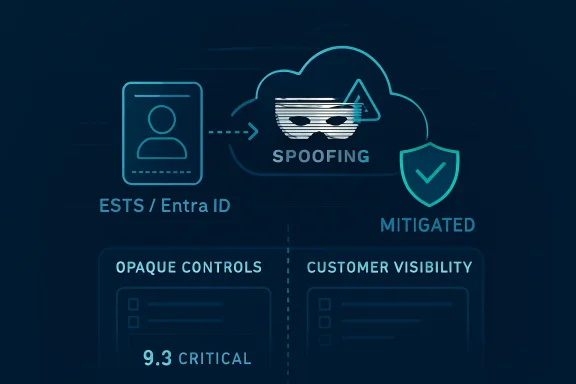
Microsoft disclosed CVE-2026-40379 on May 7, 2026 as a critical spoofing vulnerability in Microsoft Enterprise Security Token Service, saying Azure Entra ID exposed sensitive information to an unauthorized actor and that Microsoft had already fully mitigated the cloud-service issue with no customer action required. The important part is not that admins have another emergency patch to push, because they do not. The important part is that Microsoft has put a critical identity-plane flaw into the public ledger after fixing it, forcing enterprises to confront how much of their security model now depends on opaque cloud controls they cannot inspect, patch, or independently validate.
CVE-2026-40379 is the kind of advisory that looks reassuring at first glance and unsettling on the second read. Microsoft says the vulnerability is already mitigated, has not been publicly disclosed before publication, and has not been exploited in the wild. There is no download link, no KB article, no build number, and no emergency maintenance window for administrators to schedule.
That is precisely what makes it worth paying attention to. In the old Windows world, a critical vulnerability usually arrived with a patch, a reboot plan, a compatibility concern, and a race against weaponization. In the cloud identity world, the same severity can arrive as a note saying the provider has already handled it.
The affected service is Microsoft Enterprise Security Token Service, better known by the acronym ESTS, a core part of the authentication machinery behind Azure Entra ID. When a flaw appears in that layer, the blast radius is measured less in servers and more in trust relationships. Tokens are not just login artifacts; they are the bearer instruments of modern enterprise access.
Microsoft’s short executive summary says the issue involved exposure of sensitive information to an unauthorized actor in Azure Entra ID, allowing an unauthorized attacker to perform spoofing over a network. That is a dense sentence, but its meaning is straightforward enough: something about the handling or disclosure of sensitive data in the identity system could have enabled an attacker to masquerade in a way the system should not have allowed.
Those metrics tell a story even when the advisory withholds implementation details. An attacker would not need an account before beginning the attack, and the vulnerable component could be reached over the network. Successful exploitation would require user interaction, which matters, but the “changed scope” element matters more for identity pros: exploitation could affect resources beyond the original security authority of the vulnerable component.
That is exactly the anxiety around cloud identity vulnerabilities. A token-service bug is rarely just a bug in one service. It can become a question about what downstream services accept, what assumptions relying parties make, and how much evidence defenders can reconstruct after the fact.
The “availability: none” rating is also notable. This was not primarily about knocking a service offline. It was about confidentiality and integrity — the two properties that sit at the center of authentication and authorization. For defenders, a quiet identity compromise is often worse than a noisy outage.
That matters because cloud CVEs often leave customers with less technical evidence than on-premises bugs. There may be no vulnerable DLL to reverse engineer, no patch diff to inspect, and no appliance version to compare. The public record can become the only artifact most defenders ever see.
“Confirmed” does not mean every operational detail is public. It does not mean exploit code exists. It does not mean outsiders can reproduce the flaw. It means the vulnerability is not rumor, and it means Microsoft is putting its name behind the assertion that the weakness existed.
The same table lists exploit code maturity as Unproven. That tempers the immediate threat picture. Microsoft says the issue was not publicly disclosed and not exploited at publication, so the advisory is not telling admins that a live campaign is underway. It is telling them that a serious cloud identity flaw existed, was fixed, and is now being documented for transparency.
But “no customer action” is also a statement about power. Microsoft alone could fix this class of issue because Microsoft alone operates the affected cloud service. Customers consume the identity plane; they do not own it.
That is the bargain enterprises made as they moved from Active Directory forests they could patch, misconfigure, monitor, and occasionally break, into Entra ID tenants backed by Microsoft-operated infrastructure. The cloud service model removes enormous operational burdens, but it also compresses incident response into trust. If Microsoft says it mitigated the problem, customers can ask for transparency, but they cannot apply an alternate patch.
This does not make the cloud model worse by default. In many cases, it is better. A globally deployed mitigation from Microsoft can protect customers faster than any enterprise patch program could. The tradeoff is that defenders must distinguish between resolved risk and unknown exposure, and those are not the same thing.
Yet a critical spoofing vulnerability in ESTS deserves attention precisely because identity failures can be quiet. If an attacker can spoof an identity or abuse token trust, the intrusion may not look like malware at all. It may look like a legitimate session, a valid API call, or a user accessing data from a location the policy engine decided to tolerate.
The phrase “user interaction required” should not lull anyone into complacency. In identity systems, user interaction can be as mundane as following a link, completing a sign-in flow, consenting to an app, or interacting with a workflow that brokers authentication behind the scenes. The advisory does not provide those details, and we should not invent them, but the metric tells us exploitation was not purely attacker-driven.
For WindowsForum readers who have spent years hardening endpoints, this is the uncomfortable shift. Endpoint compromise still matters, but the enterprise crown jewels increasingly sit behind identity decisions made in cloud services. A spoofing flaw in that decision chain can bypass a lot of beautifully managed endpoint hygiene.
The advisory’s impact is spoofing, not information disclosure, which suggests the exposed information mattered because of what it enabled. If a system leaks the wrong token-related data, metadata, claim material, validation context, or trust boundary signal, the downstream consequence may be the ability to convince another component that the attacker is someone else. That is not a mere privacy bug.
This is where cloud identity advisories become difficult for outsiders to parse. Microsoft is unlikely to publish details that would help attackers recreate the logic flaw. Customers, meanwhile, want enough specificity to know whether their logs, conditional access policies, or application registrations require review.
The result is a sparse public document with a high score. That tension is not accidental. It is the price of documenting a critical cloud-service flaw after mitigation without turning the advisory into an attack recipe.
ESTS sits in that identity fabric as the security token service responsible for issuing and processing tokens that applications and services rely on. Most administrators never interact with it directly, which is part of the point. It is plumbing — critical, invisible, and expected to work flawlessly.
That invisibility creates a mismatch between operational dependence and operational observability. A sysadmin can monitor domain controllers, inspect event logs, test Kerberos behavior, and stage Windows updates. With cloud token services, the same admin is often reading a short advisory after the fix has already happened.
This is not an argument to retreat from Entra ID. It is an argument to treat cloud identity as infrastructure, not as a convenience layer. If the token service is critical enough to receive a 9.3 CVSS score when it fails, then tenant configuration, audit retention, app consent governance, and privileged access hygiene are not “identity team” chores. They are core security controls.
Publishing cloud CVEs is the better path. It gives defenders a record, gives risk teams something to track, and gives the broader industry a more honest view of where serious vulnerabilities occur. It also prevents the absurd comparison in which on-premises products look “worse” merely because their flaws are visible while cloud flaws disappear into provider maintenance.
But transparency cannot stop at the CVE number. Enterprises need to know whether a vulnerability had any plausible tenant-specific exposure, whether logs could show suspicious activity, whether Microsoft performed retrospective hunting, and whether customers should review any identity artifacts as a matter of caution. “No action required” answers the patching question; it does not answer every incident-response question.
To be fair, the advisory says the issue was not exploited and was not publicly disclosed. If Microsoft’s internal investigation supports that conclusion, the lack of customer action is understandable. Still, mature customers will want assurance about how that conclusion was reached, even if the underlying technical details remain confidential.
The useful response is to treat this advisory as a reminder to examine the controls that reduce damage when identity behaves unexpectedly. Conditional Access policies, phishing-resistant authentication, privileged identity management, app consent restrictions, sign-in risk policies, workload identity governance, and audit-log retention all become more important when the provider-operated token layer is a black box.
None of those controls “patch” CVE-2026-40379. That is not the point. They limit the ways an attacker can turn an identity anomaly into durable access. They also improve the odds that defenders can see suspicious behavior if a future identity-plane flaw is exploited before it is mitigated.
There is a lesson here for executives as well. Cloud identity risk cannot be delegated entirely to the provider. Microsoft is responsible for the service, but the customer is still responsible for tenant configuration, privilege boundaries, monitoring, and response. Shared responsibility is a cliché because it is true, and because everyone invokes it most loudly after something uncomfortable happens.
For security operations teams, that means CVE-2026-40379 belongs in the risk register, not necessarily in the emergency bridge. It should be documented, understood, and briefed to the people responsible for identity governance. It should not trigger random configuration changes made in the absence of evidence.
This distinction matters because alert fatigue is real. If every critical cloud CVE produces the same all-hands panic as an actively exploited on-premises RCE, organizations will eventually stop listening. The right response is proportional: recognize the architectural seriousness, verify Microsoft’s no-action guidance, and use the moment to improve identity resilience.
The advisory’s temporal score of 8.1 reflects some of that moderation. Official remediation exists, exploit maturity is unproven, and report confidence is confirmed. In plain English, the bug was real, the fix is in, and the known public attack pressure is low.
Source: MSRC Security Update Guide - Microsoft Security Response Center
 Microsoft Turns a Fixed Cloud Bug Into a Public Security Event
CVE-2026-40379 is the kind of advisory that looks reassuring at first glance and unsettling on the second read. Microsoft says the vulnerability is already mitigated, has not been publicly disclosed before publication, and has not been exploited in the wild. There is no download link, no KB article, no build number, and no emergency maintenance window for administrators to schedule.That is precisely what makes it worth paying attention to. In the old Windows world, a critical vulnerability usually arrived with a patch, a reboot plan, a compatibility concern, and a race against weaponization. In the cloud identity world, the same severity can arrive as a note saying the provider has already handled it.
The affected service is Microsoft Enterprise Security Token Service, better known by the acronym ESTS, a core part of the authentication machinery behind Azure Entra ID. When a flaw appears in that layer, the blast radius is measured less in servers and more in trust relationships. Tokens are not just login artifacts; they are the bearer instruments of modern enterprise access.
Microsoft’s short executive summary says the issue involved exposure of sensitive information to an unauthorized actor in Azure Entra ID, allowing an unauthorized attacker to perform spoofing over a network. That is a dense sentence, but its meaning is straightforward enough: something about the handling or disclosure of sensitive data in the identity system could have enabled an attacker to masquerade in a way the system should not have allowed.
The CVSS Score Says “Critical,” Even If the Patch Queue Is Empty
The advisory assigns CVE-2026-40379 a CVSS 3.1 base score of 9.3, with a temporal score of 8.1. That score is not ornamental. It reflects a network-reachable issue with low attack complexity, no privileges required, changed scope, high confidentiality impact, high integrity impact, and no availability impact.Those metrics tell a story even when the advisory withholds implementation details. An attacker would not need an account before beginning the attack, and the vulnerable component could be reached over the network. Successful exploitation would require user interaction, which matters, but the “changed scope” element matters more for identity pros: exploitation could affect resources beyond the original security authority of the vulnerable component.
That is exactly the anxiety around cloud identity vulnerabilities. A token-service bug is rarely just a bug in one service. It can become a question about what downstream services accept, what assumptions relying parties make, and how much evidence defenders can reconstruct after the fact.
The “availability: none” rating is also notable. This was not primarily about knocking a service offline. It was about confidentiality and integrity — the two properties that sit at the center of authentication and authorization. For defenders, a quiet identity compromise is often worse than a noisy outage.
Report Confidence Is the Quiet Signal in the Advisory
The user-highlighted metric, Report Confidence, is listed as Confirmed. In CVSS language, that means the existence of the vulnerability and the credibility of the known technical details are considered strong enough that the issue is not speculative. Microsoft, as the assigning CNA and the vendor of the affected service, has confirmed the vulnerability.That matters because cloud CVEs often leave customers with less technical evidence than on-premises bugs. There may be no vulnerable DLL to reverse engineer, no patch diff to inspect, and no appliance version to compare. The public record can become the only artifact most defenders ever see.
“Confirmed” does not mean every operational detail is public. It does not mean exploit code exists. It does not mean outsiders can reproduce the flaw. It means the vulnerability is not rumor, and it means Microsoft is putting its name behind the assertion that the weakness existed.
The same table lists exploit code maturity as Unproven. That tempers the immediate threat picture. Microsoft says the issue was not publicly disclosed and not exploited at publication, so the advisory is not telling admins that a live campaign is underway. It is telling them that a serious cloud identity flaw existed, was fixed, and is now being documented for transparency.
“No Customer Action” Is Comforting Until You Ask Who Holds the Controls
Microsoft’s FAQ is direct: the vulnerability has already been fully mitigated, and users of the service have nothing to do. In practical terms, that is good news. There is no sprawling patch dependency tree, no fleet of stale servers to inventory, and no month-long lag while remote offices trickle through maintenance windows.But “no customer action” is also a statement about power. Microsoft alone could fix this class of issue because Microsoft alone operates the affected cloud service. Customers consume the identity plane; they do not own it.
That is the bargain enterprises made as they moved from Active Directory forests they could patch, misconfigure, monitor, and occasionally break, into Entra ID tenants backed by Microsoft-operated infrastructure. The cloud service model removes enormous operational burdens, but it also compresses incident response into trust. If Microsoft says it mitigated the problem, customers can ask for transparency, but they cannot apply an alternate patch.
This does not make the cloud model worse by default. In many cases, it is better. A globally deployed mitigation from Microsoft can protect customers faster than any enterprise patch program could. The tradeoff is that defenders must distinguish between resolved risk and unknown exposure, and those are not the same thing.
Identity Bugs Do Not Need Ransomware Theater to Be Serious
Security teams are conditioned to triage by noise. Active exploitation, public proof-of-concept code, ransomware branding, and CISA catalog entries create an obvious queue. CVE-2026-40379 has none of that, at least according to Microsoft’s initial publication.Yet a critical spoofing vulnerability in ESTS deserves attention precisely because identity failures can be quiet. If an attacker can spoof an identity or abuse token trust, the intrusion may not look like malware at all. It may look like a legitimate session, a valid API call, or a user accessing data from a location the policy engine decided to tolerate.
The phrase “user interaction required” should not lull anyone into complacency. In identity systems, user interaction can be as mundane as following a link, completing a sign-in flow, consenting to an app, or interacting with a workflow that brokers authentication behind the scenes. The advisory does not provide those details, and we should not invent them, but the metric tells us exploitation was not purely attacker-driven.
For WindowsForum readers who have spent years hardening endpoints, this is the uncomfortable shift. Endpoint compromise still matters, but the enterprise crown jewels increasingly sit behind identity decisions made in cloud services. A spoofing flaw in that decision chain can bypass a lot of beautifully managed endpoint hygiene.
The Weakness Category Points to Information Exposure, Not a Simple Login Bypass
Microsoft maps the vulnerability to CWE-200: exposure of sensitive information to an unauthorized actor. That classification is easy to underestimate because “information disclosure” sounds less dramatic than “remote code execution.” In an identity system, however, sensitive information can be the raw material of impersonation.The advisory’s impact is spoofing, not information disclosure, which suggests the exposed information mattered because of what it enabled. If a system leaks the wrong token-related data, metadata, claim material, validation context, or trust boundary signal, the downstream consequence may be the ability to convince another component that the attacker is someone else. That is not a mere privacy bug.
This is where cloud identity advisories become difficult for outsiders to parse. Microsoft is unlikely to publish details that would help attackers recreate the logic flaw. Customers, meanwhile, want enough specificity to know whether their logs, conditional access policies, or application registrations require review.
The result is a sparse public document with a high score. That tension is not accidental. It is the price of documenting a critical cloud-service flaw after mitigation without turning the advisory into an attack recipe.
The Entra ID Context Raises the Stakes Beyond One CVE
Azure Entra ID is not just Microsoft’s login page with a new brand name. It is the control plane for Microsoft 365, Azure, application access, device compliance signals, service principals, workload identities, and a sprawling ecosystem of third-party integrations. When Entra ID is in scope, the affected conceptual surface area is enterprise access itself.ESTS sits in that identity fabric as the security token service responsible for issuing and processing tokens that applications and services rely on. Most administrators never interact with it directly, which is part of the point. It is plumbing — critical, invisible, and expected to work flawlessly.
That invisibility creates a mismatch between operational dependence and operational observability. A sysadmin can monitor domain controllers, inspect event logs, test Kerberos behavior, and stage Windows updates. With cloud token services, the same admin is often reading a short advisory after the fix has already happened.
This is not an argument to retreat from Entra ID. It is an argument to treat cloud identity as infrastructure, not as a convenience layer. If the token service is critical enough to receive a 9.3 CVSS score when it fails, then tenant configuration, audit retention, app consent governance, and privileged access hygiene are not “identity team” chores. They are core security controls.
Microsoft’s Transparency Push Is Necessary, but It Is Not Complete
Microsoft has been moving toward greater transparency for cloud-service CVEs, and CVE-2026-40379 fits that pattern. Historically, many cloud vulnerabilities were fixed silently because there was no customer patch to ship. That was convenient, but it also distorted the public understanding of risk.Publishing cloud CVEs is the better path. It gives defenders a record, gives risk teams something to track, and gives the broader industry a more honest view of where serious vulnerabilities occur. It also prevents the absurd comparison in which on-premises products look “worse” merely because their flaws are visible while cloud flaws disappear into provider maintenance.
But transparency cannot stop at the CVE number. Enterprises need to know whether a vulnerability had any plausible tenant-specific exposure, whether logs could show suspicious activity, whether Microsoft performed retrospective hunting, and whether customers should review any identity artifacts as a matter of caution. “No action required” answers the patching question; it does not answer every incident-response question.
To be fair, the advisory says the issue was not exploited and was not publicly disclosed. If Microsoft’s internal investigation supports that conclusion, the lack of customer action is understandable. Still, mature customers will want assurance about how that conclusion was reached, even if the underlying technical details remain confidential.
The Real Work for Admins Is Not Patching, but Posture
Because CVE-2026-40379 requires no customer remediation, some organizations will close the ticket immediately. That may be operationally rational. It is also a missed opportunity.The useful response is to treat this advisory as a reminder to examine the controls that reduce damage when identity behaves unexpectedly. Conditional Access policies, phishing-resistant authentication, privileged identity management, app consent restrictions, sign-in risk policies, workload identity governance, and audit-log retention all become more important when the provider-operated token layer is a black box.
None of those controls “patch” CVE-2026-40379. That is not the point. They limit the ways an attacker can turn an identity anomaly into durable access. They also improve the odds that defenders can see suspicious behavior if a future identity-plane flaw is exploited before it is mitigated.
There is a lesson here for executives as well. Cloud identity risk cannot be delegated entirely to the provider. Microsoft is responsible for the service, but the customer is still responsible for tenant configuration, privilege boundaries, monitoring, and response. Shared responsibility is a cliché because it is true, and because everyone invokes it most loudly after something uncomfortable happens.
Critical Does Not Always Mean Panic
The word “critical” is doing two jobs in this advisory. It describes the theoretical severity of successful exploitation, and it competes with the mitigating facts that Microsoft has already fixed the service-side issue and reports no exploitation. Those two truths can coexist.For security operations teams, that means CVE-2026-40379 belongs in the risk register, not necessarily in the emergency bridge. It should be documented, understood, and briefed to the people responsible for identity governance. It should not trigger random configuration changes made in the absence of evidence.
This distinction matters because alert fatigue is real. If every critical cloud CVE produces the same all-hands panic as an actively exploited on-premises RCE, organizations will eventually stop listening. The right response is proportional: recognize the architectural seriousness, verify Microsoft’s no-action guidance, and use the moment to improve identity resilience.
The advisory’s temporal score of 8.1 reflects some of that moderation. Official remediation exists, exploit maturity is unproven, and report confidence is confirmed. In plain English, the bug was real, the fix is in, and the known public attack pressure is low.
The ESTS Advisory Leaves Five Practical Signals Behind
CVE-2026-40379 is not a patching fire drill, but it is a useful stress test for how organizations think about cloud identity risk. The concrete lessons are less about this one fixed flaw than about the operating model it exposes.- Microsoft published CVE-2026-40379 on May 7, 2026 as a critical ESTS spoofing vulnerability affecting Azure Entra ID, with the issue already mitigated by Microsoft.
- The CVSS 3.1 base score is 9.3, driven by network attack vector, low complexity, no privileges required, changed scope, and high confidentiality and integrity impact.
- Microsoft says the vulnerability was not publicly disclosed and not exploited at the time of publication, while also marking report confidence as confirmed.
- There is no customer patch, KB article, download, or build number because the affected component is a Microsoft-operated cloud service.
- The advisory should prompt identity-posture review, not improvised remediation, especially around privileged access, app consent, Conditional Access, and audit visibility.
Source: MSRC Security Update Guide - Microsoft Security Response Center
