

Microsoft published CVE-2026-35428 on May 7, 2026, describing a critical Azure Cloud Shell spoofing vulnerability caused by command-injection weakness, already mitigated by Microsoft, requiring no customer action, and assessed with confirmed report confidence but no public disclosure or exploitation.
That combination is the whole story and the problem with the story. A critical cloud CVE that users cannot patch themselves is not a conventional Patch Tuesday item; it is a transparency artifact from a world where the most important fixes increasingly happen behind the curtain. CVE-2026-35428 is less a call to install an update than a reminder that the cloud has quietly changed what “vulnerability management” means.
For Windows admins trained by decades of monthly servicing, the phrase “critical vulnerability” usually starts a familiar ritual: identify affected systems, test updates, schedule reboots, monitor failures, and explain residual risk to management. CVE-2026-35428 does not fit that muscle memory. Microsoft’s own guidance says the Azure Cloud Shell issue has already been fully mitigated and that users of the service have no steps to take.
That is good news in the narrow sense. No emergency maintenance window, no GPO scramble, no fleet of stubborn servers waiting for a cumulative update, and no awkward weekend message to developers who depend on the shell for Azure operations. The vendor-operated service model did what it promises to do: Microsoft fixed the vulnerable service centrally.
But that same model also compresses the customer’s visibility. If you were exposed, you may not know exactly how, when, or for how long. If you were not exposed in any meaningful way, you may still have to account for a critical CVE in audits, risk registers, and executive dashboards. Cloud patching solves the deployment problem, but it does not automatically solve the governance problem.
The uncomfortable truth is that “no customer action” is not the same as “no customer interest.” It means customers cannot remediate the defect directly. They still have to understand whether the service sat in a path that could affect privileged workflows, sensitive subscriptions, automation scripts, or administrative habits.
The CVSS vector gives the shape of the risk. The attack vector is network, attack complexity is low, privileges required are none, and user interaction is required. Scope is changed, and the confidentiality, integrity, and availability impacts are all rated high. That is how the base score reaches 9.6, firmly in critical territory.
User interaction is the one moderating factor in the base metrics, but it should not lull anyone. In cloud administration, “user interaction” can mean a privileged person clicking, pasting, authenticating, opening, or initiating an action inside a context that already has enormous authority. A vulnerability that needs a user can still be dangerous if the user is an Azure administrator, platform engineer, or developer with access to production resources.
The most revealing part is the changed scope. CVSS uses that term when exploitation can affect a security authority beyond the vulnerable component itself. In plain English, the concern is not merely that Cloud Shell behaved badly; it is that a flaw in Cloud Shell could have consequences outside the immediate boundary of Cloud Shell.
A local terminal usually inherits the hygiene of the machine it runs on. Cloud Shell inherits something different: authenticated proximity to Azure, browser-mediated access, preinstalled tools, persistent storage options, and a workflow that encourages quick operational commands. It is not merely a terminal window; it is a privileged operational surface.
That surface often sits adjacent to sensitive tasks. Engineers use it to inspect subscriptions, manipulate resource groups, run Azure CLI commands, deploy templates, troubleshoot identity and networking, and bridge gaps when a local workstation is missing tooling. The more organizations normalize browser-based administration, the more Cloud Shell becomes a quiet control plane for the control plane.
This is why the vulnerability’s service-side mitigation should be treated as a relief, not a dismissal. The absence of a customer patch does not erase the architectural lesson. Any browser-accessible administrative shell is a high-value boundary, and the more frictionless it becomes, the more carefully it has to be isolated, logged, and governed.
That distinction matters in a cloud CVE. Customers often receive less technical depth than they would for a locally installed product because the vulnerable implementation is not sitting on their machines. There may be no patch binary to reverse, no public proof of concept, and no affected build number to compare against an asset inventory. The confidence metric becomes one of the few strong signals available.
Here, the signal is unusually clear. The exploit code maturity is unproven, public disclosure is marked no, and exploitation is marked no. At the same time, report confidence is confirmed and the severity is critical. That combination says: do not panic about known exploitation, but do not dismiss the underlying weakness as speculative.
For attackers, confirmed confidence can also be useful. It tells them the class of bug existed in a valuable service, even if the exact route has not been published. For defenders, the same signal should prompt review of how Cloud Shell is permitted, monitored, and constrained in the tenant, because the next similar issue may not be centrally fixed before anyone notices.
A vulnerability scanner wants a version, a patch, a package, or a registry state. A cloud CVE may offer none of those. The affected product is Azure Cloud Shell, the platform field is effectively not applicable, there is no KB article, no download, no build number, and the customer action field says not required. Traditional tooling can record the CVE, but it cannot remediate it in the old sense.
This is where security teams need to separate remediation from response. Microsoft has remediated the service. Customers may still need to respond internally by documenting the vendor fix, checking whether Cloud Shell usage is allowed in sensitive tenants, reviewing logs around the disclosure window where appropriate, and updating risk narratives for auditors.
The difference is subtle but important. Remediation closes the defect. Response proves that the organization understood the defect’s relevance to its environment. In regulated shops, the second task often takes longer than the first.
This is an improvement over the old cloud-security fog, where service-side bugs could be fixed silently unless they became newsworthy. Public CVEs give defenders a record, researchers a recognition path, and customers a way to discuss risk with something more concrete than “Microsoft handled it.” The acknowledgement of Tomasz Bojarski with Web Safety also shows that coordinated vulnerability disclosure is functioning here.
But transparency has layers. Publishing a CVE is not the same as publishing enough operational detail for every customer to assess exposure. Microsoft has to balance attacker enablement against defender usefulness, especially when the issue involves a live cloud service used by many tenants. The result is a controlled disclosure that confirms the flaw but leaves much of the practical blast-radius analysis to inference.
That tradeoff is defensible, but it should not be invisible. Vendors gain trust by disclosing cloud vulnerabilities, yet customers still need enough specificity to decide whether to investigate logs, brief leadership, or alter service usage. The next frontier for cloud CVEs is not merely more publication; it is better customer-consumable context.
The temporal score, however, is lower at 8.3 because exploit maturity is unproven and an official fix exists. This is exactly what temporal scoring is supposed to capture. Severity tells you how bad the bug could be; temporal context tells you how urgent it is in the world as currently observed.
That distinction is often lost in executive reporting. A critical CVE in a self-managed internet-facing product with active exploitation is not operationally equivalent to a critical cloud-service CVE that the vendor has already mitigated and says has not been publicly disclosed or exploited. Both are serious. They do not demand the same response.
The right posture is disciplined calm. Treat the vulnerability as real, confirmed, and important. Do not invent emergency patch steps that do not exist. Focus instead on Cloud Shell governance, identity hygiene, privileged-user behavior, and evidence that Microsoft’s mitigation status has been recorded in your vulnerability-management process.
Many organizations treat Cloud Shell as harmless because it is built into the portal experience. That assumption deserves scrutiny. A shell with Azure CLI and PowerShell available inside an authenticated browser session is not just another webpage; it is an administrative execution environment.
Conditional Access, privileged identity management, session controls, and logging become the compensating controls that matter. If a future Cloud Shell-class flaw requires user interaction, the risk is shaped heavily by which users can be induced to interact and what their sessions can reach. Least privilege is not an abstract principle here; it is the difference between a contained service issue and a tenant-impacting incident.
The same applies to training. Administrators should be cautious about pasting commands from untrusted sources, launching Cloud Shell from unexpected prompts, or treating browser-based admin surfaces as lower risk than local terminals. The browser has become the workstation for cloud operations, and the security model has to catch up.
Researcher credit also suggests that external scrutiny of cloud administrative surfaces remains active. That is healthy. Azure, like every major cloud platform, is too large and too complex to rely only on internal review. Bugs in managed services can affect many customers at once, so the incentive structure for responsible reporting matters.
At the same time, public credit without deep technical detail can frustrate defenders. Security teams want to know whether the issue touched tokens, command execution paths, rendered content, shell initialization, storage mounts, or portal handoffs. Microsoft’s advisory does not hand them that full map.
That tension is not going away. The cloud needs vulnerability disclosure that is safe enough not to create fresh exploitation, but specific enough for serious customers to make decisions. CVE-2026-35428 lands on the conservative side of that line.
Neither model is inherently superior. The Windows model gives customers control and pain in equal measure. The cloud model gives customers speed and opacity in equal measure. Mature IT shops need to be fluent in both.
That fluency affects reporting. A vulnerability-management program that treats every CVE as something a scanner must close will mis-handle cloud advisories. A program that treats every “no action required” cloud CVE as irrelevant will miss the chance to improve governance around powerful services.
The best approach is to create a separate lane for vendor-mitigated cloud CVEs. Record them, verify vendor status, map them to service usage, decide whether log review is warranted, and close them with evidence that makes sense for a managed service. That is not bureaucracy; it is adaptation.
Source: MSRC Security Update Guide - Microsoft Security Response Center
That combination is the whole story and the problem with the story. A critical cloud CVE that users cannot patch themselves is not a conventional Patch Tuesday item; it is a transparency artifact from a world where the most important fixes increasingly happen behind the curtain. CVE-2026-35428 is less a call to install an update than a reminder that the cloud has quietly changed what “vulnerability management” means.
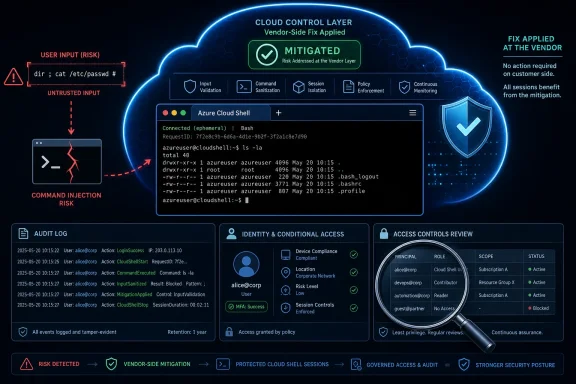 Microsoft’s Cloud Patch Was Finished Before Customers Could Begin
For Windows admins trained by decades of monthly servicing, the phrase “critical vulnerability” usually starts a familiar ritual: identify affected systems, test updates, schedule reboots, monitor failures, and explain residual risk to management. CVE-2026-35428 does not fit that muscle memory. Microsoft’s own guidance says the Azure Cloud Shell issue has already been fully mitigated and that users of the service have no steps to take.That is good news in the narrow sense. No emergency maintenance window, no GPO scramble, no fleet of stubborn servers waiting for a cumulative update, and no awkward weekend message to developers who depend on the shell for Azure operations. The vendor-operated service model did what it promises to do: Microsoft fixed the vulnerable service centrally.
But that same model also compresses the customer’s visibility. If you were exposed, you may not know exactly how, when, or for how long. If you were not exposed in any meaningful way, you may still have to account for a critical CVE in audits, risk registers, and executive dashboards. Cloud patching solves the deployment problem, but it does not automatically solve the governance problem.
The uncomfortable truth is that “no customer action” is not the same as “no customer interest.” It means customers cannot remediate the defect directly. They still have to understand whether the service sat in a path that could affect privileged workflows, sensitive subscriptions, automation scripts, or administrative habits.
A Spoofing Label Hides a Command-Injection Core
The headline impact is spoofing, but the weakness classification points to command injection: improper neutralization of special elements used in a command. That matters because “spoofing” often sounds like a user-interface trick or an identity misrepresentation problem, while command injection suggests something more mechanically dangerous. It implies that input reaching a command context was not handled safely enough.The CVSS vector gives the shape of the risk. The attack vector is network, attack complexity is low, privileges required are none, and user interaction is required. Scope is changed, and the confidentiality, integrity, and availability impacts are all rated high. That is how the base score reaches 9.6, firmly in critical territory.
User interaction is the one moderating factor in the base metrics, but it should not lull anyone. In cloud administration, “user interaction” can mean a privileged person clicking, pasting, authenticating, opening, or initiating an action inside a context that already has enormous authority. A vulnerability that needs a user can still be dangerous if the user is an Azure administrator, platform engineer, or developer with access to production resources.
The most revealing part is the changed scope. CVSS uses that term when exploitation can affect a security authority beyond the vulnerable component itself. In plain English, the concern is not merely that Cloud Shell behaved badly; it is that a flaw in Cloud Shell could have consequences outside the immediate boundary of Cloud Shell.
Cloud Shell Is Not Just a Convenience Terminal
Azure Cloud Shell has always been marketed as convenience: a browser-accessible shell with Azure tooling ready to go. For many organizations, it is the shortest path from intent to infrastructure change. That is precisely why a critical vulnerability there deserves attention even after Microsoft has mitigated it.A local terminal usually inherits the hygiene of the machine it runs on. Cloud Shell inherits something different: authenticated proximity to Azure, browser-mediated access, preinstalled tools, persistent storage options, and a workflow that encourages quick operational commands. It is not merely a terminal window; it is a privileged operational surface.
That surface often sits adjacent to sensitive tasks. Engineers use it to inspect subscriptions, manipulate resource groups, run Azure CLI commands, deploy templates, troubleshoot identity and networking, and bridge gaps when a local workstation is missing tooling. The more organizations normalize browser-based administration, the more Cloud Shell becomes a quiet control plane for the control plane.
This is why the vulnerability’s service-side mitigation should be treated as a relief, not a dismissal. The absence of a customer patch does not erase the architectural lesson. Any browser-accessible administrative shell is a high-value boundary, and the more frictionless it becomes, the more carefully it has to be isolated, logged, and governed.
The Report Confidence Metric Is Doing Real Work Here
The user-supplied excerpt about report confidence goes to the heart of this CVE. Microsoft rates the report confidence as confirmed, which means the vendor is not merely passing along a rumor or documenting a theoretical issue. The vulnerability’s existence is acknowledged with enough confidence that defenders should treat it as real, even though exploit details are not publicly laid out.That distinction matters in a cloud CVE. Customers often receive less technical depth than they would for a locally installed product because the vulnerable implementation is not sitting on their machines. There may be no patch binary to reverse, no public proof of concept, and no affected build number to compare against an asset inventory. The confidence metric becomes one of the few strong signals available.
Here, the signal is unusually clear. The exploit code maturity is unproven, public disclosure is marked no, and exploitation is marked no. At the same time, report confidence is confirmed and the severity is critical. That combination says: do not panic about known exploitation, but do not dismiss the underlying weakness as speculative.
For attackers, confirmed confidence can also be useful. It tells them the class of bug existed in a valuable service, even if the exact route has not been published. For defenders, the same signal should prompt review of how Cloud Shell is permitted, monitored, and constrained in the tenant, because the next similar issue may not be centrally fixed before anyone notices.
“No Customer Action” Is a Cloud-Era Ambiguity
Microsoft’s FAQ states that the vulnerability was fully mitigated and that no user action is required. That is the cleanest possible operational outcome. It is also the phrase that will cause the most confusion in enterprises that have built compliance machinery around patchable artifacts.A vulnerability scanner wants a version, a patch, a package, or a registry state. A cloud CVE may offer none of those. The affected product is Azure Cloud Shell, the platform field is effectively not applicable, there is no KB article, no download, no build number, and the customer action field says not required. Traditional tooling can record the CVE, but it cannot remediate it in the old sense.
This is where security teams need to separate remediation from response. Microsoft has remediated the service. Customers may still need to respond internally by documenting the vendor fix, checking whether Cloud Shell usage is allowed in sensitive tenants, reviewing logs around the disclosure window where appropriate, and updating risk narratives for auditors.
The difference is subtle but important. Remediation closes the defect. Response proves that the organization understood the defect’s relevance to its environment. In regulated shops, the second task often takes longer than the first.
The Transparency Program Is Becoming the Product
Microsoft has spent the past several years expanding the way it publishes cloud-service CVEs. The stated purpose is transparency: customers should know when vulnerabilities existed in Microsoft-operated services even if the fixes were deployed by Microsoft before the advisory appeared. CVE-2026-35428 is a textbook example of that philosophy.This is an improvement over the old cloud-security fog, where service-side bugs could be fixed silently unless they became newsworthy. Public CVEs give defenders a record, researchers a recognition path, and customers a way to discuss risk with something more concrete than “Microsoft handled it.” The acknowledgement of Tomasz Bojarski with Web Safety also shows that coordinated vulnerability disclosure is functioning here.
But transparency has layers. Publishing a CVE is not the same as publishing enough operational detail for every customer to assess exposure. Microsoft has to balance attacker enablement against defender usefulness, especially when the issue involves a live cloud service used by many tenants. The result is a controlled disclosure that confirms the flaw but leaves much of the practical blast-radius analysis to inference.
That tradeoff is defensible, but it should not be invisible. Vendors gain trust by disclosing cloud vulnerabilities, yet customers still need enough specificity to decide whether to investigate logs, brief leadership, or alter service usage. The next frontier for cloud CVEs is not merely more publication; it is better customer-consumable context.
Critical Does Not Always Mean Active Fire
A 9.6 base score will light up dashboards, and rightly so. The score reflects a worst-case technical assessment: network reachability, low complexity, no privileges required, changed scope, and high impact across confidentiality, integrity, and availability. Those are not mild ingredients.The temporal score, however, is lower at 8.3 because exploit maturity is unproven and an official fix exists. This is exactly what temporal scoring is supposed to capture. Severity tells you how bad the bug could be; temporal context tells you how urgent it is in the world as currently observed.
That distinction is often lost in executive reporting. A critical CVE in a self-managed internet-facing product with active exploitation is not operationally equivalent to a critical cloud-service CVE that the vendor has already mitigated and says has not been publicly disclosed or exploited. Both are serious. They do not demand the same response.
The right posture is disciplined calm. Treat the vulnerability as real, confirmed, and important. Do not invent emergency patch steps that do not exist. Focus instead on Cloud Shell governance, identity hygiene, privileged-user behavior, and evidence that Microsoft’s mitigation status has been recorded in your vulnerability-management process.
Azure Administrators Should Look at Habits, Not Hotfixes
Because there is no customer patch, the practical customer conversation shifts toward administrative behavior. Who can use Cloud Shell? In which tenants? Under what conditional access policies? Are privileged accounts allowed to launch it from unmanaged devices or risky sessions?Many organizations treat Cloud Shell as harmless because it is built into the portal experience. That assumption deserves scrutiny. A shell with Azure CLI and PowerShell available inside an authenticated browser session is not just another webpage; it is an administrative execution environment.
Conditional Access, privileged identity management, session controls, and logging become the compensating controls that matter. If a future Cloud Shell-class flaw requires user interaction, the risk is shaped heavily by which users can be induced to interact and what their sessions can reach. Least privilege is not an abstract principle here; it is the difference between a contained service issue and a tenant-impacting incident.
The same applies to training. Administrators should be cautious about pasting commands from untrusted sources, launching Cloud Shell from unexpected prompts, or treating browser-based admin surfaces as lower risk than local terminals. The browser has become the workstation for cloud operations, and the security model has to catch up.
The Researcher Credit Is a Small but Important Signal
The acknowledgement section credits Tomasz Bojarski with Web Safety. That may look like a footnote, but it is part of the trust chain. A named researcher and coordinated disclosure process give customers more confidence than an anonymous, unexplained advisory appearing out of nowhere.Researcher credit also suggests that external scrutiny of cloud administrative surfaces remains active. That is healthy. Azure, like every major cloud platform, is too large and too complex to rely only on internal review. Bugs in managed services can affect many customers at once, so the incentive structure for responsible reporting matters.
At the same time, public credit without deep technical detail can frustrate defenders. Security teams want to know whether the issue touched tokens, command execution paths, rendered content, shell initialization, storage mounts, or portal handoffs. Microsoft’s advisory does not hand them that full map.
That tension is not going away. The cloud needs vulnerability disclosure that is safe enough not to create fresh exploitation, but specific enough for serious customers to make decisions. CVE-2026-35428 lands on the conservative side of that line.
Windows Admins Are Learning a New Patch Language
For WindowsForum readers, the broader lesson is that Microsoft security work now spans two very different operational cultures. Windows servicing remains artifact-driven: KBs, builds, reboots, supersedence, deployment rings, and rollback plans. Azure service security is state-driven: Microsoft changes the service, publishes the record, and customers inherit the fixed condition.Neither model is inherently superior. The Windows model gives customers control and pain in equal measure. The cloud model gives customers speed and opacity in equal measure. Mature IT shops need to be fluent in both.
That fluency affects reporting. A vulnerability-management program that treats every CVE as something a scanner must close will mis-handle cloud advisories. A program that treats every “no action required” cloud CVE as irrelevant will miss the chance to improve governance around powerful services.
The best approach is to create a separate lane for vendor-mitigated cloud CVEs. Record them, verify vendor status, map them to service usage, decide whether log review is warranted, and close them with evidence that makes sense for a managed service. That is not bureaucracy; it is adaptation.
The Real Patch Is the Control Plane Around the Shell
CVE-2026-35428 does not ask customers to install anything, but it does ask them to think harder about how browser-based administration is governed. The concrete lessons are less about this single mitigated flaw than about the next one that lands in a similarly privileged service.- Microsoft released CVE-2026-35428 on May 7, 2026, for Azure Cloud Shell and says the vulnerability has already been fully mitigated.
- The advisory rates the issue critical with a CVSS 3.1 base score of 9.6 and describes the underlying weakness as command injection leading to spoofing impact.
- Microsoft says there is no public disclosure and no known exploitation at the time of publication, while also rating report confidence as confirmed.
- Customers do not have a patch, KB, download, or build number to deploy because this is a Microsoft-operated cloud service fix.
- Security teams should document the vendor mitigation, review Cloud Shell governance, and ensure privileged browser-based administration is covered by identity, access, and logging controls.
- The advisory is a reminder that cloud CVEs require a different workflow from traditional Windows patch management.
Source: MSRC Security Update Guide - Microsoft Security Response Center
