

CVE-2026-41089 is a Microsoft-disclosed Windows Netlogon remote code execution vulnerability published in the Security Update Guide on May 12, 2026, affecting the authentication plumbing Windows domains use to establish trusted communication between domain-joined machines and domain controllers. That combination — Netlogon plus remote code execution — is why this entry deserves more than a routine Patch Tuesday skim. Even when Microsoft withholds exploit mechanics, the affected component tells administrators where the blast radius may begin: the domain itself.
Netlogon is not one more Windows service sitting quietly in the background. It is part of the machinery that lets Windows clients locate domain controllers, maintain secure channels, validate machine trust, and keep Active Directory environments coherent. If that layer is wrong, the failure mode is not merely a crashed workstation or a broken line-of-business app; it can become a problem of identity, privilege, and control.
That is why a Netlogon RCE lands differently from a client-side document bug or a local privilege escalation flaw. Remote code execution in domain infrastructure raises the specter of attack paths that do not require convincing a user to open a file. Microsoft’s public guidance for CVE-2026-41089, as of disclosure, appears intentionally sparse on root cause details, which is normal for high-risk Windows vulnerabilities during the patch window.
The absence of deep technical detail should not be confused with uncertainty about the vulnerability’s existence. The user-supplied MSRC text describes a confidence metric that measures whether a vulnerability is merely rumored, partially understood, or vendor-confirmed. In this case, the key fact is vendor acknowledgment: Microsoft has assigned the CVE, named the affected Windows component, and placed it in the Security Update Guide.
That matters operationally. Attackers do not need a full write-up to begin diffing patches, probing exposed services, and correlating old protocol behavior with new binaries. Defenders, meanwhile, do not get to wait for a polished exploit blog post before deciding whether domain controllers belong at the front of the deployment queue.
That is the danger zone for Windows domain teams. When exploitability details are thin, some organizations instinctively downgrade urgency because they cannot yet picture the attack. A better reading is the opposite: if the vulnerability is in Netlogon and Microsoft has shipped a fix, the patch is the most authoritative mitigation administrators are going to get in the first hours and days.
The historical lesson is not subtle. Netlogon has been the center of major domain-security events before, most famously with Zerologon in 2020. CVE-2026-41089 should not be treated as the same bug, and there is no responsible basis to claim it has the same mechanics. But it belongs to the same class of concern: weaknesses in the protocol and service layer that underwrites Windows domain trust.
That history changes the burden of proof. A Netlogon vulnerability does not need a catchy name to matter. It only needs a path from remote interaction to code execution or domain-control impact, and the Security Update Guide title says enough to justify immediate attention.
But CVE-2026-41089 highlights the weakness in that conservative model. The more central a server is, the more dangerous it becomes to leave it behind. Domain controllers are not merely high-availability assets; they are high-consequence assets. They broker identity for almost everything else.
A Netlogon RCE shifts patch priority away from the usual desktop-first or internet-edge-first rhythm. The best target order will vary by environment, but the logic should be explicit: test quickly, patch domain controllers in controlled waves, verify replication and authentication, and then move through member servers and clients according to exposure and dependency.
The risk is not only that an attacker might compromise a domain controller directly. It is also that the vulnerability may interact with old trust relationships, stale machine accounts, third-party domain integrations, or legacy devices still relying on compatibility behavior. The environments most likely to delay Netlogon hardening are often the same environments with the most brittle identity dependencies.
The real question is whether defenders can act without perfect knowledge. For CVE-2026-41089, they can. The affected component points administrators toward domain controllers, Netlogon service behavior, authentication flows, and patch compliance. The vulnerability class points toward remote exploitation risk rather than purely local misuse.
This is where security teams should resist the temptation to overfit on CVSS subfields or exploit-maturity labels. Those fields are useful, but they are not a substitute for asset context. A medium-complexity vulnerability in a domain controller can be more urgent than a theoretically higher-scored bug in a rarely installed optional component.
There is also a communications problem inside many enterprises. “Microsoft published a Netlogon RCE” is the sentence that should move the change calendar. “No public exploit is known yet” is not the sentence that should stop it. The latter may buy testing time, not postponement.
That asymmetry is especially sharp for Windows Server. Domain controllers are usually patched with more caution than clients, and rightly so. But the existence of caution is not an argument for delay; it is an argument for rehearsed procedure. Organizations that have a known-good DC patch workflow are in a much better position than those improvising under pressure.
For CVE-2026-41089, administrators should assume that vulnerability scanners and endpoint-management products will quickly begin flagging missing updates. That creates its own noise. The useful signal is not simply “vulnerable” or “not vulnerable,” but which domain controllers, writable DCs, read-only DCs, branch-office systems, and dependent servers remain exposed after the first deployment wave.
The uncomfortable truth is that patch management for identity infrastructure cannot be solved during the month a Netlogon RCE appears. If the organization cannot patch a domain controller quickly because nobody trusts the rollback plan, that is not just a vulnerability-management issue. It is an architecture and operations issue that deserves executive visibility.
That is why Netlogon hardening has historically been messy. Microsoft can patch Windows, but it cannot instantly modernize every device that speaks to a domain controller. When a vulnerability touches secure channels or RPC behavior, defenders often discover forgotten dependencies only after enforcement changes expose them.
CVE-2026-41089 should therefore prompt more than a binary patch check. It should trigger a quick inventory of systems that talk to domain controllers in unusual ways. Legacy devices, non-Windows domain members, old Samba implementations, identity synchronization tools, and branch-office appliances deserve scrutiny.
This does not mean administrators should panic-disable services or break trusts on speculation. It means patching should be paired with observation. Event logs, authentication failures, Netlogon operational logs, and help-desk reports may reveal compatibility debt that has been invisible precisely because it has been allowed to keep working.
That is why “not publicly exploited” is a perishable status. It may be true at publication and irrelevant a week later. Once patches exist, attackers can study them, while defenders must deploy them across messy, distributed estates. The more central the component, the more attractive the research target.
Netlogon is attractive because it lives close to authentication. It is reachable in domain environments by design. It is also tied to machines, trusts, and services that administrators may not think of as exposed in the same way as a web server. That mismatch between perceived exposure and actual reachability is exactly where enterprise Windows risk often accumulates.
The sensible assumption is not that CVE-2026-41089 is already being exploited everywhere. The sensible assumption is that it will receive attention from capable researchers, red teams, and criminal operators because the payoff could be significant if the bug is practically exploitable.
The second move is sequencing. Patch a representative domain controller in a test or lower-risk site, validate authentication, Group Policy processing, replication, DNS registration, and application logons, then expand in waves. If the organization runs read-only domain controllers, child domains, or complex forest trusts, those should be included in validation rather than treated as edge cases.
The third move is telemetry. Administrators should watch for Netlogon errors, secure-channel failures, replication issues, and unusual authentication events before and after patching. A clean patch deployment is not simply one where the installer exits successfully. It is one where the identity fabric continues to behave normally.
The fourth move is communication. Application owners should know that domain-controller maintenance is not routine housekeeping this month. Help desks should be ready for password, trust, and logon symptoms that may appear if long-neglected dependencies surface.
That is where local risk modeling matters. For a small business with a single supported domain controller and automatic updates, the response may be straightforward. For a multinational with multiple forests, hybrid identity, third-party authentication tooling, and regulated maintenance windows, CVE-2026-41089 becomes a coordination exercise.
The right question is not merely whether the vulnerability is critical in the abstract. The right question is whether a compromise of the affected service could accelerate an attacker from foothold to domain-level control. In most Active Directory environments, the answer is uncomfortable enough to justify urgency.
This is also a reminder that vulnerability management should rank assets, not just CVEs. A domain controller missing one important update may deserve more attention than dozens of laptops missing lower-impact patches. Patch dashboards that flatten all vulnerable machines into the same red count can obscure the systems that actually decide the fate of the network.
Source: MSRC Security Update Guide - Microsoft Security Response Center
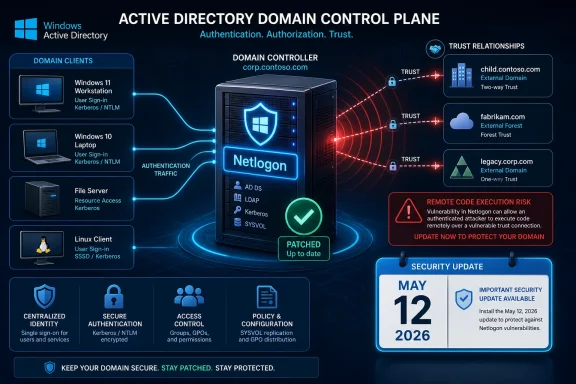 Microsoft Puts a Red Flag on the Domain Trust Layer
Netlogon is not one more Windows service sitting quietly in the background. It is part of the machinery that lets Windows clients locate domain controllers, maintain secure channels, validate machine trust, and keep Active Directory environments coherent. If that layer is wrong, the failure mode is not merely a crashed workstation or a broken line-of-business app; it can become a problem of identity, privilege, and control.That is why a Netlogon RCE lands differently from a client-side document bug or a local privilege escalation flaw. Remote code execution in domain infrastructure raises the specter of attack paths that do not require convincing a user to open a file. Microsoft’s public guidance for CVE-2026-41089, as of disclosure, appears intentionally sparse on root cause details, which is normal for high-risk Windows vulnerabilities during the patch window.
The absence of deep technical detail should not be confused with uncertainty about the vulnerability’s existence. The user-supplied MSRC text describes a confidence metric that measures whether a vulnerability is merely rumored, partially understood, or vendor-confirmed. In this case, the key fact is vendor acknowledgment: Microsoft has assigned the CVE, named the affected Windows component, and placed it in the Security Update Guide.
That matters operationally. Attackers do not need a full write-up to begin diffing patches, probing exposed services, and correlating old protocol behavior with new binaries. Defenders, meanwhile, do not get to wait for a polished exploit blog post before deciding whether domain controllers belong at the front of the deployment queue.
The Confidence Metric Is Really a Race Clock
Microsoft’s confidence language can sound academic, but for administrators it translates into a simple question: how much does the world know, and how quickly can that knowledge become weaponized? A vendor-confirmed vulnerability with limited public detail sits in an uncomfortable middle ground. It is real enough to prioritize, but opaque enough to make compensating controls imprecise.That is the danger zone for Windows domain teams. When exploitability details are thin, some organizations instinctively downgrade urgency because they cannot yet picture the attack. A better reading is the opposite: if the vulnerability is in Netlogon and Microsoft has shipped a fix, the patch is the most authoritative mitigation administrators are going to get in the first hours and days.
The historical lesson is not subtle. Netlogon has been the center of major domain-security events before, most famously with Zerologon in 2020. CVE-2026-41089 should not be treated as the same bug, and there is no responsible basis to claim it has the same mechanics. But it belongs to the same class of concern: weaknesses in the protocol and service layer that underwrites Windows domain trust.
That history changes the burden of proof. A Netlogon vulnerability does not need a catchy name to matter. It only needs a path from remote interaction to code execution or domain-control impact, and the Security Update Guide title says enough to justify immediate attention.
Domain Controllers Are Not Just Servers With Better Uptime
Many patching programs still treat domain controllers as fragile appliances: touch them last, change them carefully, and never risk authentication outages during business hours. That instinct is understandable. A bad domain-controller patch can break logons, Kerberos flows, legacy trusts, or applications that were designed around assumptions nobody remembers.But CVE-2026-41089 highlights the weakness in that conservative model. The more central a server is, the more dangerous it becomes to leave it behind. Domain controllers are not merely high-availability assets; they are high-consequence assets. They broker identity for almost everything else.
A Netlogon RCE shifts patch priority away from the usual desktop-first or internet-edge-first rhythm. The best target order will vary by environment, but the logic should be explicit: test quickly, patch domain controllers in controlled waves, verify replication and authentication, and then move through member servers and clients according to exposure and dependency.
The risk is not only that an attacker might compromise a domain controller directly. It is also that the vulnerability may interact with old trust relationships, stale machine accounts, third-party domain integrations, or legacy devices still relying on compatibility behavior. The environments most likely to delay Netlogon hardening are often the same environments with the most brittle identity dependencies.
Sparse Disclosure Is a Defensive Feature, Not a Comfort Blanket
Microsoft’s modern vulnerability pages often contain enough metadata to drive risk scoring but not enough technical detail to reproduce the bug. That frustrates defenders who want precision, and it frustrates researchers who want transparency. But for freshly patched flaws in core Windows services, sparse disclosure is part of the security choreography.The real question is whether defenders can act without perfect knowledge. For CVE-2026-41089, they can. The affected component points administrators toward domain controllers, Netlogon service behavior, authentication flows, and patch compliance. The vulnerability class points toward remote exploitation risk rather than purely local misuse.
This is where security teams should resist the temptation to overfit on CVSS subfields or exploit-maturity labels. Those fields are useful, but they are not a substitute for asset context. A medium-complexity vulnerability in a domain controller can be more urgent than a theoretically higher-scored bug in a rarely installed optional component.
There is also a communications problem inside many enterprises. “Microsoft published a Netlogon RCE” is the sentence that should move the change calendar. “No public exploit is known yet” is not the sentence that should stop it. The latter may buy testing time, not postponement.
The Patch Window Will Be Shorter Than the Change Window
Patch Tuesday creates the illusion of simultaneity: Microsoft releases fixes, vendors publish summaries, scanners update plugins, and administrators begin their monthly ritual. In reality, those clocks do not tick at the same speed. Exploit developers often begin binary diffing as soon as patches are available, while large organizations may need days or weeks to move a change through testing and maintenance windows.That asymmetry is especially sharp for Windows Server. Domain controllers are usually patched with more caution than clients, and rightly so. But the existence of caution is not an argument for delay; it is an argument for rehearsed procedure. Organizations that have a known-good DC patch workflow are in a much better position than those improvising under pressure.
For CVE-2026-41089, administrators should assume that vulnerability scanners and endpoint-management products will quickly begin flagging missing updates. That creates its own noise. The useful signal is not simply “vulnerable” or “not vulnerable,” but which domain controllers, writable DCs, read-only DCs, branch-office systems, and dependent servers remain exposed after the first deployment wave.
The uncomfortable truth is that patch management for identity infrastructure cannot be solved during the month a Netlogon RCE appears. If the organization cannot patch a domain controller quickly because nobody trusts the rollback plan, that is not just a vulnerability-management issue. It is an architecture and operations issue that deserves executive visibility.
Legacy Compatibility Is Where Netlogon Risk Likes to Hide
Netlogon is old in the way enterprise protocols become old: not obsolete, but layered with decades of compatibility expectations. Windows domains have accumulated trusts, machine accounts, appliances, backup systems, NAS devices, identity bridges, and third-party products that may depend on behavior administrators no longer actively monitor.That is why Netlogon hardening has historically been messy. Microsoft can patch Windows, but it cannot instantly modernize every device that speaks to a domain controller. When a vulnerability touches secure channels or RPC behavior, defenders often discover forgotten dependencies only after enforcement changes expose them.
CVE-2026-41089 should therefore prompt more than a binary patch check. It should trigger a quick inventory of systems that talk to domain controllers in unusual ways. Legacy devices, non-Windows domain members, old Samba implementations, identity synchronization tools, and branch-office appliances deserve scrutiny.
This does not mean administrators should panic-disable services or break trusts on speculation. It means patching should be paired with observation. Event logs, authentication failures, Netlogon operational logs, and help-desk reports may reveal compatibility debt that has been invisible precisely because it has been allowed to keep working.
Attackers Read Patch Notes Like Roadmaps
Every Patch Tuesday is also a syllabus for adversaries. A vulnerability title can identify a component, an impact, and sometimes an attack surface. Even if Microsoft withholds the root cause, the patch itself may reveal what changed to anyone willing to compare binaries.That is why “not publicly exploited” is a perishable status. It may be true at publication and irrelevant a week later. Once patches exist, attackers can study them, while defenders must deploy them across messy, distributed estates. The more central the component, the more attractive the research target.
Netlogon is attractive because it lives close to authentication. It is reachable in domain environments by design. It is also tied to machines, trusts, and services that administrators may not think of as exposed in the same way as a web server. That mismatch between perceived exposure and actual reachability is exactly where enterprise Windows risk often accumulates.
The sensible assumption is not that CVE-2026-41089 is already being exploited everywhere. The sensible assumption is that it will receive attention from capable researchers, red teams, and criminal operators because the payoff could be significant if the bug is practically exploitable.
The Practical Response Starts With Domain Controllers
The first operational move is boring and unavoidable: identify affected Windows Server builds and confirm the applicable cumulative updates. Security teams should not rely solely on dashboard rollups; they should verify the actual patch state of domain controllers, especially in remote sites or environments with multiple update-management tools.The second move is sequencing. Patch a representative domain controller in a test or lower-risk site, validate authentication, Group Policy processing, replication, DNS registration, and application logons, then expand in waves. If the organization runs read-only domain controllers, child domains, or complex forest trusts, those should be included in validation rather than treated as edge cases.
The third move is telemetry. Administrators should watch for Netlogon errors, secure-channel failures, replication issues, and unusual authentication events before and after patching. A clean patch deployment is not simply one where the installer exits successfully. It is one where the identity fabric continues to behave normally.
The fourth move is communication. Application owners should know that domain-controller maintenance is not routine housekeeping this month. Help desks should be ready for password, trust, and logon symptoms that may appear if long-neglected dependencies surface.
Microsoft’s Security Guide Is Not a Substitute for a Risk Model
The Security Update Guide is excellent at what it is built to do: publish structured vulnerability information and map fixes to products. It is not designed to know whether your organization has a flat network, forgotten domain trusts, unpatched branch controllers, or a fleet of legacy appliances that still negotiate old behaviors.That is where local risk modeling matters. For a small business with a single supported domain controller and automatic updates, the response may be straightforward. For a multinational with multiple forests, hybrid identity, third-party authentication tooling, and regulated maintenance windows, CVE-2026-41089 becomes a coordination exercise.
The right question is not merely whether the vulnerability is critical in the abstract. The right question is whether a compromise of the affected service could accelerate an attacker from foothold to domain-level control. In most Active Directory environments, the answer is uncomfortable enough to justify urgency.
This is also a reminder that vulnerability management should rank assets, not just CVEs. A domain controller missing one important update may deserve more attention than dozens of laptops missing lower-impact patches. Patch dashboards that flatten all vulnerable machines into the same red count can obscure the systems that actually decide the fate of the network.
The Netlogon Lesson for This Patch Cycle
CVE-2026-41089 is not a moment for theatrical panic, but it is a moment for disciplined priority. The public details may be limited, and the exploit maturity language may not yet point to widespread attack activity. The affected component still makes the operational conclusion clear.- Organizations should treat Windows domain controllers as priority assets for the May 12, 2026 security updates, not as systems to patch after the rest of the fleet is finished.
- Administrators should validate authentication, replication, DNS registration, Group Policy processing, and application sign-ins after the first patched domain controllers come back online.
- Security teams should monitor Netlogon and authentication-related logs for failures or anomalies that may reveal legacy dependency problems.
- Environments with non-Windows domain members, old appliances, forest trusts, or branch-office domain controllers should assume their compatibility risk is higher than the average dashboard suggests.
- The absence of public exploit details should buy only enough time for controlled testing, not enough time for indefinite deferral.
- Patch status should be verified directly on domain controllers rather than inferred from broad compliance summaries.
Source: MSRC Security Update Guide - Microsoft Security Response Center
