
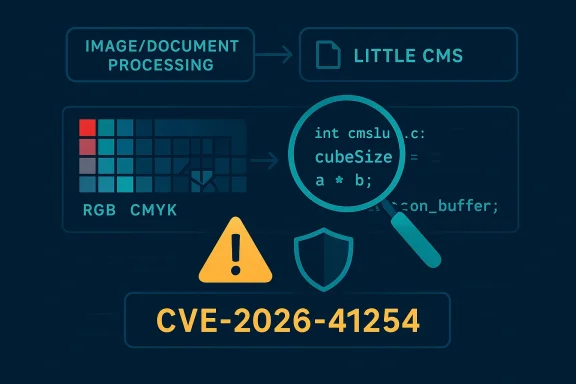
Microsoft appears to have assigned CVE-2026-41254 to a vulnerability in Little CMS (lcms2), the open-source color management library used by many graphics and document-processing applications. The brief description circulating in security feeds says the flaw is an integer overflow in the
Little CMS is a small but widely embedded dependency, which is exactly why vulnerabilities in this class matter more than the size of the codebase might suggest. It often sits several layers beneath the user interface, quietly handling color transforms for viewers, editors, print workflows, and other media-aware software. When a flaw lands in a foundational library, the blast radius is determined less by the library itself than by how many downstream applications bundle it, statically link it, or ship it through third-party packages. The CVE-2026-41254 description is consistent with that kind of supply-chain exposure.
The core failure mode described for CVE-2026-41254 is an integer overflow. In practical terms, that means arithmetic used to size a buffer, table, or cube can wrap around and produce a smaller-than-expected value. If the code then trusts that bad result, later allocations or copies can go out of bounds, trigger crashes, or create a path toward code execution depending on how the vulnerable routine is reached and what protections are in place. The fact that the check is performed after the multiplication is a telltale sign of a defensive coding defect rather than a design-level weakness.
Microsoft’s Security Update Guide has become the primary public catalog for the company’s CVEs and related advisories, and Microsoft has steadily expanded how much machine-readable information it publishes alongside each disclosure. That matters here because the security ecosystem increasingly expects more than just a title and severity label: defenders want CVSS scoring, CWE mapping, exploitability context, and deployment guidance they can automate against. Microsoft has explicitly said that its Security Update Guide and related APIs are intended to be a “one-stop-shop” for vulnerability information and that it now publishes richer standards-based metadata for CVEs.
Another important backdrop is how modern patch cycles work in the Windows world. Microsoft’s monthly security cadence typically bundles fixes across Windows, Office, Azure components, and other Microsoft-branded software, while also surfacing third-party or open-source components that show up inside Microsoft products or supported packages. That means a CVE may be “about” Little CMS, but the remediation path can still be tied to Microsoft shipping an updated component inside a product or package rather than a standalone upstream release. The public breadcrumb trail does not yet fully answer that question for CVE-2026-41254, so defenders should treat the current details as preliminary. Caution is warranted until Microsoft posts the full advisory entry.
The overflow-check ordering also matters because it hints at the risk profile. In security engineering, a check that comes after the arithmetic is often too late to prevent memory corruption or bogus size calculations. Whether the result is a crash, denial of service, or a more serious memory safety issue depends on the calling code and on how the malformed input is delivered, but the coding pattern itself is well known and dangerous. That is why integer overflows remain a persistent source of high-value CVEs.
In practical deployment terms, the threat depends on whether attackers can influence the data stream that reaches Little CMS. If the library is used to open attacker-supplied images, PDFs, or color profiles, then the vulnerability becomes more relevant to document previewers, image converters, and server-side rendering pipelines. If it is only used in tightly controlled workflows, the attack surface narrows. The current public description does not yet identify the specific trigger format, so any claims beyond that should be treated as inference, not confirmed fact.
That is especially important for libraries like Little CMS, because they do not fit neatly into the old “Windows, Office, Server” mental model. A flaw may still appear under Microsoft’s umbrella if it affects a Microsoft-shipped package, a supported runtime, or a product that bundles the dependency. In other words, the CVE may be technically open-source in origin while operationally Microsoft-relevant in distribution. That dual identity is one reason vendor advisories can be confusing at first glance. The real question is not who wrote the code, but where the code ships.
Enterprises also need to think about blast radius. A bug in a rendering service that processes external files can be much more serious than the same bug on a local workstation where only trusted users open documents. Likewise, image-conversion microservices used in portals, e-commerce back ends, and content management systems are often exposed to untrusted data by design. In those environments, a low-level integer overflow deserves high operational priority even before exploit details are known.
The likely real-world consumer risk is file-triggered instability rather than mass exploitation, at least based on what is publicly visible today. Still, history shows that document and media parsers are attractive targets because they naturally process attacker-controlled content. The absence of a confirmed exploit chain does not eliminate risk; it merely means the public evidence has not yet caught up with the disclosure.
The bigger market implication is that more vendors will be judged on how quickly they propagate upstream security fixes into their own packages. Microsoft has spent years improving transparency in the Security Update Guide, but transparency alone does not equal remediation. Users still need fast rollouts, accurate affected-product lists, and clear guidance on whether the fix comes from a Microsoft patch, an upstream library release, or a vendor rebuild.
Because Microsoft’s advisory page was not fully exposed in the sources available here, defenders should monitor both Microsoft’s Security Update Guide and upstream Little CMS release channels for the definitive fix statement. If the same CVE shows up in downstream package feeds, compare timestamps carefully and prefer the source that documents the actual patched build. That kind of cross-check is especially important when multiple vendors reuse the same library.
CVE-2026-41254 is still emerging, but its shape is already familiar enough to demand attention. Integer overflows in parsing libraries rarely stay isolated for long, especially when the code sits underneath applications that touch user-generated media or documents. The fastest defenders will verify exposure now, patch where they can, and wait for Microsoft’s complete disclosure only to refine—not begin—their response.
Source: MSRC Security Update Guide - Microsoft Security Response Center
CubeSize path inside cmslut.c, where the overflow check happens after the multiplication, a classic ordering mistake that can let unsafe values slip through. At this stage, the public record is still thin, but the pattern suggests a bug that could affect software pipelines that parse untrusted color profiles or image data.
 Background
Little CMS is a small but widely embedded dependency, which is exactly why vulnerabilities in this class matter more than the size of the codebase might suggest. It often sits several layers beneath the user interface, quietly handling color transforms for viewers, editors, print workflows, and other media-aware software. When a flaw lands in a foundational library, the blast radius is determined less by the library itself than by how many downstream applications bundle it, statically link it, or ship it through third-party packages. The CVE-2026-41254 description is consistent with that kind of supply-chain exposure.The core failure mode described for CVE-2026-41254 is an integer overflow. In practical terms, that means arithmetic used to size a buffer, table, or cube can wrap around and produce a smaller-than-expected value. If the code then trusts that bad result, later allocations or copies can go out of bounds, trigger crashes, or create a path toward code execution depending on how the vulnerable routine is reached and what protections are in place. The fact that the check is performed after the multiplication is a telltale sign of a defensive coding defect rather than a design-level weakness.
Microsoft’s Security Update Guide has become the primary public catalog for the company’s CVEs and related advisories, and Microsoft has steadily expanded how much machine-readable information it publishes alongside each disclosure. That matters here because the security ecosystem increasingly expects more than just a title and severity label: defenders want CVSS scoring, CWE mapping, exploitability context, and deployment guidance they can automate against. Microsoft has explicitly said that its Security Update Guide and related APIs are intended to be a “one-stop-shop” for vulnerability information and that it now publishes richer standards-based metadata for CVEs.
Another important backdrop is how modern patch cycles work in the Windows world. Microsoft’s monthly security cadence typically bundles fixes across Windows, Office, Azure components, and other Microsoft-branded software, while also surfacing third-party or open-source components that show up inside Microsoft products or supported packages. That means a CVE may be “about” Little CMS, but the remediation path can still be tied to Microsoft shipping an updated component inside a product or package rather than a standalone upstream release. The public breadcrumb trail does not yet fully answer that question for CVE-2026-41254, so defenders should treat the current details as preliminary. Caution is warranted until Microsoft posts the full advisory entry.
What We Know So Far
The most concrete public clue is the vulnerability summary itself: Little CMS (lcms2) through 2.18 is affected by an integer overflow inCubeSize in cmslut.c, with the overflow check occurring after the multiplication. That statement appears in multiple security aggregators and mirrors the kind of concise description that usually originates in a vendor advisory or coordinated disclosure record. For now, it is enough to establish the likely software component and the bug pattern, but not enough to confirm exploitability, impact scope, or whether Microsoft’s own products are directly exposed.Why the wording matters
The phrase “through 2.18” implies a version boundary and suggests that a fixed release exists or is expected in a later upstream version. That is useful because it gives administrators a first-pass filter for inventories that include Little CMS from source packages or embedded distributions. However, downstream vendors often backport fixes without bumping the visible version number, so version alone is not a complete answer. Enterprises should therefore verify package provenance, not just package labels.The overflow-check ordering also matters because it hints at the risk profile. In security engineering, a check that comes after the arithmetic is often too late to prevent memory corruption or bogus size calculations. Whether the result is a crash, denial of service, or a more serious memory safety issue depends on the calling code and on how the malformed input is delivered, but the coding pattern itself is well known and dangerous. That is why integer overflows remain a persistent source of high-value CVEs.
Open questions
There are still key details missing from the public record. We do not yet have a fully populated Microsoft advisory page in the sources available here, nor do we have a direct Microsoft statement about severity, exploitability, or product impact. We also do not yet know whether the issue was found internally, reported by an external researcher, or surfaced through downstream ecosystem analysis. Until that metadata appears, defenders should treat current severity estimates as provisional.- The affected code appears to be in
cmslut.c. - The bug class is an integer overflow.
- The likely affected releases are Little CMS through 2.18.
- Publicly visible exploit details are not yet established.
- Downstream impact depends on whether software embeds or ships the library.
Technical Analysis
An integer overflow in a LUT or cube-size calculation is not just an abstract programming mistake. These code paths are often used to generate lookup tables for color conversions, and those tables in turn control how pixels are mapped between color spaces. If the computed size wraps, the program may allocate too little memory and then write beyond the buffer when populating the table, or it may reject the input too late after state has already been corrupted. That makes the vulnerability especially relevant to software that processes external files, thumbnails, previews, or print jobs.How a bad multiply becomes a security issue
The dangerous sequence usually looks simple: take an input value, multiply it, check the result, and proceed. But if the multiplication itself overflows before the validation runs, the check is comparing an already-wrapped value rather than the true mathematical result. That is why secure coding guidance repeatedly stresses validating dimensions before arithmetic, using wider integer types where appropriate, and rejecting impossible inputs early. Microsoft’s own historical security bulletins have long categorized integer overflows as significant enough to merit formal security updates.In practical deployment terms, the threat depends on whether attackers can influence the data stream that reaches Little CMS. If the library is used to open attacker-supplied images, PDFs, or color profiles, then the vulnerability becomes more relevant to document previewers, image converters, and server-side rendering pipelines. If it is only used in tightly controlled workflows, the attack surface narrows. The current public description does not yet identify the specific trigger format, so any claims beyond that should be treated as inference, not confirmed fact.
Potential impact scenarios
A memory safety bug in a low-level parsing library can manifest in several ways. The least severe outcome is a process crash that can be turned into denial of service. More concerning outcomes include memory corruption in a privileged service, sandbox escape in a complex application stack, or code execution if the corrupted state is exploitable under the right conditions. Because the public description does not yet identify a CVSS score or exploit path, it is prudent to assume the impact may vary significantly across products.- Crash risk if malformed input reaches the vulnerable routine.
- Denial of service if the affected process is restarted or unstable.
- Memory corruption if the bad size calculation feeds later writes.
- Broader exposure when bundled into document or image workflows.
- Variable exploitability depending on compiler hardening and caller behavior.
Microsoft’s Disclosure Model
Microsoft’s handling of vulnerabilities has changed substantially over the last few years. The company now pushes more structured data into the Security Update Guide, including vulnerability descriptions, CVSS metadata, CWE information, and machine-readable CSAF records for consumption by tooling. That is relevant because CVE-2026-41254 appears in an ecosystem where defenders increasingly expect to automate patch triage rather than read PDF bulletins manually.Why defenders care about metadata
In older bulletin formats, an administrator might only see a product name and a short severity label. Today, teams want to know whether a flaw is exploitable remotely, whether user interaction is required, whether it is publicly disclosed, and whether it maps to a weak class that appears elsewhere in the codebase. Microsoft has explicitly said its newer guide and API were built to surface exactly that kind of information in a more standards-aligned way.That is especially important for libraries like Little CMS, because they do not fit neatly into the old “Windows, Office, Server” mental model. A flaw may still appear under Microsoft’s umbrella if it affects a Microsoft-shipped package, a supported runtime, or a product that bundles the dependency. In other words, the CVE may be technically open-source in origin while operationally Microsoft-relevant in distribution. That dual identity is one reason vendor advisories can be confusing at first glance. The real question is not who wrote the code, but where the code ships.
The role of downstream packaging
If Microsoft is the publisher for this CVE, the most likely scenarios include a Microsoft product bundling the affected library or a Microsoft-maintained package being updated through its own servicing channel. Downstream packaging is a common source of ambiguity because the fix may be delivered through Windows Update, a product-specific patch, or a package manager, depending on where the dependency lives. Until Microsoft’s advisory page is fully visible, administrators should check both Microsoft channels and upstream Little CMS release notes.- Microsoft now emphasizes structured vulnerability data.
- The Security Update Guide is designed for automation-friendly triage.
- Downstream packaging can blur the line between upstream open source and vendor-serviced fixes.
- Advisory completeness matters because metadata drives remediation priority.
Enterprise Exposure
For enterprises, the main question is where Little CMS lives in the software estate. It may appear directly in Linux distributions, container images, image-processing services, desktop tools, or vendor applications that handle color profiles. It may also be statically linked into a product, making ordinary package inventory incomplete. That is why security teams should search beyond explicit package names and include software bills of materials, container manifests, and third-party application inventories.Inventory first, patch second
The first step is identifying whether any business-critical workflow actually uses Little CMS or a Microsoft-bundled build of it. The second is determining which builds are fixed, whether a vendor has backported a patch, and whether a restart or redeployment is needed. The third is validating whether the vulnerable code sits on an internet-facing path, an internal processing pipeline, or a low-risk offline workstation. That sequencing prevents frantic but low-value patching.Enterprises also need to think about blast radius. A bug in a rendering service that processes external files can be much more serious than the same bug on a local workstation where only trusted users open documents. Likewise, image-conversion microservices used in portals, e-commerce back ends, and content management systems are often exposed to untrusted data by design. In those environments, a low-level integer overflow deserves high operational priority even before exploit details are known.
Practical response steps
- Identify products and images that ship or embed Little CMS.
- Check whether those builds are at or below the affected 2.18 line.
- Look for vendor backports, not just version bumps.
- Prioritize systems that parse external files or user uploads.
- Test remediations in rendering-heavy workflows before broad rollout.
- Asset visibility is the first control.
- Container images often hide embedded dependencies.
- Public-facing parsers deserve the fastest review.
- Backported fixes may not change visible version numbers.
- Regression testing matters in color-sensitive applications.
Consumer Impact
Consumers are less likely to recognize Little CMS by name, but they may still be affected through everyday applications that rely on it for image handling or document preview. If a desktop app opens a crafted file and crashes, the user experience is poor even when the security impact is limited. If the affected application has a larger privilege boundary or handles files in an automatic preview path, the concern rises quickly.Why this can feel invisible
Most users never see the dependency stack underneath a photo editor, PDF reader, or print utility. That invisibility is part of the problem, because vulnerabilities in libraries like Little CMS are often distributed through harmless-looking software updates or bundled application revisions rather than direct library installs. Consumers therefore end up depending on vendors they did not know were part of the chain. That makes timely software updates essential even when the advisory sounds obscure.The likely real-world consumer risk is file-triggered instability rather than mass exploitation, at least based on what is publicly visible today. Still, history shows that document and media parsers are attractive targets because they naturally process attacker-controlled content. The absence of a confirmed exploit chain does not eliminate risk; it merely means the public evidence has not yet caught up with the disclosure.
- Keep desktop apps and document viewers updated.
- Treat odd crashes after opening media files as a warning sign.
- Do not assume “graphics” bugs are harmless.
- Pay attention to application updates, not only OS patches.
- Prefer vendors that publish clear dependency disclosures.
Supply Chain Implications
CVE-2026-41254 is a good reminder that software supply chains are now as important as perimeter defenses. A single library flaw can ripple through thousands of applications if the library is bundled into distro packages, SDKs, or embedded appliances. In that sense, the question is not whether Little CMS is niche; it is whether it is embedded in enough places to become operationally broad. The public indicators suggest that is exactly the kind of situation defenders should worry about.Downstream trust is the real issue
When a package maintainer backports a fix, administrators often have to trust release notes, changelogs, and vendor statements more than version numbers. That can slow validation because the same visible version may be safe in one distribution and vulnerable in another. It also means that vulnerability management systems need better component-level intelligence, not just product-level CVE matching. This is where SBOMs stop being a buzzword and start being practical tooling.The bigger market implication is that more vendors will be judged on how quickly they propagate upstream security fixes into their own packages. Microsoft has spent years improving transparency in the Security Update Guide, but transparency alone does not equal remediation. Users still need fast rollouts, accurate affected-product lists, and clear guidance on whether the fix comes from a Microsoft patch, an upstream library release, or a vendor rebuild.
- Supply-chain risk extends beyond the source project.
- Version numbers can be misleading after backports.
- SBOM-driven validation reduces guesswork.
- Vendor patch lag remains a practical exposure.
- Clear servicing ownership improves real-world response.
Patch Strategy
Until Microsoft publishes fuller advisory details, the safest approach is to combine generic mitigation with targeted validation. That means updating affected software, checking vendor advisories for backported fixes, and testing any rendering or conversion workflows that depend on Little CMS. If a package manager or enterprise software catalog exposes an update, it should be reviewed quickly, especially for systems that handle untrusted files.What “good” remediation looks like
The best patch programs do more than install updates. They confirm whether the vulnerable component is linked dynamically or statically, whether the fix changes behavior for edge-case inputs, and whether automated tests still pass after the upgrade. In graphics and document pipelines, color handling bugs can be subtle, so the business risk of a bad hotfix can be real. Speed matters, but so does validation.Because Microsoft’s advisory page was not fully exposed in the sources available here, defenders should monitor both Microsoft’s Security Update Guide and upstream Little CMS release channels for the definitive fix statement. If the same CVE shows up in downstream package feeds, compare timestamps carefully and prefer the source that documents the actual patched build. That kind of cross-check is especially important when multiple vendors reuse the same library.
- Verify the fix in the actual shipped package.
- Confirm whether the library is embedded or shared.
- Test file parsing with representative workloads.
- Watch for regression in color conversion outputs.
- Coordinate patching with application owners, not just platform teams.
Strengths and Opportunities
The upside of this disclosure is that Microsoft’s ecosystem now gives defenders more structured ways to act on it. Even when the initial advisory is sparse, the Security Update Guide model, combined with upstream project awareness, allows faster correlation between affected components and installed software. That is a meaningful improvement over the older era of fragmented bulletin formats.- Better metadata makes triage faster.
- Upstream coordination can shorten fix time.
- Component-level awareness improves inventory accuracy.
- SBOM adoption can reveal hidden dependencies.
- Standardized CVE data helps automation.
- Backporting practices can protect older distributions without major upgrades.
- Security transparency builds confidence in remediation workflows.
Risks and Concerns
The biggest concern is the uncertainty that comes with an early disclosure. When only a short description is available, security teams may underestimate the scope, while software owners may overestimate how safe they are because they do not see the affected component directly. That mismatch can leave vulnerable parsers in production long after the advisory exists. Ambiguity is itself a risk factor.- The advisory may still be incomplete.
- Downstream packages may lag behind upstream fixes.
- Static linking can hide vulnerable versions.
- Exploitability may differ widely by application.
- Public scanners may miss embedded dependencies.
- Users may ignore “library” CVEs they do not recognize.
- Rendering services can turn a local bug into a broader exposure.
Looking Ahead
The next meaningful milestone is Microsoft’s full advisory entry, which should clarify severity, affected products, and remediation guidance if the record follows the company’s normal Security Update Guide pattern. A parallel milestone is any upstream Little CMS release notes or package advisories that identify a fixed version or backport. Once those pieces are visible, defenders can move from cautious triage to precise remediation.What to watch
- A full Microsoft advisory page for CVE-2026-41254.
- Upstream Little CMS release notes for a fixed build.
- Package-manager updates in Linux and cross-platform ecosystems.
- SBOM or dependency scans that reveal embedded lcms2 copies.
- Any evidence that the bug is reachable from untrusted file input.
CVE-2026-41254 is still emerging, but its shape is already familiar enough to demand attention. Integer overflows in parsing libraries rarely stay isolated for long, especially when the code sits underneath applications that touch user-generated media or documents. The fastest defenders will verify exposure now, patch where they can, and wait for Microsoft’s complete disclosure only to refine—not begin—their response.
Source: MSRC Security Update Guide - Microsoft Security Response Center
