

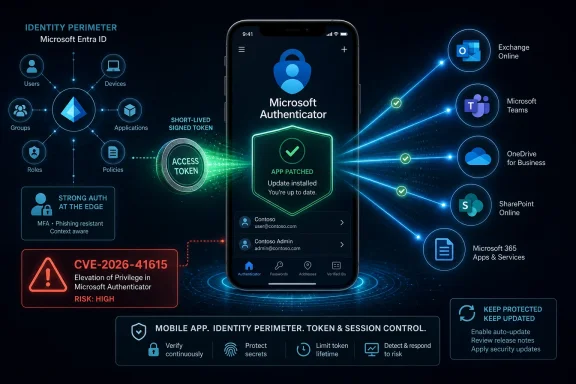
Microsoft has identified CVE-2026-41615 as a Microsoft Authenticator information disclosure vulnerability that could expose a sign-in access token for a user’s work account, potentially allowing access to organizational data and services the user is already authorized to use. That short description is more consequential than its tidy “information disclosure” label suggests. In modern Microsoft 365 and Entra ID environments, an access token is not trivia; it is a temporary bearer credential that can turn a compromised phone or app boundary mistake into a doorway into mail, files, chats, internal apps, and cloud resources. The story here is not that Microsoft Authenticator is suddenly untrustworthy, but that the industry’s strongest everyday identity controls are now concentrated inside mobile software that must be treated as production infrastructure.
For years, the average user was taught to think of authentication compromise as a stolen password. Then came multi-factor authentication, conditional access, device compliance checks, number matching, push prompts, and passkeys. Each layer made the old password-only attack less reliable, but it also shifted attacker attention toward the small window after authentication succeeds.
That is where access tokens live. A sign-in access token is proof that a user has successfully authenticated and is allowed to call specific services for a defined period of time. If a token is exposed and still valid, the attacker may not need to know the password, intercept a one-time code, or convince the user to approve another prompt.
This is why CVE-2026-41615 deserves attention even if the description sounds narrow. Microsoft’s wording points to a user’s work account, not a generic consumer sign-in. In a business tenant, that means the potential blast radius follows the user’s permissions across Microsoft 365, line-of-business apps, third-party SaaS integrations, and any data reachable through federated identity.
The important distinction is that this is not described as a universal tenant compromise or a remote code execution bug. The disclosed information would be tied to what the affected user can already access. But that is still enough to matter, because many users have access to sensitive mailboxes, Teams conversations, SharePoint libraries, customer data, finance documents, source repositories, admin portals, or internal dashboards.
A token disclosure bug can be different because the disclosed object may itself be usable. Access tokens are designed to be presented to services as proof of authorization. If a vulnerable flow exposes one to the wrong local actor, the distinction between “disclosure” and “account access” becomes uncomfortably thin.
That does not mean every token exposure becomes a breach. Tokens expire, scopes matter, conditional access may apply, and session controls can limit usefulness. Microsoft’s identity stack has more guardrails than the average attacker would like. But defenders should avoid the comforting fiction that a leaked token is merely an informational artifact.
The safer mental model is that CVE-2026-41615 is about session material. Passwords can be changed, MFA methods can be reset, and users can be retrained. Tokens require a different defensive reflex: revoke sessions, inspect sign-in logs, check unusual resource access, and ensure mobile devices are updated quickly enough that the same weakness cannot be abused repeatedly.
That evolution has been good for security in the broad sense. Phishing-resistant and MFA-backed sign-ins are better than passwords alone. Users can approve sign-ins without typing codes into fake websites. Administrators can enforce stronger authentication methods without distributing hardware tokens to every employee.
But this consolidation also creates an uncomfortable truth for IT: the perimeter moved into the employee’s phone. A personal iPhone or Android handset may now hold the practical keys to corporate services, even when the organization has invested heavily in cloud identity governance. The device does not need to be domain joined to become part of the authentication chain.
That is where vulnerabilities like CVE-2026-41615 test the assumptions behind bring-your-own-device programs. If Authenticator is used to protect a work account, the security state of that app and the mobile OS matters to the organization. A stale app version on a personal phone is no longer just a personal hygiene problem; it can become an enterprise exposure.
For a frontline employee, that may mean access to scheduling, HR self-service, Teams chats, and a handful of SharePoint sites. For a finance analyst, it may include invoices, payroll exports, vendor banking details, and executive reports. For a developer, it could include repositories, build systems, cloud dashboards, or secrets accidentally stored in collaboration tools.
For administrators, the consequences can be much more serious. If privileged accounts use Authenticator and a sign-in access token is exposed, the attacker’s opportunity may align with sensitive control planes. Even where admin actions require stronger claims, step-up authentication, or privileged access workflows, a valid session can still provide reconnaissance value and sometimes access to management surfaces that should never be casually reachable.
This is why least privilege is not just an audit slogan. Token theft turns permissions into blast radius. If users carry years of accumulated access because nobody removed them from old groups, then any session compromise inherits that administrative debt.
That mismatch is increasingly hard to defend. The Microsoft Authenticator app is not a casual utility in an enterprise environment. It is part of the sign-in fabric. Treating it as an unmanaged consumer app while relying on it for corporate access is an architectural contradiction.
The practical fix is not exotic. Organizations should ensure Authenticator updates are enforced or strongly monitored on managed devices, and they should use mobile application management where full device management is politically or operationally impossible. If a work account depends on a mobile app, the organization needs at least some visibility into whether that app is current.
The harder problem is BYOD. Many companies allow personal phones for MFA because it reduces hardware cost and user friction. CVE-2026-41615 is a reminder that convenience has an operational price: if the device participates in corporate authentication, administrators need policy levers for minimum OS versions, app protection requirements, and rapid user communication when a security update matters.
But conditional access is not a force field around every token. Its effectiveness depends on policy design, licensing, telemetry, enforcement points, and the exact way a token is used. A token issued under legitimate conditions may remain useful until it expires or is revoked, especially if an attacker can operate within expected parameters.
Defenders should therefore think in layers. Conditional access can reduce token usefulness, but it should be paired with short session lifetimes for sensitive apps, sign-in risk detection, continuous access evaluation where supported, and fast revocation procedures. A disclosed token is time-sensitive; the defender’s advantage is to make that time window small and noisy.
This is also where logging becomes more than compliance decoration. If a token is abused, the evidence may show up as unusual resource access, anomalous IP addresses, unfamiliar device claims, impossible travel, suspicious app usage, or access patterns outside the user’s normal rhythm. Organizations that do not regularly review identity and cloud app logs are effectively choosing to learn about token misuse from the aftermath.
That uncertainty matters, but it should not become paralysis. Security teams rarely get perfect exploit detail on day one, and vendors often withhold technical specifics to reduce copycat exploitation while users patch. In this case, the responsible administrator does not need a working proof of concept to act.
The minimum response is straightforward: update Microsoft Authenticator everywhere it is used for work accounts, verify mobile update compliance where possible, and review identity logs for suspicious access by high-value users. For privileged users, it is reasonable to consider revoking existing sessions after confirming the fixed app is installed.
The better response is broader. Use this moment to ask whether Authenticator is managed as a dependency, whether privileged access relies on personal devices, and whether token theft scenarios are actually represented in incident response playbooks. If the answer is no, CVE-2026-41615 is not just a vulnerability; it is a governance finding.
But passwordless does not mean secretless. Tokens, session cookies, refresh artifacts, device-bound credentials, cryptographic keys, and brokered sign-in state all still exist somewhere. The user may not type a password, but the system still needs portable proof of authentication or possession at various stages of the flow.
That is not a criticism of Microsoft Authenticator so much as a reality check for modern identity. Every security model concentrates trust somewhere. Hardware security keys concentrate it in physical devices. Platform passkeys concentrate it in OS-backed credential stores. Authenticator apps concentrate it in mobile software and the surrounding app sandbox.
The industry has made the right move by reducing reliance on passwords. The next phase is hardening the layers that replaced them. CVE-2026-41615 sits squarely in that phase: less dramatic than a wormable Windows bug, but deeply relevant to how real organizations now get breached.
The answer should be written down before an incident. Help desks need instructions for telling users how to update Authenticator without causing account lockouts. Security operations teams need queries for suspicious access. Identity administrators need a tested process for revoking sessions and forcing reauthentication. Application owners need to understand which systems rely on Entra tokens and which maintain their own sessions afterward.
There is also a communication challenge. Telling users that an MFA app needs an urgent update can sound abstract, especially if they have been told for years that MFA is the thing that protects them. The message should be plain: the app that helps you sign in has a security fix, and delaying that fix could put work data at risk.
For executives and privileged staff, the message may need to be firmer. High-value users should not be the slowest group to patch mobile authentication tools. If the organization already uses privileged access workstations, dedicated admin accounts, or phishing-resistant authentication, it should also consider whether admin approvals from unmanaged personal phones are still acceptable.
Source: MSRC Security Update Guide - Microsoft Security Response Center
 The Token Is the Prize Now
For years, the average user was taught to think of authentication compromise as a stolen password. Then came multi-factor authentication, conditional access, device compliance checks, number matching, push prompts, and passkeys. Each layer made the old password-only attack less reliable, but it also shifted attacker attention toward the small window after authentication succeeds.That is where access tokens live. A sign-in access token is proof that a user has successfully authenticated and is allowed to call specific services for a defined period of time. If a token is exposed and still valid, the attacker may not need to know the password, intercept a one-time code, or convince the user to approve another prompt.
This is why CVE-2026-41615 deserves attention even if the description sounds narrow. Microsoft’s wording points to a user’s work account, not a generic consumer sign-in. In a business tenant, that means the potential blast radius follows the user’s permissions across Microsoft 365, line-of-business apps, third-party SaaS integrations, and any data reachable through federated identity.
The important distinction is that this is not described as a universal tenant compromise or a remote code execution bug. The disclosed information would be tied to what the affected user can already access. But that is still enough to matter, because many users have access to sensitive mailboxes, Teams conversations, SharePoint libraries, customer data, finance documents, source repositories, admin portals, or internal dashboards.
“Information Disclosure” Undersells the Identity Risk
Security labels can be misleading when they cross from operating systems into identity systems. A traditional information disclosure bug might leak memory contents, file metadata, usernames, or configuration values. Those can be useful to an attacker, but they are often stepping stones.A token disclosure bug can be different because the disclosed object may itself be usable. Access tokens are designed to be presented to services as proof of authorization. If a vulnerable flow exposes one to the wrong local actor, the distinction between “disclosure” and “account access” becomes uncomfortably thin.
That does not mean every token exposure becomes a breach. Tokens expire, scopes matter, conditional access may apply, and session controls can limit usefulness. Microsoft’s identity stack has more guardrails than the average attacker would like. But defenders should avoid the comforting fiction that a leaked token is merely an informational artifact.
The safer mental model is that CVE-2026-41615 is about session material. Passwords can be changed, MFA methods can be reset, and users can be retrained. Tokens require a different defensive reflex: revoke sessions, inspect sign-in logs, check unusual resource access, and ensure mobile devices are updated quickly enough that the same weakness cannot be abused repeatedly.
Authenticator Has Become Part of the Enterprise Perimeter
Microsoft Authenticator began life in many organizations as a convenient MFA app. It is now closer to a mobile identity broker. It handles push approvals, number matching, one-time codes, passwordless sign-ins, account registration flows, and work-account authentication experiences that touch Entra ID and Microsoft 365.That evolution has been good for security in the broad sense. Phishing-resistant and MFA-backed sign-ins are better than passwords alone. Users can approve sign-ins without typing codes into fake websites. Administrators can enforce stronger authentication methods without distributing hardware tokens to every employee.
But this consolidation also creates an uncomfortable truth for IT: the perimeter moved into the employee’s phone. A personal iPhone or Android handset may now hold the practical keys to corporate services, even when the organization has invested heavily in cloud identity governance. The device does not need to be domain joined to become part of the authentication chain.
That is where vulnerabilities like CVE-2026-41615 test the assumptions behind bring-your-own-device programs. If Authenticator is used to protect a work account, the security state of that app and the mobile OS matters to the organization. A stale app version on a personal phone is no longer just a personal hygiene problem; it can become an enterprise exposure.
The User’s Permissions Define the Blast Radius
Microsoft’s description gives administrators the most important scoping clue: an exposed token could allow access to data and services that the user is authorized to use. That line both limits and sharpens the risk. The vulnerability does not magically grant global administrator rights, but it can inherit whatever real-world privileges the user already has.For a frontline employee, that may mean access to scheduling, HR self-service, Teams chats, and a handful of SharePoint sites. For a finance analyst, it may include invoices, payroll exports, vendor banking details, and executive reports. For a developer, it could include repositories, build systems, cloud dashboards, or secrets accidentally stored in collaboration tools.
For administrators, the consequences can be much more serious. If privileged accounts use Authenticator and a sign-in access token is exposed, the attacker’s opportunity may align with sensitive control planes. Even where admin actions require stronger claims, step-up authentication, or privileged access workflows, a valid session can still provide reconnaissance value and sometimes access to management surfaces that should never be casually reachable.
This is why least privilege is not just an audit slogan. Token theft turns permissions into blast radius. If users carry years of accumulated access because nobody removed them from old groups, then any session compromise inherits that administrative debt.
Mobile App Patching Is Still the Weak Link
Windows administrators have spent decades building rituals around Patch Tuesday. They test cumulative updates, stage deployments, monitor failure rates, and argue over reboot windows. Mobile app patching, by comparison, is often left to auto-update settings, user behavior, app-store rollout timing, and hope.That mismatch is increasingly hard to defend. The Microsoft Authenticator app is not a casual utility in an enterprise environment. It is part of the sign-in fabric. Treating it as an unmanaged consumer app while relying on it for corporate access is an architectural contradiction.
The practical fix is not exotic. Organizations should ensure Authenticator updates are enforced or strongly monitored on managed devices, and they should use mobile application management where full device management is politically or operationally impossible. If a work account depends on a mobile app, the organization needs at least some visibility into whether that app is current.
The harder problem is BYOD. Many companies allow personal phones for MFA because it reduces hardware cost and user friction. CVE-2026-41615 is a reminder that convenience has an operational price: if the device participates in corporate authentication, administrators need policy levers for minimum OS versions, app protection requirements, and rapid user communication when a security update matters.
Conditional Access Helps, but It Is Not Magic
A common response to token exposure is to assume conditional access will save the day. Sometimes it will. Microsoft Entra policies can evaluate user risk, device state, location, application, authentication strength, and other signals before allowing access. Session controls can limit persistence, require reauthentication, or block access from unmanaged contexts.But conditional access is not a force field around every token. Its effectiveness depends on policy design, licensing, telemetry, enforcement points, and the exact way a token is used. A token issued under legitimate conditions may remain useful until it expires or is revoked, especially if an attacker can operate within expected parameters.
Defenders should therefore think in layers. Conditional access can reduce token usefulness, but it should be paired with short session lifetimes for sensitive apps, sign-in risk detection, continuous access evaluation where supported, and fast revocation procedures. A disclosed token is time-sensitive; the defender’s advantage is to make that time window small and noisy.
This is also where logging becomes more than compliance decoration. If a token is abused, the evidence may show up as unusual resource access, anomalous IP addresses, unfamiliar device claims, impossible travel, suspicious app usage, or access patterns outside the user’s normal rhythm. Organizations that do not regularly review identity and cloud app logs are effectively choosing to learn about token misuse from the aftermath.
Microsoft’s Disclosure Leaves the Right Questions on the Table
The publicly supplied description answers the basic impact question but leaves several operational questions unresolved. We do not know from that sentence alone which platforms are affected, which app versions are vulnerable, what local conditions are required, whether a malicious app must be installed, whether user interaction is necessary, or how easily a token could be replayed outside the original device context.That uncertainty matters, but it should not become paralysis. Security teams rarely get perfect exploit detail on day one, and vendors often withhold technical specifics to reduce copycat exploitation while users patch. In this case, the responsible administrator does not need a working proof of concept to act.
The minimum response is straightforward: update Microsoft Authenticator everywhere it is used for work accounts, verify mobile update compliance where possible, and review identity logs for suspicious access by high-value users. For privileged users, it is reasonable to consider revoking existing sessions after confirming the fixed app is installed.
The better response is broader. Use this moment to ask whether Authenticator is managed as a dependency, whether privileged access relies on personal devices, and whether token theft scenarios are actually represented in incident response playbooks. If the answer is no, CVE-2026-41615 is not just a vulnerability; it is a governance finding.
The Passwordless Future Still Has Secrets
Passwordless authentication is often marketed as a clean break from the miserable password era. In many ways, it is. Reducing password reuse, phishing, and credential stuffing is a real improvement. Microsoft has pushed hard in this direction, and enterprises have benefited from stronger defaults and better MFA experiences.But passwordless does not mean secretless. Tokens, session cookies, refresh artifacts, device-bound credentials, cryptographic keys, and brokered sign-in state all still exist somewhere. The user may not type a password, but the system still needs portable proof of authentication or possession at various stages of the flow.
That is not a criticism of Microsoft Authenticator so much as a reality check for modern identity. Every security model concentrates trust somewhere. Hardware security keys concentrate it in physical devices. Platform passkeys concentrate it in OS-backed credential stores. Authenticator apps concentrate it in mobile software and the surrounding app sandbox.
The industry has made the right move by reducing reliance on passwords. The next phase is hardening the layers that replaced them. CVE-2026-41615 sits squarely in that phase: less dramatic than a wormable Windows bug, but deeply relevant to how real organizations now get breached.
Administrators Should Treat This as a Session-Control Drill
The best security teams will not respond to CVE-2026-41615 by merely forwarding a patch notice. They will use it as a live exercise in identity incident readiness. If a user’s work-account access token might have been exposed, what exactly happens next?The answer should be written down before an incident. Help desks need instructions for telling users how to update Authenticator without causing account lockouts. Security operations teams need queries for suspicious access. Identity administrators need a tested process for revoking sessions and forcing reauthentication. Application owners need to understand which systems rely on Entra tokens and which maintain their own sessions afterward.
There is also a communication challenge. Telling users that an MFA app needs an urgent update can sound abstract, especially if they have been told for years that MFA is the thing that protects them. The message should be plain: the app that helps you sign in has a security fix, and delaying that fix could put work data at risk.
For executives and privileged staff, the message may need to be firmer. High-value users should not be the slowest group to patch mobile authentication tools. If the organization already uses privileged access workstations, dedicated admin accounts, or phishing-resistant authentication, it should also consider whether admin approvals from unmanaged personal phones are still acceptable.
The Small App Update Carries a Larger Lesson
CVE-2026-41615 is not the kind of vulnerability that should trigger panic, but it is exactly the kind that should trigger disciplined cleanup. The concrete action is to update Microsoft Authenticator and reduce the chance that a work-account access token can be exposed. The larger action is to tighten the identity environment around the assumption that tokens are valuable, mobile apps are part of the control plane, and sessions need active governance.- Organizations should ensure Microsoft Authenticator is updated on every device used to sign in to work accounts.
- Security teams should treat exposed access tokens as potentially usable session material, not as harmless diagnostic data.
- Administrators should review sign-in and resource-access logs for unusual activity involving sensitive users or privileged accounts.
- High-risk users should have stale sessions revoked after devices are updated, especially if their accounts can reach administrative portals or sensitive repositories.
- BYOD policies should be revisited so that mobile authentication apps used for work are subject to minimum version and security requirements.
- Long-term risk reduction depends on least privilege, shorter session exposure, stronger device controls, and incident playbooks that explicitly cover token theft.
Source: MSRC Security Update Guide - Microsoft Security Response Center
