

Microsoft’s New Admin Wall Gets Its First Public Stress Test
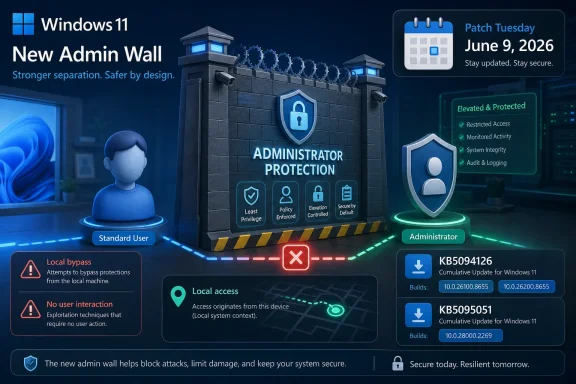
Windows Administrator Protection is supposed to harden one of the oldest weak spots in desktop security: the messy handoff between a standard user context and administrator authority. Microsoft describes the affected feature as a protection intended to prevent applications running with standard user permissions from performing actions that require administrator access. CVE-2026-42829 is therefore not just another local bug in the Windows heap of components; it is a flaw in a control designed to make privilege escalation harder in the first place.
The MSRC summary is terse, as these entries often are: improper access control allows an authorized attacker to bypass a security feature locally. The FAQ adds the more important sentence: successful exploitation could allow an attacker to run code with administrator privileges without the normal security checks. That is the line administrators should read twice.
The key word is authorized. This is not an unauthenticated network attack, and the CVSS vector says the attack is local, requires low privileges, and needs no user interaction. In practical terms, the attacker already has some foothold on the machine. The issue is what that foothold can become.
That distinction matters because Windows defenses increasingly assume compromise is layered. A phishing lure, malicious installer, browser escape, or stolen low-privilege account may be only the opening move. Controls like Administrator Protection are supposed to stop that opening move from becoming full control of the endpoint.
“Important” Does Not Mean Harmless
Microsoft rates CVE-2026-42829 as Important, not Critical, with a CVSS 3.1 base score of 7.8 and a temporal score of 6.8. That is exactly the kind of vulnerability that can be underrated by organizations that triage mostly by headline severity. The machine is not being attacked over the network, but the impact fields are all high: confidentiality, integrity, and availability.
The scoring tells a familiar local-escalation story. Attack vector is local, attack complexity is low, privileges required are low, and user interaction is none. Once the attacker is in position, the conditions are not described as exotic. Microsoft’s exploitability assessment says exploitation is less likely, but the base metrics do not portray an especially delicate bug.
That tension is common in Patch Tuesday advisories. The exploitability rating is a near-term judgment about whether Microsoft expects usable exploit code to emerge soon. The CVSS base score describes what happens if the vulnerability is exploited under the assumed conditions. For defenders, both matter, but neither should be treated as a complete risk model.
The “security feature bypass” label can also lull teams into thinking the issue is secondary. Sometimes that is fair: a bypass may only weaken a mitigation that still requires another vulnerability to matter. Here, the named feature is specifically about administrator elevation checks. If an attacker can sidestep those checks, the bypass begins to look a lot like the missing link in a post-compromise chain.
Report Confidence Is the Quiet Alarm Bell
The user-supplied emphasis on Report Confidence is not a side note; it is the most revealing part of this CVE. Microsoft lists the Report Confidence value as Confirmed. That means this is not merely a theoretical weakness, a rumor, or a vague class of behavior inferred from incomplete research. The vendor is acknowledging that the vulnerability exists.
That does not mean exploit code is public. Microsoft lists exploit code maturity as Unproven, says the issue was not publicly disclosed before publication, and says it has not been exploited in the wild. Those are all reassuring facts. But “confirmed” lowers the fog around the vulnerability’s existence, even if Microsoft is withholding the kind of technical detail that would help attackers reproduce it.
This is the strange middle ground of modern vulnerability disclosure. Defenders receive enough information to know that a control failed, what products are affected, what broad access conditions apply, and which updates fix it. Attackers receive the same metadata and can use it as a map of where to begin looking. The absence of a public proof of concept is useful, but it is not the same thing as safety.
The acknowledgements credit SentinelOne researchers Simone Nicchi and Antonio Cocomazzi. That detail matters because coordinated disclosure by credible researchers usually means the bug has been observed, reduced, and reported through a process that gives Microsoft enough confidence to publish a fix. It also suggests that the interesting technical story may eventually surface in a research blog, conference talk, or post-patch analysis.
The Affected Surface Is Narrower Than “Windows,” But Not Small
CVE-2026-42829 affects Windows 11, not the whole supported Windows universe listed in many Patch Tuesday tables. Microsoft’s update table names Windows 11 version 24H2, Windows 11 version 25H2, and Windows 11 version 26H1 across x64 and Arm64. That matters for prioritization: Windows 10 fleets and older server deployments are not called out in the published affected product list.
For Windows 11 24H2 and 25H2, the relevant update is KB5094126. The fixed build numbers are 10.0.26100.8655 for 24H2 and 10.0.26200.8655 for 25H2. For Windows 11 26H1, the relevant update is KB5095051, with fixed build 10.0.28000.2269.
That product split also hints at where Administrator Protection sits in Microsoft’s evolving Windows security model. The feature is part of the modern Windows 11 hardening story, not a legacy control bolted onto every supported branch. In other words, the vulnerability is tied to the new privilege model Microsoft wants customers to adopt.
This creates an awkward message for enterprises. Microsoft is right to keep pushing Windows toward stronger default boundaries, more standard-user operation, and fewer ambient administrator assumptions. But the more visible those controls become, the more attractive they become as research targets. The first serious bypasses are not arguments against the model; they are the price of making the model real.
Local Bugs Are Still Enterprise Bugs
There is a persistent myth in patch triage that local vulnerabilities can wait because “the attacker already needs access.” That logic breaks down in enterprise environments where low-privilege access is often the commodity part of an intrusion. Initial access brokers, malicious OAuth grants, stolen VPN credentials, unsafe installers, and browser-delivered payloads all create situations where the attacker’s next question is how to become more powerful on the endpoint.
A local administrator bypass can be especially useful on workstations used by developers, help desk staff, finance teams, and administrators who sometimes handle privileged material even when logged in as standard users. If the machine can be pushed from low privilege to administrator without normal prompts or checks, the attacker may be able to tamper with security tools, harvest credentials, modify persistence mechanisms, or disable controls meant to contain the breach.
The absence of user interaction is important here. Many local elevation paths still require some dance involving the user: opening a file, approving a prompt, launching a privileged helper, or interacting with a crafted object. Microsoft’s vector says CVE-2026-42829 does not require another user to participate. That makes it more valuable after compromise.
None of this means every Windows 11 endpoint is moments from takeover. Microsoft says exploitation is less likely, and there is an official fix. But local privilege escalation is the connective tissue of real-world intrusion chains. It is rarely the first headline, and often the reason the first headline becomes expensive.
Administrator Protection Is Trying to Retire a Bad Windows Habit
For decades, Windows security has had to work around the cultural gravity of administrator accounts. Consumer PCs trained users to expect broad control. Business software often assumed write access to protected locations. Help desks learned to solve compatibility problems by granting more rights. Attackers learned the same lesson.
User Account Control improved the situation but never fully solved it. UAC was a speed bump, a consent mechanism, and a compatibility compromise, not a pure security boundary in the way many users imagined. Microsoft’s newer privilege-hardening work is more ambitious: reduce standing administrative power and make elevation more deliberate, constrained, and auditable.
Administrator Protection belongs to that newer philosophy. The goal is not merely to ask “Are you sure?” before an installer runs. The goal is to stop code already running as a standard user from silently converting its position into administrator authority. That is a subtle but crucial shift.
CVE-2026-42829 shows why that shift is hard. Any system that brokers privilege must decide which caller is allowed to do what, under which identity, in which context, and with which token semantics. Improper access control is a broad CWE label, but in this area it usually means the boundary between ordinary and elevated action was not checked as tightly as it needed to be.
The Patch Is the Easy Part; Verifying the Boundary Is Harder
For most users, remediation is straightforward: install the June 9, 2026 security updates for the affected Windows 11 release. Consumer devices with automatic updates should receive the fix through normal servicing. Managed devices should pick it up through Windows Update for Business, WSUS, Configuration Manager, Intune, or whatever patch channel the organization uses.
The harder part is verification. Administrators need to confirm not just that a KB appears in inventory, but that the fixed build number is present on the endpoint. That matters in mixed Windows 11 fleets where 24H2, 25H2, and 26H1 may coexist, especially in organizations piloting new releases on Arm64 laptops or developer hardware.
The build numbers are clean anchors for that work. Windows 11 24H2 should move to 10.0.26100.8655, Windows 11 25H2 to 10.0.26200.8655, and Windows 11 26H1 to 10.0.28000.2269. If your reporting only says “June update installed” without showing OS build, it is worth tightening that dashboard.
Security teams should also resist treating this as a one-off patch ticket. If Administrator Protection is enabled or being piloted, CVE-2026-42829 is a reason to review telemetry around elevation attempts, policy exceptions, local administrator group membership, and endpoint detection rules that assume standard-user containment. A bypass in the privilege broker is exactly where policy intent and machine reality can diverge.
The Missing Technical Detail Is a Feature and a Frustration
Microsoft has not published step-by-step exploit mechanics, and that is normal. The advisory gives enough to guide defenders without giving exploit writers a recipe. For readers who want root cause, that can feel unsatisfying, especially when the affected feature is new and consequential.
This withholding also has costs. Defenders cannot easily write bespoke detections for the exploit path. They cannot determine whether a compensating control blocks the vulnerable behavior. They cannot confidently say whether a given lockdown baseline makes exploitation materially harder beyond Microsoft’s published metrics.
That is why the CVSS vector becomes so important. Local attack vector, low complexity, low privileges, no user interaction, unchanged scope, and high impact across confidentiality, integrity, and availability is the closest thing to a technical sketch. It tells us the bug is not a social-engineering oddity and not a remote worm. It is a local bypass with potentially full endpoint consequences.
The exploitability assessment tempers that picture. “Exploitation Less Likely” and “Unproven” exploit maturity mean Microsoft does not see this as an imminent mass exploitation event at publication time. But those labels are snapshots. Once a patch ships, reverse engineering begins, and the most interesting bugs are often understood better after defenders have already moved on.
Security Feature Bypasses Deserve a Different Triage Muscle
Security feature bypasses occupy an uncomfortable category. They often do not deliver initial compromise by themselves, so they can seem less urgent than remote code execution. Yet they frequently determine whether an attacker can move from nuisance to control.
The right question is not “Can this bug compromise us from the Internet?” The better question is “If an attacker lands on a standard-user Windows 11 box, does this bug change what happens next?” For CVE-2026-42829, Microsoft’s own FAQ suggests the answer is yes. Successful exploitation could allow code to run with administrator privileges without the normal checks.
That should put the vulnerability on a faster track for certain machines. Developer workstations, privileged access workstations, security operations systems, IT admin laptops, jump hosts, and endpoints used to manage cloud or identity infrastructure all deserve prompt attention. The same is true for shared machines where standard-user isolation is part of the trust model.
Home users should not panic, but they should update. The risk is lower than a drive-by remote exploit, but malware that reaches a local account benefits enormously from administrative power. If a machine is already exposed to risky software downloads, game mods, pirated tools, unsigned utilities, or aggressive browser extensions, local privilege escalation is not theoretical.
Windows 11’s Version Sprawl Complicates a Simple Fix
The affected list is a reminder that Windows 11 servicing is now a moving target across multiple annual releases and architectures. Version 24H2 remains widely deployed, 25H2 is in the pipeline for organizations standardizing on newer baselines, and 26H1 appears in the table as a supported branch with its own KB and build number. Arm64 is no longer a curiosity either; it appears alongside x64 in the affected products.
That makes patch compliance more tedious than the old “install the Windows update” shorthand suggests. IT teams need to know which release each endpoint is on, whether update deferrals apply, whether safeguard holds are blocking feature movement, and whether Arm64 devices are being inventoried with the same rigor as x64 devices. The security update itself may be routine; the fleet reality rarely is.
The split between KB5094126 and KB5095051 also matters for help desks. If a user reports an elevation or administrator prompt issue after patching, support staff need to know which branch they are troubleshooting. Security fixes in privilege-management code can change edge-case behavior, especially for older installers, management agents, or scripts that relied on assumptions Microsoft is trying to eliminate.
That does not mean admins should delay. It means they should patch with eyes open, watch for elevation-related regressions, and be prepared to separate a legitimate application compatibility issue from a security control doing its job.
The SentinelOne Credit Hints at the Coming Post-Patch Story
Researcher acknowledgements are often the first breadcrumb in a longer story. SentinelOne’s credited researchers may eventually publish technical details, or they may not. If they do, defenders will learn whether this was a token-handling mistake, a policy enforcement gap, a privileged service issue, a race, a broker confusion problem, or something else entirely.
Until then, speculation should stay bounded. The advisory says improper access control, not memory corruption. It says local, not adjacent or network. It says low privileges, no user interaction, and confirmed report confidence. Those facts are enough to shape remediation without pretending we know the internal mechanics.
The interesting strategic point is that endpoint protection vendors and independent researchers are now probing the same Windows privilege features Microsoft is positioning as the future of safer administration. That is healthy. Security features become trustworthy only after they survive hostile attention.
Still, Microsoft will need to communicate clearly as these features mature. If Administrator Protection is to become a pillar of Windows hardening, enterprises need more than marketing claims. They need crisp documentation, predictable behavior, eventing that maps to real detection logic, and advisories that explain enough for risk owners to make informed decisions.
The June Fix Turns a New Windows Promise Into an Operations Test
This is the kind of CVE that rewards boring discipline rather than dramatic response. The facts are concrete, the fix is available, and Microsoft is not reporting public disclosure or active exploitation at publication time. The operational challenge is making sure the right Windows 11 systems actually reach the fixed builds before the vulnerability becomes better understood outside Redmond and the original research team.
- CVE-2026-42829 is a confirmed Windows Administrator Protection security feature bypass, not a speculative advisory.
- The vulnerability requires local access with low privileges, but it does not require user interaction and carries high impact if successfully exploited.
- Microsoft rates exploitation as less likely and says the issue was not publicly disclosed or exploited at the time of release.
- Windows 11 versions 24H2 and 25H2 are fixed through KB5094126, while Windows 11 version 26H1 is fixed through KB5095051.
- Administrators should verify fixed OS builds rather than relying only on KB inventory, especially across mixed x64 and Arm64 fleets.
- The vulnerability is most urgent on endpoints where standard-user containment is part of the security model, including admin, developer, and privileged-access workstations.
The broader lesson is that Windows security is moving from “who is an administrator?” toward “when, how, and under what checks does administrator power appear?” CVE-2026-42829 is an early scar on that transition, but not a reason to abandon it. If anything, it shows why the transition matters: the old Windows habit of casual elevation is exactly what attackers exploit, and the new model will only earn trust if Microsoft keeps patching, documenting, and hardening the privilege boundary until bypasses like this become increasingly rare and operationally unsurprising.