

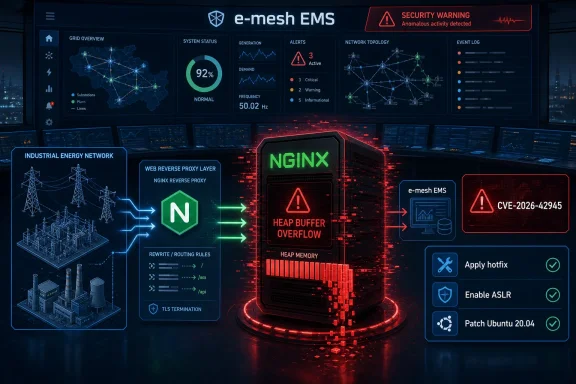
The issue, republished by CISA from Hitachi Energy’s PSIRT advisory 8DBD000253, lands in an awkward place for defenders. e-mesh EMS is an energy management system, not a public web app, but the vulnerable component is NGINX, the same reverse proxy and web server software that underpins countless internet-facing services. That collision between industrial uptime and commodity web plumbing is the real story.
A Web-Server Bug Has Walked Into the Control Room
The vulnerable component is NGINX’s ngx_http_rewrite_module, and the condition is unusually specific: a rewrite directive followed by another rewrite, if, or set directive, combined with an unnamed PCRE capture such as $1 or $2 and a replacement string containing a question mark. Under crafted HTTP requests, that pattern can trigger heap corruption in an NGINX worker process.
On a generic website, that would already be serious. In an energy-management environment, the operational meaning changes. A worker crash is not merely a web-service hiccup if the affected interface supports monitoring, dispatch, visualization, or orchestration functions around distributed energy resources.
Hitachi Energy rates the issue as CVSS 3.1 score 8.1, or “High,” while the CVSS 4.0 score rises to 9.2, or “Critical.” That difference captures the modern scoring system’s sharper emphasis on attacker reach and technical impact. CISA’s republication also repeats the vendor’s warning that successful exploitation could lead to denial of service and possible arbitrary code execution.
The advisory does not say that e-mesh EMS is being exploited in the wild. It also does not claim that every installation is trivially exploitable. But it does say enough to make this a maintenance-window priority rather than a paperwork exercise.
The Exploit Path Is Narrow, but the Blast Radius Is Not
Security teams often underestimate configuration-dependent vulnerabilities because they read like edge cases. This one requires a particular rewrite pattern, an attacker-controlled request, and in the code-execution scenario, either disabled Address Space Layout Randomization or a bypass of it. That is not the same as a universal remote-root bug.
But industrial systems are not judged only by exploit elegance. They are judged by consequences, recovery time, and the number of people who must sign off before a hotfix touches production. A vulnerability that can restart a worker process on demand may become a reliability problem before it becomes a full compromise.
The NGINX flaw has already drawn broader attention outside the Hitachi Energy advisory. Akamai’s security researchers described CVE-2026-42945 as a critical heap buffer overflow, and other security reporting has referred to the bug as “NGINX Rift.” Help Net Security reported that affected NGINX Open Source versions include releases through 1.30.0, with NGINX Plus releases also in scope.
That broader context matters because Hitachi Energy is not dealing with a bespoke bug that only its engineers understand. It is dealing with a supply-chain-style inheritance problem: a widely deployed component, a known vulnerability, and fielded industrial products that depend on validated software baselines.
In other words, this is not a patch-now-because-the-internet-is-on-fire advisory. It is a patch-now-because-you-do-not-want-a-web-layer memory bug deciding the availability posture of an energy platform.
The Patch Is Simple; the Environment Is Not
Hitachi Energy’s remediation is direct: apply the hotfix for the relevant e-mesh EMS version so NGINX is updated to version 1.30.2 or the latest supported release. That is the easy sentence in the advisory. Everything after it is where real environments get complicated.
The affected e-mesh EMS versions are 4.1.6, 4.4.2, and 4.7.0. Operators need to confirm which product line they are running, whether local configuration includes the risky rewrite pattern, and whether the vendor hotfix has been validated against their deployment architecture. In energy environments, that validation usually means more than “the package installs.”
The advisory also gives a mitigation path for organizations that cannot immediately patch: ensure rewrite configuration does not contain a question mark in replacements for unnamed captures, and ensure ASLR is active with a value of 2 across all deployment targets. That combination reduces the known trigger and hardens the operating system against the code-execution side of the issue.
Still, mitigation is not remediation. Removing a hazardous rewrite pattern may be sensible emergency work, but it depends on knowing where the pattern exists and whether application behavior relies on it. Enabling ASLR should be a baseline defense, but it should not be treated as a magic shield against memory corruption.
The uncomfortable truth is that many industrial operators now have to audit web-server semantics as part of energy-management risk. That is not because utilities suddenly became web companies. It is because modern operational technology quietly absorbed the same reverse proxies, Linux distributions, TLS stacks, and scripting engines as the rest of enterprise IT.
Ubuntu 20.04 Turns This From a CVE Into a Lifecycle Problem
The most revealing part of the advisory may not be the NGINX flaw at all. Hitachi Energy separately notes that the underlying Ubuntu Server 20.04 LTS is end of life for affected e-mesh EMS 4.1.6 and 4.4.2 environments, and advises upgrading to Ubuntu Server 22.04 or 24.04, or activating Ubuntu Pro/ESM as an interim measure.
That sentence widens the aperture. The risk is not just a vulnerable NGINX worker; it is the familiar industrial-control dilemma of long-lived platforms riding on general-purpose operating systems whose support clocks keep moving. Once the OS falls out of standard support, every future CVE response becomes a negotiation between vendor compatibility, extended maintenance, and operational risk.
For WindowsForum readers used to Microsoft’s lifecycle drama, the pattern will sound familiar. The end of support for Windows 10 is not just about missing feature updates; it is about the cost of remaining on a platform after the default security pipeline narrows. Ubuntu 20.04 in an industrial appliance is the Linux version of that same planning failure, except the affected system may sit closer to energy operations than to a user’s desktop.
Ubuntu Pro/ESM can be a legitimate bridge, especially where upgrade windows are scarce. But it should be treated as a bridge, not a destination. Extended security maintenance buys time; it does not erase architectural debt.
That matters because attackers do not care whether a vulnerable system is hard to update. They care whether it is reachable, predictable, and valuable. Energy-management software satisfies at least two of those conditions by default.
CISA’s Republication Is a Signal, Not an Endorsement
CISA’s advisory is unusual in tone because it explicitly says the document is a verbatim republication of Hitachi Energy’s CSAF advisory and is provided as-is. The agency says it is not responsible for the editorial or technical accuracy of the republished advisory and does not endorse the commercial product. That legal language may read like boilerplate, but it tells defenders how to use the document.
CISA is amplifying vendor-supplied information for visibility. It is not independently rewriting the technical record. The first operational stop for affected customers remains Hitachi Energy’s service organization or product provider, especially for hotfix availability and platform-specific upgrade paths.
At the same time, CISA’s recommended practices remain the right baseline for industrial-control environments. Minimize network exposure. Keep control-system devices off the public internet. Place control networks and remote devices behind firewalls. Isolate business and control networks. Use VPNs only as part of a maintained, hardened remote-access design, not as an excuse to flatten the environment.
Those recommendations are old because they are still correct. They are also often the only reason a configuration-dependent bug does not become an incident. If an attacker cannot reach the NGINX interface, the exploit chain stops before the clever part begins.
But defenders should resist the comforting myth that segmentation alone solves patching. Segmentation reduces exposure; it does not eliminate insider risk, compromised jump hosts, misconfigured remote access, or vendor-maintenance pathways. The patch still matters.
The Windows Angle Is the Management Plane
This is not a Windows vulnerability, but it is absolutely a Windows shop problem. Many energy and industrial operators manage mixed environments where Windows endpoints, Active Directory, VPN clients, jump servers, SIEM tooling, and patch-management workflows sit beside Linux-based appliances and OT applications. The compromise path into an industrial web interface may begin on a Windows laptop.
That is why this advisory belongs in a Windows community publication. The vulnerable service may run on Ubuntu and NGINX, but the humans who administer it often authenticate through Windows domains, document changes in Microsoft 365, remote in from managed Windows workstations, and monitor alerts through enterprise security tooling. The boundary between IT and OT is porous in practice, even when diagrams insist otherwise.
For sysadmins, the action item is not to become an NGINX module expert overnight. It is to make sure asset inventory, vulnerability management, and change-control processes can see the non-Windows systems that Windows administrators indirectly support. If e-mesh EMS is invisible to the corporate security program because it belongs to “operations,” then the organization has already lost half the argument.
For security teams, the issue should trigger a hunt for exposed management interfaces, especially those reachable from business networks or remote-access enclaves. Even where the affected system is not internet-facing, access logs may show probing, malformed requests, or repeated worker restarts. A denial-of-service symptom can be the first clue that someone has found a fragile edge.
For executives, the lesson is dull but expensive: lifecycle management is now a resilience function. If critical infrastructure platforms depend on web servers, Linux distributions, and third-party packages, then support timelines and patch pathways are part of operational risk, not back-office hygiene.
The Vendor Fix Should Not Become a One-Off Fire Drill
The correct near-term response is to apply Hitachi Energy’s hotfix. But the better long-term response is to ask why a component-level flaw can still surprise an organization running critical systems. That question is uncomfortable because it points to inventory, ownership, and maintenance contracts rather than to a single CVE.
Operators should know which versions of e-mesh EMS are deployed, which Ubuntu versions sit underneath them, what NGINX versions are bundled, and whether any local configuration changes have created risky rewrite patterns. That information should exist before an advisory lands. If it has to be reconstructed during the incident-response meeting, the process is already too slow.
The advisory’s ASLR mitigation is a good example. “Ensure ASLR is active” sounds simple, but in a large estate it becomes a configuration-management question. Which hosts? Which build images? Which exceptions? Who owns the drift report? These are not glamorous security tasks, but they decide whether mitigations are real or merely aspirational.
The same is true for the Ubuntu 20.04 note. A platform that is still operationally useful may be security-expired in ways that are easy to ignore until a CVE forces the conversation. The responsible path is to turn that forced conversation into an upgrade plan with dates, testing gates, fallback procedures, and ownership.
This is where OT security matures or stalls. Mature organizations use advisories like this to tighten the system. Immature ones patch the immediate flaw and leave the lifecycle problem intact for the next advisory.
The e-mesh EMS Advisory Leaves Defenders With a Short, Practical List
The important details are concrete enough that affected organizations should not wait for perfect certainty. Hitachi Energy has identified the affected product versions, the vulnerable component, the hotfix direction, and the immediate mitigations. The remaining work is local: determine exposure, apply the vendor fix, and reduce the chance that a commodity web bug can interrupt industrial operations.
- e-mesh EMS versions 4.1.6, 4.4.2, and 4.7.0 are the affected Hitachi Energy releases named in the CISA-republished advisory.
- The vulnerability is CVE-2026-42945, a heap-based buffer overflow in NGINX’s rewrite module that can crash worker processes and may enable code execution under weaker memory-protection conditions.
- The vendor remediation is to apply the appropriate e-mesh EMS hotfix so NGINX is updated to version 1.30.2 or a later supported version.
- Temporary mitigation includes removing the risky rewrite configuration pattern involving question marks in replacements for unnamed captures and confirming that ASLR is enabled across deployment targets.
- Sites running e-mesh EMS 4.1.6 or 4.4.2 on Ubuntu Server 20.04 need to treat the operating-system lifecycle warning as part of the remediation plan, not as a footnote.
The larger lesson is that industrial cybersecurity is no longer separable from the ordinary software supply chain. A flaw in a web-server rewrite module can become an energy-management advisory; an operating-system lifecycle date can become an operational-risk deadline; and a patch that looks routine on paper can require the coordination of vendors, sysadmins, OT engineers, and security leadership. The organizations that handle this well will not be the ones with the longest exception registers, but the ones that make these dependencies visible before the next inherited vulnerability arrives.
References
- Hitachi Energy e-mesh EMS CISA · 2026-07-07T12:00:00+00:00