

CVE-2026-43199 is a newly published Linux kernel vulnerability, disclosed by kernel.org and listed by Microsoft’s Security Update Guide on May 6, 2026, that fixes a Mellanox/NVIDIA mlx5 Ethernet driver bug triggered during IPsec MAC address handling in kernel workqueue execution. It is not the kind of flaw that lends itself to splashy exploit demos, and that is precisely why administrators should pay attention. The bug sits at the boundary between high-speed networking, cryptographic offload, and kernel scheduling rules — a place where modern infrastructure quietly depends on correctness. For WindowsForum readers, the lesson is less “panic now” than “know where Linux is hiding in your Windows estate.”
The vulnerability record describes a fix in
The affected function,
The fix is almost comically small. Instead of asking the hardware for the local MAC address, the driver now copies it from
Small patches like this are easy to misread. They look too minor to deserve a CVE, especially when the NVD entry is still awaiting enrichment and has no CVSS score attached. But the kernel’s CVE process increasingly catalogs reliability and memory-safety repairs in subsystems that power real production deployments, and the absence of a score should not be mistaken for the absence of operational relevance.
That narrower scope matters. An administrator running a standard Windows 11 desktop, a Hyper-V test box with virtual NICs, or a Linux VM without mlx5 hardware passthrough is unlikely to have a direct exposure. The vulnerable path lives in a specialized performance feature, not in the ordinary TCP/IP stack.
Yet “specialized” no longer means “rare.” ConnectX adapters, BlueField DPUs, SR-IOV, SmartNIC offload, and hardware crypto acceleration have moved from exotic HPC corners into cloud, storage, virtualization, and east-west traffic encryption designs. The systems most likely to touch this code are precisely the systems where packet processing is business-critical.
That is what makes this CVE worth more than a quick shrug. The technical condition is narrow, but the environments that use it tend to be dense, expensive, and sensitive to downtime. When a driver bug appears in the offload path of a data-center NIC, it can matter even if the vulnerability never becomes a household name.
A “scheduling while atomic” warning means the kernel caught code trying to sleep where it should not. That does not automatically mean a remote attacker can take over a machine. It does mean the driver crossed a line the kernel depends on for internal consistency.
In this case, the call trace shows the path moving through workqueue processing into mlx5 IPsec acceleration setup, then into a hardware query function. Hardware command execution is allowed to wait because devices do not always answer instantly. The scheduling bug appears because the caller’s context was not supposed to tolerate that wait.
The fix says something important about the nature of the mistake. The driver did not need a new synchronization model or an elaborate refactor. It needed to stop asking firmware for data the networking stack had already cached. In kernel engineering, sometimes the best fix is not to make a blocking operation safe; it is to remove the blocking operation entirely.
That is why hardware offload exists. With supported mlx5 hardware, Linux can push parts of IPsec processing down into the NIC. The adapter performs encryption, decryption, and related packet handling so the host CPU is not spending its life grinding through ESP traffic.
The tradeoff is complexity. Once crypto policy becomes NIC state, the driver has to translate kernel networking and xfrm state into hardware commands. It has to know the right source and destination addresses, handle events, update security associations, and recover from hardware or policy changes.
CVE-2026-43199 lives in that translation layer. The driver needed MAC addresses while building acceleration attributes for IPsec. It reached for a hardware query and, in doing so, violated the rules of the context it was running in. That is a mundane bug in code, but it appears in a subsystem whose whole purpose is to make secure networking fast enough for modern infrastructure.
For a Windows administrator, the practical question is not “Is Windows vulnerable?” It is “Where do I operate Linux kernels under a Microsoft umbrella?” That includes Azure Linux images, Linux containers on Windows hosts, WSL environments in development fleets, Azure Kubernetes Service nodes, third-party Linux appliances running on Hyper-V, and bare-metal servers managed by Windows-centric teams.
Most of those environments still will not meet the specific hardware and configuration conditions. WSL, for example, is not typically exercising a physical mlx5 NIC IPsec offload path from inside a developer workstation. A cloud or data-center host using SR-IOV, accelerated networking, or passed-through Mellanox hardware is a more plausible place to investigate.
The Microsoft listing is therefore best understood as an inventory prompt. It tells Windows-heavy shops not to assume that “Linux kernel CVE” means “someone else’s problem.” The modern Microsoft estate includes a lot of Linux, and the riskiest instances are often the ones least visible to desktop-focused patch dashboards.
The absence of a score is not the same as a low score. It simply means the federal vulnerability database has not attached its vector string yet. Administrators who use CVSS as their only triage input can get caught in the gap between disclosure and enrichment.
That gap is especially awkward for kernel bugs. A driver reliability flaw can be operationally severe in a network appliance and irrelevant on a laptop. CVSS tries to abstract risk into a general score, but hardware-dependent kernel paths often resist that simplification.
The better triage question is environmental. Do you run Linux kernels with mlx5 hardware? Do you use IPsec acceleration or offload? Are those systems carrying production traffic, storage replication, cluster networking, or tenant isolation? If yes, the lack of a published score should not keep this off the patch board.
Querying hardware is not free. It may sleep, fail, race with device reset, or depend on firmware state. In a slow administrative path, those costs are manageable. In a constrained path, they become bugs.
This is why the fix is elegant. The network device already knows its MAC address. The IPsec acceleration setup can copy that address directly without waking the command machinery underneath the NIC driver.
There is also a security-adjacent lesson here. Modern security features, including encrypted transport offload, are only as reliable as the mundane plumbing around them. A crypto algorithm can be correct while the driver code that prepares its metadata still trips over scheduler rules.
This is not a trace from someone opening a browser tab. It is a trace from a kernel worker thread handling mlx5 IPsec-related work. In a production environment, comparable conditions might appear during IPsec security association setup, policy changes, device events, failover, offload initialization, or network reconfiguration.
A “scheduling while atomic” warning may show up in kernel logs before users notice anything. Depending on kernel configuration, workload, and timing, it could be a noisy warning, a sign of degraded reliability, or a precursor to more visible trouble. The CVE text does not claim arbitrary code execution, privilege escalation, or data disclosure, and it would be irresponsible to invent those claims.
But administrators should not ignore kernel warnings on network infrastructure just because packets are still flowing. The first symptom of a driver timing bug is often a log line that looks academic until the next maintenance window, link flap, or failover event turns it into an outage.
A vulnerability scanner may flag every Linux machine with a kernel in a broad affected range. That is safe but noisy. Another tool may miss systems entirely because they are appliances, storage nodes, hypervisor hosts, lab servers, or vendor-managed images. That is quieter but more dangerous.
The right response is neither panic nor dismissal. It is to correlate kernel versions, mlx5 driver presence, hardware models, and IPsec offload configuration. The affected population may be small, but it may include important machines.
This is especially true in mixed Windows and Linux shops. Windows teams may own Active Directory, endpoint management, and Hyper-V. Linux teams may own Kubernetes, network appliances, or storage. Cloud teams may own everything and nothing. A CVE in a NIC driver cuts across those boundaries, because the physical network path rarely respects org charts.
That abstraction is usually a feature. It lets teams consume high-performance networking without becoming firmware specialists. But when a driver CVE lands, abstraction complicates triage. The question becomes whether the vulnerable code runs in the guest, the host, the DPU, or some provider-managed layer.
Azure, AWS, Google Cloud, private OpenStack, VMware, and Kubernetes environments all have different answers depending on how acceleration is implemented. Some customers manage their own Linux kernels on bare metal. Others consume provider-maintained host networking. Still others pass through devices to workloads for performance-sensitive applications.
For WindowsForum’s audience, the practical move is to avoid assumptions. If you operate Linux guests only as ordinary VMs with emulated or paravirtual NICs, this CVE may be informational. If you operate GPU, RDMA, storage, security gateway, or high-throughput network nodes with Mellanox-class adapters, it deserves a place in the next maintenance conversation.
CVE-2026-43199 lands in that second category based on the available description. It is a resolved kernel bug with a concrete trace and a small patch. It should not be marketed as a universal emergency. It also should not be waved away just because it lacks a polished advisory narrative.
The challenge for IT teams is that the old mental model — wait for a vendor score, sort by severity, patch the reds first — is increasingly inadequate for kernel and driver CVEs. Hardware-specific bugs can be low priority for most machines and high priority for the few that matter most.
That makes local knowledge more valuable than ever. A vulnerability record can tell you what changed. Only your inventory can tell you whether that change matters.
Consider the modern Windows-adjacent estate. SQL Server may run on Linux. Kubernetes nodes may host .NET services. Azure appliances and marketplace images may sit beside Windows Server workloads. Security products, backup systems, observability collectors, storage gateways, and VPN infrastructure often use Linux under the hood.
A kernel driver CVE in a Mellanox IPsec path will not affect most of those systems. But the fact that it plausibly could affect any of them is the point. The boundary between “Windows environment” and “Linux environment” is no longer a clean management boundary.
That is why Microsoft’s CVE listing matters even when the bug is not in Windows. It reflects the world Microsoft now inhabits: Windows clients, Windows Server, Azure, Linux, containers, firmware, hardware offload, and open-source kernels all sharing the same operational map.
The second step is to determine whether IPsec offload is in use. The vulnerable path is tied to IPsec MAC address initialization for acceleration attributes, so a server with an mlx5 NIC but no IPsec offload usage has a different risk profile from a gateway or host actively using hardware-assisted ESP processing.
The third step is to track vendor kernels rather than only upstream commits. Enterprise distributions, cloud images, appliance vendors, and OEM stacks may backport the fix under different kernel version strings. A machine can be fixed without running the newest upstream kernel, and a machine can be exposed despite appearing “new enough” if the relevant backport is absent.
Finally, teams should review logs for related warnings if they operate affected hardware. Kernel traces mentioning
Administrators should be careful with self-built kernel cherry-picks on production networking hosts. The patch itself is small, but mlx5 drivers sit in a complex stack involving firmware, devlink, SR-IOV, RDMA, xfrm, and distribution support policy. A clean vendor update is usually preferable unless you already run custom kernels as a matter of practice.
Where patching must wait, risk reduction is configuration-dependent. If IPsec offload is not required, disabling the feature may reduce exposure to the problematic path. If offload is required for throughput, the safer mitigation may be a controlled maintenance window rather than an emergency toggle.
There is no one-size-fits-all playbook here. A lab host can wait. A production IPsec gateway using ConnectX hardware probably should not. A cloud tenant may need to ask whether the vulnerable code is in a customer-managed kernel or provider-managed infrastructure.
But quiet CVEs are where mature operations teams distinguish themselves. They do not patch every machine blindly, and they do not ignore every unscored vulnerability. They build enough inventory context to know which small bugs intersect with important systems.
In this case, the intersection is high-performance Linux networking, mlx5 hardware, and IPsec offload. That is a small target, but one that may sit under VPN gateways, encrypted east-west traffic, storage fabrics, or cloud hosts. A three-line driver change can matter a great deal if it prevents a scheduler violation in the middle of that path.
The broader story is that offload keeps moving complexity out of CPUs and into devices, drivers, and firmware-adjacent code. That improves performance, but it spreads the security and reliability surface across layers many organizations do not monitor with the same discipline as operating systems and applications.
Source: NVD / Linux Kernel Security Update Guide - Microsoft Security Response Center
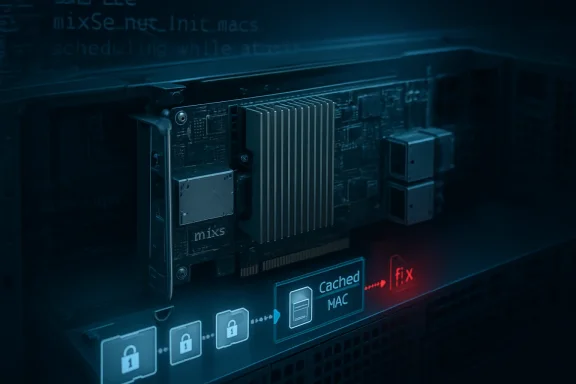 A Small Driver Fix Exposes a Big Infrastructure Assumption
The vulnerability record describes a fix in net/mlx5e, the Linux Ethernet driver used for Mellanox ConnectX and related NVIDIA networking hardware. The problem is a classic kernel sin: code running in an atomic context calls into a path that can sleep. In ordinary application programming, that sounds like a scheduling nuisance; in the kernel, it is a rule violation that can produce warnings, instability, or worse under the wrong workload.The affected function,
mlx5e_ipsec_init_macs(), was querying the NIC for a MAC address by calling mlx5_query_mac_address(). That call can descend into mlx5_cmd_exec(), a hardware command path that may wait. The catch is that the call happened from mlx5e_ipsec_handle_event, a workqueue path the kernel treated as atomic for this operation, producing the “scheduling while atomic” complaint shown in the trace.The fix is almost comically small. Instead of asking the hardware for the local MAC address, the driver now copies it from
netdev->dev_addr using ether_addr_copy(). That address was already available in the network device structure, so the driver was paying the cost — and taking the scheduling risk — of asking a question it already knew the answer to.Small patches like this are easy to misread. They look too minor to deserve a CVE, especially when the NVD entry is still awaiting enrichment and has no CVSS score attached. But the kernel’s CVE process increasingly catalogs reliability and memory-safety repairs in subsystems that power real production deployments, and the absence of a score should not be mistaken for the absence of operational relevance.
The Vulnerability Is Narrow, but the Blast Radius Is Not Obvious
CVE-2026-43199 is not a generic Linux networking flaw. It is tied to the mlx5 Ethernet driver and specifically to IPsec acceleration paths. That means the most likely exposed systems are not random laptops or commodity VMs, but servers using NVIDIA/Mellanox NICs with kernel-supported IPsec offload features enabled.That narrower scope matters. An administrator running a standard Windows 11 desktop, a Hyper-V test box with virtual NICs, or a Linux VM without mlx5 hardware passthrough is unlikely to have a direct exposure. The vulnerable path lives in a specialized performance feature, not in the ordinary TCP/IP stack.
Yet “specialized” no longer means “rare.” ConnectX adapters, BlueField DPUs, SR-IOV, SmartNIC offload, and hardware crypto acceleration have moved from exotic HPC corners into cloud, storage, virtualization, and east-west traffic encryption designs. The systems most likely to touch this code are precisely the systems where packet processing is business-critical.
That is what makes this CVE worth more than a quick shrug. The technical condition is narrow, but the environments that use it tend to be dense, expensive, and sensitive to downtime. When a driver bug appears in the offload path of a data-center NIC, it can matter even if the vulnerability never becomes a household name.
“Scheduling While Atomic” Is Kernelese for a Broken Promise
Linux kernel code runs under different execution constraints depending on context. Some code can block, sleep, allocate memory patiently, and wait for hardware. Other code must finish quickly because it is holding locks, running with preemption disabled, or operating in a context where sleeping would violate scheduler assumptions.A “scheduling while atomic” warning means the kernel caught code trying to sleep where it should not. That does not automatically mean a remote attacker can take over a machine. It does mean the driver crossed a line the kernel depends on for internal consistency.
In this case, the call trace shows the path moving through workqueue processing into mlx5 IPsec acceleration setup, then into a hardware query function. Hardware command execution is allowed to wait because devices do not always answer instantly. The scheduling bug appears because the caller’s context was not supposed to tolerate that wait.
The fix says something important about the nature of the mistake. The driver did not need a new synchronization model or an elaborate refactor. It needed to stop asking firmware for data the networking stack had already cached. In kernel engineering, sometimes the best fix is not to make a blocking operation safe; it is to remove the blocking operation entirely.
IPsec Offload Turns Security Plumbing Into Hardware State
IPsec is old, proven, and still operationally awkward. It protects IP traffic using security associations, policies, sequence numbers, keys, and encapsulation modes that must line up across hosts or gateways. In software, that work can be CPU-intensive, especially at high throughput.That is why hardware offload exists. With supported mlx5 hardware, Linux can push parts of IPsec processing down into the NIC. The adapter performs encryption, decryption, and related packet handling so the host CPU is not spending its life grinding through ESP traffic.
The tradeoff is complexity. Once crypto policy becomes NIC state, the driver has to translate kernel networking and xfrm state into hardware commands. It has to know the right source and destination addresses, handle events, update security associations, and recover from hardware or policy changes.
CVE-2026-43199 lives in that translation layer. The driver needed MAC addresses while building acceleration attributes for IPsec. It reached for a hardware query and, in doing so, violated the rules of the context it was running in. That is a mundane bug in code, but it appears in a subsystem whose whole purpose is to make secure networking fast enough for modern infrastructure.
The Microsoft Angle Is Real, but Easy to Overstate
The user-facing source here is Microsoft’s Security Update Guide entry for CVE-2026-43199. That can cause confusion because the vulnerability is in the Linux kernel, not in Windows itself. Microsoft tracks many third-party and open-source vulnerabilities because its products, services, cloud images, containers, developer tooling, and Linux distributions may incorporate or expose affected components.For a Windows administrator, the practical question is not “Is Windows vulnerable?” It is “Where do I operate Linux kernels under a Microsoft umbrella?” That includes Azure Linux images, Linux containers on Windows hosts, WSL environments in development fleets, Azure Kubernetes Service nodes, third-party Linux appliances running on Hyper-V, and bare-metal servers managed by Windows-centric teams.
Most of those environments still will not meet the specific hardware and configuration conditions. WSL, for example, is not typically exercising a physical mlx5 NIC IPsec offload path from inside a developer workstation. A cloud or data-center host using SR-IOV, accelerated networking, or passed-through Mellanox hardware is a more plausible place to investigate.
The Microsoft listing is therefore best understood as an inventory prompt. It tells Windows-heavy shops not to assume that “Linux kernel CVE” means “someone else’s problem.” The modern Microsoft estate includes a lot of Linux, and the riskiest instances are often the ones least visible to desktop-focused patch dashboards.
NVD’s Missing Score Should Not Become a Patch Deferral Strategy
At publication, NVD marks the record as awaiting enrichment. No CVSS 4.0, 3.x, or 2.0 base score is available from NVD in the entry. That is normal for freshly published CVEs, especially those emitted from the kernel.org pipeline before downstream vendors have completed their analysis.The absence of a score is not the same as a low score. It simply means the federal vulnerability database has not attached its vector string yet. Administrators who use CVSS as their only triage input can get caught in the gap between disclosure and enrichment.
That gap is especially awkward for kernel bugs. A driver reliability flaw can be operationally severe in a network appliance and irrelevant on a laptop. CVSS tries to abstract risk into a general score, but hardware-dependent kernel paths often resist that simplification.
The better triage question is environmental. Do you run Linux kernels with mlx5 hardware? Do you use IPsec acceleration or offload? Are those systems carrying production traffic, storage replication, cluster networking, or tenant isolation? If yes, the lack of a published score should not keep this off the patch board.
The Patch Is a Reminder That Cached State Exists for a Reason
The fixed code path replaces a hardware query with a copy fromnetdev->dev_addr. That may sound like an implementation detail, but it gets to a deeper principle in kernel networking. The kernel maintains canonical state for devices so subsystems do not have to poke hardware every time they need basic information.Querying hardware is not free. It may sleep, fail, race with device reset, or depend on firmware state. In a slow administrative path, those costs are manageable. In a constrained path, they become bugs.
This is why the fix is elegant. The network device already knows its MAC address. The IPsec acceleration setup can copy that address directly without waking the command machinery underneath the NIC driver.
There is also a security-adjacent lesson here. Modern security features, including encrypted transport offload, are only as reliable as the mundane plumbing around them. A crypto algorithm can be correct while the driver code that prepares its metadata still trips over scheduler rules.
The Call Trace Tells Operators Where to Look
The reported trace nameskworker/u112:2, mlx5e_ipsec_init_macs, mlx5e_ipsec_build_accel_xfrm_attrs, and mlx5e_ipsec_handle_event. Those function names are not merely developer breadcrumbs. They tell operators what kind of system behavior might surface the bug.This is not a trace from someone opening a browser tab. It is a trace from a kernel worker thread handling mlx5 IPsec-related work. In a production environment, comparable conditions might appear during IPsec security association setup, policy changes, device events, failover, offload initialization, or network reconfiguration.
A “scheduling while atomic” warning may show up in kernel logs before users notice anything. Depending on kernel configuration, workload, and timing, it could be a noisy warning, a sign of degraded reliability, or a precursor to more visible trouble. The CVE text does not claim arbitrary code execution, privilege escalation, or data disclosure, and it would be irresponsible to invent those claims.
But administrators should not ignore kernel warnings on network infrastructure just because packets are still flowing. The first symptom of a driver timing bug is often a log line that looks academic until the next maintenance window, link flap, or failover event turns it into an outage.
Enterprise Risk Lives in the Places Patch Tools Abstract Away
Patch management products are good at naming operating systems and package versions. They are less good at understanding hardware execution paths. CVE-2026-43199 is the kind of vulnerability that forces an inventory question most enterprises still answer poorly: which Linux kernels are paired with which NICs and which offload features?A vulnerability scanner may flag every Linux machine with a kernel in a broad affected range. That is safe but noisy. Another tool may miss systems entirely because they are appliances, storage nodes, hypervisor hosts, lab servers, or vendor-managed images. That is quieter but more dangerous.
The right response is neither panic nor dismissal. It is to correlate kernel versions, mlx5 driver presence, hardware models, and IPsec offload configuration. The affected population may be small, but it may include important machines.
This is especially true in mixed Windows and Linux shops. Windows teams may own Active Directory, endpoint management, and Hyper-V. Linux teams may own Kubernetes, network appliances, or storage. Cloud teams may own everything and nothing. A CVE in a NIC driver cuts across those boundaries, because the physical network path rarely respects org charts.
Cloud and Virtualization Make Hardware Bugs Less Visible, Not Less Relevant
In a traditional server room, an administrator might know exactly which rack contains Mellanox adapters. In cloud and virtualized environments, that knowledge is fuzzier. The guest OS sees a virtual function, an accelerated path, or an abstracted network interface, while the underlying host and fabric remain someone else’s problem.That abstraction is usually a feature. It lets teams consume high-performance networking without becoming firmware specialists. But when a driver CVE lands, abstraction complicates triage. The question becomes whether the vulnerable code runs in the guest, the host, the DPU, or some provider-managed layer.
Azure, AWS, Google Cloud, private OpenStack, VMware, and Kubernetes environments all have different answers depending on how acceleration is implemented. Some customers manage their own Linux kernels on bare metal. Others consume provider-maintained host networking. Still others pass through devices to workloads for performance-sensitive applications.
For WindowsForum’s audience, the practical move is to avoid assumptions. If you operate Linux guests only as ordinary VMs with emulated or paravirtual NICs, this CVE may be informational. If you operate GPU, RDMA, storage, security gateway, or high-throughput network nodes with Mellanox-class adapters, it deserves a place in the next maintenance conversation.
The Kernel CVE Firehose Rewards Context, Not Alarmism
The Linux kernel has been assigning CVEs to a large number of fixes, and that has changed the vulnerability landscape for defenders. Many records are thin, newly published, and initially unscored. Some describe serious exploitable conditions. Others describe correctness bugs whose security impact depends heavily on configuration.CVE-2026-43199 lands in that second category based on the available description. It is a resolved kernel bug with a concrete trace and a small patch. It should not be marketed as a universal emergency. It also should not be waved away just because it lacks a polished advisory narrative.
The challenge for IT teams is that the old mental model — wait for a vendor score, sort by severity, patch the reds first — is increasingly inadequate for kernel and driver CVEs. Hardware-specific bugs can be low priority for most machines and high priority for the few that matter most.
That makes local knowledge more valuable than ever. A vulnerability record can tell you what changed. Only your inventory can tell you whether that change matters.
The Windows Admin’s Linux Problem Keeps Getting Bigger
Windows administrators have spent years being told that Linux is now part of their job, usually in the context of containers, cloud, DevOps, or identity integration. CVE-2026-43199 is a more infrastructure-flavored reminder. Linux is not just running developer tools; it is running the network paths underneath services Windows users depend on.Consider the modern Windows-adjacent estate. SQL Server may run on Linux. Kubernetes nodes may host .NET services. Azure appliances and marketplace images may sit beside Windows Server workloads. Security products, backup systems, observability collectors, storage gateways, and VPN infrastructure often use Linux under the hood.
A kernel driver CVE in a Mellanox IPsec path will not affect most of those systems. But the fact that it plausibly could affect any of them is the point. The boundary between “Windows environment” and “Linux environment” is no longer a clean management boundary.
That is why Microsoft’s CVE listing matters even when the bug is not in Windows. It reflects the world Microsoft now inhabits: Windows clients, Windows Server, Azure, Linux, containers, firmware, hardware offload, and open-source kernels all sharing the same operational map.
What to Do Before This Becomes Just Another Stale CVE
The first administrative step is to identify Linux systems using the mlx5 driver. On many machines, this will be obvious from hardware inventory,lspci, loaded modules, or network interface naming. In more managed environments, the answer may require cloud instance metadata, vendor documentation, or coordination with infrastructure teams.The second step is to determine whether IPsec offload is in use. The vulnerable path is tied to IPsec MAC address initialization for acceleration attributes, so a server with an mlx5 NIC but no IPsec offload usage has a different risk profile from a gateway or host actively using hardware-assisted ESP processing.
The third step is to track vendor kernels rather than only upstream commits. Enterprise distributions, cloud images, appliance vendors, and OEM stacks may backport the fix under different kernel version strings. A machine can be fixed without running the newest upstream kernel, and a machine can be exposed despite appearing “new enough” if the relevant backport is absent.
Finally, teams should review logs for related warnings if they operate affected hardware. Kernel traces mentioning
mlx5e_ipsec_init_macs, mlx5_query_mac_address, mlx5_cmd_exec, or “scheduling while atomic” are worth preserving and correlating with network changes. Logs will not substitute for patching, but they can help identify whether the bug has been observed in the field.The Patch Window Belongs to the Few Systems That Actually Match
The most concrete action is to patch when your distribution or vendor supplies an update containing the fix. For upstream and stable-kernel consumers, the referenced kernel commits are the path to resolution. For enterprise Linux, the answer will arrive through the normal errata machinery.Administrators should be careful with self-built kernel cherry-picks on production networking hosts. The patch itself is small, but mlx5 drivers sit in a complex stack involving firmware, devlink, SR-IOV, RDMA, xfrm, and distribution support policy. A clean vendor update is usually preferable unless you already run custom kernels as a matter of practice.
Where patching must wait, risk reduction is configuration-dependent. If IPsec offload is not required, disabling the feature may reduce exposure to the problematic path. If offload is required for throughput, the safer mitigation may be a controlled maintenance window rather than an emergency toggle.
There is no one-size-fits-all playbook here. A lab host can wait. A production IPsec gateway using ConnectX hardware probably should not. A cloud tenant may need to ask whether the vulnerable code is in a customer-managed kernel or provider-managed infrastructure.
The Quiet Fixes Are the Ones That Test Operational Maturity
CVE-2026-43199 will not dominate security headlines, and that is appropriate. The available record points to a specific kernel driver bug, a specific offload-related path, and a straightforward fix. It does not currently carry the hallmarks of a mass-exploitation crisis.But quiet CVEs are where mature operations teams distinguish themselves. They do not patch every machine blindly, and they do not ignore every unscored vulnerability. They build enough inventory context to know which small bugs intersect with important systems.
In this case, the intersection is high-performance Linux networking, mlx5 hardware, and IPsec offload. That is a small target, but one that may sit under VPN gateways, encrypted east-west traffic, storage fabrics, or cloud hosts. A three-line driver change can matter a great deal if it prevents a scheduler violation in the middle of that path.
The broader story is that offload keeps moving complexity out of CPUs and into devices, drivers, and firmware-adjacent code. That improves performance, but it spreads the security and reliability surface across layers many organizations do not monitor with the same discipline as operating systems and applications.
The Practical Read for WindowsForum Readers
This vulnerability is a useful filter for separating theoretical exposure from real infrastructure risk. Treat it as a targeted investigation, not a general Windows emergency. The systems to prioritize are Linux hosts with mlx5 networking and IPsec acceleration, especially if they carry production encrypted traffic.- CVE-2026-43199 was published on May 6, 2026, and currently lacks an NVD severity score while enrichment is pending.
- The fixed bug is a Linux mlx5 Ethernet driver scheduling violation in an IPsec MAC address query path.
- The vulnerable condition depends on mlx5-class hardware and IPsec offload-related code paths, not ordinary Windows networking.
- The repair avoids a sleeping hardware command by copying the MAC address already stored in
netdev->dev_addr. - Windows-centric teams should check Azure, Hyper-V, Kubernetes, appliance, and bare-metal Linux systems where Mellanox/NVIDIA adapters may be used.
- Vendor kernel updates and distribution backports are the safest remediation route for production systems.
Source: NVD / Linux Kernel Security Update Guide - Microsoft Security Response Center
