

CVE-2026-43250 is a Linux kernel vulnerability published on May 6, 2026, affecting the ChipIdea USB Device Controller driver when a USB gadget device is disconnected and reconnected during an active multi-segment DMA transfer. The bug is not a headline-grabbing remote code execution flaw; it is the kind of driver-state cleanup failure that turns routine embedded-device churn into kernel memory risk. Its importance lies less in the CVE score, which NVD has not yet assigned, than in what it reveals about USB gadget reliability, DMA lifetime management, and the increasingly blurry boundary between “just a crash” and “security-relevant corruption.”
The vulnerable code sits in the Linux kernel’s ChipIdea UDC driver, part of the USB gadget stack used by devices that present themselves to a host over USB. Think development boards, industrial controllers, embedded appliances, phones in certain modes, and hardware that exposes Ethernet, serial, storage, or debug functions through USB. This is not the same threat model as plugging a malicious thumb drive into a Windows laptop; here the Linux system is often the USB device, not the USB host.
That distinction matters because it narrows the blast radius but does not make the issue trivial. The affected path is reached when a gadget endpoint is shut down while a transfer is in flight. In the failure scenario described by the kernel CVE record, a disconnect during a multi-segment DMA transfer returns a request to the gadget layer without fully unwinding the DMA and scatter-gather state attached to that request.
On reconnect, the same request may be reused. Because fields such as
That is the central lesson of CVE-2026-43250: the bug is not in the exciting moment where data is transferred, but in the boring moment where an aborted transfer is cleaned up. Kernel security has always lived in those seams.
The normal completion path in the driver already knew what to do. When hardware dequeues a completed request, it unmaps the DMA buffers and handles scatter-gather bounce-buffer cleanup before returning the request upward. The shutdown path,
That asymmetry is the whole story. A request completed normally came back clean. A request aborted by endpoint shutdown could come back wearing old DMA state like a forged passport.
The fix is correspondingly small. The patch adds DMA unmapping when mapped scatter-gather entries are present, and it calls the bounce-buffer cleanup routine with copying disabled because the transfer is being aborted rather than completed. In other words, the driver now treats an aborted request as an object whose hardware-facing state must be dismantled before anyone in the gadget layer is allowed to see it again.
The restraint of the patch should not be mistaken for insignificance. In kernel code, a seven-line fix can close a path to corruption if those seven lines sit between “hardware owns this buffer” and “software is free to reuse this request.”
Why
The name
Emergency exits are where cleanup bugs concentrate. Developers tend to optimize their attention around the normal path: map the buffer, submit the request, complete the transfer, unmap the buffer, call the completion handler. The exceptional path must reproduce enough of that choreography to leave the system coherent, but it often does so under pressure, with partial state, and during disconnect or shutdown sequences that are harder to test.
CVE-2026-43250 fits that pattern almost perfectly. A disconnect happens during an active transfer. The driver returns a request upward with
This is the kernel equivalent of handing back a rental car with the engine still running and the GPS still navigating to the previous driver’s destination. The paperwork says the trip is over. The machine disagrees.
When a driver maps a scatter-gather list for DMA, it is creating a temporary hardware-facing view of memory. That view has rules. It may involve cache maintenance, IOMMU mappings, bounce buffers, alignment constraints, and bookkeeping that says which entries are safe for the device to use.
Bounce buffers add another layer. If the original buffer cannot be used directly by the hardware because of alignment or addressability constraints, data may be staged through a compatible buffer. When the transfer completes normally, data may need to be copied back. When it is aborted, copying back can be wrong, pointless, or actively dangerous.
That is why the fix’s
For sysadmins, this may sound like driver trivia. For anyone who maintains embedded Linux fleets, it is a reminder that a USB reconnect storm, a flaky cable, a host reboot, or a user repeatedly power-cycling a device can exercise code paths that ordinary throughput tests never touch.
This is where kernel CVE handling remains frustrating for enterprise security teams. The modern Linux process increasingly assigns CVEs to resolved defects that may have plausible security consequences but do not arrive with a polished exploit narrative. That is more transparent than hiding them in changelogs, but it creates triage noise.
CVE-2026-43250 lands in the ambiguous middle. The record explicitly mentions potential memory corruption, which raises the stakes beyond a simple device disconnect bug. At the same time, exploiting it would appear to require a specific hardware and role configuration: a Linux system using the ChipIdea UDC gadget driver, active USB gadget transfers, and a disconnect or endpoint shutdown at the right time.
The practical severity therefore depends heavily on deployment. A developer board on a lab bench is one thing. A field-deployed embedded gateway exposing USB Ethernet to an upstream controller is another. A consumer device with no exposed gadget mode at all may be unaffected in any meaningful operational sense.
This distinction is worth making because Windows administrators are now routinely exposed to Linux CVEs in Microsoft tooling. Defender, Azure, container scanning, SBOM pipelines, and vulnerability dashboards do not care about old platform boundaries. If an organization runs Linux anywhere in its Microsoft-managed estate, Linux kernel CVEs may surface next to Windows Server, Exchange, Edge, and .NET issues.
For WindowsForum readers, the headline is not “patch Windows for a USB bug.” It is “your Microsoft security console may be correctly telling you about a Linux kernel flaw.” That is the world we now administer.
The operational question is whether any of your Linux systems use the affected driver in the affected role. If not, the CVE is inventory noise. If yes, it becomes a kernel maintenance item, especially for devices where USB disconnects during transfer are routine rather than exceptional.
That is exactly where patching is hardest. A cloud server can usually receive a vendor kernel update, reboot under maintenance, and move on. An embedded device may run a vendor-forked kernel, a board support package that trails upstream by years, or a custom product kernel where every driver change must be regression-tested against hardware that is no longer on the engineer’s desk.
CVE-2026-43250 is therefore a supply-chain vulnerability in the practical sense, even if not in the fashionable branding sense. The fix exists upstream and in stable commits, but it must still travel through silicon vendors, board vendors, product vendors, firmware teams, managed-service providers, and finally customer update channels.
That trip can take weeks in a disciplined environment and years in a neglected one. The uncomfortable truth of embedded security is that many devices are built on Linux precisely because the kernel is flexible, and then shipped into operational settings where kernel updates are treated as existential surgery.
That narrower access model should temper panic. It should not invite dismissal. Physical and near-physical attack surfaces matter in kiosks, industrial installations, medical devices, point-of-sale systems, test rigs, automotive tooling, factory controllers, and secure facilities where a USB cable is part of normal operation.
A reliability bug can become a security bug when an attacker can make the rare timing window common. Disconnects that happen once in a year of normal use can be turned into loops. Transfers that normally complete can be intentionally interrupted. A driver state leak that looks like a lab nuisance can become an availability problem, and possibly more, if it corrupts memory in a privileged kernel context.
The record’s reference to potential memory corruption is doing a lot of work. Without a demonstrated exploit, responsible analysis should avoid claiming privilege escalation or code execution. But kernel memory corruption is not a category enterprises can ignore simply because exploitation is inconvenient.
In risk terms, CVE-2026-43250 is less “drop everything” and more “do not let affected embedded kernels rot.” That is a dull sentence, but dull sentences are where most infrastructure security actually lives.
The same model also creates pressure. Every small driver fix can become a CVE. Every CVE can become a dashboard alert. Every dashboard alert can become a ticket assigned to someone who has never heard of ChipIdea and has no idea whether their organization owns affected hardware.
That is not a reason to stop assigning CVEs. It is a reason to improve asset intelligence. Vulnerability management without hardware and kernel-config awareness is just spreadsheet weather.
For this issue, the most useful questions are concrete. Are you running Linux kernels that include
Many embedded products do not run a stock distribution kernel. They run vendor trees with backported patches, local board files, out-of-tree drivers, and configuration deltas that make version numbers misleading. A device may report an old kernel version but include the fix, or report a vendor-branded newer kernel and still lack it.
That means administrators and product teams should track the patch by behavior and commit lineage, not just by version string. The relevant correction is the addition of DMA unmapping and scatter-gather bounce-buffer cleanup in
This is where SBOMs and VEX statements can be useful, but only if they are specific. “Linux kernel present” is not useful. “ChipIdea UDC driver not built” is useful. “Affected driver present but gadget mode disabled in product configuration” is useful. “Patched via upstream stable commit backport” is useful.
The better vulnerability programs are moving from package-name matching toward exposure reasoning. CVE-2026-43250 is a good test of whether that transition is real or just conference talk.
That is a classic kernel pattern. The mainline path is reviewed, benchmarked, and exercised constantly. The abort path is harder to trigger, less frequently tested, and often depends on timing that fuzzers and integration tests must deliberately create.
A mature fix does not invent a new model; it makes the abnormal path obey the same contract as the normal path. Requests returned to gadget drivers must be reusable. Reusable means not carrying stale DMA mappings. Stale DMA mappings are not merely untidy. They can point hardware at memory the driver no longer owns.
There is an architectural lesson here for driver authors beyond USB. Any API that returns objects to an upper layer after cancellation must define precisely what state is preserved and what state is cleared. If the upper layer is allowed to reuse the object, lower-layer hardware state must not leak across that boundary.
This is the kind of bug that static analysis sometimes misses because each individual line can look reasonable. The request is returned with shutdown status. The gadget layer is informed. The endpoint is drained. Only when you compare the shutdown path to the completion path does the missing cleanup stand out.
That does not mean every Linux CVE deserves the same attention as a wormable Windows flaw. It means the first step is no longer dismissal. The first step is classification.
CVE-2026-43250 should be classified by role. A Windows desktop with no Linux kernel is irrelevant. A Hyper-V host running Linux guests is probably irrelevant unless those guests expose the affected USB gadget stack. A fleet of ARM-based appliances managed by the same IT organization may be relevant. A lab full of USB-connected embedded boards may be very relevant.
The Microsoft Security Update Guide entry will inevitably pull some Windows admins into that classification exercise. That is not a bug in the ecosystem. It is the ecosystem telling the truth: modern infrastructure is mixed, layered, and full of components whose security boundaries do not align with org charts.
This is particularly relevant in manufacturing and development environments. Engineers often connect boards over USB, run large transfers, reset hosts, reflash firmware, and repeat. A bug that requires disconnect during active transfer may be easy to reproduce in exactly those settings.
For production devices, the risk depends on whether the USB gadget interface is exposed and used. Some products ship with USB ports available only for service. Others use USB internally, hidden behind enclosures or connected to companion controllers. Internal does not mean impossible, but it does affect likelihood.
The right operational response is to patch affected kernels through normal firmware channels, prioritize devices that expose USB gadget functions, and add disconnect-under-load testing where possible. If your regression suite never yanks the cable mid-transfer, it is not testing the path this CVE is about.
Security scoring is a convenience layer, not a substitute for engineering judgment. CVSS often struggles with hardware-dependent kernel bugs because the same flaw can be unreachable in one product and serious in another. A single base score cannot express whether your device exposes the relevant USB role, whether untrusted users can cause reconnects, or whether corrupted DMA state could cross a meaningful security boundary.
This is why vulnerability management needs context from kernel engineers, firmware owners, and product teams. The security team can see the CVE. It may not know whether
The organizations that handle this well will not treat CVE-2026-43250 as a universal emergency. They will treat it as a precise question sent to the owners of Linux-based USB gadget devices: are we on this path, and if so, when do we take the fix?
Source: NVD / Linux Kernel Security Update Guide - Microsoft Security Response Center
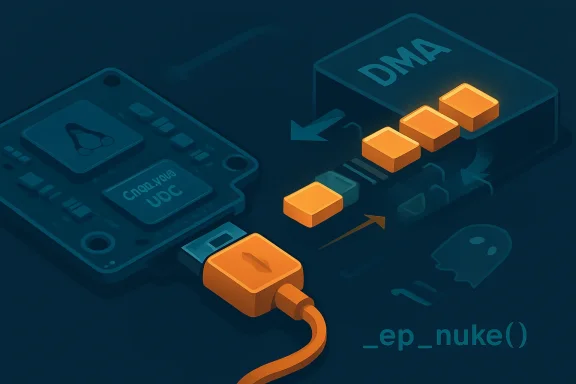 A Small USB Driver Bug Lands in a Very Large Supply Chain
The vulnerable code sits in the Linux kernel’s ChipIdea UDC driver, part of the USB gadget stack used by devices that present themselves to a host over USB. Think development boards, industrial controllers, embedded appliances, phones in certain modes, and hardware that exposes Ethernet, serial, storage, or debug functions through USB. This is not the same threat model as plugging a malicious thumb drive into a Windows laptop; here the Linux system is often the USB device, not the USB host.That distinction matters because it narrows the blast radius but does not make the issue trivial. The affected path is reached when a gadget endpoint is shut down while a transfer is in flight. In the failure scenario described by the kernel CVE record, a disconnect during a multi-segment DMA transfer returns a request to the gadget layer without fully unwinding the DMA and scatter-gather state attached to that request.
On reconnect, the same request may be reused. Because fields such as
num_mapped_sgs and the scatter-gather pointer still look populated, the enqueue path can incorrectly assume mapping has already been done. The driver then risks feeding stale or invalid DMA addresses back into hardware, producing “not page aligned sg buffer” errors and, in the more serious formulation, possible memory corruption.That is the central lesson of CVE-2026-43250: the bug is not in the exciting moment where data is transferred, but in the boring moment where an aborted transfer is cleaned up. Kernel security has always lived in those seams.
The Vulnerability Is a Lifetime Bug, Not a USB Spectacle
The phrase “USB vulnerability” often conjures images of hostile peripherals, firmware implants, and BadUSB-style attacks. CVE-2026-43250 is more prosaic and, in many environments, more believable. It is a resource lifetime bug: memory and DMA mappings are created, an exceptional path interrupts the normal flow, and the cleanup routine fails to make the object safe for reuse.The normal completion path in the driver already knew what to do. When hardware dequeues a completed request, it unmaps the DMA buffers and handles scatter-gather bounce-buffer cleanup before returning the request upward. The shutdown path,
_ep_nuke(), did not mirror that logic closely enough.That asymmetry is the whole story. A request completed normally came back clean. A request aborted by endpoint shutdown could come back wearing old DMA state like a forged passport.
The fix is correspondingly small. The patch adds DMA unmapping when mapped scatter-gather entries are present, and it calls the bounce-buffer cleanup routine with copying disabled because the transfer is being aborted rather than completed. In other words, the driver now treats an aborted request as an object whose hardware-facing state must be dismantled before anyone in the gadget layer is allowed to see it again.
The restraint of the patch should not be mistaken for insignificance. In kernel code, a seven-line fix can close a path to corruption if those seven lines sit between “hardware owns this buffer” and “software is free to reuse this request.”
Why _ep_nuke() Is Exactly Where Bugs Hide
The name _ep_nuke() is kernel slang with a certain brutal honesty. Its job is to tear down all pending endpoint requests, usually because the endpoint is being disabled, the gadget is disconnecting, or the controller is stopping activity. It is not the cheerful path through the driver. It is the emergency exit.Emergency exits are where cleanup bugs concentrate. Developers tend to optimize their attention around the normal path: map the buffer, submit the request, complete the transfer, unmap the buffer, call the completion handler. The exceptional path must reproduce enough of that choreography to leave the system coherent, but it often does so under pressure, with partial state, and during disconnect or shutdown sequences that are harder to test.
CVE-2026-43250 fits that pattern almost perfectly. A disconnect happens during an active transfer. The driver returns a request upward with
-ESHUTDOWN, which correctly tells the gadget layer the transfer did not complete. But status is only one part of the contract. The request also carries hidden state about DMA mappings and scatter-gather bounce buffers, and that state was not being fully reset.This is the kernel equivalent of handing back a rental car with the engine still running and the GPS still navigating to the previous driver’s destination. The paperwork says the trip is over. The machine disagrees.
Scatter-Gather Makes the Failure Subtle
Scatter-gather I/O exists because real memory is messy. A large logical transfer may be represented by multiple memory segments, allowing hardware to move data without forcing the kernel to allocate one physically contiguous buffer. DMA engines love this model, but only if the mapping between CPU-visible memory and device-visible addresses is carefully managed.When a driver maps a scatter-gather list for DMA, it is creating a temporary hardware-facing view of memory. That view has rules. It may involve cache maintenance, IOMMU mappings, bounce buffers, alignment constraints, and bookkeeping that says which entries are safe for the device to use.
Bounce buffers add another layer. If the original buffer cannot be used directly by the hardware because of alignment or addressability constraints, data may be staged through a compatible buffer. When the transfer completes normally, data may need to be copied back. When it is aborted, copying back can be wrong, pointless, or actively dangerous.
That is why the fix’s
copy=false detail matters. The corrected shutdown path cleans up the bounce-buffer state without pretending the aborted transfer produced valid data. It is not merely freeing memory; it is preserving the semantic difference between completion and cancellation.For sysadmins, this may sound like driver trivia. For anyone who maintains embedded Linux fleets, it is a reminder that a USB reconnect storm, a flaky cable, a host reboot, or a user repeatedly power-cycling a device can exercise code paths that ordinary throughput tests never touch.
The Security Label Arrives Before the Score
As of publication, NVD lists the CVE as awaiting enrichment, with no CVSS 4.0, CVSS 3.x, or CVSS 2.0 base score assigned. That is typical for the growing pile of kernel CVEs emitted from upstream fixes before downstream databases have finished classifying severity. The absence of a score should not be read as an all-clear, but neither should the existence of a CVE be read as an emergency.This is where kernel CVE handling remains frustrating for enterprise security teams. The modern Linux process increasingly assigns CVEs to resolved defects that may have plausible security consequences but do not arrive with a polished exploit narrative. That is more transparent than hiding them in changelogs, but it creates triage noise.
CVE-2026-43250 lands in the ambiguous middle. The record explicitly mentions potential memory corruption, which raises the stakes beyond a simple device disconnect bug. At the same time, exploiting it would appear to require a specific hardware and role configuration: a Linux system using the ChipIdea UDC gadget driver, active USB gadget transfers, and a disconnect or endpoint shutdown at the right time.
The practical severity therefore depends heavily on deployment. A developer board on a lab bench is one thing. A field-deployed embedded gateway exposing USB Ethernet to an upstream controller is another. A consumer device with no exposed gadget mode at all may be unaffected in any meaningful operational sense.
Microsoft’s CVE Page Is a Signal, Not a Windows Alert
The user-facing source for many people will be Microsoft’s Security Update Guide entry, because Microsoft mirrors and tracks many third-party CVEs in its ecosystem. That does not mean Windows itself is vulnerable to this Linux kernel driver bug. It means the CVE is visible through Microsoft’s vulnerability portal, likely because Microsoft’s products and services increasingly intersect with Linux, open-source components, container hosts, Azure images, WSL-related ecosystems, and supply-chain reporting.This distinction is worth making because Windows administrators are now routinely exposed to Linux CVEs in Microsoft tooling. Defender, Azure, container scanning, SBOM pipelines, and vulnerability dashboards do not care about old platform boundaries. If an organization runs Linux anywhere in its Microsoft-managed estate, Linux kernel CVEs may surface next to Windows Server, Exchange, Edge, and .NET issues.
For WindowsForum readers, the headline is not “patch Windows for a USB bug.” It is “your Microsoft security console may be correctly telling you about a Linux kernel flaw.” That is the world we now administer.
The operational question is whether any of your Linux systems use the affected driver in the affected role. If not, the CVE is inventory noise. If yes, it becomes a kernel maintenance item, especially for devices where USB disconnects during transfer are routine rather than exceptional.
Embedded Linux Carries the Real Exposure
The ChipIdea controller IP has a long history in embedded SoCs, especially in ARM-based platforms. The relevant Linux driver is not the center of gravity for desktop or server Linux. It is more likely to matter in appliances, evaluation boards, custom hardware, vendor SDK kernels, Android-adjacent devices, industrial equipment, and products that use Linux as firmware rather than as a general-purpose operating system.That is exactly where patching is hardest. A cloud server can usually receive a vendor kernel update, reboot under maintenance, and move on. An embedded device may run a vendor-forked kernel, a board support package that trails upstream by years, or a custom product kernel where every driver change must be regression-tested against hardware that is no longer on the engineer’s desk.
CVE-2026-43250 is therefore a supply-chain vulnerability in the practical sense, even if not in the fashionable branding sense. The fix exists upstream and in stable commits, but it must still travel through silicon vendors, board vendors, product vendors, firmware teams, managed-service providers, and finally customer update channels.
That trip can take weeks in a disciplined environment and years in a neglected one. The uncomfortable truth of embedded security is that many devices are built on Linux precisely because the kernel is flexible, and then shipped into operational settings where kernel updates are treated as existential surgery.
The Attack Surface Is Physical, Local, and Still Worth Taking Seriously
There is no public indication here of a remote network attack that compromises arbitrary Linux servers. The described trigger involves USB gadget behavior during disconnect and reconnect around an active transfer. That suggests an attacker would likely need influence over the USB host side, physical access, or control of an environment that can cause repeated disconnects while transfers are active.That narrower access model should temper panic. It should not invite dismissal. Physical and near-physical attack surfaces matter in kiosks, industrial installations, medical devices, point-of-sale systems, test rigs, automotive tooling, factory controllers, and secure facilities where a USB cable is part of normal operation.
A reliability bug can become a security bug when an attacker can make the rare timing window common. Disconnects that happen once in a year of normal use can be turned into loops. Transfers that normally complete can be intentionally interrupted. A driver state leak that looks like a lab nuisance can become an availability problem, and possibly more, if it corrupts memory in a privileged kernel context.
The record’s reference to potential memory corruption is doing a lot of work. Without a demonstrated exploit, responsible analysis should avoid claiming privilege escalation or code execution. But kernel memory corruption is not a category enterprises can ignore simply because exploitation is inconvenient.
In risk terms, CVE-2026-43250 is less “drop everything” and more “do not let affected embedded kernels rot.” That is a dull sentence, but dull sentences are where most infrastructure security actually lives.
The Fix Shows the Kernel’s Strength and Its Burden
One reason Linux keeps winning in embedded systems is that bugs like this can be found, discussed, fixed, and propagated across stable trees. The upstream development model gives maintainers the ability to correct a driver path once and then push it into supported branches. The CVE process then makes the issue visible to scanners and compliance systems that would never parse a mailing-list patch on their own.The same model also creates pressure. Every small driver fix can become a CVE. Every CVE can become a dashboard alert. Every dashboard alert can become a ticket assigned to someone who has never heard of ChipIdea and has no idea whether their organization owns affected hardware.
That is not a reason to stop assigning CVEs. It is a reason to improve asset intelligence. Vulnerability management without hardware and kernel-config awareness is just spreadsheet weather.
For this issue, the most useful questions are concrete. Are you running Linux kernels that include
drivers/usb/chipidea/udc.c? Is the driver built and loaded? Is the device acting as a USB gadget? Are multi-segment DMA transfers plausible in your workload? Can a host disconnect or reset the device during active transfers? If the answer to those questions is no, the CVE can be deprioritized. If the answer is yes, the patch belongs in your next kernel update cycle.Distribution Kernels May Not Be the Whole Story
For mainstream Linux distributions, the remediation path is familiar: wait for the vendor kernel update, apply it, reboot into the fixed kernel, and verify the running version. That workflow may cover development machines and general-purpose systems, but it is not enough for the hardware most likely to use this driver.Many embedded products do not run a stock distribution kernel. They run vendor trees with backported patches, local board files, out-of-tree drivers, and configuration deltas that make version numbers misleading. A device may report an old kernel version but include the fix, or report a vendor-branded newer kernel and still lack it.
That means administrators and product teams should track the patch by behavior and commit lineage, not just by version string. The relevant correction is the addition of DMA unmapping and scatter-gather bounce-buffer cleanup in
_ep_nuke() to match the normal dequeue path. If a vendor says a firmware image fixes CVE-2026-43250, they should be able to point to that logic in their kernel tree or release notes.This is where SBOMs and VEX statements can be useful, but only if they are specific. “Linux kernel present” is not useful. “ChipIdea UDC driver not built” is useful. “Affected driver present but gadget mode disabled in product configuration” is useful. “Patched via upstream stable commit backport” is useful.
The better vulnerability programs are moving from package-name matching toward exposure reasoning. CVE-2026-43250 is a good test of whether that transition is real or just conference talk.
The Real Story Is Cleanup Discipline Under Failure
The most interesting part of this bug is that the normal path was already correct. The driver knew how to unmap requests and clean bounce buffers when hardware completed work. The vulnerability emerged because endpoint shutdown did not perform the same cleanup before returning the request.That is a classic kernel pattern. The mainline path is reviewed, benchmarked, and exercised constantly. The abort path is harder to trigger, less frequently tested, and often depends on timing that fuzzers and integration tests must deliberately create.
A mature fix does not invent a new model; it makes the abnormal path obey the same contract as the normal path. Requests returned to gadget drivers must be reusable. Reusable means not carrying stale DMA mappings. Stale DMA mappings are not merely untidy. They can point hardware at memory the driver no longer owns.
There is an architectural lesson here for driver authors beyond USB. Any API that returns objects to an upper layer after cancellation must define precisely what state is preserved and what state is cleared. If the upper layer is allowed to reuse the object, lower-layer hardware state must not leak across that boundary.
This is the kind of bug that static analysis sometimes misses because each individual line can look reasonable. The request is returned with shutdown status. The gadget layer is informed. The endpoint is drained. Only when you compare the shutdown path to the completion path does the missing cleanup stand out.
For Windows-Centric Shops, Linux Kernel CVEs Are Now Normal Business
A decade ago, a Windows administrator could plausibly treat Linux kernel driver CVEs as someone else’s problem. In 2026, that posture is obsolete. Windows environments routinely contain Linux in virtualization stacks, containers, appliances, security tools, storage products, network gear, development boards, Azure workloads, and WSL-adjacent workflows.That does not mean every Linux CVE deserves the same attention as a wormable Windows flaw. It means the first step is no longer dismissal. The first step is classification.
CVE-2026-43250 should be classified by role. A Windows desktop with no Linux kernel is irrelevant. A Hyper-V host running Linux guests is probably irrelevant unless those guests expose the affected USB gadget stack. A fleet of ARM-based appliances managed by the same IT organization may be relevant. A lab full of USB-connected embedded boards may be very relevant.
The Microsoft Security Update Guide entry will inevitably pull some Windows admins into that classification exercise. That is not a bug in the ecosystem. It is the ecosystem telling the truth: modern infrastructure is mixed, layered, and full of components whose security boundaries do not align with org charts.
Patch Priority Belongs to Devices That Reconnect Under Load
The most exposed systems are not necessarily the most internet-facing. They are the systems that naturally exercise the failure mode. If a device spends its life connected over USB gadget Ethernet, serial, mass storage, or a custom function and transfers data while hosts reboot, cables loosen, docks power-cycle, or test scripts reset connections, the trigger condition is not exotic.This is particularly relevant in manufacturing and development environments. Engineers often connect boards over USB, run large transfers, reset hosts, reflash firmware, and repeat. A bug that requires disconnect during active transfer may be easy to reproduce in exactly those settings.
For production devices, the risk depends on whether the USB gadget interface is exposed and used. Some products ship with USB ports available only for service. Others use USB internally, hidden behind enclosures or connected to companion controllers. Internal does not mean impossible, but it does affect likelihood.
The right operational response is to patch affected kernels through normal firmware channels, prioritize devices that expose USB gadget functions, and add disconnect-under-load testing where possible. If your regression suite never yanks the cable mid-transfer, it is not testing the path this CVE is about.
The Patch Queue Says More Than the Scoreboard
NVD’s empty CVSS fields will tempt some teams to wait. That may be reasonable for unaffected systems, but it is the wrong signal for affected embedded products. The useful signal is that upstream has identified a real cleanup flaw, described a plausible stale-DMA-state consequence, and provided a small, targeted fix.Security scoring is a convenience layer, not a substitute for engineering judgment. CVSS often struggles with hardware-dependent kernel bugs because the same flaw can be unreachable in one product and serious in another. A single base score cannot express whether your device exposes the relevant USB role, whether untrusted users can cause reconnects, or whether corrupted DMA state could cross a meaningful security boundary.
This is why vulnerability management needs context from kernel engineers, firmware owners, and product teams. The security team can see the CVE. It may not know whether
CONFIG_USB_CHIPIDEA_UDC is enabled, whether the hardware block exists, or whether gadget requests are reused by the product’s function driver.The organizations that handle this well will not treat CVE-2026-43250 as a universal emergency. They will treat it as a precise question sent to the owners of Linux-based USB gadget devices: are we on this path, and if so, when do we take the fix?
The USB Gadget Fix That Should Shape This Week’s Triage
This CVE is narrow enough to triage quickly but concrete enough to deserve a real answer. The goal is not to create panic; it is to prevent a small kernel cleanup bug from becoming another untracked embedded exposure.- Systems are only practically exposed if they use the Linux ChipIdea USB Device Controller gadget driver in a configuration where endpoint shutdown can occur during active transfers.
- The failure mode comes from stale DMA and scatter-gather state being returned to the gadget layer after an aborted transfer.
- The upstream fix makes
_ep_nuke()perform the same essential cleanup that the normal hardware dequeue path already performs. - NVD had not assigned a CVSS score at the time the CVE was published, so local exposure should drive priority more than the empty severity fields.
- Windows administrators may see the CVE through Microsoft tooling, but the vulnerable component is a Linux kernel driver, not a Windows USB stack flaw.
- Embedded and appliance vendors should verify backports by patch content, not by kernel version strings alone.
Source: NVD / Linux Kernel Security Update Guide - Microsoft Security Response Center
