

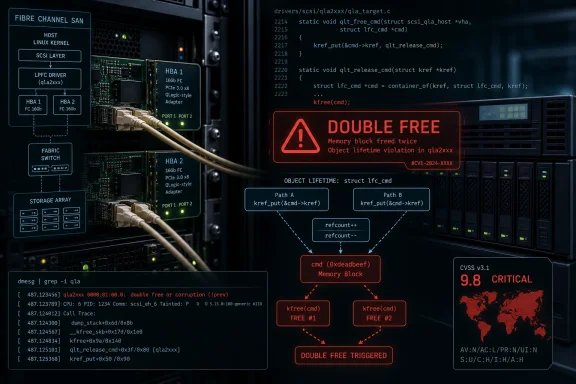
A Critical Score Lands in a Very Narrow Corridor
The National Vulnerability Database entry for CVE-2026-43414 is still marked as undergoing enrichment, but the kernel.org CNA score is already blunt: 9.8 Critical under CVSS 3.1, with the classic remote, low-complexity, no-privileges, no-user-interaction vector. That score reads like a five-alarm fire. The vulnerable code path, however, lives in drivers/scsi/qla2xxx, the Linux driver family for QLogic Fibre Channel host bus adapters.
That distinction matters. A vulnerability in a Fibre Channel driver is not the same thing as a bug in OpenSSH, SMB, RDP, or a default web service. It generally matters most to systems that actually load the qla2xxx module and use the relevant adapter family in a storage fabric.
The kernel patch tells a more grounded story than the score. In qla24xx_els_dcmd_iocb(), the driver assigns a cleanup function to sp->free; during certain errors, kref_put() can release the object and call that cleanup path. The cleanup function already frees the fcport, so explicitly freeing it again afterward creates the double free.
The fix removes two calls to qla2x00_free_fcport(fcport). That is the kind of kernel patch that looks almost comically small until you remember that ownership rules are the difference between a stable storage stack and a panic in the middle of a maintenance window.
The Bug Is About Ownership, Not Just Memory
A double free is one of those phrases that security people understand instantly and everyone else should learn to distrust. It means software released the same memory object twice, leaving the allocator and the rest of the kernel with an inconsistent view of what is alive, what is reusable, and what may now be under someone else’s control.
In user space, that can mean crashes or exploitable corruption. In kernel space, the consequences can be uglier because the code runs with the highest privileges on the machine. If the wrong object is corrupted in the wrong way, a bug that began as cleanup confusion can become denial of service, privilege escalation, or worse.
But exploitability is not a magic property conferred by the word double free. Attackers need a path to trigger the condition, shape memory in a useful way, and do so reliably on the victim’s kernel build and hardware environment. In this case, the vulnerability is tied to Fibre Channel driver behavior, error handling, and fcport lifetime management, which narrows the realistic target population.
That is why the CVSS score and the practical response can feel out of alignment. The score describes a worst-case model based on the vulnerability’s theoretical characteristics. Administrators still have to ask the more useful question: do we run affected kernels with qla2xxx hardware or modules in paths that untrusted actors can influence?
Fibre Channel Is Old-School Infrastructure With Modern Blast Radius
Fibre Channel is not fashionable in the way Kubernetes, confidential computing, or AI accelerators are fashionable. It is better described as quietly indispensable. In many enterprise environments, it is the storage plumbing behind databases, virtual machine clusters, backup systems, archival platforms, and high-availability workloads.
That makes a qla2xxx bug more interesting than its niche label suggests. A crash in an ordinary desktop peripheral driver is annoying. A crash in a SAN-connected host can disrupt access to shared storage, trigger failovers, knock clustered workloads into recovery behavior, and produce a chain of symptoms that look like a storage outage rather than a security event.
Windows shops should pay attention for exactly that reason. The Windows servers may be clean, patched, and governed by familiar Microsoft tooling while the storage-adjacent Linux systems around them carry the risk. Backup servers, Linux-based SAN utilities, appliance VMs, hypervisor management components, and mixed estates can all become part of the dependency graph.
This is where vulnerability management often fails. Asset inventories tend to be organized by operating system, owner, or business application. Storage driver exposure cuts across those categories and asks a more physical question: which machines are attached to which fabrics, through which adapters, using which kernel modules?
The Patch Also Admits the First Fix Was Not Enough
The phrase “Completely fix” in the patch subject is doing more work than usual. The patch references earlier fixes, including one literally titled “Fix double free of fcport.” That means CVE-2026-43414 is not merely a fresh defect; it is part of a cleanup sequence where an earlier attempt did not fully close the ownership hole.
This happens often in kernel development, especially in driver code that has accumulated years of feature work, hardware support, and vendor-specific behaviors. The hard part is not always noticing that memory is freed twice. The hard part is proving which path owns the object under every successful completion, failed allocation, reset, abort, timeout, and partial-initialization case.
The vulnerable function’s logic is a classic example. One path sets a destructor-like callback. Another path drops a reference. A cleanup function invoked by reference counting frees the fcport. Then the local error path tries to be tidy and frees the same object again.
The fix is conceptually simple: trust the reference-counted release path and stop manually freeing the object after kref_put(). The two deleted lines are not an omission; they are the correction. In modern kernel code, fewer cleanup calls can be safer when object lifetime is already centralized.
CVSS Makes the Alert Loud, but Distributions Decide the Tempo
The NVD entry was published on May 8, 2026, and the user-supplied record shows kernel.org adding the CVSS vector on May 11. Ubuntu’s tracker lists the issue with a Critical CVSS score but assigns it a Medium Ubuntu priority, while multiple Ubuntu kernel packages were still marked as needing evaluation when the page was last updated. Debian’s tracker shows a more granular picture, with some releases fixed, some vulnerable, and older code paths not affected.
That divergence is not hypocrisy. It is the normal translation layer between upstream CVE metadata and downstream distribution reality. A kernel.org CNA can describe the upstream bug and score it according to the vulnerability’s modeled properties; a distribution has to map that bug onto its actual kernel versions, backports, hardware enablement stacks, and support policy.
This is why administrators should resist treating “Critical” as a universal reboot order. The right response is urgent triage, not blind panic. If your affected hosts are SAN-attached Linux boxes running qla2xxx, the issue deserves a fast maintenance plan. If your fleet has no QLogic Fibre Channel adapters and never loads the module, the practical exposure is much lower.
That does not mean ignoring it. Kernel vulnerabilities have a habit of hiding in appliance images and vendor-managed systems where administrators rarely inspect modules directly. The most dangerous machine in this story may not be a general-purpose Linux server at all, but a storage gateway or backup appliance that quietly runs an affected kernel under a polished management UI.
The Windows Angle Is the Infrastructure Around Windows
On a site called WindowsForum, a Linux SCSI driver CVE might look misplaced at first glance. It is not. Windows environments increasingly depend on Linux in places that are easy to forget precisely because those systems are not the domain controllers, file servers, or Windows 11 endpoints everyone sees.
A Windows-heavy enterprise may still run Linux backup repositories, Linux-based monitoring collectors, storage appliances, container hosts, Git runners, security scanners, and virtualization support systems. It may use SAN fabrics that serve both Windows and Linux workloads. It may also use Hyper-V or VMware clusters where Linux management appliances and storage-connected hosts sit in the same operational blast radius as Windows servers.
That is the practical lesson of CVE-2026-43414. The vulnerability is not a Windows bug, but a Windows outage does not require a Windows bug. If shared storage becomes unstable because a Linux host panics, corrupts driver state, or disappears from a fabric at the wrong time, Windows workloads can still feel the impact.
The security industry tends to discuss vulnerabilities as if each one lives inside a product boundary. Infrastructure does not behave that way. Storage, identity, backup, networking, and virtualization are dependency layers; when one layer trips, the incident report rarely respects the operating system taxonomy used by the patch dashboard.
The Real Triage Starts With Module Exposure
The first useful question is whether the qla2xxx driver is present and loaded. On Linux systems, administrators can check module state, hardware inventory, and kernel package versions directly. In managed environments, the same information may come from configuration management, EDR telemetry, or vendor appliance documentation.
The second question is whether the system uses QLogic Fibre Channel hardware in a role where disruption matters. A lab box with an unused adapter is not the same risk as a clustered database node attached to production storage. A backup appliance with qla2xxx in the I/O path may deserve more attention than a general-purpose VM with no passthrough hardware.
The third question is whether the distribution has backported the fix. Kernel version numbers can mislead because enterprise distributions routinely carry patches without jumping to a new upstream major release. Debian, Ubuntu, Red Hat-family distributions, SUSE, and appliance vendors may all resolve the same upstream bug with different package names and timelines.
Finally, administrators should consider operational timing. Kernel patches usually mean reboots unless live-patching support covers the exact issue and code path. For SAN-attached systems, reboot planning is not clerical; it intersects with multipathing, failover design, cluster quorum, backup windows, and maintenance coordination with storage teams.
A Two-Line Fix Can Still Be a Change-Control Event
The patch itself deletes two lines. The deployment may still require a full change-control process. That mismatch is a recurring source of frustration for administrators and a recurring source of risk for organizations that reduce patching to a compliance checkbox.
Kernel storage drivers are unforgiving because they sit below the applications and above the hardware. A regression can look like path flapping, device timeouts, discovery failures, boot delays, or degraded multipath behavior. Even when the security fix is correct, the surrounding kernel update may include other changes that administrators must validate.
This is especially true for long-lived enterprise systems attached to Fibre Channel fabrics. Those environments often combine older adapters, vendor-certified firmware, distribution-specific driver backports, and conservative maintenance policies. The safest patch is not always the newest upstream kernel; it is the vendor-supported kernel package that fixes the CVE while preserving the tested stack.
That does not excuse delay. It argues for disciplined urgency. Treat the CVE as a reason to find the affected systems now, confirm vendor guidance, test the update on representative hardware, and schedule production rollout before the issue becomes another stale exception in the risk register.
Security Scoring Still Needs Human Judgment
CVE-2026-43414 is a useful case study in how CVSS can be both accurate and misleading. The vector says network attack, low complexity, no privileges, no user interaction, unchanged scope, and high impact across confidentiality, integrity, and availability. In the abstract, that is Critical.
Yet the code path lives in a specialized driver, and the real-world ability to trigger it depends on storage topology and driver behavior. A vulnerability can have severe potential impact while still being reachable only in a subset of environments. Good defenders know how to hold both ideas at once.
The danger is that organizations often fail in opposite directions. Some teams see “Critical” and trigger emergency processes without confirming exposure, burning political capital on systems that cannot be affected. Others see “driver bug” and dismiss it, overlooking the SAN-attached systems that keep business-critical workloads alive.
The better approach is exposure-weighted prioritization. A Critical score should get the issue onto the day’s agenda. Hardware, module, kernel, and vendor status should decide how aggressively it moves through the queue.
The CVE Reveals the Messy Middle of Kernel Security
Linux kernel security is not a neat conveyor belt where a bug is found, a patch lands, distributions update instantly, and every administrator reboots at once. It is a messy middle of upstream commits, stable backports, distribution advisories, appliance firmware, cloud images, and operational exceptions.
CVE-2026-43414 entered public tracking after the upstream patch work had already appeared on kernel mailing lists. The CVE text mirrors the patch explanation closely, which is common for kernel CVEs generated from resolved upstream vulnerabilities. That makes the record useful but terse; it tells administrators what went wrong, not whether their exact fleet is exposed.
The distribution trackers then add another layer. Ubuntu’s page may say “Needs evaluation” for many kernel variants while Debian’s tracker distinguishes fixed, vulnerable, and not-affected releases. Enterprise Linux vendors may carry their own backport decisions, and hardware vendors may publish driver bundles or advisories on a separate cadence.
This is why serious vulnerability management for Linux kernels cannot rely only on the NVD page. The NVD entry is the starting whistle. The authoritative answer for a production system is usually the distribution or appliance vendor’s fixed package list, paired with local evidence that the vulnerable driver and hardware path exist.
Storage Bugs Are Availability Bugs First, Even When Scored Broader
The CVSS vector assigns high impact to confidentiality, integrity, and availability. That is plausible for kernel memory corruption in a privileged driver. But for most administrators, the most immediate concern is availability.
A double free in a storage driver can crash a host. It can also destabilize device discovery or error recovery in ways that are painful to diagnose. The symptoms may arrive as kernel oops messages, path failures, timeouts, or application-level complaints that do not immediately scream “security vulnerability.”
That matters for incident response. If a SAN-connected Linux system has unexplained qla2xxx crashes, administrators should not treat the CVE only as a future patching concern. They should correlate kernel logs, adapter firmware, recent fabric events, and package versions to determine whether the vulnerable path may already be involved.
The security framing also affects monitoring. A purely network-centric detection strategy may miss the operational evidence. Storage driver faults often show up in dmesg, journal logs, multipath status, HBA diagnostics, and fabric telemetry before they show up in a SIEM rule with a neat CVE tag.
The Small Print Administrators Should Not Skip
The practical response to CVE-2026-43414 is neither panic nor indifference. It is a short, hardware-aware audit followed by vendor-aligned patching. The organizations that handle this well will be the ones that know where Fibre Channel still exists in their estate.
- Identify Linux systems that load the qla2xxx driver or contain QLogic Fibre Channel adapters, including appliances and virtualization hosts that may not appear in ordinary server inventories.
- Check the distribution or appliance vendor’s advisory rather than assuming an upstream kernel version number tells the whole story.
- Prioritize SAN-attached production systems, backup infrastructure, clustered hosts, and storage gateways over machines where the driver is absent or unused.
- Plan kernel updates with storage failover, multipathing, maintenance windows, and reboot dependencies in mind.
- Treat unexplained qla2xxx errors or Fibre Channel instability as operational signals worth correlating with this CVE, not merely as generic driver noise.
- Document non-exposure explicitly, because “not affected” is only useful when it is backed by module, hardware, and package evidence.
The broader lesson is that vulnerability response improves when inventories include the hardware and kernel modules that make a CVE relevant. Software bills of materials get most of the attention, but driver exposure is often just as decisive.
The Kernel Patch Is Simple; the Estate Is Not
There is an almost elegant minimalism to the upstream fix. Two manual frees disappear, and the reference-counted cleanup path becomes the single owner of the fcport release. In a perfect world, that would be the end of the story.
Real estates are not perfect. They have old SANs, inherited adapters, vendor-certified kernels, appliance images, and maintenance windows negotiated around business calendars. They also have Windows administrators who may not think of Linux Fibre Channel drivers as part of their risk surface until a storage incident proves otherwise.
CVE-2026-43414 should be treated as a focused but serious infrastructure vulnerability: narrow in affected hardware, potentially severe where that hardware is in production, and easy to mishandle if teams respond only to the headline score. The next step is not to memorize another CVE number; it is to make sure the organization can answer, quickly and with evidence, which kernels sit between its critical workloads and its storage fabric.
References
- CVE-2026-43414 scsi: qla2xxx: Completely fix fcport double free NVD / Linux Kernel · 2026-05-25T01:01:39-07:00