

CVE-2026-43464 is a Linux kernel vulnerability, published by NVD on May 8, 2026 and sourced to kernel.org, affecting Mellanox mlx5 Ethernet receive handling when XDP multi-buffer programs alter packet-buffer layout on affected 6.6, 6.12, 6.17, 6.18, 6.19, and 7.0 release lines. It is not a Windows vulnerability, but it matters to the WindowsForum crowd because modern Windows estates rarely stop at Windows: Hyper-V hosts, WSL workflows, Azure Linux guests, Kubernetes nodes, and high-throughput NICs all live in the same operational blast radius. The bug is a reminder that today’s security work is less about memorizing product names than understanding where packet processing, kernel memory accounting, and vendor backports quietly intersect. The headline is not “remote code execution panic”; it is that a small driver accounting mistake can still earn a high availability score when it sits on the network fast path.
The kernel.org CNA score for CVE-2026-43464 is CVSS 3.1 7.5, with the familiar high-availability vector: network adjacent in practical feel, no privileges, no user interaction, no confidentiality or integrity impact, and a denial-of-service consequence. That sounds dramatic, and in vulnerability management dashboards it will look dramatic. But the technical center of gravity is narrower than the number alone implies.
This is not a bug in Windows TCP/IP, SMB, RDP, or Defender. It is not a generic Linux networking flaw that automatically makes every Linux VM equally exposed. The vulnerable code path is in
That distinction matters because the industry’s CVE machinery often flattens nuance. A kernel bug with a “network” attack vector and “high” availability impact can land in the same queue as broader remote denial-of-service issues, even when exploitation depends on a particular driver, queue mode, hardware family, kernel branch, and packet-processing configuration. Security teams still need to patch it, but they should not mistake the score for a complete threat model.
The bigger lesson is that Linux’s networking acceleration stack has become a layered system of assumptions. XDP, page pools, NIC drivers, fragmented buffers, and BPF helpers all cooperate at speeds where abstractions are expensive and bugs are rarely poetic. CVE-2026-43464 is one of those defects where the vulnerability description reads like plumbing because the vulnerability is plumbing — and plumbing failures still flood datacenters.
Multi-buffer XDP complicates the picture because packets may span multiple fragments. Jumbo frames, larger payloads, and hardware receive layouts mean the kernel is not always dealing with one neat linear buffer. The driver and XDP layer must agree on what fragments exist, who owns them, and when references are released.
CVE-2026-43464 sits precisely in that ownership contract. XDP programs can call helpers such as
That is how a vulnerability becomes an accounting problem. The last fragment in the reported reproducer could be released by XDP code without being tracked on the driver side, leading to a negative page-pool reference count during page release. The kernel warning in the disclosure is not merely decorative; it is the symptom of two subsystems disagreeing about memory ownership.
When that disagreement happens in kernel space, the best-case outcome is a warning and a controlled failure. The worse operational outcome is instability in a host whose job is to move packets quickly and boringly. Availability bugs do not need to steal secrets to ruin a maintenance window.
For datacenters, the story is different. Mellanox/NVIDIA networking hardware is common in high-performance Linux environments, cloud infrastructure, storage fabrics, AI clusters, virtualization hosts, and Kubernetes nodes. The affected driver family is not an obscure hobbyist corner of the kernel; it sits in places where network throughput and low latency are business requirements.
This is also where Windows administrators can get caught by surprise. A shop that is “mostly Windows” may still run Linux appliances, backup repositories, monitoring boxes, container nodes, reverse proxies, storage gateways, or Azure Linux VMs. A Hyper-V cluster may host Linux guests that use accelerated networking. A Windows developer may rely on Linux test infrastructure through WSL, CI runners, or container hosts. The OS boundary is real, but the operational boundary is blurrier.
The risk calculation therefore starts with inventory, not ideology. If you do not run affected Linux kernels, mlx5 hardware, and relevant XDP workloads, this CVE is not your emergency. If you do, the question becomes how quickly your distribution has picked up the stable patch and whether your rollback plan respects the fact that network driver updates are not casual package bumps.
That is especially true for systems tuned around specific kernel, NIC firmware, and driver combinations. In a high-throughput environment, “just update the kernel” can be correct security advice and incomplete change-management advice at the same time.
Linux stable trees are living branches. Fixes are backported, regressions can be backported, and security-relevant behavior may appear in multiple long-term or short-lived release lines with different package names across distributions. The same upstream flaw can look different depending on whether you run a vendor kernel, a cloud kernel, a real-time kernel, an HWE kernel, or a custom build.
This is where CPE data is useful but dangerous. CPEs give scanners a way to map a CVE to version ranges, but kernel packaging turns that into a rough sketch rather than a courtroom transcript. Distribution kernels often carry patches that do not align neatly with upstream semantic versions. A system may report a vulnerable-looking kernel version while containing a vendor backport, or it may report a customized kernel whose vulnerability state cannot be inferred from the upstream number alone.
The user-provided NVD record even includes the familiar invitation: “Are we missing a CPE here?” That line is more revealing than it looks. Vulnerability databases are not omniscient ledgers; they are enrichment systems trying to keep up with upstream disclosures, vendor advisories, backports, and package ecosystems that move on different clocks.
For administrators, the practical answer is to treat NVD as the alerting layer, not the final authority. Confirm against your Linux distribution’s security tracker, your kernel package changelog, your cloud vendor advisory, and — for custom kernels — the relevant stable commits. In other words: scanners start the conversation; they do not close the ticket.
This is how mature systems fail. Not through obvious negligence, but through tightly coupled invariants that are easy to disturb. The driver must account for the original XDP buffer fragments, while XDP may present a changed layout after program execution. The old assumption was too rigid; the new behavior failed to preserve all the accounting the driver still needed.
The patch described in the CVE effectively restores page-fragment counting for all original XDP buffer fragments across the relevant XDP actions:
There is a quiet warning here for anyone writing or deploying BPF/XDP programs. These systems are powerful because they allow programmable behavior at a point in the stack traditionally reserved for driver and kernel logic. But once a BPF program can reshape data before the driver is finished accounting for its buffers, the line between “programmable packet filter” and “co-author of kernel memory semantics” gets thin.
That does not make XDP unsafe by default. It makes it sophisticated infrastructure that deserves the same testing culture as kernel modules, storage drivers, and hypervisor components. The bug was reportedly observable through a selftest scenario involving
That is still serious. A high-throughput Linux system whose networking path can be driven into warnings, reference-count failures, or unstable behavior is a target worth caring about. For load balancers, ingress gateways, storage front ends, and cluster nodes, packet processing is not a supporting feature; it is the job.
Availability bugs also create second-order risk. If a host fails under certain traffic patterns, failover systems take over. If failover systems are underprovisioned or share the same kernel and hardware profile, the failure can cascade. If the remediation requires kernel replacement, maintenance windows collide with service-level agreements.
The security industry often reserves emotional urgency for code execution. That bias is understandable, but it is incomplete. A network-facing availability flaw in the right infrastructure tier can be more operationally damaging than a local privilege escalation on a lightly used workstation.
For Windows-heavy enterprises, this is where the conversation should shift from “does it affect Windows?” to “does it affect the services Windows users depend on?” Active Directory, SQL Server, Exchange, Windows endpoints, and Microsoft 365 integrations all rely on supporting infrastructure that may include Linux load balancers, proxies, observability stacks, and security appliances. A Linux driver bug can become a Windows outage without ever loading a Windows driver.
That inventory is often harder than it should be. Network adapters may be abstracted by cloud platforms. Container nodes may be rebuilt frequently. Appliance vendors may ship Linux kernels under branded management layers. Security scanners may see a kernel version but not the NIC path or XDP configuration. Infrastructure-as-code can tell you what you intended to deploy, not always what firmware and driver combination is actually running.
The practical triage sequence is therefore architectural. Start with externally reachable or high-volume Linux systems. Prioritize hosts using Mellanox/NVIDIA ConnectX adapters or cloud instances backed by equivalent accelerated networking. Check whether XDP programs are deployed directly, through Cilium, custom BPF pipelines, DDoS filters, packet brokers, or performance-tuned ingress stacks. Then map those systems to distribution advisories and kernel updates.
In mixed Windows/Linux environments, the ownership problem can be political. The Windows team may own the service, the Linux team may own the nodes, the network team may own the NICs, and the security team may own the scanner. CVE-2026-43464 is a small example of why that split creates blind spots. The vulnerable component lives at the seam.
The best-run organizations will not create a war room for every high-scored kernel driver CVE. They will, however, have enough asset context to know when one deserves fast handling. That context is the difference between patch fatigue and risk management.
The public vulnerability ecosystem has been under strain for years. CVE volume keeps rising, software supply chains keep widening, and downstream consumers increasingly expect machine-readable perfection from systems that depend on human and vendor interpretation. Kernel CVEs make the pressure worse because “Linux kernel” is not a single packaged product in the way many enterprise tools want it to be.
This is why administrators should read CVE records as documents with provenance. A CNA description from kernel.org carries technical value. NVD enrichment adds CPE mapping and normalization value. Distribution trackers add package applicability. Cloud providers add managed-service context. None of these sources alone is the whole truth.
CVE-2026-43464 illustrates the point neatly. The NVD CPE ranges are broad enough to trigger scanner findings, but distro pages may show “needs evaluation,” “not in release,” “ignored,” or package-specific status across kernel variants. A security dashboard that compresses that into “Linux kernel vulnerable” may be technically defensible and operationally vague.
The fix is not to distrust vulnerability databases. The fix is to stop pretending they replace engineering judgment. For kernel issues especially, the last mile is always local: the running kernel, the loaded driver, the hardware path, the distribution patch level, and the workload.
WSL made Linux a first-class developer companion on Windows desktops. Azure made Linux virtual machines ordinary in Microsoft shops. Kubernetes made Linux nodes common even where the application owners live in Visual Studio and Azure DevOps. Security appliances, reverse proxies, monitoring systems, and network tools often run Linux even when their consumers are Windows endpoints.
That does not mean CVE-2026-43464 should alarm every Windows administrator. It means the old platform silos are a bad guide to risk. A Windows outage may begin in a Linux ingress node. A Microsoft Entra-authenticated application may depend on Linux packet filtering. A Windows Server estate may be fronted by a Linux load balancer using high-performance NICs.
The point is not that everything is vulnerable to everything. The point is that modern infrastructure is compositional. When the Linux networking fast path wobbles, Windows users may experience the wobble as a slow app, a failed login, a broken VPN path, or an unavailable service.
That is why CVE triage should include service mapping. Ask not only “is this CVE on a Windows machine?” but “is this CVE on a machine that Windows workloads traverse?” The answer often changes the priority.
That means administrators should verify both security and behavior. Does the updated kernel include the relevant stable patch? Does the host still negotiate expected link speeds and offloads? Do XDP programs load and behave correctly? Do traffic tests show acceptable packet loss, latency, and CPU utilization? Does rollback preserve both kernel and NIC firmware assumptions?
For container platforms, node cycling may be the cleanest path. Drain, update, reboot, validate, and return nodes to service. For appliances, the answer may be vendor firmware or a vendor-supplied kernel image rather than a normal package update. For cloud guests, the fix may depend on the guest OS image even when the underlying hardware is abstracted.
Mitigation without patching is less satisfying here. If the affected path requires mlx5 and XDP multi-buffer behavior, disabling or removing the relevant XDP programs might reduce exposure in some deployments, but that may also remove the very traffic handling the system was designed to perform. Swapping hardware paths or disabling acceleration is even more disruptive.
The right move is not theatrical hardening. It is controlled kernel maintenance. CVE-2026-43464 is a good candidate for prompt patching on affected infrastructure, not for improvised one-liners copied into production because a scanner used the word “high.”
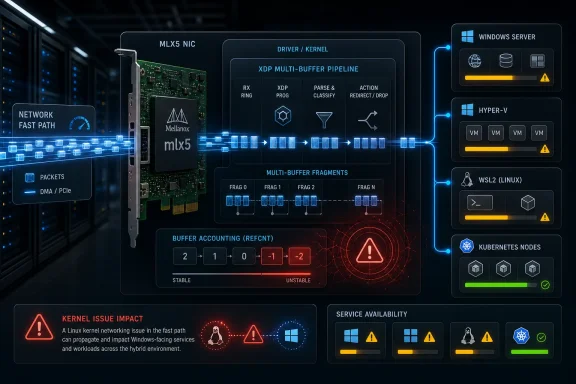 A High-Severity Bug With a Narrower Story Than the Score Suggests
The kernel.org CNA score for CVE-2026-43464 is CVSS 3.1 7.5, with the familiar high-availability vector: network adjacent in practical feel, no privileges, no user interaction, no confidentiality or integrity impact, and a denial-of-service consequence. That sounds dramatic, and in vulnerability management dashboards it will look dramatic. But the technical center of gravity is narrower than the number alone implies.This is not a bug in Windows TCP/IP, SMB, RDP, or Defender. It is not a generic Linux networking flaw that automatically makes every Linux VM equally exposed. The vulnerable code path is in
mlx5e, the Ethernet driver for NVIDIA/Mellanox ConnectX-class adapters, and the trigger involves XDP multi-buffer handling on the receive path.That distinction matters because the industry’s CVE machinery often flattens nuance. A kernel bug with a “network” attack vector and “high” availability impact can land in the same queue as broader remote denial-of-service issues, even when exploitation depends on a particular driver, queue mode, hardware family, kernel branch, and packet-processing configuration. Security teams still need to patch it, but they should not mistake the score for a complete threat model.
The bigger lesson is that Linux’s networking acceleration stack has become a layered system of assumptions. XDP, page pools, NIC drivers, fragmented buffers, and BPF helpers all cooperate at speeds where abstractions are expensive and bugs are rarely poetic. CVE-2026-43464 is one of those defects where the vulnerability description reads like plumbing because the vulnerability is plumbing — and plumbing failures still flood datacenters.
The Fast Path Is Where Small Accounting Bugs Become Security Events
XDP, or eXpress Data Path, lets programs run very early in the Linux networking receive path, before packets climb the traditional network stack. That is the point: drop garbage, redirect traffic, pass valid frames, or bounce packets back out with less overhead than conventional processing. In environments that care about packet rates — load balancers, DDoS filtering, telemetry collectors, container hosts, trading networks, and virtualized infrastructure — XDP is not an academic feature.Multi-buffer XDP complicates the picture because packets may span multiple fragments. Jumbo frames, larger payloads, and hardware receive layouts mean the kernel is not always dealing with one neat linear buffer. The driver and XDP layer must agree on what fragments exist, who owns them, and when references are released.
CVE-2026-43464 sits precisely in that ownership contract. XDP programs can call helpers such as
bpf_xdp_pull_data() or bpf_xdp_adjust_tail(), changing the layout of the XDP buffer while the driver still has bookkeeping to do. A previous fix corrected one bad assumption — that the buffer layout would remain unchanged during program execution — but introduced another: fragments dropped or altered by XDP still had to be counted correctly by the driver.That is how a vulnerability becomes an accounting problem. The last fragment in the reported reproducer could be released by XDP code without being tracked on the driver side, leading to a negative page-pool reference count during page release. The kernel warning in the disclosure is not merely decorative; it is the symptom of two subsystems disagreeing about memory ownership.
When that disagreement happens in kernel space, the best-case outcome is a warning and a controlled failure. The worse operational outcome is instability in a host whose job is to move packets quickly and boringly. Availability bugs do not need to steal secrets to ruin a maintenance window.
The Mellanox Angle Makes This a Datacenter Problem, Not a Desktop Panic
For ordinary Windows 11 desktop users, CVE-2026-43464 is background noise. Your gaming PC, office laptop, or family desktop is unlikely to be running an affected Linux kernel with the mlx5 driver and XDP multi-buffer workloads. Even many Linux systems will never touch the vulnerable path.For datacenters, the story is different. Mellanox/NVIDIA networking hardware is common in high-performance Linux environments, cloud infrastructure, storage fabrics, AI clusters, virtualization hosts, and Kubernetes nodes. The affected driver family is not an obscure hobbyist corner of the kernel; it sits in places where network throughput and low latency are business requirements.
This is also where Windows administrators can get caught by surprise. A shop that is “mostly Windows” may still run Linux appliances, backup repositories, monitoring boxes, container nodes, reverse proxies, storage gateways, or Azure Linux VMs. A Hyper-V cluster may host Linux guests that use accelerated networking. A Windows developer may rely on Linux test infrastructure through WSL, CI runners, or container hosts. The OS boundary is real, but the operational boundary is blurrier.
The risk calculation therefore starts with inventory, not ideology. If you do not run affected Linux kernels, mlx5 hardware, and relevant XDP workloads, this CVE is not your emergency. If you do, the question becomes how quickly your distribution has picked up the stable patch and whether your rollback plan respects the fact that network driver updates are not casual package bumps.
That is especially true for systems tuned around specific kernel, NIC firmware, and driver combinations. In a high-throughput environment, “just update the kernel” can be correct security advice and incomplete change-management advice at the same time.
The Version Matrix Is a Warning About Kernel Backport Reality
The NVD change history lists affected configurations across several kernel streams: 6.6.115 up to before 6.7, 6.12.56 up to before 6.13, 6.17.6 up to before 6.18, 6.18 release candidates and 6.18.1 up to before 6.18.19, 6.19 up to before 6.19.9, and 7.0 release candidates. That spread is not unusual for Linux kernel CVEs, but it is uncomfortable for teams that still think of vulnerability exposure as a single version number.Linux stable trees are living branches. Fixes are backported, regressions can be backported, and security-relevant behavior may appear in multiple long-term or short-lived release lines with different package names across distributions. The same upstream flaw can look different depending on whether you run a vendor kernel, a cloud kernel, a real-time kernel, an HWE kernel, or a custom build.
This is where CPE data is useful but dangerous. CPEs give scanners a way to map a CVE to version ranges, but kernel packaging turns that into a rough sketch rather than a courtroom transcript. Distribution kernels often carry patches that do not align neatly with upstream semantic versions. A system may report a vulnerable-looking kernel version while containing a vendor backport, or it may report a customized kernel whose vulnerability state cannot be inferred from the upstream number alone.
The user-provided NVD record even includes the familiar invitation: “Are we missing a CPE here?” That line is more revealing than it looks. Vulnerability databases are not omniscient ledgers; they are enrichment systems trying to keep up with upstream disclosures, vendor advisories, backports, and package ecosystems that move on different clocks.
For administrators, the practical answer is to treat NVD as the alerting layer, not the final authority. Confirm against your Linux distribution’s security tracker, your kernel package changelog, your cloud vendor advisory, and — for custom kernels — the relevant stable commits. In other words: scanners start the conversation; they do not close the ticket.
The Prior Fix Fixed One Assumption and Exposed Another
The most interesting part of CVE-2026-43464 is that it follows a previous correction. The disclosure says an earlier commit fixed the mlx5 driver’s assumption that XDP buffer layout could not change during program execution. That was a legitimate bug to address. But the fix changed enough of the driver’s fragment-counting behavior to create a new page-fragment reference counting issue.This is how mature systems fail. Not through obvious negligence, but through tightly coupled invariants that are easy to disturb. The driver must account for the original XDP buffer fragments, while XDP may present a changed layout after program execution. The old assumption was too rigid; the new behavior failed to preserve all the accounting the driver still needed.
The patch described in the CVE effectively restores page-fragment counting for all original XDP buffer fragments across the relevant XDP actions:
XDP_TX, XDP_REDIRECT, and XDP_PASS. That is not glamorous, but it is exactly the sort of fix kernel maintainers spend their lives getting right. It says: even if the packet’s logical layout changes, the driver’s memory ownership responsibilities do not disappear.There is a quiet warning here for anyone writing or deploying BPF/XDP programs. These systems are powerful because they allow programmable behavior at a point in the stack traditionally reserved for driver and kernel logic. But once a BPF program can reshape data before the driver is finished accounting for its buffers, the line between “programmable packet filter” and “co-author of kernel memory semantics” gets thin.
That does not make XDP unsafe by default. It makes it sophisticated infrastructure that deserves the same testing culture as kernel modules, storage drivers, and hypervisor components. The bug was reportedly observable through a selftest scenario involving
test_xdp_native_adjst_tail_shrnk_data, a 3600-byte payload, and a 256-byte shrink — exactly the kind of edge condition that separates “works in the lab” from “survives production traffic.”Availability Is the Security Property Everyone Underestimates Until It Vanishes
CVE-2026-43464 has no claimed confidentiality impact and no claimed integrity impact in the provided CVSS vector. That means the advisory is not saying attackers can read memory, rewrite files, steal credentials, or execute arbitrary code. The impact is availability.That is still serious. A high-throughput Linux system whose networking path can be driven into warnings, reference-count failures, or unstable behavior is a target worth caring about. For load balancers, ingress gateways, storage front ends, and cluster nodes, packet processing is not a supporting feature; it is the job.
Availability bugs also create second-order risk. If a host fails under certain traffic patterns, failover systems take over. If failover systems are underprovisioned or share the same kernel and hardware profile, the failure can cascade. If the remediation requires kernel replacement, maintenance windows collide with service-level agreements.
The security industry often reserves emotional urgency for code execution. That bias is understandable, but it is incomplete. A network-facing availability flaw in the right infrastructure tier can be more operationally damaging than a local privilege escalation on a lightly used workstation.
For Windows-heavy enterprises, this is where the conversation should shift from “does it affect Windows?” to “does it affect the services Windows users depend on?” Active Directory, SQL Server, Exchange, Windows endpoints, and Microsoft 365 integrations all rely on supporting infrastructure that may include Linux load balancers, proxies, observability stacks, and security appliances. A Linux driver bug can become a Windows outage without ever loading a Windows driver.
The Scanner Will Shout, but the Hardware Inventory Decides
The fastest way to mishandle this CVE is to treat every Linux kernel finding as equal. The second-fastest way is to dismiss it because it is “just Mellanox.” The correct response is narrower and more disciplined: identify where the mlx5 driver is present, where XDP is enabled, where affected kernel ranges exist, and where those systems sit in the traffic path.That inventory is often harder than it should be. Network adapters may be abstracted by cloud platforms. Container nodes may be rebuilt frequently. Appliance vendors may ship Linux kernels under branded management layers. Security scanners may see a kernel version but not the NIC path or XDP configuration. Infrastructure-as-code can tell you what you intended to deploy, not always what firmware and driver combination is actually running.
The practical triage sequence is therefore architectural. Start with externally reachable or high-volume Linux systems. Prioritize hosts using Mellanox/NVIDIA ConnectX adapters or cloud instances backed by equivalent accelerated networking. Check whether XDP programs are deployed directly, through Cilium, custom BPF pipelines, DDoS filters, packet brokers, or performance-tuned ingress stacks. Then map those systems to distribution advisories and kernel updates.
In mixed Windows/Linux environments, the ownership problem can be political. The Windows team may own the service, the Linux team may own the nodes, the network team may own the NICs, and the security team may own the scanner. CVE-2026-43464 is a small example of why that split creates blind spots. The vulnerable component lives at the seam.
The best-run organizations will not create a war room for every high-scored kernel driver CVE. They will, however, have enough asset context to know when one deserves fast handling. That context is the difference between patch fatigue and risk management.
NVD’s Partial Enrichment Is Now Part of the Story
The NVD record for this CVE was published on May 8, modified by kernel.org on May 11, and received NIST initial analysis on May 20. It shows NVD had not provided its own CVSS score at the time reflected in the user-provided data, while kernel.org supplied the CVSS 3.1 vector. That gap is not a scandal; it is the current shape of vulnerability intelligence.The public vulnerability ecosystem has been under strain for years. CVE volume keeps rising, software supply chains keep widening, and downstream consumers increasingly expect machine-readable perfection from systems that depend on human and vendor interpretation. Kernel CVEs make the pressure worse because “Linux kernel” is not a single packaged product in the way many enterprise tools want it to be.
This is why administrators should read CVE records as documents with provenance. A CNA description from kernel.org carries technical value. NVD enrichment adds CPE mapping and normalization value. Distribution trackers add package applicability. Cloud providers add managed-service context. None of these sources alone is the whole truth.
CVE-2026-43464 illustrates the point neatly. The NVD CPE ranges are broad enough to trigger scanner findings, but distro pages may show “needs evaluation,” “not in release,” “ignored,” or package-specific status across kernel variants. A security dashboard that compresses that into “Linux kernel vulnerable” may be technically defensible and operationally vague.
The fix is not to distrust vulnerability databases. The fix is to stop pretending they replace engineering judgment. For kernel issues especially, the last mile is always local: the running kernel, the loaded driver, the hardware path, the distribution patch level, and the workload.
The Windows Relevance Is Hybrid Infrastructure, Not Brand Confusion
WindowsForum readers may reasonably ask why a Linux kernel CVE belongs in a Windows-centric publication. The answer is that Windows administration in 2026 is hybrid by default. Even organizations that standardized on Microsoft identity, endpoint management, and productivity stacks routinely depend on Linux in the infrastructure layer.WSL made Linux a first-class developer companion on Windows desktops. Azure made Linux virtual machines ordinary in Microsoft shops. Kubernetes made Linux nodes common even where the application owners live in Visual Studio and Azure DevOps. Security appliances, reverse proxies, monitoring systems, and network tools often run Linux even when their consumers are Windows endpoints.
That does not mean CVE-2026-43464 should alarm every Windows administrator. It means the old platform silos are a bad guide to risk. A Windows outage may begin in a Linux ingress node. A Microsoft Entra-authenticated application may depend on Linux packet filtering. A Windows Server estate may be fronted by a Linux load balancer using high-performance NICs.
The point is not that everything is vulnerable to everything. The point is that modern infrastructure is compositional. When the Linux networking fast path wobbles, Windows users may experience the wobble as a slow app, a failed login, a broken VPN path, or an unavailable service.
That is why CVE triage should include service mapping. Ask not only “is this CVE on a Windows machine?” but “is this CVE on a machine that Windows workloads traverse?” The answer often changes the priority.
Patch, Test, and Resist the Temptation to Overgeneralize
The remediation story is straightforward in principle: move to a kernel build that includes the stable fix for the affected branch, or consume the distribution/vendor update that backports it. In practice, kernel updates on network-critical systems deserve testing. This bug lives in driver receive handling; the fix touches fragment counting; the relevant machines may be performance-sensitive.That means administrators should verify both security and behavior. Does the updated kernel include the relevant stable patch? Does the host still negotiate expected link speeds and offloads? Do XDP programs load and behave correctly? Do traffic tests show acceptable packet loss, latency, and CPU utilization? Does rollback preserve both kernel and NIC firmware assumptions?
For container platforms, node cycling may be the cleanest path. Drain, update, reboot, validate, and return nodes to service. For appliances, the answer may be vendor firmware or a vendor-supplied kernel image rather than a normal package update. For cloud guests, the fix may depend on the guest OS image even when the underlying hardware is abstracted.
Mitigation without patching is less satisfying here. If the affected path requires mlx5 and XDP multi-buffer behavior, disabling or removing the relevant XDP programs might reduce exposure in some deployments, but that may also remove the very traffic handling the system was designed to perform. Swapping hardware paths or disabling acceleration is even more disruptive.
The right move is not theatrical hardening. It is controlled kernel maintenance. CVE-2026-43464 is a good candidate for prompt patching on affected infrastructure, not for improvised one-liners copied into production because a scanner used the word “high.”
The Real Signal Hides in the Fragment Counter
The concrete takeaways are narrower than the CVSS headline but more useful than a generic “patch now” banner. CVE-2026-43464 should push teams to improve kernel-driver visibility, especially where Linux hosts sit in front of Windows-facing services.- Systems without affected Linux kernels, mlx5 hardware, and relevant XDP receive-path usage are unlikely to be meaningfully exposed to this specific flaw.
- Systems using Mellanox/NVIDIA mlx5 networking in high-throughput Linux roles deserve priority review, especially if XDP or BPF-based packet processing is deployed.
- NVD CPE data should be treated as an alerting aid, while distribution advisories and package changelogs should determine whether a given host is actually fixed.
- The reported impact is availability rather than data theft or privilege escalation, but availability on a network fast path can still be business-critical.
- Kernel updates for network-critical systems should be paired with traffic validation, driver checks, and rollback planning rather than treated like ordinary userland patches.
References
- Primary source: NVD / Linux Kernel
Published: 2026-05-22T01:01:22-07:00
NVD - CVE-2026-43464
 nvd.nist.gov
- Security advisory: MSRC
Published: 2026-05-22T01:01:22-07:00
Original feed URL
Security Update Guide - Microsoft Security Response Center
 msrc.microsoft.com
- Related coverage: cve.imfht.com
CVE-2026-43464: net/mlx5e: RX, Fix XDP multi-buf frag counting for legacy RQ - Vulnerability Platform
[HIGH 7.5] Overview This vulnerability involves incorrect handling of the XDP (Express Data Path) multi-buffer fragment counting logic in the Linux kernel's driv cve.imfht.com
- Related coverage: spinics.net
[PATCH net 5/5] net/mlx5e: RX, Fix XDP multi-buf frag counting for legacy RQ — Linux Kernel
Linux Kernel: [PATCH net 5/5] net/mlx5e: RX, Fix XDP multi-buf frag counting for legacy RQ
www.spinics.net
- Official source: nist.gov
National Vulnerability Database
NIST maintains the National Vulnerability Database (NVD), a repository of information on software and hardware flaws that can compromise computer security. This is a key piece of the nation’s cybersecurity infrastructure.www.nist.gov - Related coverage: labs.cloudsecurityalliance.org
NVD Enrichment Triage: Enterprise Vulnerability Programs Must Adapt
PDF documentlabs.cloudsecurityalliance.org
- Related coverage: first.org
The National Vulnerability Database Ms. Tanya Brewer NVD Program Manager June 2024
PDF documentwww.first.org
