

CVE-2026-43465 is a Linux kernel mlx5e network-driver flaw, published by NVD on May 8, 2026 and last modified on May 20, that affects Mellanox/NVIDIA mlx5 Ethernet receive paths when XDP multi-buffer programs reshape packet fragments under striding receive queues. The short version is less dramatic than the 9.8 CVSS score suggests, but more interesting: a tiny accounting mistake in a high-performance NIC path can still become a kernel integrity problem. This is not a Windows vulnerability, yet it matters to WindowsForum readers because modern Windows estates increasingly sit beside Linux appliances, Hyper-V guests, Kubernetes nodes, WSL-heavy developer workstations, and storage or networking boxes that depend on the Linux kernel. The bug is a reminder that the fastest path through the stack is often also the least forgiving.
The headline number attached to CVE-2026-43465 is severe: kernel.org’s CNA score lists it as CVSS 3.1 9.8 critical, with a network attack vector and no privileges, no user interaction, and high impact across confidentiality, integrity, and availability. That score reads like the opening line of a mass-exploitation emergency. The technical description, however, points to a narrower failure mode inside the mlx5e driver’s receive handling for XDP multi-buffer packets.
That tension is the story. The vulnerability lives in the Linux driver for mlx5 hardware, the family behind many Mellanox and NVIDIA ConnectX adapters used in data centers, virtualization hosts, storage networks, and high-throughput Linux servers. It is not a bug in TCP/IP generally, and it is not a bug in Windows’ networking stack.
But the affected code sits exactly where modern infrastructure has been pushing more complexity: below the ordinary socket layer, close to the NIC, in a place designed to process packets before the rest of the kernel has to care. XDP, the eXpress Data Path, exists because operators want firewalls, load balancers, telemetry filters, and packet processors to run at line rate. When that kind of machinery gets memory accounting wrong, the blast radius is not measured in pretty UI crashes; it is measured in kernel warnings, reference-count underflows, and the possibility of memory corruption.
The original report describes a selftest triggering a warning in
A striding receive queue lets the driver carve a larger memory allocation into multiple receive slots. Instead of treating every incoming packet as a fresh, isolated allocation, the driver can pack multiple packets or fragments into a more efficient memory layout. That pays off on busy NICs, especially when packet processing is pushed closer to the hardware.
XDP multi-buffer support complicates the picture. A packet is no longer necessarily one neat linear blob. It can be represented as a head area plus fragments, and an XDP program can alter that representation while it is running. Helpers such as
CVE-2026-43465 is the fallout from that exact assumption. An earlier fix corrected the mlx5 driver’s belief that an XDP buffer’s layout would remain unchanged during program execution. But that fix introduced a new accounting hole: even if a fragment was dropped from the program’s view of the packet, the driver still needed to count it for page-fragment release purposes. The data plane changed shape, but the lifetime accounting still had to remember where the packet had been.
This is the sort of bug that rarely makes sense from the outside until you view the network stack as a set of overlapping ownership claims. The XDP program sees packet data. The driver sees receive descriptors and fragments. The page pool sees references to reusable memory. The kernel sees all of it as one trust boundary. When one layer silently skips a fragment, the others do not become safer; they become confused.
That distinction matters for administrators. A box is not meaningfully exposed just because it can receive packets over the network. It needs the affected kernel code, the mlx5e driver, relevant hardware or virtualized driver exposure, and an XDP multi-buffer path that can be exercised in the vulnerable way. The bug description says the issue applies to XDP_PASS as well as XDP_TX and XDP_REDIRECT paths, which broadens the driver-side fix, but it does not magically make every Linux server equally vulnerable.
The “no privileges” part should also be handled carefully. Remote network packets can be attacker-controlled, but XDP programs themselves are not typically arbitrary code supplied by unauthenticated outsiders. In most deployments, loading eBPF/XDP programs is a privileged administrative act or mediated by a container platform, CNI plugin, observability agent, DDoS mitigation stack, or networking appliance software. The more realistic concern is not that anyone on the Internet can upload an XDP program to your NIC. It is that once an affected XDP configuration exists, traffic may trigger a memory-accounting bug in kernel space.
This is why a critical score can be both defensible and misleading. Kernel memory corruption primitives deserve severe treatment because successful exploitation can collapse the security model of the host. But operational priority still depends on exposure. A Windows laptop with WSL installed is not in the same category as a Linux-based edge router with ConnectX hardware and XDP acceleration enabled.
For WindowsForum’s mixed-platform audience, the right reading is not panic. It is inventory. If Linux is only a guest used for light development, the concern is low. If Linux is running as the network plane, storage fabric, Kubernetes node, firewall, packet broker, appliance OS, or Hyper-V-adjacent service host, then mlx5e and XDP are no longer exotic terms. They are part of the estate.
Then the XDP program calls
That one-off mismatch is not merely an accounting nuisance. Reference counts are one of the kernel’s core ways of deciding when memory is still in use. If the driver releases something too many times, or releases based on stale assumptions, the kernel can trip warnings or move toward use-after-free territory depending on the surrounding paths and timing.
The patch’s direction is telling. It restores page fragment counting across the original XDP buffer fragments for relevant XDP actions: XDP_TX, XDP_REDIRECT, and XDP_PASS. In effect, the driver must remember the original fragment universe even after the XDP program reshapes the packet’s current layout. Separately, because one pointer still tracks the original tail, the number of fragments passed to
That sounds like kernel minutiae because it is kernel minutiae. But kernel security often lives in minutiae. The attacker does not need the user interface to lie; the attacker needs two subsystems to disagree about ownership for just long enough.
The interesting part is that the vulnerability appears to be born from repair work. The description says a referenced commit fixed the driver’s assumption that an XDP buffer layout could not change during program execution. That was the right class of fix. But it left behind a second-order problem: dropped fragments still mattered to the driver’s page accounting.
This is the stable-kernel dilemma in miniature. Backports are supposed to bring fixes to users who cannot jump to the latest mainline. Yet every backport lands in a slightly different code neighborhood, with different historical assumptions and helper behavior. A fix that is conceptually correct can still be incomplete in one receive-queue variant or one fragment lifecycle path.
The existence of a sibling issue, CVE-2026-43464 for the legacy receive queue path, reinforces the point. The striding RQ and legacy RQ variants are different code paths, but they share the same general failure class: XDP multi-buffer packet layout changes colliding with mlx5e fragment counting. When bugs arrive in pairs across parallel paths, it usually means the abstraction boundary itself is under stress.
For administrators, this argues against cherry-picking individual commits unless there is no alternative. Vendor kernels, distribution updates, and appliance firmware releases exist because the right answer is often a set of related patches tested together. The dangerous move is to see a one-line CVE description, apply a single patch to a custom kernel, and assume the rest of the receive path has been made whole.
The mlx5 angle is especially relevant in high-performance environments. ConnectX-class adapters are common in virtualization hosts, AI clusters, storage networks, RDMA deployments, and dense server platforms. Even if the Windows servers themselves are not affected, the Linux infrastructure around them may be. A compromised or unstable Linux networking node can still take down application availability for Windows users.
The risk is highest where Linux is doing packet work on behalf of other systems. That includes load-balancing nodes, DDoS filtering boxes, Kubernetes CNIs using eBPF acceleration, observability stacks that attach BPF programs, and custom appliances that lean on XDP for speed. In those environments, the Linux host is not merely another server. It is part of the network fabric.
There is also a subtler Windows angle: hardware and driver assumptions travel across operating-system boundaries even when vulnerabilities do not. The same organizations that standardized on high-throughput NICs for Windows Hyper-V or Storage Spaces Direct may also deploy the same adapters in Linux hosts. Inventory systems often track server models and OS versions, but not whether XDP multi-buffer is active on a specific driver path. CVEs like this expose that blind spot.
This does not mean Windows administrators need to become Linux kernel developers overnight. It does mean the patch conversation should include the people who manage NIC firmware, host kernels, eBPF tooling, Kubernetes networking, and appliance vendors. If those teams are separate, CVE-2026-43465 is exactly the kind of issue that gets lost between them.
The problem is that many organizations do not know where XDP is active. eBPF has moved from niche kernel hacking to mainstream infrastructure. It appears in CNI plugins, service meshes, observability agents, security sensors, load balancers, packet filters, and vendor appliances. An admin may not have written an XDP program and may still be running one indirectly.
That is why the most useful response starts with configuration discovery. Identify Linux hosts with mlx5 hardware and the mlx5e driver. Check kernel versions against distribution advisories rather than raw upstream version numbers when possible, because enterprise vendors backport security fixes without changing the base kernel version in the way upstream users expect. Then look for XDP attachment on interfaces, especially on ingress paths facing untrusted traffic.
The presence of XDP alone is not proof of exploitability. The vulnerable behavior depends on multi-buffer handling and packet-layout modifications. But from a defensive standpoint, XDP on mlx5e is enough to justify faster validation. A production host doing line-rate packet processing is rarely a place where administrators want to wait for a kernel warning to explain the architecture.
If XDP is not in use, the immediate exposure is likely lower. Still, this is kernel driver code. Distribution updates that include the fix should be applied through normal maintenance windows, especially on servers with mlx5 hardware. The most common mistake in vulnerability management is treating “not currently exploitable in our default configuration” as “never needs patching.”
It is a strength because the description is unusually specific. It names the functions, the selftest, the fragment counter values, the XDP helper behavior, and the affected XDP actions. It gives defenders enough information to understand the failure mode rather than relying on a marketing-grade phrase like “memory corruption vulnerability.”
It is a weakness because the CVE format encourages over-compression. A 9.8 score sits next to a deeply conditional driver path, and many scanners will flatten that into “critical Linux kernel vulnerability.” That is not wrong in the abstract, but it is incomplete in the field. A vulnerability record cannot know whether your host has a ConnectX adapter, whether your distro backported the fix, whether XDP is attached, or whether the interface is reachable by hostile traffic.
This is where security teams need to resist both reflexes: minimizing obscure kernel bugs because they are obscure, and maximizing every critical CVSS into an all-hands incident. CVE-2026-43465 belongs in the middle category that good infrastructure teams handle well. It is severe enough to patch promptly on exposed systems, technical enough to require targeted scoping, and specific enough that inventory can separate urgent hosts from background noise.
The NVD change history also shows the timing. The CVE was received from kernel.org on May 8, 2026; kernel.org added the CVSS vector on May 11; NIST’s initial analysis on May 20 added CWE and CPE configuration data. That staggered enrichment is normal, but it matters operationally. A scanner result on May 9 may not have had the same metadata as a scanner result on May 21.
Security dashboards often pretend vulnerability data is static. It is not. For fast-moving kernel issues, the metadata matures after the first alert. Good patch management should revisit early findings once vendor advisories, distro packages, and NVD enrichment catch up.
Selftests are not glamorous. They do not get the same attention as fuzzers with logos or named vulnerabilities with websites. But in kernel networking, they are one of the best defenses against regressions that emerge when performance code evolves. A test that sends a no-payload packet through a multi-buffer XDP path may sound artificial, but artificial edge cases are how real memory-lifetime bugs are exposed before attackers get creative.
The patch also shows the value of fixing behavior across actions rather than only the triggered test path. The report explicitly notes that XDP_PASS is affected even though it is handled in a different code path. That is the kind of detail that separates a narrow test fix from a real driver fix. The bug is not “the selftest failed”; the bug is that original fragments still need to be counted regardless of how the XDP action proceeds.
For enterprise users, the lesson is not that upstream kernels are unsafe. It is that complex fast paths are constantly being corrected. The Linux kernel’s public development model means these fixes are visible, traceable, and backported, but it also means vulnerability management has to understand the cadence. A fix can enter mainline, move into stable branches, then appear in distributions under version strings that do not obviously match upstream.
That last point trips up Windows-centric shops. Windows admins are used to KB numbers, cumulative updates, and a relatively centralized servicing story. Linux kernel servicing is more fragmented: upstream, stable, vendor, cloud image, appliance firmware, container host, and live-patch vendor may all tell parts of the story. CVE-2026-43465 is not hard to understand because the bug is impossible; it is hard because the operational path from patch to production can be plural.
Administrators should avoid relying solely on upstream kernel version comparisons. Enterprise distributions frequently carry old-looking kernel version numbers with many backported fixes. A RHEL, Ubuntu, Debian, SUSE, AlmaLinux, Rocky, Oracle, Proxmox, or appliance kernel may show a base version that appears affected while already containing the patch, or the reverse may be true for custom kernels. The vendor advisory and package changelog are more authoritative than
Live patching may or may not be sufficient depending on the vendor and the exact code path. Network driver fixes, especially those touching receive queue logic and memory accounting, can be awkward in live environments because loaded modules, active interfaces, and NIC state matter. Even when a live patch exists, administrators should confirm whether a driver reload, interface bounce, or full reboot is required for the fixed code to take over.
Mitigation without patching is possible only in the broad sense: reduce exposure of affected paths. That could mean disabling or detaching XDP programs where feasible, moving traffic away from affected mlx5e hosts, or scheduling maintenance for packet-processing nodes before general-purpose systems. But these are operational workarounds, not substitutes for the fix. The bug is in kernel driver accounting, and the durable answer is corrected driver code.
The other practical move is logging and crash review. Systems that have shown
CVE-2026-43465 is particularly relevant because the affected surface is network plumbing. A Linux host with a broken receive path can impair services that are entirely Windows from the user’s perspective. If a Linux load balancer, firewall, Kubernetes node, or storage gateway falls over, the help desk ticket will not say “mlx5e XDP fragment accounting.” It will say Outlook is slow, the ERP app is down, or file access is intermittent.
The issue also lands during a period when eBPF is increasingly sold as a security and observability feature. That is not a bad thing; eBPF and XDP are powerful. But they shift more logic into privileged kernel-adjacent execution paths. The more organizations depend on those paths for packet filtering and telemetry, the more they must treat eBPF configuration as part of the production attack surface.
For Windows administrators, the action item is not to memorize XDP internals. It is to ask better inventory questions. Which Linux systems carry high-throughput NICs? Which of them run eBPF or XDP programs? Which are maintained by infrastructure teams versus application teams? Which appliances are really Linux boxes behind a web UI? Those questions turn a scary CVE number into an actionable patch list.
This is also where cross-team communication matters. The security team may see a critical Linux kernel CVE. The network team may know which hosts use ConnectX cards. The platform team may know which clusters run Cilium, Katran-like components, custom XDP filters, or vendor accelerators. The Windows team may know which business services depend on those paths. None of those groups has the whole picture alone.
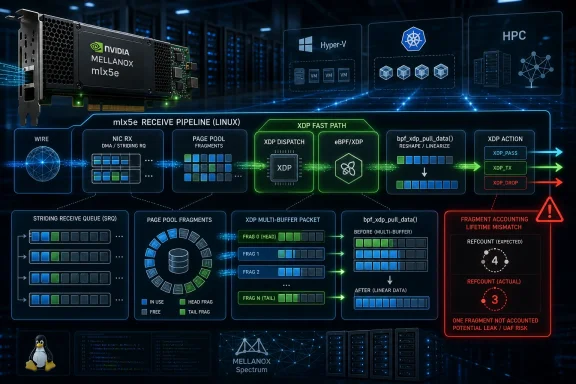 A Critical Score Lands on a Narrow Piece of Kernel Plumbing
The headline number attached to CVE-2026-43465 is severe: kernel.org’s CNA score lists it as CVSS 3.1 9.8 critical, with a network attack vector and no privileges, no user interaction, and high impact across confidentiality, integrity, and availability. That score reads like the opening line of a mass-exploitation emergency. The technical description, however, points to a narrower failure mode inside the mlx5e driver’s receive handling for XDP multi-buffer packets.That tension is the story. The vulnerability lives in the Linux driver for mlx5 hardware, the family behind many Mellanox and NVIDIA ConnectX adapters used in data centers, virtualization hosts, storage networks, and high-throughput Linux servers. It is not a bug in TCP/IP generally, and it is not a bug in Windows’ networking stack.
But the affected code sits exactly where modern infrastructure has been pushing more complexity: below the ordinary socket layer, close to the NIC, in a place designed to process packets before the rest of the kernel has to care. XDP, the eXpress Data Path, exists because operators want firewalls, load balancers, telemetry filters, and packet processors to run at line rate. When that kind of machinery gets memory accounting wrong, the blast radius is not measured in pretty UI crashes; it is measured in kernel warnings, reference-count underflows, and the possibility of memory corruption.
The original report describes a selftest triggering a warning in
mlx5e_page_release_fragmented, after a packet with no payload passes through a multi-buffer XDP path and causes the driver’s page fragment accounting to disagree with the page pool’s reference count. In plain English: the driver and the memory allocator stopped agreeing on how many packet fragments were still alive. In kernel networking, that disagreement is exactly the kind of book-keeping error that turns boring arithmetic into a security CVE.The Fast Path Is Where Linux Keeps Finding Sharp Edges
The mlx5e driver is built for performance hardware. Striding receive queues, page pools, fragmented receive buffers, and XDP programs are not everyday desktop abstractions; they are the vocabulary of servers trying to move absurd amounts of traffic without wasting CPU cycles. That is why this bug feels obscure at first glance, and why dismissing it as obscure would be a mistake.A striding receive queue lets the driver carve a larger memory allocation into multiple receive slots. Instead of treating every incoming packet as a fresh, isolated allocation, the driver can pack multiple packets or fragments into a more efficient memory layout. That pays off on busy NICs, especially when packet processing is pushed closer to the hardware.
XDP multi-buffer support complicates the picture. A packet is no longer necessarily one neat linear blob. It can be represented as a head area plus fragments, and an XDP program can alter that representation while it is running. Helpers such as
bpf_xdp_pull_data() and bpf_xdp_adjust_tail() are useful because packet-processing programs often need to pull headers into a contiguous area or trim payload. They are also dangerous assumptions killers: once the program can reshape the buffer, the driver cannot pretend the layout is frozen.CVE-2026-43465 is the fallout from that exact assumption. An earlier fix corrected the mlx5 driver’s belief that an XDP buffer’s layout would remain unchanged during program execution. But that fix introduced a new accounting hole: even if a fragment was dropped from the program’s view of the packet, the driver still needed to count it for page-fragment release purposes. The data plane changed shape, but the lifetime accounting still had to remember where the packet had been.
This is the sort of bug that rarely makes sense from the outside until you view the network stack as a set of overlapping ownership claims. The XDP program sees packet data. The driver sees receive descriptors and fragments. The page pool sees references to reusable memory. The kernel sees all of it as one trust boundary. When one layer silently skips a fragment, the others do not become safer; they become confused.
The Exploit Story Is Not as Simple as the CVSS Vector
The CVSS vector says network, low complexity, no privileges, no user interaction. That is useful for vulnerability management dashboards, but it is not the same thing as a field exploit narrative. The report’s reproduction path involves Linux kernel XDP selftests, an mlx5 driver path, XDP multi-buffer programs, and a packet shape that causes a fragment to be dropped afterbpf_xdp_pull_data() moves the header.That distinction matters for administrators. A box is not meaningfully exposed just because it can receive packets over the network. It needs the affected kernel code, the mlx5e driver, relevant hardware or virtualized driver exposure, and an XDP multi-buffer path that can be exercised in the vulnerable way. The bug description says the issue applies to XDP_PASS as well as XDP_TX and XDP_REDIRECT paths, which broadens the driver-side fix, but it does not magically make every Linux server equally vulnerable.
The “no privileges” part should also be handled carefully. Remote network packets can be attacker-controlled, but XDP programs themselves are not typically arbitrary code supplied by unauthenticated outsiders. In most deployments, loading eBPF/XDP programs is a privileged administrative act or mediated by a container platform, CNI plugin, observability agent, DDoS mitigation stack, or networking appliance software. The more realistic concern is not that anyone on the Internet can upload an XDP program to your NIC. It is that once an affected XDP configuration exists, traffic may trigger a memory-accounting bug in kernel space.
This is why a critical score can be both defensible and misleading. Kernel memory corruption primitives deserve severe treatment because successful exploitation can collapse the security model of the host. But operational priority still depends on exposure. A Windows laptop with WSL installed is not in the same category as a Linux-based edge router with ConnectX hardware and XDP acceleration enabled.
For WindowsForum’s mixed-platform audience, the right reading is not panic. It is inventory. If Linux is only a guest used for light development, the concern is low. If Linux is running as the network plane, storage fabric, Kubernetes node, firewall, packet broker, appliance OS, or Hyper-V-adjacent service host, then mlx5e and XDP are no longer exotic terms. They are part of the estate.
Page Fragment Accounting Is the Bug, Not the Footnote
The mechanics of CVE-2026-43465 are unusually instructive because the report gives a clean sequence. The mlx5 driver allocates a page-pool page and initializes it with a fragment reference count of 64. A test sends a packet with no payload. The receive path sets up the XDP buffer so the packet data begins in the first fragment of that page.Then the XDP program calls
bpf_xdp_pull_data(). That helper moves the header into the linear area of the XDP buffer. Since the packet has no remaining payload, the tail fragment is dropped from the program’s packet layout, reducing the page-pool reference count from 64 to 63. The mlx5 driver, however, skips counting that dropped fragment. Later, the driver releases all 64 fragments even though the page-pool count says only 63 remain.That one-off mismatch is not merely an accounting nuisance. Reference counts are one of the kernel’s core ways of deciding when memory is still in use. If the driver releases something too many times, or releases based on stale assumptions, the kernel can trip warnings or move toward use-after-free territory depending on the surrounding paths and timing.
The patch’s direction is telling. It restores page fragment counting across the original XDP buffer fragments for relevant XDP actions: XDP_TX, XDP_REDIRECT, and XDP_PASS. In effect, the driver must remember the original fragment universe even after the XDP program reshapes the packet’s current layout. Separately, because one pointer still tracks the original tail, the number of fragments passed to
xdp_update_skb_frags_info() has to be calculated differently to reflect the new fragment count.That sounds like kernel minutiae because it is kernel minutiae. But kernel security often lives in minutiae. The attacker does not need the user interface to lie; the attacker needs two subsystems to disagree about ownership for just long enough.
The Affected Kernel Ranges Show Why Backports Are Hard
NVD’s affected configuration list is broader than a single development snapshot. It includes Linux 6.18 release candidates, 7.0 release candidates, and stable ranges that begin at 6.6.115, 6.12.56, 6.17.6, 6.18.1, and 6.19, with fixes landing before 6.7, 6.13, 6.18, 6.18.19, and 6.19.9 depending on branch. That is a messy-looking set of ranges, but it is normal for kernel CVEs that are introduced or exposed through backported fixes.The interesting part is that the vulnerability appears to be born from repair work. The description says a referenced commit fixed the driver’s assumption that an XDP buffer layout could not change during program execution. That was the right class of fix. But it left behind a second-order problem: dropped fragments still mattered to the driver’s page accounting.
This is the stable-kernel dilemma in miniature. Backports are supposed to bring fixes to users who cannot jump to the latest mainline. Yet every backport lands in a slightly different code neighborhood, with different historical assumptions and helper behavior. A fix that is conceptually correct can still be incomplete in one receive-queue variant or one fragment lifecycle path.
The existence of a sibling issue, CVE-2026-43464 for the legacy receive queue path, reinforces the point. The striding RQ and legacy RQ variants are different code paths, but they share the same general failure class: XDP multi-buffer packet layout changes colliding with mlx5e fragment counting. When bugs arrive in pairs across parallel paths, it usually means the abstraction boundary itself is under stress.
For administrators, this argues against cherry-picking individual commits unless there is no alternative. Vendor kernels, distribution updates, and appliance firmware releases exist because the right answer is often a set of related patches tested together. The dangerous move is to see a one-line CVE description, apply a single patch to a custom kernel, and assume the rest of the receive path has been made whole.
Windows Shops Should Care Because Linux Is Already in the Rack
A Windows-first organization can look at CVE-2026-43465 and reasonably ask why it belongs on its radar. The answer is that the boundary between “Windows environment” and “Linux environment” has been obsolete for years. Windows admins now routinely own estates that include Linux-based hypervisor guests, Kubernetes clusters, storage appliances, SDN components, monitoring collectors, backup targets, VPN appliances, developer systems with WSL, and cloud instances that front-end or back-end Windows workloads.The mlx5 angle is especially relevant in high-performance environments. ConnectX-class adapters are common in virtualization hosts, AI clusters, storage networks, RDMA deployments, and dense server platforms. Even if the Windows servers themselves are not affected, the Linux infrastructure around them may be. A compromised or unstable Linux networking node can still take down application availability for Windows users.
The risk is highest where Linux is doing packet work on behalf of other systems. That includes load-balancing nodes, DDoS filtering boxes, Kubernetes CNIs using eBPF acceleration, observability stacks that attach BPF programs, and custom appliances that lean on XDP for speed. In those environments, the Linux host is not merely another server. It is part of the network fabric.
There is also a subtler Windows angle: hardware and driver assumptions travel across operating-system boundaries even when vulnerabilities do not. The same organizations that standardized on high-throughput NICs for Windows Hyper-V or Storage Spaces Direct may also deploy the same adapters in Linux hosts. Inventory systems often track server models and OS versions, but not whether XDP multi-buffer is active on a specific driver path. CVEs like this expose that blind spot.
This does not mean Windows administrators need to become Linux kernel developers overnight. It does mean the patch conversation should include the people who manage NIC firmware, host kernels, eBPF tooling, Kubernetes networking, and appliance vendors. If those teams are separate, CVE-2026-43465 is exactly the kind of issue that gets lost between them.
The Real Test Is Whether XDP Is in Production
The practical triage question is simple: are affected Linux kernels using mlx5e with XDP multi-buffer paths on systems that process untrusted or semi-trusted traffic? If the answer is yes, patching moves up the queue. If the answer is no, the CVE may still require tracking, but it probably does not outrank broader remote-code-execution or privilege-escalation emergencies.The problem is that many organizations do not know where XDP is active. eBPF has moved from niche kernel hacking to mainstream infrastructure. It appears in CNI plugins, service meshes, observability agents, security sensors, load balancers, packet filters, and vendor appliances. An admin may not have written an XDP program and may still be running one indirectly.
That is why the most useful response starts with configuration discovery. Identify Linux hosts with mlx5 hardware and the mlx5e driver. Check kernel versions against distribution advisories rather than raw upstream version numbers when possible, because enterprise vendors backport security fixes without changing the base kernel version in the way upstream users expect. Then look for XDP attachment on interfaces, especially on ingress paths facing untrusted traffic.
The presence of XDP alone is not proof of exploitability. The vulnerable behavior depends on multi-buffer handling and packet-layout modifications. But from a defensive standpoint, XDP on mlx5e is enough to justify faster validation. A production host doing line-rate packet processing is rarely a place where administrators want to wait for a kernel warning to explain the architecture.
If XDP is not in use, the immediate exposure is likely lower. Still, this is kernel driver code. Distribution updates that include the fix should be applied through normal maintenance windows, especially on servers with mlx5 hardware. The most common mistake in vulnerability management is treating “not currently exploitable in our default configuration” as “never needs patching.”
The NVD Record Says Less Than the Patch Does
NVD’s record is useful for dates, affected CPEs, references, and the official CVSS metadata, but the patch discussion tells the better story. The CVE description is effectively a kernel commit message turned into a vulnerability record. That is both a strength and a weakness.It is a strength because the description is unusually specific. It names the functions, the selftest, the fragment counter values, the XDP helper behavior, and the affected XDP actions. It gives defenders enough information to understand the failure mode rather than relying on a marketing-grade phrase like “memory corruption vulnerability.”
It is a weakness because the CVE format encourages over-compression. A 9.8 score sits next to a deeply conditional driver path, and many scanners will flatten that into “critical Linux kernel vulnerability.” That is not wrong in the abstract, but it is incomplete in the field. A vulnerability record cannot know whether your host has a ConnectX adapter, whether your distro backported the fix, whether XDP is attached, or whether the interface is reachable by hostile traffic.
This is where security teams need to resist both reflexes: minimizing obscure kernel bugs because they are obscure, and maximizing every critical CVSS into an all-hands incident. CVE-2026-43465 belongs in the middle category that good infrastructure teams handle well. It is severe enough to patch promptly on exposed systems, technical enough to require targeted scoping, and specific enough that inventory can separate urgent hosts from background noise.
The NVD change history also shows the timing. The CVE was received from kernel.org on May 8, 2026; kernel.org added the CVSS vector on May 11; NIST’s initial analysis on May 20 added CWE and CPE configuration data. That staggered enrichment is normal, but it matters operationally. A scanner result on May 9 may not have had the same metadata as a scanner result on May 21.
Security dashboards often pretend vulnerability data is static. It is not. For fast-moving kernel issues, the metadata matures after the first alert. Good patch management should revisit early findings once vendor advisories, distro packages, and NVD enrichment catch up.
The Selftest Discovery Is a Quiet Win for Kernel Engineering
One of the more reassuring details is that the issue was discovered by a kernel selftest:drivers/net/xdp.py, specifically test_xdp_native_tx_mb. That matters because it shows the bug was not necessarily uncovered by a public exploit campaign or a crash dump from a production outage. It was found by a test designed to stress the exact kind of XDP multi-buffer behavior that had become risky.Selftests are not glamorous. They do not get the same attention as fuzzers with logos or named vulnerabilities with websites. But in kernel networking, they are one of the best defenses against regressions that emerge when performance code evolves. A test that sends a no-payload packet through a multi-buffer XDP path may sound artificial, but artificial edge cases are how real memory-lifetime bugs are exposed before attackers get creative.
The patch also shows the value of fixing behavior across actions rather than only the triggered test path. The report explicitly notes that XDP_PASS is affected even though it is handled in a different code path. That is the kind of detail that separates a narrow test fix from a real driver fix. The bug is not “the selftest failed”; the bug is that original fragments still need to be counted regardless of how the XDP action proceeds.
For enterprise users, the lesson is not that upstream kernels are unsafe. It is that complex fast paths are constantly being corrected. The Linux kernel’s public development model means these fixes are visible, traceable, and backported, but it also means vulnerability management has to understand the cadence. A fix can enter mainline, move into stable branches, then appear in distributions under version strings that do not obviously match upstream.
That last point trips up Windows-centric shops. Windows admins are used to KB numbers, cumulative updates, and a relatively centralized servicing story. Linux kernel servicing is more fragmented: upstream, stable, vendor, cloud image, appliance firmware, container host, and live-patch vendor may all tell parts of the story. CVE-2026-43465 is not hard to understand because the bug is impossible; it is hard because the operational path from patch to production can be plural.
The Patch Window Is Where Risk Becomes Practical
For most organizations, the right response is boring: update the kernel or vendor-provided appliance image that contains the mlx5e fix. The challenge is deciding how quickly and where first. On a developer workstation without mlx5 hardware, this is not an emergency. On an Internet-facing Linux packet-processing node using mlx5e and XDP, it deserves urgent attention.Administrators should avoid relying solely on upstream kernel version comparisons. Enterprise distributions frequently carry old-looking kernel version numbers with many backported fixes. A RHEL, Ubuntu, Debian, SUSE, AlmaLinux, Rocky, Oracle, Proxmox, or appliance kernel may show a base version that appears affected while already containing the patch, or the reverse may be true for custom kernels. The vendor advisory and package changelog are more authoritative than
uname -r alone.Live patching may or may not be sufficient depending on the vendor and the exact code path. Network driver fixes, especially those touching receive queue logic and memory accounting, can be awkward in live environments because loaded modules, active interfaces, and NIC state matter. Even when a live patch exists, administrators should confirm whether a driver reload, interface bounce, or full reboot is required for the fixed code to take over.
Mitigation without patching is possible only in the broad sense: reduce exposure of affected paths. That could mean disabling or detaching XDP programs where feasible, moving traffic away from affected mlx5e hosts, or scheduling maintenance for packet-processing nodes before general-purpose systems. But these are operational workarounds, not substitutes for the fix. The bug is in kernel driver accounting, and the durable answer is corrected driver code.
The other practical move is logging and crash review. Systems that have shown
mlx5e_page_release_fragmented warnings, page-pool helper warnings, unexplained mlx5e receive path splats, or instability during MTU changes and queue reconfiguration deserve closer inspection. The call trace in the report includes paths through receive queue shutdown and MTU-related link changes, which means the visible failure may appear during configuration churn rather than at the exact instant of packet receipt.The WindowsForum Angle Is Mixed Infrastructure, Not OS Tribalism
It is tempting to file Linux kernel CVEs under “somebody else’s platform.” That attitude has not matched enterprise reality for a long time. Windows estates rely on Linux in the places users do not see: ingress controllers, reverse proxies, backup repositories, hypervisor-adjacent appliances, SIEM collectors, cloud-native middleware, and developer infrastructure.CVE-2026-43465 is particularly relevant because the affected surface is network plumbing. A Linux host with a broken receive path can impair services that are entirely Windows from the user’s perspective. If a Linux load balancer, firewall, Kubernetes node, or storage gateway falls over, the help desk ticket will not say “mlx5e XDP fragment accounting.” It will say Outlook is slow, the ERP app is down, or file access is intermittent.
The issue also lands during a period when eBPF is increasingly sold as a security and observability feature. That is not a bad thing; eBPF and XDP are powerful. But they shift more logic into privileged kernel-adjacent execution paths. The more organizations depend on those paths for packet filtering and telemetry, the more they must treat eBPF configuration as part of the production attack surface.
For Windows administrators, the action item is not to memorize XDP internals. It is to ask better inventory questions. Which Linux systems carry high-throughput NICs? Which of them run eBPF or XDP programs? Which are maintained by infrastructure teams versus application teams? Which appliances are really Linux boxes behind a web UI? Those questions turn a scary CVE number into an actionable patch list.
This is also where cross-team communication matters. The security team may see a critical Linux kernel CVE. The network team may know which hosts use ConnectX cards. The platform team may know which clusters run Cilium, Katran-like components, custom XDP filters, or vendor accelerators. The Windows team may know which business services depend on those paths. None of those groups has the whole picture alone.
The Small Fragment Count That Should Drive the Patch Plan
The operational story of CVE-2026-43465 is specific enough to avoid panic and serious enough to avoid delay. Treat it as a targeted kernel-driver issue with high consequence on the wrong systems, not as a universal Linux fire drill.- Systems running affected Linux kernels with mlx5e hardware and XDP multi-buffer processing should be prioritized for vendor kernel or appliance updates.
- Hosts without mlx5 hardware, without the mlx5e driver, or without XDP exposure are less likely to be practically affected, but they should still receive normal kernel security maintenance.
- Distribution advisories and package changelogs should be trusted over raw upstream version comparisons because enterprise kernels often backport fixes.
- Workarounds such as detaching XDP programs or moving traffic away from affected hosts can reduce exposure temporarily, but they do not replace the driver fix.
- Mixed Windows and Linux environments should map dependencies through load balancers, Kubernetes nodes, storage gateways, and network appliances rather than treating this as a Linux-only curiosity.
References
- Primary source: NVD / Linux Kernel
Published: 2026-05-22T01:01:28-07:00
NVD - CVE-2026-43465
 nvd.nist.gov
- Security advisory: MSRC
Published: 2026-05-22T01:01:28-07:00
Original feed URL
Security Update Guide - Microsoft Security Response Center
 msrc.microsoft.com
- Related coverage: cve.imfht.com
CVE-2026-43465: net/mlx5e: RX, Fix XDP multi-buf frag counting for striding RQ - Vulnerability Platform
[CRITICAL 9.8] Overview A logical error exists in the Linux kernel Mellanox mlx5e network driver regarding XDP multi-buff fragment counting. When an XDP program modi cve.imfht.com
- Related coverage: spinics.net
[PATCH net 4/5] net/mlx5e: RX, Fix XDP multi-buf frag counting for striding RQ — Linux Kernel
Linux Kernel: [PATCH net 4/5] net/mlx5e: RX, Fix XDP multi-buf frag counting for striding RQ
www.spinics.net
- Related coverage: docs.nvidia.com
