

CVE-2026-43496 is a newly published Linux kernel vulnerability, disclosed through kernel.org and added to NVD on May 21, 2026, that fixes a traffic-control crash in the RED queueing discipline when nested under schedulers such as TBF and paired with QFQ children. The bug is not a Windows vulnerability, but it matters to the WindowsForum crowd because modern Windows estates increasingly contain Linux in WSL, appliances, hypervisors, routers, Kubernetes nodes, and cloud images. This is the kind of CVE that looks tiny in a scanner row and large in an outage review. Its real lesson is that kernel networking bugs do not need glamorous exploit chains to become operationally significant.
The patch behind CVE-2026-43496 changes one line in
The failure mode appears when RED has a child qdisc such as QFQ whose
The old RED code then went straight to the child’s raw
There is a useful humility in this bug. The kernel had the correct helper already. The vulnerability was that one queueing discipline did not use it in a composition that the traffic-control subsystem permits.
That does not make it irrelevant. Availability bugs in kernel networking sit in an uncomfortable middle ground: they are often too conditional for panic headlines and too close to production datapaths to ignore. If a host, router, VM, or container node can be crashed by traffic that exercises a configured qdisc stack, the business impact is still a denial of service.
The setup is not default desktop Linux. It involves Linux traffic control, RED, child qdiscs such as QFQ, and parent schedulers such as TBF. That narrows the exposed population considerably. It also means the exposed population is more likely to include systems whose owners deliberately shaped traffic for latency, fairness, congestion signaling, or bandwidth control.
Those are often not hobby boxes. They are gateways, lab routers, virtualization hosts, ISP-adjacent systems, test rigs, high-throughput servers, or appliances built on Linux. A bug that crashes a kernel in those places deserves more respect than a missing score field gives it.
RED, short for Random Early Detection, is one of the classic active queue management algorithms. Instead of waiting for a queue to fill completely and then dropping packets in bursts, RED starts dropping or marking packets earlier based on average queue size. In theory, that nudges senders to slow down before the buffer becomes a swamp.
QFQ, or Quick Fair Queueing, is a fairness-oriented scheduler. TBF, the Token Bucket Filter, is commonly used for rate limiting. Put these together and Linux can express sophisticated packet pipelines: a parent shapes the total rate, an intermediate qdisc manages congestion behavior, and a child decides fairness among flows.
The vulnerability comes from a subtle contract: after a qdisc has peeked at a packet, the subsequent dequeue should retrieve that same peeked packet, not blindly call down into a child and hope state is still aligned.
The old RED path broke that contract. It asked the child for visibility through one mechanism, then consumed through another. Most of the time, software survives this kind of mismatch until a specific combination makes the state machine honest. Here, RED plus QFQ plus a parent retrieval path made the mismatch crash-visible.
That is both better and worse for defenders. It is better because the record tells engineers what actually broke: RED called the wrong dequeue path after a peek. It is worse because most vulnerability management dashboards are not designed to reason about nested qdisc topologies.
A scanner can say “Linux kernel vulnerable.” It usually cannot say whether you have RED attached to a QFQ child under TBF on an interface reachable by untrusted traffic. That context lives in
This is where modern CVE handling still lags reality. The identifier is global, but the risk is local. CVE-2026-43496 is a perfect example: a small patch with a narrow trigger, but a potentially severe consequence on the wrong system.
WSL is the obvious bridge for developers, but it is not the most operationally interesting one. The more important Linux surfaces are the infrastructure pieces: VPN appliances, SD-WAN boxes, NAS systems, firewalls, load balancers, Kubernetes workers, CI runners, Azure and AWS Linux images, monitoring collectors, and embedded systems that quietly move packets for Windows users.
Many of those systems use Linux traffic control directly or indirectly. Container platforms use shaping and policing. Network appliances expose GUI toggles that map onto qdisc configuration. Lab environments use
That does not mean every Windows shop is exposed to CVE-2026-43496. It means the boundary between “Windows vulnerability” and “business-impacting vulnerability” has dissolved. A Windows file server can be perfectly patched and still lose connectivity because a Linux gateway panics under a traffic-control edge case.
CVSS is a translation layer, not the source of truth. For this flaw, the source of truth is the kernel patch and the crash trace: a specific scheduling stack can dereference null and panic the kernel. The missing score tells us more about data pipeline timing than about exploitability.
For administrators, the useful question is not “Is this Critical?” It is “Do we run affected kernels with RED in a nested qdisc arrangement where QFQ or similar peek behavior is present?” If the answer is no, the practical risk falls sharply. If the answer is yes, an availability fix belongs in the normal kernel update path, and possibly faster for network-facing systems.
Security programs that still gate action solely on NVD severity will stumble on bugs like this. A not-yet-scored denial-of-service issue on a packet-forwarding host may matter more than a high-scored library flaw on a dormant package. Context beats the badge.
That minimalism is reassuring. The patch does not redesign RED, alter queue thresholds, or change the broader traffic-control interface. It corrects how RED consumes a packet after the qdisc stack has already observed one through peek semantics.
The patch also tells us the configurations worth auditing. Look for RED qdiscs with child schedulers, especially QFQ. Look for parent schedulers such as TBF that may peek before dequeueing. Look for custom
On Linux systems,
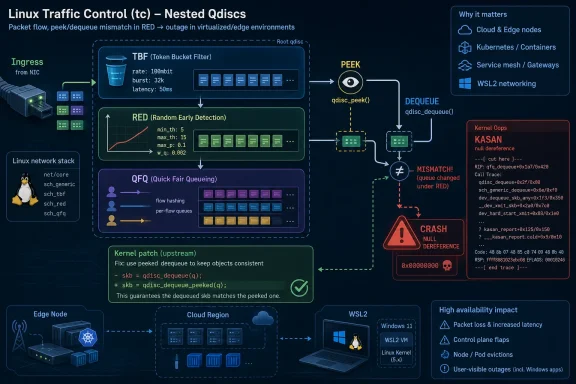
That stack is the story. TBF is the parent asking for a packet. RED is the intermediate discipline that mishandles the transition from peek to dequeue. QFQ is the child that had put the packet in a special path and then got called as if nothing had been peeked.
The process name in the trace is
There is no public evidence in the supplied record of widespread exploitation. There is, however, a clear reproducer class, enough kernel detail for capable operators to understand affected configurations, and stable-branch references that indicate the fix was backported. That is the normal shape of a kernel availability CVE that should be patched without panic.
This is why Linux kernel CVEs often create a mismatch between vulnerability volume and remediation clarity. A central dashboard may flag hundreds of assets. The actual blast radius may be five packet-shaping nodes. Or the dashboard may miss the one embedded appliance that actually runs the vulnerable pattern.
The fix is not to turn every Windows administrator into a kernel scheduler expert. It is to improve ownership. If a Linux box is part of the path that Windows authentication, file access, remote work, or application delivery depends on, somebody needs to know how it is patched and how its traffic shaping is configured.
The same applies to cloud images. A VM running Linux as a router, NAT gateway, VPN endpoint, or test harness may be more exposed than a general-purpose application server. If it uses custom qdisc settings, it deserves specific attention.
That said, WSL should not be waved away categorically. WSL 2 uses a real Linux kernel supplied through Microsoft’s update channels, and developers can run networking tools in complex environments. But the specific qdisc combinations involved here are far more characteristic of network engineering, testing, appliances, and server infrastructure than ordinary developer shells.
The more sensible Windows angle is dependency mapping. If your Windows fleet relies on Linux network components, those Linux kernels are part of your Windows availability story. If your developers use Linux-based CI systems to build Windows software, those hosts belong in your security maintenance calendar.
The lesson is not “patch WSL immediately because of RED.” It is “stop pretending Linux dependencies are peripheral just because the user-facing estate is Windows.”
That still leaves timing. Distribution kernels are not all updated at the same pace, and enterprise vendors often backport fixes without changing the visible kernel version in the way upstream users expect. Administrators should verify vendor advisories and package changelogs rather than relying only on
For self-built kernels, the remediation is clearer but more laborious: ensure the RED patch is present in
Temporary mitigation is configuration-dependent. Removing or simplifying the affected qdisc hierarchy may avoid the crash path, but that could also change bandwidth control, latency, fairness, or congestion behavior. In production networks, changing traffic shaping can be its own incident.
That distinction matters for prioritization. A public exploit is not the only trigger worth caring about. A misbehaving client, a test script, a monitoring probe, or a traffic burst in a shaped environment could plausibly exercise a brittle qdisc path if the configuration matches.
The bug also illustrates why selftests matter. The patchset added tests that force RED and SFB to dequeue from a child’s
Kernel networking is full of these contracts. A helper function is not just syntactic sugar; it is institutional memory encoded as an API. When a subsystem forgets to use it, the crash may not arrive for years, but the bug is already there.
The right response is targeted. Inventory Linux systems that use
For vulnerability managers, this is a good test of process maturity. Can the team distinguish a generic kernel CVE from a configuration-relevant one? Can it ask network engineers for qdisc state? Can it avoid both extremes: ignoring the bug because NVD has no score, or declaring an all-hands emergency because a scanner printed a CVE?
For Windows administrators, the immediate action is to look sideways. The vulnerable code may not live on the Windows hosts you patch every month. It may live in the Linux infrastructure that makes those hosts reachable, fast, or segmented.
 A One-Line Kernel Fix Exposes a Whole Class of Fragile Assumptions
The patch behind CVE-2026-43496 changes one line in net/sched/sch_red.c: instead of calling a child queueing discipline’s dequeue() method directly, RED now calls qdisc_dequeue_peeked(). That sounds like kernel housekeeping, and in one sense it is. But in packet scheduling, housekeeping is the contract that keeps the network stack from stepping on its own state.The failure mode appears when RED has a child qdisc such as QFQ whose
peek() behavior uses the kernel’s deferred dequeue machinery. A parent scheduler such as TBF first asks whether a packet is available. The child stack says yes, but the packet may now be parked in the gso_skb path that tracks a packet already observed by peek().The old RED code then went straight to the child’s raw
dequeue() callback. That bypassed the “you already peeked this packet” path and made QFQ look in the wrong place. In the reported trace, the result was a null-pointer dereference inside qfq_dequeue, caught by KASAN and severe enough to panic the kernel.There is a useful humility in this bug. The kernel had the correct helper already. The vulnerability was that one queueing discipline did not use it in a composition that the traffic-control subsystem permits.
This Is Not a Remote-Code-Execution Headline, and That Is the Point
The most important thing to say plainly is that the public record for CVE-2026-43496 does not currently describe a remote code execution flaw, privilege escalation, or data disclosure. NVD had not assigned CVSS scores at publication time, and the available description points to a kernel panic triggered by a specific traffic-control configuration. The visible impact is availability.That does not make it irrelevant. Availability bugs in kernel networking sit in an uncomfortable middle ground: they are often too conditional for panic headlines and too close to production datapaths to ignore. If a host, router, VM, or container node can be crashed by traffic that exercises a configured qdisc stack, the business impact is still a denial of service.
The setup is not default desktop Linux. It involves Linux traffic control, RED, child qdiscs such as QFQ, and parent schedulers such as TBF. That narrows the exposed population considerably. It also means the exposed population is more likely to include systems whose owners deliberately shaped traffic for latency, fairness, congestion signaling, or bandwidth control.
Those are often not hobby boxes. They are gateways, lab routers, virtualization hosts, ISP-adjacent systems, test rigs, high-throughput servers, or appliances built on Linux. A bug that crashes a kernel in those places deserves more respect than a missing score field gives it.
The Vulnerability Lives in the Gap Between “Peek” and “Dequeue”
Traffic control in Linux is built around queueing disciplines, or qdiscs, which decide how packets leave an interface. Some are simple FIFO queues. Others shape bandwidth, apply fairness, drop early to signal congestion, or emulate network conditions for testing.RED, short for Random Early Detection, is one of the classic active queue management algorithms. Instead of waiting for a queue to fill completely and then dropping packets in bursts, RED starts dropping or marking packets earlier based on average queue size. In theory, that nudges senders to slow down before the buffer becomes a swamp.
QFQ, or Quick Fair Queueing, is a fairness-oriented scheduler. TBF, the Token Bucket Filter, is commonly used for rate limiting. Put these together and Linux can express sophisticated packet pipelines: a parent shapes the total rate, an intermediate qdisc manages congestion behavior, and a child decides fairness among flows.
The vulnerability comes from a subtle contract: after a qdisc has peeked at a packet, the subsequent dequeue should retrieve that same peeked packet, not blindly call down into a child and hope state is still aligned.
qdisc_dequeue_peeked() exists for precisely that reason. It respects the deferred packet state created by peek emulation.The old RED path broke that contract. It asked the child for visibility through one mechanism, then consumed through another. Most of the time, software survives this kind of mismatch until a specific combination makes the state machine honest. Here, RED plus QFQ plus a parent retrieval path made the mismatch crash-visible.
Kernel CVEs Have Become More Numerous, Not Always More Dramatic
The Linux kernel’s move to assign more CVEs for resolved bugs has changed the texture of vulnerability feeds. Security teams now see more kernel CVEs that look like commit messages because, in many cases, that is exactly where the truth is. The description for CVE-2026-43496 is less a polished advisory than a kernel developer’s explanation of the failure path.That is both better and worse for defenders. It is better because the record tells engineers what actually broke: RED called the wrong dequeue path after a peek. It is worse because most vulnerability management dashboards are not designed to reason about nested qdisc topologies.
A scanner can say “Linux kernel vulnerable.” It usually cannot say whether you have RED attached to a QFQ child under TBF on an interface reachable by untrusted traffic. That context lives in
tc output, image build scripts, appliance defaults, router configs, orchestration templates, and sometimes in the memory of the one engineer who tuned the box three years ago.This is where modern CVE handling still lags reality. The identifier is global, but the risk is local. CVE-2026-43496 is a perfect example: a small patch with a narrow trigger, but a potentially severe consequence on the wrong system.
Windows Shops Should Care Because Linux Is Already in the Room
For a Windows-focused publication, the temptation is to file this under “not our problem.” That would be comforting and wrong. Windows environments now routinely depend on Linux components, even when the desktop and identity layers remain Microsoft-centered.WSL is the obvious bridge for developers, but it is not the most operationally interesting one. The more important Linux surfaces are the infrastructure pieces: VPN appliances, SD-WAN boxes, NAS systems, firewalls, load balancers, Kubernetes workers, CI runners, Azure and AWS Linux images, monitoring collectors, and embedded systems that quietly move packets for Windows users.
Many of those systems use Linux traffic control directly or indirectly. Container platforms use shaping and policing. Network appliances expose GUI toggles that map onto qdisc configuration. Lab environments use
tc to reproduce customer conditions. Developers use it to simulate loss, latency, and bandwidth limits.That does not mean every Windows shop is exposed to CVE-2026-43496. It means the boundary between “Windows vulnerability” and “business-impacting vulnerability” has dissolved. A Windows file server can be perfectly patched and still lose connectivity because a Linux gateway panics under a traffic-control edge case.
The Absence of an NVD Score Is Not a Risk Decision
At the time the record was published, NVD listed no CVSS v4.0, v3.x, or v2.0 base score for CVE-2026-43496. That is not unusual in the current CVE ecosystem, where enrichment can lag publication. It is also not a reason to treat the issue as zero priority.CVSS is a translation layer, not the source of truth. For this flaw, the source of truth is the kernel patch and the crash trace: a specific scheduling stack can dereference null and panic the kernel. The missing score tells us more about data pipeline timing than about exploitability.
For administrators, the useful question is not “Is this Critical?” It is “Do we run affected kernels with RED in a nested qdisc arrangement where QFQ or similar peek behavior is present?” If the answer is no, the practical risk falls sharply. If the answer is yes, an availability fix belongs in the normal kernel update path, and possibly faster for network-facing systems.
Security programs that still gate action solely on NVD severity will stumble on bugs like this. A not-yet-scored denial-of-service issue on a packet-forwarding host may matter more than a high-scored library flaw on a dormant package. Context beats the badge.
The Patch Tells Administrators Where to Look
The fix landed as part of a small net scheduler patchset that addressed RED and a similar issue in SFB, with selftests added to force the problematic dequeue-from-gso_skb scenario. For CVE-2026-43496 specifically, the RED change is minimal: replace direct child dequeue with qdisc_dequeue_peeked().That minimalism is reassuring. The patch does not redesign RED, alter queue thresholds, or change the broader traffic-control interface. It corrects how RED consumes a packet after the qdisc stack has already observed one through peek semantics.
The patch also tells us the configurations worth auditing. Look for RED qdiscs with child schedulers, especially QFQ. Look for parent schedulers such as TBF that may peek before dequeueing. Look for custom
tc configurations rather than assuming the vulnerable arrangement appears only in hand-written lab scripts.On Linux systems,
tc qdisc show and tc -s qdisc show are the natural starting points. Appliance owners may not get shell access, which moves the burden to the vendor advisory process. If a vendor ships Linux-based traffic shaping, customers should expect that vendor to track stable kernel fixes even when the CVE lacks a dramatic score.The Crash Trace Is a Map, Not Just Noise
The trace included in the record is dense, but it is unusually helpful. It shows KASAN reporting a null-pointer dereference in a low memory range, with the fault occurring inqfq_dequeue. The call stack then walks back through red_dequeue, tbf_dequeue, and __qdisc_run.That stack is the story. TBF is the parent asking for a packet. RED is the intermediate discipline that mishandles the transition from peek to dequeue. QFQ is the child that had put the packet in a special path and then got called as if nothing had been peeked.
The process name in the trace is
ping, but that should not be overread. ping is often a convenient traffic generator in kernel testing. The important detail is that ordinary packet transmission through the configured qdisc hierarchy was enough to hit the crash in the test environment.There is no public evidence in the supplied record of widespread exploitation. There is, however, a clear reproducer class, enough kernel detail for capable operators to understand affected configurations, and stable-branch references that indicate the fix was backported. That is the normal shape of a kernel availability CVE that should be patched without panic.
The Enterprise Risk Is Concentrated in the Boxes Nobody Inventories Well
The systems most likely to matter here are also the systems many organizations inventory poorly. Endpoint agents are good at finding Windows laptops. They are less good at describing the kernel configuration of a WAN optimizer, a container host, or a lab bridge running a tunedtc stack.This is why Linux kernel CVEs often create a mismatch between vulnerability volume and remediation clarity. A central dashboard may flag hundreds of assets. The actual blast radius may be five packet-shaping nodes. Or the dashboard may miss the one embedded appliance that actually runs the vulnerable pattern.
The fix is not to turn every Windows administrator into a kernel scheduler expert. It is to improve ownership. If a Linux box is part of the path that Windows authentication, file access, remote work, or application delivery depends on, somebody needs to know how it is patched and how its traffic shaping is configured.
The same applies to cloud images. A VM running Linux as a router, NAT gateway, VPN endpoint, or test harness may be more exposed than a general-purpose application server. If it uses custom qdisc settings, it deserves specific attention.
WSL Is Probably Not the Center of This Story
Windows Subsystem for Linux will come up because it is the most visible Linux presence on Windows desktops. For most users, WSL is unlikely to be where CVE-2026-43496 becomes operationally important. The vulnerability sits in Linux kernel traffic-control scheduling, not in a typical userland package installed inside a distro.That said, WSL should not be waved away categorically. WSL 2 uses a real Linux kernel supplied through Microsoft’s update channels, and developers can run networking tools in complex environments. But the specific qdisc combinations involved here are far more characteristic of network engineering, testing, appliances, and server infrastructure than ordinary developer shells.
The more sensible Windows angle is dependency mapping. If your Windows fleet relies on Linux network components, those Linux kernels are part of your Windows availability story. If your developers use Linux-based CI systems to build Windows software, those hosts belong in your security maintenance calendar.
The lesson is not “patch WSL immediately because of RED.” It is “stop pretending Linux dependencies are peripheral just because the user-facing estate is Windows.”
Stable Kernel Backports Are the Real Remediation Channel
For most organizations, the practical fix is not to cherry-pick a kernel commit. It is to consume the patched kernel from the distribution, appliance vendor, or cloud image provider that owns the kernel ABI and support promise. The upstream stable references in the CVE record suggest the fix was propagated beyond mainline development.That still leaves timing. Distribution kernels are not all updated at the same pace, and enterprise vendors often backport fixes without changing the visible kernel version in the way upstream users expect. Administrators should verify vendor advisories and package changelogs rather than relying only on
uname -r.For self-built kernels, the remediation is clearer but more laborious: ensure the RED patch is present in
net/sched/sch_red.c, rebuild, test the traffic-control configuration, and roll forward. For appliances, the right answer is firmware or vendor kernel update. For containers, remember that this is a host kernel issue; updating a container image will not patch the kernel beneath it.Temporary mitigation is configuration-dependent. Removing or simplifying the affected qdisc hierarchy may avoid the crash path, but that could also change bandwidth control, latency, fairness, or congestion behavior. In production networks, changing traffic shaping can be its own incident.
The Security Signal Is Smaller Than the Reliability Signal
CVE-2026-43496 is a security record because a kernel panic is a denial-of-service condition. But the most valuable signal for many administrators is reliability. If your packet scheduler can panic under legitimate traffic, your network stack has a correctness problem whether or not an attacker is involved.That distinction matters for prioritization. A public exploit is not the only trigger worth caring about. A misbehaving client, a test script, a monitoring probe, or a traffic burst in a shaped environment could plausibly exercise a brittle qdisc path if the configuration matches.
The bug also illustrates why selftests matter. The patchset added tests that force RED and SFB to dequeue from a child’s
gso_skb path. That is not glamorous security work, but it is how mature subsystems stop rediscovering the same class of mistake.Kernel networking is full of these contracts. A helper function is not just syntactic sugar; it is institutional memory encoded as an API. When a subsystem forgets to use it, the crash may not arrive for years, but the bug is already there.
The Practical Reading for Patch Queues and Network Teams
This CVE should not send administrators into emergency mode unless they know they are running the affected traffic-control pattern on critical systems. It should, however, move into the next kernel maintenance window for Linux hosts that shape traffic, forward packets, or sit in front of Windows-dependent services.The right response is targeted. Inventory Linux systems that use
tc. Confirm whether RED is configured with child qdiscs such as QFQ. Check vendor kernel updates for the RED dequeue fix. Treat appliances as first-class Linux systems even when their interface hides the kernel.For vulnerability managers, this is a good test of process maturity. Can the team distinguish a generic kernel CVE from a configuration-relevant one? Can it ask network engineers for qdisc state? Can it avoid both extremes: ignoring the bug because NVD has no score, or declaring an all-hands emergency because a scanner printed a CVE?
For Windows administrators, the immediate action is to look sideways. The vulnerable code may not live on the Windows hosts you patch every month. It may live in the Linux infrastructure that makes those hosts reachable, fast, or segmented.
The Few Facts That Should Drive the Change Window
CVE-2026-43496 is a small patch with a narrow trigger, but it sits in a kernel subsystem where narrow bugs can produce wide outages. The safest reading is neither alarmist nor dismissive: patch through supported channels, audit traffic-control configurations, and give network-path Linux hosts more attention than generic servers.- CVE-2026-43496 affects the Linux kernel’s RED queueing discipline when it is composed with child qdiscs whose peek behavior uses the deferred dequeue path.
- The observed failure is a kernel panic caused by a null-pointer dereference in a nested traffic-control stack involving RED, QFQ, and a parent scheduler such as TBF.
- The fix replaces a direct child
dequeue()call in RED withqdisc_dequeue_peeked(), preserving the packet selected during the earlier peek operation. - NVD published the record on May 21, 2026, but had not provided CVSS scoring in the record text available at publication time.
- The highest-priority systems to check are Linux routers, traffic shapers, appliances, container hosts, lab networks, and cloud instances that use custom
tcqdisc configurations. - Updating containers or userland packages will not remediate this class of issue because the vulnerable component is the host kernel.
References
- Primary source: NVD / Linux Kernel
Published: 2026-05-22T01:02:01-07:00
NVD - CVE-2026-43496
 nvd.nist.gov
- Security advisory: MSRC
Published: 2026-05-22T01:02:01-07:00
Original feed URL
Security Update Guide - Microsoft Security Response Center
 msrc.microsoft.com
- Official source: nist.gov
National Vulnerability Database
NIST maintains the National Vulnerability Database (NVD), a repository of information on software and hardware flaws that can compromise computer security. This is a key piece of the nation’s cybersecurity infrastructure.www.nist.gov - Related coverage: db.gcve.eu
Vulnerability-Lookup
Vulnerability-Lookup - Fast vulnerability lookup correlation from different sources.db.gcve.eu - Related coverage: synscan.net
CVE-2025-43496 — apple / ipados | SynScan
CVE-2025-43496 is a high-severity vulnerability affecting apple / ipados (2025). Check if your assets are exposed with SynScan.synscan.net - Related coverage: labs.cloudsecurityalliance.org
NVD Enrichment Triage: Enterprise Vulnerability Programs Must Adapt
PDF documentlabs.cloudsecurityalliance.org
- Related coverage: spinics.net
[GIT PULL] Networking for v7.1-rc3 — Linux Kernel
Linux Kernel: [GIT PULL] Networking for v7.1-rc3
www.spinics.net
- Related coverage: lore-kernel.gnuweeb.org
- Related coverage: dfsg-new-queue.debian.org

DFSG NEW Queue - Review: linux 7.0.7-1
dfsg-new-queue.debian.org
- Related coverage: git.zx2c4.com
linux-rng - Development tree for the kernel CSPRNG
git.zx2c4.com
- Related coverage: git1.toradex.com
