

GhostLock, tracked as CVE-2026-43499, is a long-lived Linux kernel use-after-free in futex and real-time mutex priority-inheritance code. On kernels with
The flaw is not remotely exploitable by itself, but that does not make shared Linux infrastructure safe. Container hosts, Kubernetes workers, CI runners, development systems, and servers that execute third-party or otherwise less-trusted code should receive the highest priority. The complete remedy is to install the corrected kernel package identified by the applicable distribution vendor, reboot into it, and verify the exact running package.
For mixed Windows and Linux estates, the first operational question is often not how the kernel bug works. It is who owns the Linux system, who can approve its reboot, and who is responsible for preventing an old image from restoring the vulnerability later.
Windows-led infrastructure teams may control the virtualization platform, identity system, cloud subscription, backup environment, endpoint tooling, or management network while another group maintains the Linux guest. Container hosts may belong to a platform team, their workloads to application teams, and their base images to a separate engineering group. That division can leave a security update technically available but operationally unowned.
That prerequisite is meaningful, but many modern systems intentionally execute code that administrators do not fully trust. CI runners process repository-controlled scripts. Container platforms launch workloads belonging to different applications, teams, or customers. Shared development systems provide user sessions. Hosting systems and application platforms execute extensions, uploaded components, dependencies, and automation tasks.
These environments depend on the kernel to keep a low-privileged process from taking control of the operating system. Local access is therefore an attack prerequisite, not a safety guarantee.
Nebula Security’s VEGA research team named and analyzed GhostLock. The researchers report that, on kernels with
Containers increase the potential infrastructure impact because ordinary containers share the host kernel. Namespaces, capabilities, control groups, seccomp policies, and related controls restrict workloads, but they do not provide each container with an independent kernel. A reachable kernel vulnerability may therefore threaten the host and neighboring workloads even when the initiating container lacks elevated capabilities.
Virtual machines have a different boundary. Exploiting GhostLock inside a Linux guest could compromise that guest’s root and kernel boundary. It does not, by itself, demonstrate an escape through the hypervisor into a Windows or Linux virtualization host. Administrators should treat a compromised guest as serious without mischaracterizing the flaw as an automatic hypervisor takeover.
Asset role should drive urgency. Shared container nodes, build infrastructure, development systems, managed hosting platforms, and servers with low-privileged users warrant faster action than tightly controlled single-purpose systems.
Futexes, or fast userspace mutexes, allow much synchronization work to occur in userspace while providing kernel assistance when threads must wait or coordinate. Priority inheritance helps prevent a high-priority task from being indefinitely blocked behind a lower-priority task that owns a required lock.
The relevant kernel code must maintain relationships among lock owners, waiting tasks, dependency chains, effective priorities, and cleanup operations. The supplied technical facts place the GhostLock error in
That distinction matters in the requeue-PI path. In that context, the task performing cleanup is not necessarily the task represented by the waiter. Using the wrong task can leave the actual waiter’s
This supported task-identity and lifetime issue is sufficient to explain the vulnerability at an administrator-relevant level. More detailed assertions about every lock, dequeue, rollback, and priority-adjustment sequence should not be treated as established without the corresponding primary kernel material for the applicable branch.
Production remediation should therefore be based on a supported distribution package that incorporates the correction, rather than on an administrator’s interpretation of one source fragment.
They further report using that condition to gain root privileges and escape a restricted container into the shared host kernel. The demonstrated exploit reportedly combines controlled memory reuse, address-layout discovery, and additional kernel exploitation techniques.
Those mechanics establish why the bug should be treated as more than a theoretical lifetime error, but administrators do not need to reproduce the chain to make a remediation decision. Exploit behavior can vary according to architecture, kernel configuration, downstream patches, hardening, memory layout, and exact package build.
The actionable conclusion is narrower and stronger: researchers report a practical privilege-escalation and container-escape path, so affected systems that execute less-trusted local code should be patched before exploit compatibility is tested in the organization’s environment.
A failed public proof of concept would not prove that a system is safe. It could mean only that the exploit was built for another package, configuration, architecture, or memory layout.
GhostLock therefore deserves priority wherever workloads at different trust levels share one kernel. Removing optional capabilities, applying seccomp policies, limiting interactive access, and using restrictive container profiles remain valuable security measures. They should not be mistaken for correction of the kernel bug.
On kernels with
While a corrected package is pending, administrators can reduce exposure by:
The package-status matrix below is therefore a verification guide, not a claim that each vendor operates a particular GhostLock tracker or uses one standard advisory process.
Do not infer a vendor’s package status from another distribution, even when the products share upstream components. Do not generalize that every system on a major release is fixed or vulnerable without identifying the exact kernel package and supported product stream.
Alternate cloud, real-time, OEM, hardware-enablement, appliance, and vendor-specific kernels can follow different release paths. Scanner findings based only on upstream version comparison can consequently produce false positives or false negatives.
The closure decision should rest on two forms of evidence:
That does not mean every production branch can be safely repaired by copying one upstream source change into a locally built kernel. Stable branches and downstream kernels may require adapted patches, prerequisites, follow-up changes, or packaging adjustments.
Supported distribution packages are preferable because they combine the applicable code correction with branch-specific integration, dependency handling, testing, package metadata, and an auditable update path. A locally built kernel might contain the intended source change while remaining difficult to inventory, reproduce, support, or prove compliant.
If a corrected package is not yet available, security teams should document the affected assets, reduce less-trusted local execution, isolate higher-risk workloads, monitor the product maintainer’s security information, and reserve a maintenance window. Replacing a supported enterprise kernel with an unrelated upstream build can introduce compatibility and availability risks and should not be the default response.
Risk-based acceleration remains appropriate. A multi-tenant container node or shared CI runner should receive testing and maintenance resources before a controlled single-purpose server with no interactive users. The same severity score does not imply identical operational risk across those roles.
Stack-offset randomization may make predictable reuse more difficult. Static user-mode-helper configuration may obstruct a demonstrated route used after the initial memory corruption. Results depend on the kernel build and configuration, and another exploit could use different techniques.
The distinction is important: hardening may interfere with a known method, while the corrected kernel repairs the vulnerable state-management logic. Keep supported hardening enabled, but do not close a GhostLock ticket because a proof of concept crashes, fails to infer an address, or cannot complete its final privilege-escalation stage.
A machine patched for another kernel issue may remain exposed to CVE-2026-43499. Conversely, a GhostLock-corrected package does not prove that every other kernel vulnerability has been resolved. Vulnerability-management systems should retain separate findings and map each one to the package evidence applicable to the installed kernel stream.
The broader lesson is that old kernel code is not automatically safe code. Long-lived concurrency and object-lifetime assumptions can remain unnoticed until researchers find a practical way to turn them into privilege escalation. Once researchers report a working exploit, administrators should evaluate the demonstrated impact and exposed asset roles rather than relying on the age of the code or the word “local” in the attack vector.
If the applicable corrected package is pending, reduce or suspend untrusted local execution, move workloads to corrected hosts where possible, isolate vulnerable nodes, prevent vulnerable images from scaling back into service, monitor the product maintainer’s security information, and reserve a reboot window. Do not claim that capabilities, namespaces, exploit failure, or general hardening fully resolves the vulnerability.
The remediation ticket closes only when there are two pieces of evidence: the vendor or product maintainer confirms that the installed package contains the CVE-2026-43499 correction for that exact product stream, and post-reboot package-manager output plus
CONFIG_FUTEX_PI enabled, the researchers report that an unprivileged local user can reach the vulnerable path without special privileges or user namespaces. They also report demonstrating local privilege escalation to root and escape from a container into the shared host kernel.The flaw is not remotely exploitable by itself, but that does not make shared Linux infrastructure safe. Container hosts, Kubernetes workers, CI runners, development systems, and servers that execute third-party or otherwise less-trusted code should receive the highest priority. The complete remedy is to install the corrected kernel package identified by the applicable distribution vendor, reboot into it, and verify the exact running package.
Verify and remediate now
Decision facts
1. Record the running kernel and configuration
CONFIG_FUTEX_PImust be enabled for the vulnerable path to be reachable.- On kernels with that option enabled, the researchers report no special privileges or user namespaces are required.
- The researchers report that their exploit can escape a container into the shared host kernel.
- Hardening and workload restrictions may reduce exposure, but installing the vendor-corrected kernel and rebooting is the only complete remediation.
uname -r
If the running kernel exposes its configuration:
grep '^CONFIG_FUTEX_PI=' /boot/config-"$(uname -r)"
Some systems publish the active configuration through/proc/config.gzinstead:
zgrep '^CONFIG_FUTEX_PI=' /proc/config.gz
Absence of either file is not proof that the option is disabled. Use the distribution’s package metadata or build configuration if necessary.
2. Install the approved vendor kernel update
Debian and Ubuntu:
Follow the organization’s approved package procedure if it uses targeted package installation, unattended upgrades, phased deployment, configuration management, or another controlled update method. The objective is to install the available kernel packages for the system—not merely list candidate updates.Code:sudo apt update sudo apt upgrade
RHEL-family systems:
sudo dnf update kernel
SUSE systems:
sudo zypper patch
Package names and update commands can vary for cloud, real-time, OEM, hardware-enablement, enterprise, and vendor-specific kernels. Confirm that the transaction actually installs the corrected package for the kernel stream in use.
3. Verify the installed package before reboot
Debian and Ubuntu:
dpkg-query -W 'linux-image*' 2>/dev/null
RHEL-family systems:
rpm -q kernel
SUSE systems:
rpm -qa | grep '^kernel-'
Compare the installed package with the fixed package or status supplied for the exact distribution release and kernel stream.
4. Reboot into the corrected kernel
sudo reboot
5. Confirm the kernel that booted
uname -r
Then use the distribution package manager to map that exact running release to an installed package. On Debian and Ubuntu, for example:
dpkg-query -S "/boot/vmlinuz-$(uname -r)"
On RPM-based systems:
rpm -qf "/boot/vmlinuz-$(uname -r)"
Do not close the finding merely because an updated package exists on disk. Until the machine boots the corrected kernel, it can remain exposed through the older kernel still resident in memory.
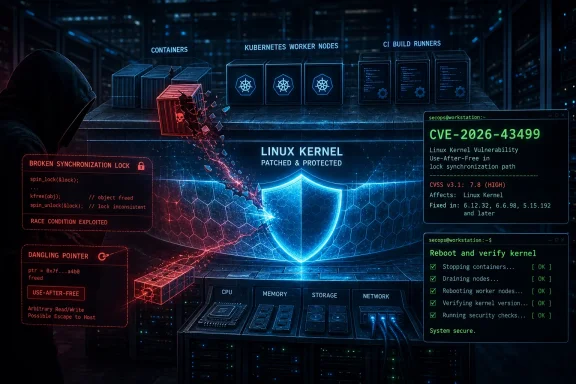 Ownership Comes Before the Maintenance Window
For mixed Windows and Linux estates, the first operational question is often not how the kernel bug works. It is who owns the Linux system, who can approve its reboot, and who is responsible for preventing an old image from restoring the vulnerability later.Windows-led infrastructure teams may control the virtualization platform, identity system, cloud subscription, backup environment, endpoint tooling, or management network while another group maintains the Linux guest. Container hosts may belong to a platform team, their workloads to application teams, and their base images to a separate engineering group. That division can leave a security update technically available but operationally unowned.
Ownership checklist for Windows-led mixed estates
- Identify the Linux asset owner: Determine who is accountable for every Linux VM, container host, appliance, CI runner, Kubernetes worker, cloud image, and managed node.
- Identify the service owner: Record the team responsible for the application or platform that depends on the Linux asset, even when that team does not administer the operating system.
- Identify the management plane: Establish whether updates are controlled through SSH automation, configuration management, a cloud service, a virtualization platform, Kubernetes node management, or an appliance vendor.
- Identify the image pipeline: Find the team responsible for golden images, VM templates, container-host images, autoscaling groups, recovery media, and infrastructure-as-code definitions.
- Identify the maintenance-window owner: Name the person or team authorized to drain workloads, reboot hosts, validate service health, and approve emergency scheduling.
- Confirm escalation paths: If the Linux owner cannot patch promptly, determine who can isolate the asset, move workloads, authorize emergency maintenance, or formally accept the residual risk.
- Prevent reintroduction: Ensure patched systems cannot later be replaced by an older template, snapshot, node image, recovery image, or autoscaling definition containing a vulnerable kernel.
- Preserve evidence: Assign responsibility for recording the vendor package status, package-manager output, reboot time, running kernel, and post-maintenance service checks.
A Local Bug That Attacks Linux Trust Boundaries
GhostLock is not a standalone remote-code-execution vulnerability. An attacker first needs the ability to execute code locally, such as through a compromised service, stolen account, malicious workload, build job, plug-in, package hook, or another initial foothold.That prerequisite is meaningful, but many modern systems intentionally execute code that administrators do not fully trust. CI runners process repository-controlled scripts. Container platforms launch workloads belonging to different applications, teams, or customers. Shared development systems provide user sessions. Hosting systems and application platforms execute extensions, uploaded components, dependencies, and automation tasks.
These environments depend on the kernel to keep a low-privileged process from taking control of the operating system. Local access is therefore an attack prerequisite, not a safety guarantee.
Nebula Security’s VEGA research team named and analyzed GhostLock. The researchers report that, on kernels with
CONFIG_FUTEX_PI enabled, the vulnerable path can be reached through threading and synchronization operations without special capabilities or user namespaces. They also report developing a reliable local privilege-escalation exploit and a container-escape demonstration. Those exploitability statements should be understood as researcher-reported findings for tested environments, not as guarantees of identical behavior on every architecture, configuration, and distribution package.Containers increase the potential infrastructure impact because ordinary containers share the host kernel. Namespaces, capabilities, control groups, seccomp policies, and related controls restrict workloads, but they do not provide each container with an independent kernel. A reachable kernel vulnerability may therefore threaten the host and neighboring workloads even when the initiating container lacks elevated capabilities.
Virtual machines have a different boundary. Exploiting GhostLock inside a Linux guest could compromise that guest’s root and kernel boundary. It does not, by itself, demonstrate an escape through the hypervisor into a Windows or Linux virtualization host. Administrators should treat a compromised guest as serious without mischaracterizing the flaw as an automatic hypervisor takeover.
Asset role should drive urgency. Shared container nodes, build infrastructure, development systems, managed hosting platforms, and servers with low-privileged users warrant faster action than tightly controlled single-purpose systems.
Fifteen Years of Compatibility Hid a Task-Identity Error
The affected logic dates to the Linux 2.6.39 development era, placing the underlying mistake in code introduced roughly 15 years before the GhostLock research became public.Futexes, or fast userspace mutexes, allow much synchronization work to occur in userspace while providing kernel assistance when threads must wait or coordinate. Priority inheritance helps prevent a high-priority task from being indefinitely blocked behind a lower-priority task that owns a required lock.
The relevant kernel code must maintain relationships among lock owners, waiting tasks, dependency chains, effective priorities, and cleanup operations. The supplied technical facts place the GhostLock error in
remove_waiter() and distinguish the currently executing task, represented by current, from the task associated with the waiter, represented by waiter->task.That distinction matters in the requeue-PI path. In that context, the task performing cleanup is not necessarily the task represented by the waiter. Using the wrong task can leave the actual waiter’s
pi_blocked_on state referring to data whose lifetime has ended, creating the use-after-free condition.This supported task-identity and lifetime issue is sufficient to explain the vulnerability at an administrator-relevant level. More detailed assertions about every lock, dequeue, rollback, and priority-adjustment sequence should not be treated as established without the corresponding primary kernel material for the applicable branch.
Production remediation should therefore be based on a supported distribution package that incorporates the correction, rather than on an administrator’s interpretation of one source fragment.
What the Researchers Reported About Exploitation
Nebula Security’s GhostLock research describes an exploit that creates a priority-inheritance dependency condition and reaches error handling in the vulnerable requeue path. The researchers say the resulting stalepi_blocked_on state can refer to obsolete waiter data and be developed into a kernel memory-corruption primitive.They further report using that condition to gain root privileges and escape a restricted container into the shared host kernel. The demonstrated exploit reportedly combines controlled memory reuse, address-layout discovery, and additional kernel exploitation techniques.
Those mechanics establish why the bug should be treated as more than a theoretical lifetime error, but administrators do not need to reproduce the chain to make a remediation decision. Exploit behavior can vary according to architecture, kernel configuration, downstream patches, hardening, memory layout, and exact package build.
The actionable conclusion is narrower and stronger: researchers report a practical privilege-escalation and container-escape path, so affected systems that execute less-trusted local code should be patched before exploit compatibility is tested in the organization’s environment.
A failed public proof of concept would not prove that a system is safe. It could mean only that the exploit was built for another package, configuration, architecture, or memory layout.
Containers Turn “Local” Into an Infrastructure Problem
For container hosts, CI systems, shared development machines, and managed hosting platforms, local code execution is often part of the service rather than an exceptional event. The kernel boundary is what is supposed to stop a compromised job or container from becoming a host-wide incident.GhostLock therefore deserves priority wherever workloads at different trust levels share one kernel. Removing optional capabilities, applying seccomp policies, limiting interactive access, and using restrictive container profiles remain valuable security measures. They should not be mistaken for correction of the kernel bug.
On kernels with
CONFIG_FUTEX_PI enabled, the researchers report no special privileges or user namespaces are required. Disabling unrelated container features does not establish that the vulnerable path is unreachable.While a corrected package is pending, administrators can reduce exposure by:
- Draining untrusted workloads from affected nodes.
- Pausing multi-tenant or externally controlled build jobs.
- Restricting low-privileged interactive access.
- Moving builds and containers to corrected hosts.
- Temporarily dedicating nodes to workloads of one trust level.
- Isolating vulnerable systems from management and high-value service networks.
- Preventing new vulnerable nodes from being created by scaling or recovery automation.
Distribution Package Status Is the Real Version Test
Upstream kernel versions can help developers understand where a change entered the source tree, but production distributions commonly backport security corrections into older branches. A kernel with an older-looking upstream version may contain the correction, while a newer-looking custom or alternate package may still require validation.The package-status matrix below is therefore a verification guide, not a claim that each vendor operates a particular GhostLock tracker or uses one standard advisory process.
| Distribution family | Where to obtain authoritative status | What administrators must verify |
|---|---|---|
| Debian | The security and package information supplied for the installed Debian release | Exact release, architecture, kernel package, fixed package threshold or status, installed package, and kernel running after reboot |
| Ubuntu | Canonical’s security and package information for the installed Ubuntu release and kernel stream | Supported release, applicable kernel package, corrected package status, installed package, and booted kernel |
| SUSE and openSUSE | SUSE or openSUSE security and package information applicable to the installed product | Product release, enabled repositories, applicable kernel package, corrected package status, and reboot completion |
| Red Hat Enterprise Linux | Red Hat security and package information for the installed RHEL product and enabled repositories | Product release, package stream, applicable corrected package, installed package, and running kernel |
| AlmaLinux | AlmaLinux security and repository information for the installed major release | Repository availability, applicable package release, installed package, and running kernel |
| Oracle Linux | Oracle security and package information for the kernel package actually installed | Oracle Linux release, exact kernel package family, applicable corrected package, installed version, and running version |
| Amazon Linux | Amazon Linux security and repository information for the deployed generation and image | Amazon Linux generation, package availability, installed release, machine-image status, and booted kernel |
Alternate cloud, real-time, OEM, hardware-enablement, appliance, and vendor-specific kernels can follow different release paths. Scanner findings based only on upstream version comparison can consequently produce false positives or false negatives.
The closure decision should rest on two forms of evidence:
- The applicable vendor or product maintainer identifies the installed package as containing the correction for CVE-2026-43499.
- Package-manager and post-reboot evidence shows that the system is actually running that package.
Timeline
- 2011: The affected rtmutex logic entered the Linux kernel during the 2.6.39 development period.
- April 2026: The kernel correction was integrated. The supplied facts establish the month for that event but do not establish every surrounding disclosure, backport, or acknowledgment date.
- 2026 vendor rollout: Distribution and product maintainers assessed supported branches and prepared or issued applicable packages according to their own processes.
- Research publication: Nebula Security published detailed GhostLock research and exploit analysis. The supplied facts do not establish a publication month.
Why Supported Packages Matter More Than Improvised Patches
The kernel correction addresses the task-identity mistake by ensuring that relevantremove_waiter() handling follows the task associated with the waiter rather than assuming that the currently executing task is the same actor.That does not mean every production branch can be safely repaired by copying one upstream source change into a locally built kernel. Stable branches and downstream kernels may require adapted patches, prerequisites, follow-up changes, or packaging adjustments.
Supported distribution packages are preferable because they combine the applicable code correction with branch-specific integration, dependency handling, testing, package metadata, and an auditable update path. A locally built kernel might contain the intended source change while remaining difficult to inventory, reproduce, support, or prove compliant.
If a corrected package is not yet available, security teams should document the affected assets, reduce less-trusted local execution, isolate higher-risk workloads, monitor the product maintainer’s security information, and reserve a maintenance window. Replacing a supported enterprise kernel with an unrelated upstream build can introduce compatibility and availability risks and should not be the default response.
Risk-based acceleration remains appropriate. A multi-tenant container node or shared CI runner should receive testing and maintenance resources before a controlled single-purpose server with no interactive users. The same severity score does not imply identical operational risk across those roles.
Hardening Can Disrupt an Exploit Without Curing the Bug
Nebula Security discussesRANDOMIZE_KSTACK_OFFSET and STATIC_USERMODE_HELPER as controls that may complicate parts of its demonstrated exploit chain. They remain useful defense-in-depth features, but neither should be recorded as a complete GhostLock workaround.Stack-offset randomization may make predictable reuse more difficult. Static user-mode-helper configuration may obstruct a demonstrated route used after the initial memory corruption. Results depend on the kernel build and configuration, and another exploit could use different techniques.
The distinction is important: hardening may interfere with a known method, while the corrected kernel repairs the vulnerable state-management logic. Keep supported hardening enabled, but do not close a GhostLock ticket because a proof of concept crashes, fails to infer an address, or cannot complete its final privilege-escalation stage.
Action checklist for administrators
- Inventory Linux systems by distribution, release, architecture, exact installed kernel package, and running kernel.
- Determine whether
CONFIG_FUTEX_PIis enabled, using reliable build or package information when runtime configuration files are unavailable. - Prioritize container hosts, Kubernetes workers, CI runners, shared servers, development machines, hosting platforms, and systems offering low-privileged accounts.
- Assign an accountable asset owner, service owner, image owner, and maintenance-window owner.
- Obtain correction status from the vendor or product maintainer responsible for the exact kernel package in use.
- Install the approved corrected package rather than merely checking whether an update is listed.
- Verify the installed package through the distribution package manager.
- Drain or stop workloads safely, reboot, and run
uname -r. - Map the running kernel back to the installed package and compare it with the maintainer’s corrected package status.
- Where a fix is pending, reduce less-trusted local execution and isolate shared workloads without recording those steps as full remediation.
- Preserve supported kernel and container hardening while recognizing that it does not replace the corrected package.
- Update VM templates, node images, autoscaling groups, recovery media, provisioning definitions, and replacement-node workflows.
- Test disaster recovery and autoscaling so they cannot restore an older vulnerable kernel.
- Attach package-status evidence, package-manager output, post-reboot kernel output, and service validation to the change or vulnerability ticket.
GhostLock Is Not Another Vulnerability With a New Name
GhostLock should be tracked independently from other Linux local-root and container-related disclosures. Similar outcomes do not mean vulnerabilities affect the same subsystem, require the same conditions, or are corrected by the same package.A machine patched for another kernel issue may remain exposed to CVE-2026-43499. Conversely, a GhostLock-corrected package does not prove that every other kernel vulnerability has been resolved. Vulnerability-management systems should retain separate findings and map each one to the package evidence applicable to the installed kernel stream.
The broader lesson is that old kernel code is not automatically safe code. Long-lived concurrency and object-lifetime assumptions can remain unnoticed until researchers find a practical way to turn them into privilege escalation. Once researchers report a working exploit, administrators should evaluate the demonstrated impact and exposed asset roles rather than relying on the age of the code or the word “local” in the attack vector.
Direct Verdict
Patch multi-tenant container hosts, Kubernetes workers, CI and build runners, shared development servers, hosting platforms, and systems with low-privileged or third-party users first. Next, patch application servers and Linux VMs where compromise of a service could provide local execution. Controlled single-purpose systems should still be updated, but they can follow the assets that intentionally run less-trusted code.If the applicable corrected package is pending, reduce or suspend untrusted local execution, move workloads to corrected hosts where possible, isolate vulnerable nodes, prevent vulnerable images from scaling back into service, monitor the product maintainer’s security information, and reserve a reboot window. Do not claim that capabilities, namespaces, exploit failure, or general hardening fully resolves the vulnerability.
The remediation ticket closes only when there are two pieces of evidence: the vendor or product maintainer confirms that the installed package contains the CVE-2026-43499 correction for that exact product stream, and post-reboot package-manager output plus
uname -r prove that the machine is running the corrected kernel.References
- Primary source: Linuxiac
Published: Thu, 09 Jul 2026 16:10:33 GMT
Loading…
linuxiac.com - Independent coverage: cyberpress.org
Published: Wed, 08 Jul 2026 07:33:14 GMT
Loading…
cyberpress.org - Related coverage: privacyguides.org
Loading…
www.privacyguides.org - Related coverage: pragma-core.com
Loading…
pragma-core.com - Related coverage: thehackernews.com
Loading…
thehackernews.com - Related coverage: 0daynews.com
Loading…
0daynews.com
- Related coverage: arstechnica.com
Loading…
arstechnica.com - Related coverage: privatedevops.com
Loading…
privatedevops.com - Related coverage: labs.cloudsecurityalliance.org
CSA research note dirty frag linux lpe container 20260509 csa styled
PDF documentlabs.cloudsecurityalliance.org
- Related coverage: access.redhat.com
Loading…
access.redhat.com