

CVE-2026-43501 is a newly published Linux kernel IPv6 vulnerability, disclosed through the kernel.org CVE process and added to NVD on May 21, 2026, involving an out-of-bounds write in the RPL Source Routing Header handling path. It is not a Windows bug, but it matters to WindowsForum readers because Linux now sits inside plenty of Windows-adjacent infrastructure: WSL environments, Hyper-V guests, routers, appliances, containers, and cloud workloads. The immediate story is a kernel memory-safety fix in a relatively obscure IPv6 code path. The larger story is how modern vulnerability management keeps forcing administrators to understand the difference between “published,” “scored,” “patched,” and “actually exploitable in my estate.”
The vulnerability sits in the Linux kernel’s IPv6 RPL handling, specifically in the path that processes an RFC 6554 Source Routing Header. RPL, short for Routing Protocol for Low-Power and Lossy Networks, is not the sort of feature most desktop users knowingly enable. It is more commonly associated with constrained networks, sensor-style deployments, and specialized IPv6 routing scenarios.
That obscurity is exactly why this kind of bug can be awkward for defenders. The systems most exposed to unusual IPv6 packet paths are often not the laptops people patch first, but the embedded gateways, edge boxes, virtual appliances, and general-purpose Linux servers that have accumulated network roles over time. A feature can be rarely used and still reachable enough to deserve attention.
The CVE description says the issue was resolved by changing how the kernel reserves headroom when a decompressed and recompressed Source Routing Header grows. In plain English, the kernel was rewriting packet metadata and data structures under an assumption about available space. Under a crafted packet shape, that assumption breaks.
The reported failure mode is concrete: a crafted IPv6 raw packet over the loopback interface can drive the packet buffer into a state where rebuilding the MAC header causes a small out-of-bounds write far away from where the kernel intended to write. KASAN, the kernel address sanitizer used to catch memory bugs, reportedly flags a 14-byte out-of-bounds write in the IPv6 routing header receive path.
That is not the same thing as a public weaponized exploit. But in kernel security, a reproducible out-of-bounds write is not a bookkeeping mistake. It is the kind of primitive that forces maintainers, distribution vendors, and security teams to treat the affected code as potentially dangerous until proven otherwise.
CVE-2026-43501 is a failure in that accounting. The vulnerable path decompresses a Source Routing Header, swaps the next segment into the IPv6 destination address, recompresses the routing header, then removes the old header and pushes the new one back with the IPv6 header. The recompressed result can be larger than the original header.
That detail is the trap. Compression sounds like it should reduce size, but this code is not compressing an arbitrary file; it is encoding IPv6 address segments relative to shared prefixes. When the swap changes how much prefix is common between the destination and segment addresses, the recompressed routing header can grow. The description gives a maximum growth case of eight bytes.
Eight bytes is small enough to look harmless and large enough to break a kernel invariant. The prior expansion check was gated on
This is the kind of vulnerability that makes kernel engineers sound superstitious about “just a few bytes.” In userspace, an eight-byte miscalculation may crash a process. In kernel packet handling, it can corrupt memory in a privileged context reached by input data.
On one hand, it suggests the issue is not a generic “any IPv6 packet from anywhere owns the machine” bug. Raw sockets, loopback delivery, routing header details, and kernel configuration all matter. The path described is technical and narrow.
On the other hand, the presence of a simple local reproducer means defenders should not dismiss this as purely theoretical. A local user or process able to create the necessary packet shape may be able to trigger kernel memory corruption. In containerized or virtualized environments, raw socket permissions, network namespace exposure, and capability boundaries become part of the real risk calculation.
That is especially relevant in mixed Windows and Linux estates. A Windows admin may not think of IPv6 RPL as part of their patch routine, but they may still operate Linux build runners, Kubernetes nodes, WSL-backed developer environments, security appliances, or Hyper-V guests. The vulnerable code path lives below the application layer where inventory tools are often weakest.
The most responsible reading today is cautious rather than theatrical. This is a kernel memory-safety bug with a fix available in stable kernel commits, recently published as a CVE, and not yet scored by NVD at the time of publication. That means teams should track patches and exposure, not wait for a single magic number to tell them whether it matters.
This is becoming a familiar problem. NIST has been adjusting how NVD enrichment works because CVE volume has grown faster than traditional manual analysis can comfortably absorb. More records now arrive before full downstream metadata is ready, leaving security teams with a description, references, and little else.
For a practical defender, the vendor and upstream context matter. The source here is kernel.org, and the references point to stable kernel commits. That means the vulnerability has been accepted by the Linux kernel security process as a real defect with a concrete fix, not merely a speculative third-party report.
Third-party vulnerability databases may assign their own provisional severity. Those scores can be useful as triage hints, but they should not override local context. A kernel out-of-bounds write reachable only under constrained local conditions has a different operational meaning on a locked-down server than on a multi-tenant build host with permissive container networking.
The uncomfortable truth is that NVD’s delay exposes a weakness in many patch programs. Too many workflows are built around severity ingestion rather than evidence evaluation. CVE-2026-43501 is a reminder that the first serious triage step is not “what color did the dashboard turn?” but “which of our systems run affected kernels, expose the relevant functionality, and grant the privileges needed to trigger the path?”
That is the right kind of kernel fix. It does not try to ban a strange packet shape after the fact. It repairs the invariant that packet transformation code depends on: before pushing headers and rebuilding metadata, reserve enough room for both the new header and the link-layer header bookkeeping.
Small patches in packet-handling code can have outsized security significance. The bug is not that Linux supports RPL. The bug is that the stack allowed a legal-ish transformation path to proceed while silently eroding the headroom required by later code.
This distinction matters for administrators reading advisories. The fix is likely to appear as part of ordinary kernel updates from distributions rather than as a toggle users can safely manage themselves. Disabling IPv6 outright is a blunt instrument that may break modern networks, cloud services, and Windows-adjacent management assumptions. Updating the kernel is the clean answer.
The catch is timing. Upstream stable commits are not the same thing as an installed package on your fleet. Distribution maintainers need to backport, test, publish, and annotate updates. Appliance vendors may take longer. Cloud images and containers may lag behind base operating system repositories.
Active Directory environments increasingly rely on Linux-based monitoring, backup, CI/CD, VPN, reverse proxy, storage, and observability components. Windows developers run Linux kernels through WSL 2. Enterprises run Linux guests on Hyper-V and Azure. Security products and network appliances often hide Linux behind a browser UI and a vendor logo.
That blended reality changes how CVEs should be consumed. A vulnerability in the Linux IPv6 stack may not require emergency action on every Windows endpoint, but it can still affect the systems that authenticate, route, inspect, build, or protect those endpoints. In 2026, platform boundaries are administrative conveniences, not security boundaries.
WSL deserves a careful note. WSL 2 uses a Microsoft-provided Linux kernel, and its exposure model is not identical to a normal LAN-facing Linux server. The CVE’s described reproducer involves raw IPv6 packet construction and loopback behavior, so the practical exploitability inside WSL will depend on kernel version, privileges, namespace behavior, and Microsoft’s servicing path. It should be tracked, not assumed.
The same logic applies to containers. Containers share the host kernel, so a kernel networking bug is not contained by the presence of a container boundary. Whether an unprivileged container can trigger this particular path depends on capabilities such as raw socket access and the host’s network namespace configuration. But the general rule remains: if the bug is in the kernel, container patching means host patching.
CVE-2026-43501 is not an indictment of IPv6 as a protocol. It is an example of what happens when complex optional protocol machinery remains compiled, reachable, and insufficiently exercised by ordinary production traffic. Edge-case packet paths can sit quietly until a sanitizer, fuzzer, researcher, or production crash walks into them.
RPL and Source Routing Headers are especially good at producing administrator unease because they sound like features attackers would love. Source routing has a long security history, and many networks restrict or drop routing headers for good reasons. But the kernel still has to parse what it receives under supported configurations, and local packet paths may bypass the intuition administrators have about perimeter filtering.
The operational takeaway is not to panic about every IPv6 extension header. It is to treat IPv6 posture as something that belongs in asset management. Which systems have IPv6 enabled? Which kernels are running? Which hosts allow raw sockets? Which workloads have elevated network capabilities? Those answers matter more than a generic statement that “we do not use RPL.”
A surprising number of organizations cannot answer those questions quickly. That is where bugs like this become disruptive. The patch may be simple, but proving exposure across servers, developer machines, appliances, and cloud nodes is rarely simple.
That combination punishes teams that have outsourced judgment to scanners. A scanner may flag the CVE without knowing whether the running kernel has a backported fix. Another may ignore it until a severity score appears. A third may assign a third-party score that conflicts with a vendor advisory later.
Linux kernel patching makes this worse because version numbers lie by omission. Enterprise distributions routinely backport fixes without changing to the newest upstream kernel version. A system may report an older kernel series and still contain the fix, or it may report a familiar distribution release and lack the relevant vendor package.
The only durable approach is to connect three layers: upstream commits, vendor advisories, and installed package metadata. That is not glamorous work, but it is what separates vulnerability management from vulnerability theater. The CVE tells you what class of bug exists. Your distribution tells you how it is fixed for your supported kernel. Your inventory tells you whether the fix is actually deployed.
This is where Windows-heavy organizations often underinvest. They have mature Microsoft patch telemetry but weaker visibility into Linux kernels running under infrastructure services. The result is a split-brain security program: excellent Patch Tuesday discipline on endpoints, uneven hygiene on the systems that route traffic and run automation.
But minimizing it because it involves RPL is equally lazy. Kernel memory corruption is a serious class, and the existence of a local raw-socket reproducer gives security teams a concrete reason to evaluate privilege boundaries. Multi-user Linux systems, build hosts, research boxes, container hosts, and appliances deserve earlier attention than isolated desktops with little untrusted local code.
The best patch priority is therefore tiered. Internet-facing Linux routers, gateways, and appliances should be checked quickly if they run kernels with the affected code. Multi-tenant or semi-trusted Linux hosts should follow. Single-purpose servers with tight local access controls can be patched on the next controlled maintenance window, assuming no vendor advisory raises the severity.
For Windows administrators, the question is not whether to drop everything. It is whether your patch process even knows where Linux kernels are hiding. If the answer is “inside someone else’s appliance,” then the next question is whether that vendor has acknowledged the CVE and shipped an update.
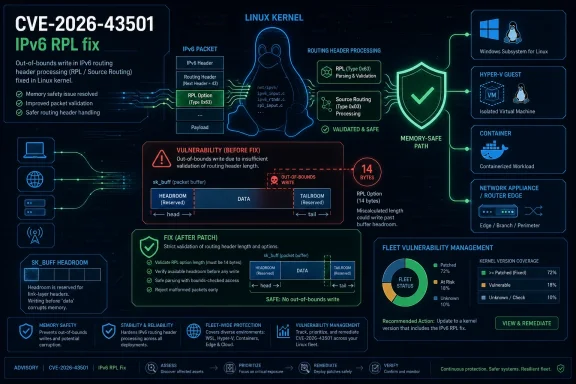 A Kernel Corner Case Becomes a Fleet-Management Problem
The vulnerability sits in the Linux kernel’s IPv6 RPL handling, specifically in the path that processes an RFC 6554 Source Routing Header. RPL, short for Routing Protocol for Low-Power and Lossy Networks, is not the sort of feature most desktop users knowingly enable. It is more commonly associated with constrained networks, sensor-style deployments, and specialized IPv6 routing scenarios.That obscurity is exactly why this kind of bug can be awkward for defenders. The systems most exposed to unusual IPv6 packet paths are often not the laptops people patch first, but the embedded gateways, edge boxes, virtual appliances, and general-purpose Linux servers that have accumulated network roles over time. A feature can be rarely used and still reachable enough to deserve attention.
The CVE description says the issue was resolved by changing how the kernel reserves headroom when a decompressed and recompressed Source Routing Header grows. In plain English, the kernel was rewriting packet metadata and data structures under an assumption about available space. Under a crafted packet shape, that assumption breaks.
The reported failure mode is concrete: a crafted IPv6 raw packet over the loopback interface can drive the packet buffer into a state where rebuilding the MAC header causes a small out-of-bounds write far away from where the kernel intended to write. KASAN, the kernel address sanitizer used to catch memory bugs, reportedly flags a 14-byte out-of-bounds write in the IPv6 routing header receive path.
That is not the same thing as a public weaponized exploit. But in kernel security, a reproducible out-of-bounds write is not a bookkeeping mistake. It is the kind of primitive that forces maintainers, distribution vendors, and security teams to treat the affected code as potentially dangerous until proven otherwise.
The Bug Is About Headroom, but the Lesson Is About Assumptions
Linux networking is built around thesk_buff, or socket buffer, a structure that carries packet data and metadata through the stack. Network code often needs to push and pull headers as packets move between layers, tunnels, routing logic, and transformations. That machinery depends on there being enough space before and after packet data to adjust headers safely.CVE-2026-43501 is a failure in that accounting. The vulnerable path decompresses a Source Routing Header, swaps the next segment into the IPv6 destination address, recompresses the routing header, then removes the old header and pushes the new one back with the IPv6 header. The recompressed result can be larger than the original header.
That detail is the trap. Compression sounds like it should reduce size, but this code is not compressing an arbitrary file; it is encoding IPv6 address segments relative to shared prefixes. When the swap changes how much prefix is common between the destination and segment addresses, the recompressed routing header can grow. The description gives a maximum growth case of eight bytes.
Eight bytes is small enough to look harmless and large enough to break a kernel invariant. The prior expansion check was gated on
segments_left == 0, which meant earlier segments could consume headroom without ensuring enough room remained for the MAC header rebuild. Once the front of the buffer had less room than skb->mac_len, a negative offset stored into a 16-bit field could wrap, and a later memory move could land roughly 64KiB away from the intended buffer head.This is the kind of vulnerability that makes kernel engineers sound superstitious about “just a few bytes.” In userspace, an eight-byte miscalculation may crash a process. In kernel packet handling, it can corrupt memory in a privileged context reached by input data.
The Reproducer Matters More Than the Acronym Soup
The CVE text includes a highly specific reproducer condition: anAF_INET6 raw socket using IPV6_HDRINCL, a two-segment type-3 Source Routing Header, and compression values that trigger the bad growth pattern. That specificity cuts both ways.On one hand, it suggests the issue is not a generic “any IPv6 packet from anywhere owns the machine” bug. Raw sockets, loopback delivery, routing header details, and kernel configuration all matter. The path described is technical and narrow.
On the other hand, the presence of a simple local reproducer means defenders should not dismiss this as purely theoretical. A local user or process able to create the necessary packet shape may be able to trigger kernel memory corruption. In containerized or virtualized environments, raw socket permissions, network namespace exposure, and capability boundaries become part of the real risk calculation.
That is especially relevant in mixed Windows and Linux estates. A Windows admin may not think of IPv6 RPL as part of their patch routine, but they may still operate Linux build runners, Kubernetes nodes, WSL-backed developer environments, security appliances, or Hyper-V guests. The vulnerable code path lives below the application layer where inventory tools are often weakest.
The most responsible reading today is cautious rather than theatrical. This is a kernel memory-safety bug with a fix available in stable kernel commits, recently published as a CVE, and not yet scored by NVD at the time of publication. That means teams should track patches and exposure, not wait for a single magic number to tell them whether it matters.
NVD’s Missing Score Is Not a Missing Risk
The NVD entry for CVE-2026-43501 currently lists no NIST-provided CVSS v4.0, v3.x, or v2 score. That absence will be misread in some dashboards as ambiguity, and in some organizations ambiguity becomes delay. But “not yet scored” is not the same as “low severity.”This is becoming a familiar problem. NIST has been adjusting how NVD enrichment works because CVE volume has grown faster than traditional manual analysis can comfortably absorb. More records now arrive before full downstream metadata is ready, leaving security teams with a description, references, and little else.
For a practical defender, the vendor and upstream context matter. The source here is kernel.org, and the references point to stable kernel commits. That means the vulnerability has been accepted by the Linux kernel security process as a real defect with a concrete fix, not merely a speculative third-party report.
Third-party vulnerability databases may assign their own provisional severity. Those scores can be useful as triage hints, but they should not override local context. A kernel out-of-bounds write reachable only under constrained local conditions has a different operational meaning on a locked-down server than on a multi-tenant build host with permissive container networking.
The uncomfortable truth is that NVD’s delay exposes a weakness in many patch programs. Too many workflows are built around severity ingestion rather than evidence evaluation. CVE-2026-43501 is a reminder that the first serious triage step is not “what color did the dashboard turn?” but “which of our systems run affected kernels, expose the relevant functionality, and grant the privileges needed to trigger the path?”
The Fix Is Small Because the Broken Invariant Was Precise
The proposed remedy is conceptually straightforward: expand the packet head whenever the remaining room is less than the push size plusmac_len, and request enough extra room so the rebuilt MAC header fits afterward. In other words, make the buffer accounting match the worst case rather than the expected case.That is the right kind of kernel fix. It does not try to ban a strange packet shape after the fact. It repairs the invariant that packet transformation code depends on: before pushing headers and rebuilding metadata, reserve enough room for both the new header and the link-layer header bookkeeping.
Small patches in packet-handling code can have outsized security significance. The bug is not that Linux supports RPL. The bug is that the stack allowed a legal-ish transformation path to proceed while silently eroding the headroom required by later code.
This distinction matters for administrators reading advisories. The fix is likely to appear as part of ordinary kernel updates from distributions rather than as a toggle users can safely manage themselves. Disabling IPv6 outright is a blunt instrument that may break modern networks, cloud services, and Windows-adjacent management assumptions. Updating the kernel is the clean answer.
The catch is timing. Upstream stable commits are not the same thing as an installed package on your fleet. Distribution maintainers need to backport, test, publish, and annotate updates. Appliance vendors may take longer. Cloud images and containers may lag behind base operating system repositories.
Windows Shops Still Own the Linux Underlay
For WindowsForum readers, the easy mistake is to file this under “not my platform.” That may be true for a standalone Windows 11 desktop. It is less true for the infrastructure surrounding almost any serious Windows deployment.Active Directory environments increasingly rely on Linux-based monitoring, backup, CI/CD, VPN, reverse proxy, storage, and observability components. Windows developers run Linux kernels through WSL 2. Enterprises run Linux guests on Hyper-V and Azure. Security products and network appliances often hide Linux behind a browser UI and a vendor logo.
That blended reality changes how CVEs should be consumed. A vulnerability in the Linux IPv6 stack may not require emergency action on every Windows endpoint, but it can still affect the systems that authenticate, route, inspect, build, or protect those endpoints. In 2026, platform boundaries are administrative conveniences, not security boundaries.
WSL deserves a careful note. WSL 2 uses a Microsoft-provided Linux kernel, and its exposure model is not identical to a normal LAN-facing Linux server. The CVE’s described reproducer involves raw IPv6 packet construction and loopback behavior, so the practical exploitability inside WSL will depend on kernel version, privileges, namespace behavior, and Microsoft’s servicing path. It should be tracked, not assumed.
The same logic applies to containers. Containers share the host kernel, so a kernel networking bug is not contained by the presence of a container boundary. Whether an unprivileged container can trigger this particular path depends on capabilities such as raw socket access and the host’s network namespace configuration. But the general rule remains: if the bug is in the kernel, container patching means host patching.
IPv6 Is No Longer Optional Enough to Ignore
Security teams have spent years treating IPv6 as either a future problem or a nuisance to disable. That posture is harder to defend now. IPv6 is present by default in major operating systems, used by cloud providers, required in some environments, and embedded into modern network stacks even where administrators think they run “IPv4-only” networks.CVE-2026-43501 is not an indictment of IPv6 as a protocol. It is an example of what happens when complex optional protocol machinery remains compiled, reachable, and insufficiently exercised by ordinary production traffic. Edge-case packet paths can sit quietly until a sanitizer, fuzzer, researcher, or production crash walks into them.
RPL and Source Routing Headers are especially good at producing administrator unease because they sound like features attackers would love. Source routing has a long security history, and many networks restrict or drop routing headers for good reasons. But the kernel still has to parse what it receives under supported configurations, and local packet paths may bypass the intuition administrators have about perimeter filtering.
The operational takeaway is not to panic about every IPv6 extension header. It is to treat IPv6 posture as something that belongs in asset management. Which systems have IPv6 enabled? Which kernels are running? Which hosts allow raw sockets? Which workloads have elevated network capabilities? Those answers matter more than a generic statement that “we do not use RPL.”
A surprising number of organizations cannot answer those questions quickly. That is where bugs like this become disruptive. The patch may be simple, but proving exposure across servers, developer machines, appliances, and cloud nodes is rarely simple.
The Vulnerability Industry Still Rewards the Wrong Reflex
CVE publication has become both more useful and more misleading. It gives defenders a shared handle, but the handle often arrives before the context. CVE-2026-43501 has a detailed technical description and stable kernel references, yet the most visible public scoring field remains empty in NVD.That combination punishes teams that have outsourced judgment to scanners. A scanner may flag the CVE without knowing whether the running kernel has a backported fix. Another may ignore it until a severity score appears. A third may assign a third-party score that conflicts with a vendor advisory later.
Linux kernel patching makes this worse because version numbers lie by omission. Enterprise distributions routinely backport fixes without changing to the newest upstream kernel version. A system may report an older kernel series and still contain the fix, or it may report a familiar distribution release and lack the relevant vendor package.
The only durable approach is to connect three layers: upstream commits, vendor advisories, and installed package metadata. That is not glamorous work, but it is what separates vulnerability management from vulnerability theater. The CVE tells you what class of bug exists. Your distribution tells you how it is fixed for your supported kernel. Your inventory tells you whether the fix is actually deployed.
This is where Windows-heavy organizations often underinvest. They have mature Microsoft patch telemetry but weaker visibility into Linux kernels running under infrastructure services. The result is a split-brain security program: excellent Patch Tuesday discipline on endpoints, uneven hygiene on the systems that route traffic and run automation.
Patch Priority Belongs to Exposure, Not Drama
CVE-2026-43501 should not be treated like a remote worm until evidence says so. The described path is specific, the public record does not yet establish broad unauthenticated remote exploitation, and NVD has not provided a formal score. Overstating the bug helps nobody.But minimizing it because it involves RPL is equally lazy. Kernel memory corruption is a serious class, and the existence of a local raw-socket reproducer gives security teams a concrete reason to evaluate privilege boundaries. Multi-user Linux systems, build hosts, research boxes, container hosts, and appliances deserve earlier attention than isolated desktops with little untrusted local code.
The best patch priority is therefore tiered. Internet-facing Linux routers, gateways, and appliances should be checked quickly if they run kernels with the affected code. Multi-tenant or semi-trusted Linux hosts should follow. Single-purpose servers with tight local access controls can be patched on the next controlled maintenance window, assuming no vendor advisory raises the severity.
For Windows administrators, the question is not whether to drop everything. It is whether your patch process even knows where Linux kernels are hiding. If the answer is “inside someone else’s appliance,” then the next question is whether that vendor has acknowledged the CVE and shipped an update.
The Practical Read for Mixed Windows and Linux Estates
The most useful response is boring, specific, and documented. Treat CVE-2026-43501 as a kernel networking fix that needs normal but deliberate handling, not as an abstract CVE feed item waiting for a score.- Inventory Linux kernels on servers, appliances, cloud instances, Hyper-V guests, WSL environments, and container hosts that support Windows-facing services.
- Check distribution and vendor advisories rather than relying only on upstream kernel version strings, because many supported Linux platforms backport fixes.
- Prioritize systems that allow untrusted local users, raw socket creation, privileged containers, or unusual IPv6 routing behavior.
- Do not assume that disabling an application or patching a container image fixes a host-kernel networking vulnerability.
- Track NVD scoring when it arrives, but do not let the absence of a score block remediation planning for affected systems.
- Record whether a system is fixed, not merely whether a scanner stopped reporting the CVE.
References
- Primary source: NVD / Linux Kernel
Published: 2026-05-22T01:01:55-07:00
NVD - CVE-2026-43501
 nvd.nist.gov
- Security advisory: MSRC
Published: 2026-05-22T01:01:55-07:00
Original feed URL
Security Update Guide - Microsoft Security Response Center
 msrc.microsoft.com
- Official source: nist.gov
National Vulnerability Database
NIST maintains the National Vulnerability Database (NVD), a repository of information on software and hardware flaws that can compromise computer security. This is a key piece of the nation’s cybersecurity infrastructure.www.nist.gov - Related coverage: rapid7.com
Rapid7 Vulnerability Database
Rapid7's VulnDB is curated repository of vetted computer software exploits and exploitable vulnerabilities.www.rapid7.com - Related coverage: linux.oracle.com

