

CVE-2026-43968 is a medium-severity CRLF injection flaw disclosed in May 2026 in ninenines cowlib, where the Erlang library’s Server-Sent Events encoder can let attacker-controlled carriage returns split one intended event into additional forged events for downstream SSE clients. The bug is not a Windows vulnerability in the ordinary Patch Tuesday sense, but it matters to WindowsForum readers because modern Windows estates are full of web front ends, dashboards, automation portals, developer tools, and cloud services that consume open-source libraries far outside the operating system. Its lesson is familiar and uncomfortable: the dangerous character was not exotic, the protocol was not obscure, and the trust boundary was probably assumed rather than enforced.
The vulnerability sits in the gap between how cowlib built Server-Sent Events and how SSE clients are required to parse them. In affected versions,
That sounds like a fussy standards-compliance issue until you remember what SSE is designed to do. It is a simple, long-lived HTTP stream that lets a server push messages to a browser or client without the ceremony of WebSockets. Each message is text, each field is line-based, and a blank line dispatches the event.
If an attacker can smuggle a line terminator into a field that the server thought was a harmless value, they may be able to end the current line and start a new one. From there, the attacker is not merely altering a string. They are shaping the event stream the client believes came from the server.
That is why the phrase event splitting is more useful than the generic “CRLF injection” label. The attacker’s prize is not a malformed response for its own sake. The prize is control over how the receiving client divides, names, and dispatches events.
That is good maintenance. It is also a reminder that protocol encoders are security-sensitive code, even when they do not parse passwords, tokens, or SQL. Anything that converts structured application state into a wire format is deciding where one unit of meaning ends and another begins.
The CVSS ratings land in the medium range: 6.3 under CVSS 4.0 from the assigning authority, and 4.0 under NVD’s CVSS 3.1 analysis. That will tempt some teams to ignore it, especially if their dashboards are already overloaded with critical remote-code-execution bugs and actively exploited edge-device flaws. But a medium score can still be a real production risk when the affected code sits on a user-facing stream and accepts attacker-influenced content.
Security scores compress context. This bug’s severity depends heavily on whether an application passes user-controlled values into SSE fields, whether clients dispatch on
But line-oriented protocols have a long memory of injection bugs. Email headers, HTTP headers, logs, Redis-like command streams, and countless internal text formats all share the same failure mode: once a delimiter can be attacker-controlled, data starts masquerading as structure. The cowlib issue is a modern Erlang-flavored instance of a very old family of mistakes.
The distinction between
Windows administrators should feel a little déjà vu here. Windows line endings historically use CRLF, Unix systems commonly use LF, and web protocols have their own strict or permissive rules depending on context. Cross-platform software lives in that messy middle, where assumptions about “a newline” are easy to make and hard to audit.
Yet the risk may still appear inside Microsoft-heavy environments. Enterprises that standardize on Windows clients and servers increasingly deploy Linux containers, Erlang or Elixir services, reverse proxies, internal web dashboards, CI systems, and observability tools. The dependency graph does not respect the boundary between “Microsoft stack” and “open source stack” the way procurement diagrams do.
For sysadmins, the practical question is not whether cowlib ships in Windows. It is whether any service your organization runs uses cowlib directly or through Cowboy, whether that service exposes SSE endpoints, and whether user-controlled data flows into the event fields. That takes software inventory and application knowledge, not just operating-system patch compliance.
This is where SBOMs, dependency scanning, and runtime ownership become less theoretical. A vulnerability in a relatively small Erlang library can be irrelevant to a desktop fleet and material to the internal admin portal that hundreds of employees keep open all day. Asset management that stops at installed Windows updates will miss that class of exposure.
But the more interesting risk is broader. SSE clients often use event names as control signals. One event might update a notification count, another might mark a background job as complete, another might deliver a privileged status change to a management console. If a malicious value can become a new event, the attacker may be able to influence state transitions rather than merely display text.
This is why “stored-XSS-equivalent” is a useful but incomplete phrase. Some applications do not insert event data into the DOM at all. They route it, deserialize it, or use it to trigger client-side behaviors. In those systems, forged events may attack business logic, not HTML.
The precondition is still important. The application must pass user-controlled content into
That is not a free pass. “Trusted” has a way of eroding over time. A field that started as an internal status string becomes a customer-visible label; a comment field becomes a debugging note; a notification body starts accepting markdown; a username or project name flows into an event for convenience. Injection bugs thrive in those quiet product evolutions.
The vulnerable behavior arose from inconsistent normalization. Some fields rejected
That mismatch is a common source of security bugs in web infrastructure. A proxy and an origin disagree about header parsing. A sanitizer and a browser disagree about HTML recovery. A firewall and an application disagree about URL decoding. Here, an SSE encoder and an SSE decoder disagree about line termination.
The defensive rule is simple to state and tedious to implement: normalize and validate according to the receiving parser’s rules, not according to the developer’s intuition. If the receiving client will treat a byte as syntax, the sending server must not let attacker-controlled data contain that byte unescaped or unframed.
But patching the library does not answer the more durable question: where else does the application rely on line-oriented output formats while accepting user-controlled data? If a team treats this only as a cowlib ticket, it will miss the chance to harden an entire class of event-stream, header, and log-generation code.
The workaround is equally revealing. The advisory recommends rejecting or stripping carriage returns and line feeds from user-controlled SSE field values, or ensuring those values are derived only from trusted application-controlled data. That is not glamorous, but it is exactly the sort of rule that belongs near the boundary where application data becomes protocol text.
For WindowsForum’s IT audience, the operational playbook is not to panic. It is to ask better inventory questions. Which services expose SSE endpoints? Which ones are written in Erlang or Elixir? Which ones depend on Cowboy or cowlib? Which events include user-generated names, messages, labels, comments, or descriptions? Which clients dispatch privileged behavior based on event type?
Those questions should be answerable before a CVE drops. In many organizations, they are not.
Internal automation deserves equal attention. SSE is often used in developer platforms and administrative tools because it is ideal for streaming progress logs, build updates, deployment status, and live monitoring messages. These are precisely the places where users may control project names, branch names, commit messages, ticket titles, host labels, or free-form comments.
A forged “success” event in a toy app is harmless. A forged event in a deployment dashboard, approval workflow, or incident console is a different matter. Even if server-side authorization remains intact, client-side confusion can waste operator time, conceal failure, or induce someone to take an action based on a false state.
Security teams sometimes dismiss client-side logic attacks because “the server is the source of truth.” That is true in architecture diagrams and less true in human operations. Dashboards are decision engines. If an attacker can make a trusted interface lie convincingly, they can move the incident from code into process.
That is exactly why it is worth writing about. Mature security programs are not defined only by how they respond to critical alerts. They are defined by whether they can close medium-severity bugs that sit in real trust boundaries before those bugs become incident details.
The problem is prioritization. A dependency scanner may flag cowlib, but it cannot always know whether the vulnerable function is reachable or whether untrusted input reaches the relevant fields. An application team may know the data flow but not the CVE. An infrastructure team may own the container image but not the Erlang dependency. The risk sits between teams.
This is where organizations need a better middle gear. Not every medium CVE deserves a war room, but not every medium CVE deserves a quarterly patch window either. Bugs affecting protocol serialization, authentication flows, authorization decisions, or administrative interfaces deserve faster triage because their impact is shaped by business context.
That shift changes the job of Windows administration. The old patch-management model was already difficult; the new one is more distributed. A fleet can be fully current on Windows cumulative updates while still running a vulnerable open-source package inside a container on a Windows-hosted development box or an Azure workload.
This does not make Windows less important. It makes Windows part of a larger operational fabric. Defender, Intune, Azure Arc, GitHub Advanced Security, package registries, and CI/CD controls all become pieces of the same risk-management story. The admin who can connect endpoint posture to application dependency posture is the admin who will catch bugs like this before they become mysteries.
It also means vulnerability communication must be precise. Calling this a Microsoft bug would be wrong. Ignoring it because it is not a Microsoft bug would also be wrong. The right framing is that Microsoft-heavy environments are just as exposed to open-source application-layer flaws as anyone else when they run the affected software patterns.
SSE endpoints are a good starting point because they are easy to overlook. They often sit behind authenticated dashboards rather than public marketing pages, and they may not receive the same scrutiny as REST endpoints. Yet they are long-lived, trusted, and wired directly into user interfaces.
Development teams should also inspect any code that builds line-based messages manually. Logs, multipart boundaries, email content, cache commands, reverse-proxy headers, and custom streaming formats all deserve suspicion when delimiters can be influenced by users. The recurring pattern is not Erlang-specific.
The lesson is not “never use SSE.” SSE remains a perfectly reasonable tool. The lesson is that simple protocols still need exact encoders, and exact encoders need tests for the boring characters everyone thinks they already handled.
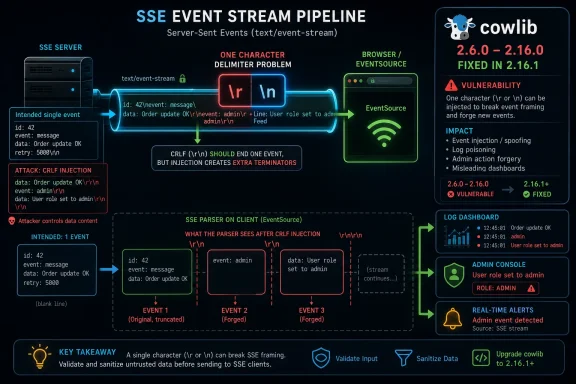 A One-Character Bug With a Protocol-Sized Blast Radius
The vulnerability sits in the gap between how cowlib built Server-Sent Events and how SSE clients are required to parse them. In affected versions, cow_sse:event/1 checked the id and event fields for line feed characters, but not for a bare carriage return. The helper used for data and comment fields similarly split only on line feeds, even though SSE parsing treats carriage return, line feed, and CRLF as line terminators.That sounds like a fussy standards-compliance issue until you remember what SSE is designed to do. It is a simple, long-lived HTTP stream that lets a server push messages to a browser or client without the ceremony of WebSockets. Each message is text, each field is line-based, and a blank line dispatches the event.
If an attacker can smuggle a line terminator into a field that the server thought was a harmless value, they may be able to end the current line and start a new one. From there, the attacker is not merely altering a string. They are shaping the event stream the client believes came from the server.
That is why the phrase event splitting is more useful than the generic “CRLF injection” label. The attacker’s prize is not a malformed response for its own sake. The prize is control over how the receiving client divides, names, and dispatches events.
The Patch Tells the Story Better Than the Score
The fix is almost comically small, which is often how these bugs look in hindsight. The cowlib patch changed the relevant checks and splits so that\r\n, \r, and \n are all treated as line separators where the SSE specification says they should be. It also added tests covering newline and carriage-return cases, converting the bug from a tacit assumption into executable proof.That is good maintenance. It is also a reminder that protocol encoders are security-sensitive code, even when they do not parse passwords, tokens, or SQL. Anything that converts structured application state into a wire format is deciding where one unit of meaning ends and another begins.
The CVSS ratings land in the medium range: 6.3 under CVSS 4.0 from the assigning authority, and 4.0 under NVD’s CVSS 3.1 analysis. That will tempt some teams to ignore it, especially if their dashboards are already overloaded with critical remote-code-execution bugs and actively exploited edge-device flaws. But a medium score can still be a real production risk when the affected code sits on a user-facing stream and accepts attacker-influenced content.
Security scores compress context. This bug’s severity depends heavily on whether an application passes user-controlled values into SSE fields, whether clients dispatch on
event.type, and whether event.data is later inserted into the DOM or trusted by application logic. In one deployment, it may be inert. In another, it may become a stored-XSS-equivalent workflow bypass hiding behind an innocuous dependency update.SSE’s Simplicity Is Also Its Trap
Server-Sent Events became popular because they are boring in the best possible way. They ride over HTTP, work naturally with browsers throughEventSource, and are easy to reason about for one-way streams such as notifications, job progress, chat updates, telemetry, and administrative dashboards. Compared with WebSockets, SSE often looks like the conservative choice.But line-oriented protocols have a long memory of injection bugs. Email headers, HTTP headers, logs, Redis-like command streams, and countless internal text formats all share the same failure mode: once a delimiter can be attacker-controlled, data starts masquerading as structure. The cowlib issue is a modern Erlang-flavored instance of a very old family of mistakes.
The distinction between
\n and \r is especially treacherous because developers often think of newline as one thing. Many languages, frameworks, and editors smooth over the difference. Protocols do not always have that luxury. When the receiver treats several byte sequences as equivalent terminators, the sender must neutralize all of them, not just the one most common on the developer’s workstation.Windows administrators should feel a little déjà vu here. Windows line endings historically use CRLF, Unix systems commonly use LF, and web protocols have their own strict or permissive rules depending on context. Cross-platform software lives in that messy middle, where assumptions about “a newline” are easy to make and hard to audit.
This Is Not Microsoft’s Bug, But Microsoft Shops Still Own the Risk
The user-submitted source points to Microsoft’s Security Response Center page, but the vulnerability itself is in cowlib, part of the Erlang ecosystem. That distinction matters. This is not a Windows kernel flaw, not an Exchange Server zero-day, and not something Windows Update will necessarily remediate across a fleet.Yet the risk may still appear inside Microsoft-heavy environments. Enterprises that standardize on Windows clients and servers increasingly deploy Linux containers, Erlang or Elixir services, reverse proxies, internal web dashboards, CI systems, and observability tools. The dependency graph does not respect the boundary between “Microsoft stack” and “open source stack” the way procurement diagrams do.
For sysadmins, the practical question is not whether cowlib ships in Windows. It is whether any service your organization runs uses cowlib directly or through Cowboy, whether that service exposes SSE endpoints, and whether user-controlled data flows into the event fields. That takes software inventory and application knowledge, not just operating-system patch compliance.
This is where SBOMs, dependency scanning, and runtime ownership become less theoretical. A vulnerability in a relatively small Erlang library can be irrelevant to a desktop fleet and material to the internal admin portal that hundreds of employees keep open all day. Asset management that stops at installed Windows updates will miss that class of exposure.
Event Splitting Is a Logic Attack Before It Is a Browser Attack
The advisory mentions browserEventSource clients and DOM insertion because that is the easiest risk to picture. A forged event arrives, application JavaScript receives an unexpected event.type or event.data, and unsafe rendering turns the forged payload into script execution or UI manipulation. That is serious enough.But the more interesting risk is broader. SSE clients often use event names as control signals. One event might update a notification count, another might mark a background job as complete, another might deliver a privileged status change to a management console. If a malicious value can become a new event, the attacker may be able to influence state transitions rather than merely display text.
This is why “stored-XSS-equivalent” is a useful but incomplete phrase. Some applications do not insert event data into the DOM at all. They route it, deserialize it, or use it to trigger client-side behaviors. In those systems, forged events may attack business logic, not HTML.
The precondition is still important. The application must pass user-controlled content into
id, event, data, or comment fields, either directly through cow_sse:event/1 or through a higher-level wrapper such as Cowboy streaming helpers. Applications that build SSE messages only from trusted, application-controlled values are not affected in the same way.That is not a free pass. “Trusted” has a way of eroding over time. A field that started as an internal status string becomes a customer-visible label; a comment field becomes a debugging note; a notification body starts accepting markdown; a username or project name flows into an event for convenience. Injection bugs thrive in those quiet product evolutions.
The Real Boundary Is Between Bytes and Meaning
Most secure-coding guidance tells developers to validate input and encode output. Correct, but too generic. CVE-2026-43968 shows that the output encoder itself must understand the grammar it is producing. If it emits SSE, it must honor SSE’s line model, not a simplified local approximation of it.The vulnerable behavior arose from inconsistent normalization. Some fields rejected
\n; one helper split on \n; but the protocol says clients interpret \r\n, \r, and \n as line endings. The attacker lives in the mismatch between the sender’s narrower model and the receiver’s broader model.That mismatch is a common source of security bugs in web infrastructure. A proxy and an origin disagree about header parsing. A sanitizer and a browser disagree about HTML recovery. A firewall and an application disagree about URL decoding. Here, an SSE encoder and an SSE decoder disagree about line termination.
The defensive rule is simple to state and tedious to implement: normalize and validate according to the receiving parser’s rules, not according to the developer’s intuition. If the receiving client will treat a byte as syntax, the sending server must not let attacker-controlled data contain that byte unescaped or unframed.
Dependency Updates Are the Boring Part; Data-Flow Review Is the Hard Part
The fixed cowlib version is 2.16.1, and affected semver releases begin at 2.6.0. Updating is the obvious first move. For teams using Hex, Renovate, Dependabot-like workflows, or internal dependency mirrors, this should be a straightforward library bump once compatibility is confirmed.But patching the library does not answer the more durable question: where else does the application rely on line-oriented output formats while accepting user-controlled data? If a team treats this only as a cowlib ticket, it will miss the chance to harden an entire class of event-stream, header, and log-generation code.
The workaround is equally revealing. The advisory recommends rejecting or stripping carriage returns and line feeds from user-controlled SSE field values, or ensuring those values are derived only from trusted application-controlled data. That is not glamorous, but it is exactly the sort of rule that belongs near the boundary where application data becomes protocol text.
For WindowsForum’s IT audience, the operational playbook is not to panic. It is to ask better inventory questions. Which services expose SSE endpoints? Which ones are written in Erlang or Elixir? Which ones depend on Cowboy or cowlib? Which events include user-generated names, messages, labels, comments, or descriptions? Which clients dispatch privileged behavior based on event type?
Those questions should be answerable before a CVE drops. In many organizations, they are not.
The Browser Makes the Impact Visible, but Automation May Make It Worse
The classic web-security framing centers on the browser because browsers are whereEventSource is standardized and where DOM insertion can go badly wrong. A maliciously split event could become a fake message, a fake update, or a payload that lands in unsafe rendering code. That is the scenario most teams will test first.Internal automation deserves equal attention. SSE is often used in developer platforms and administrative tools because it is ideal for streaming progress logs, build updates, deployment status, and live monitoring messages. These are precisely the places where users may control project names, branch names, commit messages, ticket titles, host labels, or free-form comments.
A forged “success” event in a toy app is harmless. A forged event in a deployment dashboard, approval workflow, or incident console is a different matter. Even if server-side authorization remains intact, client-side confusion can waste operator time, conceal failure, or induce someone to take an action based on a false state.
Security teams sometimes dismiss client-side logic attacks because “the server is the source of truth.” That is true in architecture diagrams and less true in human operations. Dashboards are decision engines. If an attacker can make a trusted interface lie convincingly, they can move the incident from code into process.
Medium Severity Is Where Backlogs Go to Die
The uncomfortable part of CVE-2026-43968 is that it looks like backlog material. It is medium severity. It requires a particular data flow. It affects a library that many Windows administrators will not recognize by name. It is not, based on available public information, an actively exploited internet-wide emergency.That is exactly why it is worth writing about. Mature security programs are not defined only by how they respond to critical alerts. They are defined by whether they can close medium-severity bugs that sit in real trust boundaries before those bugs become incident details.
The problem is prioritization. A dependency scanner may flag cowlib, but it cannot always know whether the vulnerable function is reachable or whether untrusted input reaches the relevant fields. An application team may know the data flow but not the CVE. An infrastructure team may own the container image but not the Erlang dependency. The risk sits between teams.
This is where organizations need a better middle gear. Not every medium CVE deserves a war room, but not every medium CVE deserves a quarterly patch window either. Bugs affecting protocol serialization, authentication flows, authorization decisions, or administrative interfaces deserve faster triage because their impact is shaped by business context.
The Microsoft Angle Is the Ecosystem Angle
Microsoft’s presence here is mostly as a vulnerability-indexing and security-guidance surface, not as the owner of the flawed code. That is still significant. The modern Microsoft ecosystem is not a monoculture of Windows binaries serviced by Windows Update. It is GitHub, Azure, containers, Linux workloads, open-source packages, identity integrations, developer platforms, and third-party services stitched into Windows-centered businesses.That shift changes the job of Windows administration. The old patch-management model was already difficult; the new one is more distributed. A fleet can be fully current on Windows cumulative updates while still running a vulnerable open-source package inside a container on a Windows-hosted development box or an Azure workload.
This does not make Windows less important. It makes Windows part of a larger operational fabric. Defender, Intune, Azure Arc, GitHub Advanced Security, package registries, and CI/CD controls all become pieces of the same risk-management story. The admin who can connect endpoint posture to application dependency posture is the admin who will catch bugs like this before they become mysteries.
It also means vulnerability communication must be precise. Calling this a Microsoft bug would be wrong. Ignoring it because it is not a Microsoft bug would also be wrong. The right framing is that Microsoft-heavy environments are just as exposed to open-source application-layer flaws as anyone else when they run the affected software patterns.
The Small Fix That Should Trigger a Larger Audit
The cowlib patch did the immediate job: align event construction with the SSE specification and add tests around the dangerous line endings. That is the visible repair. The more valuable internal response is to use this CVE as a prompt to review how applications construct protocol text from user-controlled values.SSE endpoints are a good starting point because they are easy to overlook. They often sit behind authenticated dashboards rather than public marketing pages, and they may not receive the same scrutiny as REST endpoints. Yet they are long-lived, trusted, and wired directly into user interfaces.
Development teams should also inspect any code that builds line-based messages manually. Logs, multipart boundaries, email content, cache commands, reverse-proxy headers, and custom streaming formats all deserve suspicion when delimiters can be influenced by users. The recurring pattern is not Erlang-specific.
The lesson is not “never use SSE.” SSE remains a perfectly reasonable tool. The lesson is that simple protocols still need exact encoders, and exact encoders need tests for the boring characters everyone thinks they already handled.
The Practical Reading of CVE-2026-43968 for WindowsForum Readers
The useful response is narrower than alarm and broader than a dependency bump. Treat this as a targeted application-security check for services that use Erlang, Elixir, Cowboy, cowlib, or SSE streams, especially where browser clients or admin dashboards react to event names and payloads.- Organizations running cowlib versions from 2.6.0 before 2.16.1 should plan an update to 2.16.1 or later after normal compatibility testing.
- Teams should identify SSE endpoints that pass usernames, project names, messages, comments, labels, or other user-controlled content into event fields.
- Developers should reject or strip carriage returns and line feeds from user-controlled SSE field values when those values are not meant to contain protocol structure.
- Security reviewers should test event-stream clients for unsafe assumptions about
event.typeand unsafe rendering ofevent.data. - Administrators should not expect Windows Update alone to resolve this class of exposure, because the vulnerable component is an application dependency rather than a Windows component.
- Dependency alerts for medium-severity protocol-encoding bugs should be triaged with application context, not dismissed solely because the score is below critical.
References
- Primary source: MSRC
Published: 2026-05-26T01:38:33-07:00
Security Update Guide - Microsoft Security Response Center
 msrc.microsoft.com
