

Microsoft classifies CVE-2026-45471 as a Microsoft Word remote code execution vulnerability even though its CVSS attack vector is local, because “remote” describes where the attacker may be sitting, while AV:L describes where the vulnerable code must actually be triggered: on the victim’s machine. That distinction is not pedantry; it is the difference between exploit mechanics and attacker geography. In Office vulnerabilities, the attacker often sends a document from elsewhere, but the dangerous parsing, rendering, or execution path happens inside Word after a user or preview handler touches the file.
The confusing phrase is “remote code execution,” a term that has accumulated more operational meaning than linguistic precision. To many administrators, RCE sounds like a packet crossing the network, striking a listening service, and instantly running code without anyone opening anything. That is one form of RCE, but it is not the only one Microsoft labels that way.
In the Word case, the important outcome is that attacker-controlled code may run on a target system. The initial delivery can be remote — an email attachment, a Teams message, a download link, a file share, or some other lure — but the exploitation path still depends on local processing by Microsoft Word or a related Office component.
That is why the CVSS vector can say AV:L without contradicting the title. CVSS is scoring the condition required to exploit the vulnerable component. If the victim’s machine must open, preview, or otherwise process malicious content locally, the attack vector is local even when the attacker is across the internet.
This is also why Microsoft’s own guidance often says the term “remote” refers to the attacker’s location. In plain English, the adversary does not need to be physically present at the keyboard. In CVSS English, however, the vulnerable action is not reached over a network protocol by directly sending packets to Word as a server.
That complexity creates a familiar attack model. The adversary prepares a malicious document and persuades the victim, or some automated local component, to process it. The exploit does not need the attacker to log into the machine, but it does need the target system to do something with the file.
This is the source of the apparent contradiction. The malicious file can arrive from a remote attacker, but once it lands, the vulnerable operation is local. The exploit is not “remote” in the same sense as a wormable SMB flaw, an exposed web service bug, or an unauthenticated RPC vulnerability.
The better phrase would often be arbitrary code execution via malicious local file processing. That is more precise, but it is also clumsy, unfamiliar to patch dashboards, and less immediately meaningful to broad security audiences. So the industry continues to use RCE as a shorthand for the consequence: attacker code runs where it should not.
For Office bugs, AV:L is common when the exploit depends on a document being opened or rendered on the target machine. The attacker may be remote, anonymous, and nowhere near the device, but CVSS still sees the exploit as local because the vulnerable code path runs after the malicious content is handled locally.
That sounds counterintuitive until you separate delivery from execution. Email delivery is remote. Browser download is remote. A file share can be remote. But Word’s parsing of the document happens in the user’s session, on the user’s machine, under the privileges available to that process.
CVSS tries to make those distinctions machine-readable. Security titles try to make risks human-readable. CVE-2026-45471 sits directly in the gap between those two languages.
The attacker does not need VPN credentials, physical access, or an existing foothold if the social-engineering path works. They need a plausible lure, a vulnerable Office build, and a user or workflow that causes the document to be processed. In many environments, that is not a rare alignment of stars; it is Tuesday morning.
The operational risk also depends on what happens after code execution. If Word runs with the user’s privileges, the attacker may gain the same access the user has: local files, network shares, cached tokens, browser session artifacts, and line-of-business data reachable from that account. In a flat network or a permissive identity environment, “just the user’s rights” can still be a serious breach.
That is why RCE remains a high-signal phrase even when AV:L appears in the CVSS string. It tells defenders the payload can cross from malformed content into code execution. The local vector tells them how that crossing is likely triggered.
Attackers exploit that expectation. A malicious invoice, résumé, legal notice, shipping document, or HR form is not exotic. It is ordinary business theater with exploit code behind the curtain.
CVE entries that combine RCE impact with local attack vector often land in this same pattern. They are not saying the vulnerability is harmless unless an attacker is already on the box. They are saying the exploit path must be activated through local content handling, usually by the victim or by a local application acting on the victim’s behalf.
That distinction affects mitigation. Network firewall rules alone will not solve the problem. The practical defenses live closer to the endpoint: patching Office, hardening attachment handling, blocking risky file types, limiting preview behavior, enforcing Protected View, and reducing the blast radius of user accounts.
This is the same ambiguity that frustrates patch prioritization meetings. A CISO sees “remote code execution” and thinks urgent. A vulnerability analyst sees AV:L and thinks user interaction or local processing. A desktop engineering team sees Microsoft Word and thinks Office update rings, add-ins, compatibility testing, and help-desk tickets.
All three reactions are valid. The mistake is forcing them into a binary of “remote” versus “local.” The vulnerability can be remote in attacker position, local in trigger condition, and severe in impact.
The better reading is layered: the attacker can be remote; the exploit is triggered locally; the consequence may be arbitrary code execution. Once phrased that way, the title and CVSS vector stop fighting each other.
That makes patching important, but it also makes controls around document handling important. A fully patched Office estate is the cleanest answer, yet many organizations still have staggered update channels, compatibility constraints, VDI images, offline endpoints, or legacy Office installs hiding in corners. Those delays create the window attackers need.
Detection should also match the likely chain. Look for suspicious child processes spawned by Office applications, unusual script interpreter launches, unexpected network connections after document open events, and endpoint telemetry showing Office behaving like a loader rather than a productivity suite. The exploit details for a specific CVE determine the exact signals, but the broad pattern is familiar.
The local attack vector should therefore shape the response, not weaken it. It tells defenders where to apply friction: at the document boundary, the Office process boundary, the endpoint behavior boundary, and the identity boundary.
If exploitation requires a user to open a malicious document, phishing resilience and attachment controls become central. If merely previewing a file is enough, the risk rises because users may trigger the vulnerable path without consciously opening the document. If the exploit runs only with the current user’s privileges, privilege management and segmentation become crucial. If it can escape sandboxing or chain with privilege escalation, the story becomes more dangerous.
This is where administrators should resist headline-only triage. RCE is a serious impact category, but the CVSS vector and exploitability notes tell you how attackers are likely to operationalize it. The title gets the ticket opened; the metrics decide how the incident-response and patch-management machinery should move.
For home users, the advice is simpler. Install the Office update, avoid opening unexpected documents, and treat unsolicited Word files as executable-adjacent content rather than inert paperwork. Modern Office documents may look like paper, but from a security perspective they are structured inputs to a very large parser.
Security teams have spent years hardening browsers because browsers process hostile content by design. Office deserves similar mental treatment. A document from outside the organization is not just a document; it is a bundle of structured data asking a privileged local application to interpret it.
That does not mean every Word vulnerability deserves panic. It does mean the old comfort of “the user has to open a file” is weaker than it sounds. Users open files for a living, and attackers know how to make that action feel routine.
The phrase remote code execution with a local attack vector is awkward, but it captures modern endpoint reality. Remote attackers do not always need remote sockets. Sometimes they just need a document convincing enough to make local software betray its owner.
That distinction should produce better defenses, not semantic arguments. If the attacker is remote, inbound content controls matter. If the trigger is local, endpoint hardening matters. If the result is code execution, post-exploitation detection and least privilege matter.
For WindowsForum readers, this is the kind of vulnerability that rewards boring discipline. Patch Office. Keep Microsoft Defender or equivalent endpoint protection current. Do not let Office spawn arbitrary scripting engines without scrutiny. Treat document-handling policies as security controls, not productivity annoyances.
That framing leaves administrators with concrete conclusions:
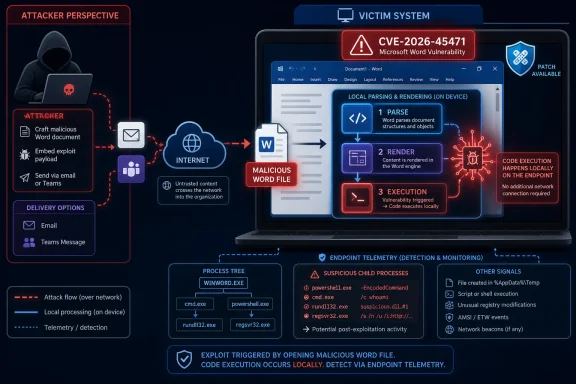 Microsoft’s RCE Label Is About the Outcome, Not the Transport
The confusing phrase is “remote code execution,” a term that has accumulated more operational meaning than linguistic precision. To many administrators, RCE sounds like a packet crossing the network, striking a listening service, and instantly running code without anyone opening anything. That is one form of RCE, but it is not the only one Microsoft labels that way.In the Word case, the important outcome is that attacker-controlled code may run on a target system. The initial delivery can be remote — an email attachment, a Teams message, a download link, a file share, or some other lure — but the exploitation path still depends on local processing by Microsoft Word or a related Office component.
That is why the CVSS vector can say AV:L without contradicting the title. CVSS is scoring the condition required to exploit the vulnerable component. If the victim’s machine must open, preview, or otherwise process malicious content locally, the attack vector is local even when the attacker is across the internet.
This is also why Microsoft’s own guidance often says the term “remote” refers to the attacker’s location. In plain English, the adversary does not need to be physically present at the keyboard. In CVSS English, however, the vulnerable action is not reached over a network protocol by directly sending packets to Word as a server.
The Word Document Is the Courier, Not the Crime Scene
Microsoft Word vulnerabilities usually live in the messy borderland between file format complexity and user interaction. Word is not just a text editor; it is a compatibility engine for decades of document structures, embedded objects, macros-adjacent behaviors, templates, fonts, rendering paths, and parsers that must handle both modern Office Open XML and older legacy formats.That complexity creates a familiar attack model. The adversary prepares a malicious document and persuades the victim, or some automated local component, to process it. The exploit does not need the attacker to log into the machine, but it does need the target system to do something with the file.
This is the source of the apparent contradiction. The malicious file can arrive from a remote attacker, but once it lands, the vulnerable operation is local. The exploit is not “remote” in the same sense as a wormable SMB flaw, an exposed web service bug, or an unauthenticated RPC vulnerability.
The better phrase would often be arbitrary code execution via malicious local file processing. That is more precise, but it is also clumsy, unfamiliar to patch dashboards, and less immediately meaningful to broad security audiences. So the industry continues to use RCE as a shorthand for the consequence: attacker code runs where it should not.
CVSS Speaks in Preconditions, Not Headlines
CVSS is built to describe exploitability through standardized metrics. Attack Vector is one of those metrics, and it asks how close the attacker’s exploit path must be to the vulnerable component. Network means the vulnerable component can be reached across a network boundary. Adjacent means the attacker must be on the same logical or physical network. Local means exploitation requires local access or local user-assisted processing on the target system. Physical means the attacker needs hands-on access.For Office bugs, AV:L is common when the exploit depends on a document being opened or rendered on the target machine. The attacker may be remote, anonymous, and nowhere near the device, but CVSS still sees the exploit as local because the vulnerable code path runs after the malicious content is handled locally.
That sounds counterintuitive until you separate delivery from execution. Email delivery is remote. Browser download is remote. A file share can be remote. But Word’s parsing of the document happens in the user’s session, on the user’s machine, under the privileges available to that process.
CVSS tries to make those distinctions machine-readable. Security titles try to make risks human-readable. CVE-2026-45471 sits directly in the gap between those two languages.
“Remote” Still Matters to Defenders
It would be a mistake to treat the local attack vector as comforting. A vulnerability that requires a malicious Word document to be opened can still be extremely practical for attackers. Phishing remains one of the most reliable intrusion paths in enterprise environments precisely because it turns remote intent into local execution.The attacker does not need VPN credentials, physical access, or an existing foothold if the social-engineering path works. They need a plausible lure, a vulnerable Office build, and a user or workflow that causes the document to be processed. In many environments, that is not a rare alignment of stars; it is Tuesday morning.
The operational risk also depends on what happens after code execution. If Word runs with the user’s privileges, the attacker may gain the same access the user has: local files, network shares, cached tokens, browser session artifacts, and line-of-business data reachable from that account. In a flat network or a permissive identity environment, “just the user’s rights” can still be a serious breach.
That is why RCE remains a high-signal phrase even when AV:L appears in the CVSS string. It tells defenders the payload can cross from malformed content into code execution. The local vector tells them how that crossing is likely triggered.
The User Interaction Trap Has Always Been Office’s Weak Spot
The Office threat model has long depended on the gap between safe handling and dangerous handling. Protected View, Mark of the Web, attachment scanning, macro blocking, and enterprise policy controls all exist because documents are a natural malware delivery vehicle. Users expect to receive them, open them, edit them, and trust them just enough to get work done.Attackers exploit that expectation. A malicious invoice, résumé, legal notice, shipping document, or HR form is not exotic. It is ordinary business theater with exploit code behind the curtain.
CVE entries that combine RCE impact with local attack vector often land in this same pattern. They are not saying the vulnerability is harmless unless an attacker is already on the box. They are saying the exploit path must be activated through local content handling, usually by the victim or by a local application acting on the victim’s behalf.
That distinction affects mitigation. Network firewall rules alone will not solve the problem. The practical defenses live closer to the endpoint: patching Office, hardening attachment handling, blocking risky file types, limiting preview behavior, enforcing Protected View, and reducing the blast radius of user accounts.
The Name Is Imperfect, but the Risk Is Real
Security naming often compresses too much into too few words. “Microsoft Word Remote Code Execution Vulnerability” is accurate in the broad industry sense, but it is not self-explanatory. It says the attacker may achieve code execution remotely, not that Word is necessarily listening on a network socket waiting to be exploited.This is the same ambiguity that frustrates patch prioritization meetings. A CISO sees “remote code execution” and thinks urgent. A vulnerability analyst sees AV:L and thinks user interaction or local processing. A desktop engineering team sees Microsoft Word and thinks Office update rings, add-ins, compatibility testing, and help-desk tickets.
All three reactions are valid. The mistake is forcing them into a binary of “remote” versus “local.” The vulnerability can be remote in attacker position, local in trigger condition, and severe in impact.
The better reading is layered: the attacker can be remote; the exploit is triggered locally; the consequence may be arbitrary code execution. Once phrased that way, the title and CVSS vector stop fighting each other.
Patch Triage Should Follow the Kill Chain
For administrators, the useful question is not whether Microsoft’s title is philosophically elegant. The useful question is how this vulnerability would appear in a real intrusion attempt. With a Word RCE, the path usually begins with content delivery, moves through user interaction or local preview, and ends with code running inside a user context.That makes patching important, but it also makes controls around document handling important. A fully patched Office estate is the cleanest answer, yet many organizations still have staggered update channels, compatibility constraints, VDI images, offline endpoints, or legacy Office installs hiding in corners. Those delays create the window attackers need.
Detection should also match the likely chain. Look for suspicious child processes spawned by Office applications, unusual script interpreter launches, unexpected network connections after document open events, and endpoint telemetry showing Office behaving like a loader rather than a productivity suite. The exploit details for a specific CVE determine the exact signals, but the broad pattern is familiar.
The local attack vector should therefore shape the response, not weaken it. It tells defenders where to apply friction: at the document boundary, the Office process boundary, the endpoint behavior boundary, and the identity boundary.
The Fine Print Changes the Enterprise Answer
The practical severity of CVE-2026-45471 depends on details beyond the title: affected Word versions, exploit complexity, required privileges, user interaction, whether Preview Pane is implicated, and whether exploitation has been observed in the wild. Those fields matter because Office vulnerabilities vary widely in how easily they move from proof-of-concept to campaign weapon.If exploitation requires a user to open a malicious document, phishing resilience and attachment controls become central. If merely previewing a file is enough, the risk rises because users may trigger the vulnerable path without consciously opening the document. If the exploit runs only with the current user’s privileges, privilege management and segmentation become crucial. If it can escape sandboxing or chain with privilege escalation, the story becomes more dangerous.
This is where administrators should resist headline-only triage. RCE is a serious impact category, but the CVSS vector and exploitability notes tell you how attackers are likely to operationalize it. The title gets the ticket opened; the metrics decide how the incident-response and patch-management machinery should move.
For home users, the advice is simpler. Install the Office update, avoid opening unexpected documents, and treat unsolicited Word files as executable-adjacent content rather than inert paperwork. Modern Office documents may look like paper, but from a security perspective they are structured inputs to a very large parser.
The Real Lesson Is That Office Is an Execution Surface
The recurring confusion around Word RCE labels points to a deeper truth: productivity applications are part of the attack surface, not a separate office-work island. Word, Excel, PowerPoint, Outlook, and their preview components sit directly in the path between untrusted outside content and trusted internal users. That makes them attractive targets even when the vulnerability is not remotely reachable over a listening service.Security teams have spent years hardening browsers because browsers process hostile content by design. Office deserves similar mental treatment. A document from outside the organization is not just a document; it is a bundle of structured data asking a privileged local application to interpret it.
That does not mean every Word vulnerability deserves panic. It does mean the old comfort of “the user has to open a file” is weaker than it sounds. Users open files for a living, and attackers know how to make that action feel routine.
The phrase remote code execution with a local attack vector is awkward, but it captures modern endpoint reality. Remote attackers do not always need remote sockets. Sometimes they just need a document convincing enough to make local software betray its owner.
The CVSS String Is Telling You Where to Defend
The right takeaway from CVE-2026-45471 is not that Microsoft mislabeled the bug. It is that two classification systems are describing different parts of the same attack. The title describes impact and attacker posture; the CVSS attack vector describes the exploitation path.That distinction should produce better defenses, not semantic arguments. If the attacker is remote, inbound content controls matter. If the trigger is local, endpoint hardening matters. If the result is code execution, post-exploitation detection and least privilege matter.
For WindowsForum readers, this is the kind of vulnerability that rewards boring discipline. Patch Office. Keep Microsoft Defender or equivalent endpoint protection current. Do not let Office spawn arbitrary scripting engines without scrutiny. Treat document-handling policies as security controls, not productivity annoyances.
The Sentence That Should Sit in Every Patch Note
The shortest accurate explanation is this: CVE-2026-45471 is called remote code execution because a remote attacker may cause code to run on the victim’s system, but CVSS marks it local because the vulnerable Word code must be invoked on that victim system through local processing of malicious content.That framing leaves administrators with concrete conclusions:
- The “remote” label does not necessarily mean the vulnerable component is exploitable directly over the network.
- The AV:L metric does not necessarily mean the attacker needs physical access or an existing local account.
- The likely delivery path is malicious content that Word or a related local component processes on the victim machine.
- The practical response should combine Office patching with attachment controls, endpoint monitoring, and least-privilege enforcement.
- The risk should be evaluated from the full CVSS vector and Microsoft’s exploitability notes, not from the title alone.
References
- Primary source: MSRC
Published: 2026-06-09T07:00:00-07:00
Security Update Guide - Microsoft Security Response Center
 msrc.microsoft.com
- Official source: microsoft.com
CVE-2026-31431: Copy Fail vulnerability enables Linux root privilege escalation across cloud environments | Microsoft Security Blog
A high-severity Linux vulnerability, “Copy Fail” (CVE-2026-31431), enables root privilege escalation across cloud environments and Kubernetes workloads. With a working exploit already in the wild, organizations should act quickly to detect, mitigate, and reduce risk.www.microsoft.com
